
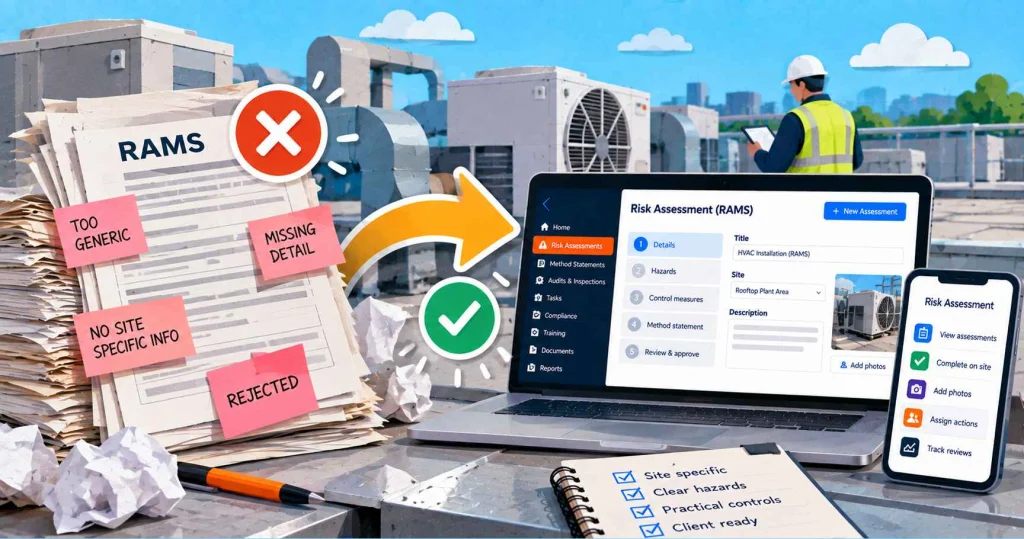
A rejected RAMS costs a day on site. Most rejections come down to five avoidable problems.
That delay can leave engineers waiting, equipment booked but unused, and planned isolations or access windows needing to be rearranged. If the client spots the problem on the morning work is due to start, a fairly small paperwork issue can affect the whole job.
Most of these problems can be picked up before the document reaches the client. The RAMS needs to describe the job being carried out, at that site, using the equipment, substances and controls the engineers will actually be working with.
1. The document is generic
Principal contractors want to see the job, not a template. Site-specific hazards, access routes and isolation points must be named.
Reusing previous RAMS can save time, but every section needs checking against the new job. Old site names, equipment that isn’t being used, or hazards copied across from another project quickly show that a document hasn’t been properly reviewed.
For HVAC work, include where the equipment is located, how engineers will reach it, how services will be isolated, and whether people will still be using the surrounding area. A rooftop installation, ceiling void, and plant room may involve similar equipment, but the access and working conditions can be completely different.
The reviewer needs enough detail to understand where the work is taking place and how it will be controlled, even if they haven’t personally visited the area.
2. It ignores the client’s required sections
Many clients mandate their own headings and sign-off boxes. If your document skips them it goes straight back.
Get those requirements before the final RAMS is prepared. One client might want specific sections covering permits and isolations, while another may ask for emergency arrangements, competency records, environmental controls, or subcontractor information.
Check the submission process too. A client may use their own template, document naming system or approval route. Sending a perfectly usable RAMS in the wrong format can still result in another round of emails and revisions.
3. Controls do not match the hazards
Refrigerant handling with no mention of ventilation, or ductwork at height with no rescue plan, is an instant rejection.
Controls need to explain what will actually happen on site. If work at height is identified, the RAMS should state how access will be provided, what equipment will be used, and what arrangements are needed if something goes wrong.
Cleaners, adhesives, oils, refrigerants, and other substances need the same level of thought. The RAMS should reflect the relevant COSHH controls and how that particular product will be used during the job.
Sequence matters as well. An isolation, exclusion zone, or equipment check needs to happen before the engineer reaches the part of the job where that control is needed.
4. The wrong version was issued
Two versions in circulation and nobody sure which one was approved. Keep one controlled document with an issue record.
This often happens after a client asks for a change. Someone updates the RAMS, an engineer still has the first copy, and another person forwards an older attachment from an email chain. Suddenly, there are several versions of the same job document in circulation.
Give every revision a clear version or issue number and record what changed. Once the revised document is approved, the old version should no longer be the one engineers are relying on.
A clear issue history also answers a simple question if it comes up later: which version did the client approve?
5. Nobody signed it
Operatives must acknowledge the method statement before work starts. Digital sign-off removes the paper chase.
Don’t leave acknowledgement until the engineer arrives on site. Give operatives time to read the method beforehand, particularly where the work involves unusual access, isolations, substances, or site restrictions.
That review can pick up problems too. An engineer familiar with the site may notice that the planned access route won’t work or that a piece of equipment mentioned in the method isn’t suitable for the location.
A revised RAMS may need to be signed again. An acknowledgement against version one doesn’t show that the engineer has read the change made in version two.
These are fairly basic document controls, but they are easy to lose when RAMS are being copied, edited, emailed, and stored in different places. Keeping the job details, client requirements, hazards, current version, and acknowledgements together gives the client fewer reasons to send the document back.