
When carrying out a workplace risk assessment, most health and safety managers know what to look for. Unsafe equipment, working at height, hazardous substances, and poor housekeeping are familiar concerns. But some workplace hazards are harder to identify because they aren’t immediately visible.
An employee working excessive hours, an engineer attending remote sites
alone or a manager struggling with an increasing workload may all face risks
that affect their health and safety. These situations can develop gradually,
with problems sometimes going unnoticed until someone makes a mistake, has an
accident or takes time off work.
Psychosocial risks at work received renewed attention during European
Week for Safety and Health at Work, held from 19–24 October 2026. The event
marked the launch of the European Agency for Safety and Health at Work’s
2026–2028 campaign, Together for Mental Health at Work.
Although the campaign is European, UK employers have their own legal
responsibilities in this area. The Health and Safety Executive (HSE) already
requires organisations to assess and manage work-related stress.
What Are Psychosocial Risks at Work?
Psychosocial risks are aspects of work that can affect an employee’s
mental or physical health. They’re usually associated with how work is
organised, managed and carried out.
The HSE identifies six areas of work design that can contribute to
work-related stress:
- Demands: Excessive workloads, unrealistic
deadlines and difficult working patterns.
- Control: Employees have limited influence over how they carry out their responsibilities.
- Role: Unclear responsibilities or conflicting expectations.
- Change: Organisational changes that aren’t communicated or managed properly.
- Support: Insufficient guidance or assistance from managers and colleagues.
- Relationships: Workplace conflict, bullying, or poor communication.
These issues don’t always occur separately. Someone regularly working long shifts may also have little control over their workload or feel unable to raise concerns with management.
The effects can extend beyond stress. Fatigue, reduced concentration, and
poor decision-making can increase the likelihood of accidents, particularly in
jobs involving machinery, driving, or other safety-critical activities.
What Does UK Law Say About
Psychosocial Risks?
UK employers have a legal responsibility to protect employees from risks
to their health and safety, including those arising from work-related stress.
Under the Management of Health and Safety at Work Regulations 1999,
employers must carry out suitable and sufficient risk assessments and introduce
appropriate control measures.
The HSE confirms that employers must assess risks associated with
work-related stress and take action to prevent harm to employees’ mental and
physical health. Organisations with five or more employees must record the
significant findings of their assessments.
For health and safety managers, this means looking beyond the physical
hazards associated with a task. Working hours, employee workloads, supervision
arrangements, and access to support may also need to be assessed.
If employees regularly work overtime to meet production targets, for
example, managers should consider whether those working arrangements could
contribute to fatigue or stress.
Fatigue Management at Work: Recognising the Warning Signs
Fatigue can affect employees across almost every industry, particularly
where work involves long hours, irregular shifts, or safety-critical activities.
An employee may appear capable of completing their normal duties while
feeling tired enough for their concentration, reaction times, and judgement to
be affected.
According to the HSE, fatigue can increase the likelihood of errors and
accidents, especially when working patterns don’t allow sufficient rest and
recovery.
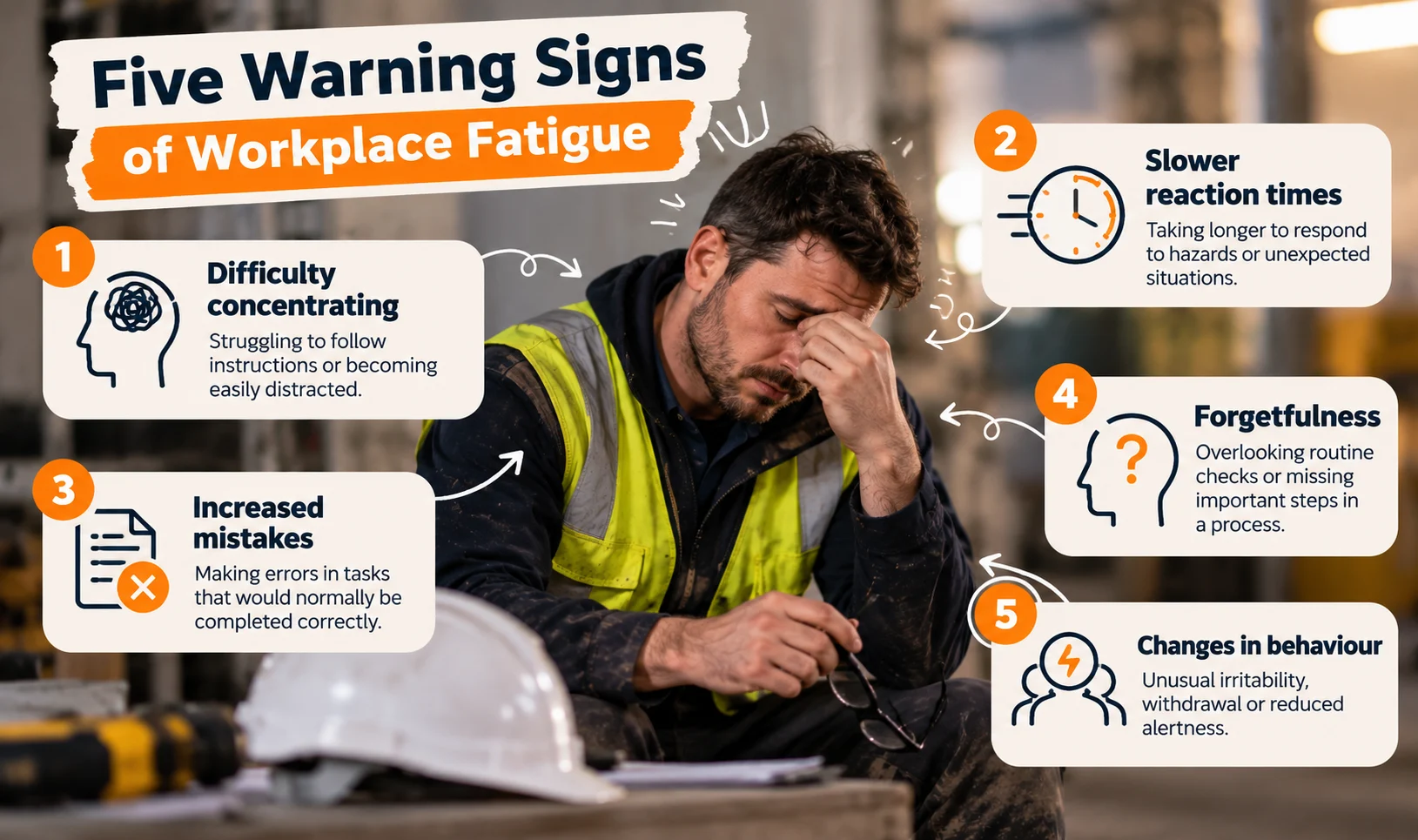
Five Warning Signs of Workplace Fatigue
Employers and supervisors should look out for:
- Difficulty concentrating: Struggling to follow
instructions or becoming easily distracted.
- Slower reaction times: Taking longer to respond to hazards or unexpected situations.
- Increased mistakes: Making errors in tasks that would normally be completed correctly.
- Forgetfulness: Overlooking routine checks or missing important steps in a process.
- Changes in behaviour: Unusual irritability, withdrawal
or reduced alertness.
These signs can have several causes, but they should encourage managers to check whether fatigue could be affecting someone’s ability to work safely.
How Can Employers Manage Fatigue?
Fatigue management at work involves reviewing how shifts, workloads and rest periods are organised.
Employees need sufficient recovery time between shifts, particularly when working nights, early mornings or consecutive long days. Managers should also consider whether workloads are realistic and whether employees are taking their allocated breaks.
Where employees drive for work, journey planning should account for fatigue, appropriate breaks and any driving-hours rules that apply.
Employees should feel able to report when they’re too tired to work safely. Recording fatigue-related incidents and near misses can help managers identify recurring problems and review working arrangements before someone gets hurt.
Lone Working: Managing Physical Risks and Isolation
Lone working is common across many industries, from maintenance engineers and delivery drivers to security personnel and employees visiting remote locations.
Although these employees may be experienced, working without direct supervision can create additional risks.
Consider an engineer attending a remote site to complete maintenance. They arrive in the morning, begin work and are expected to finish later that afternoon.
Two hours pass without anyone hearing from them.
Their manager assumes they’re busy, but what happens if the engineer has suffered an injury, become unwell or encountered an emergency? Nobody may realise that assistance is needed.
Simply knowing where an employee is supposed to be isn’t enough. Employers need arrangements that allow them to check on lone workers and respond when something goes wrong.
What Should a Lone Worker Risk Assessment Include?
A lone worker risk assessment should identify the hazards associated with the task, location and employee’s ability to access help.
The HSE advises employers to provide appropriate training, supervision and monitoring arrangements.
These should include:
- Regular check-ins: Agreed contact intervals based
on the risks involved.
- Escalation procedures: Clear instructions for responding when a check-in is missed.
- Emergency arrangements: Reliable methods for raising an alarm and obtaining help.
- Reviewed risk assessments: Regular checks to ensure assessments reflect current conditions.
- Accurate records: Documentation of check-ins,
incidents, and follow-up actions.
The level of monitoring should reflect the risks involved. Some high-risk activities require more than one person and must not be carried out alone.
Employers should also consider the effects of working in isolation. Employees spending long periods away from colleagues may experience reduced support and additional pressure, particularly when dealing with difficult situations on their own.
Regular communication gives employees opportunities to raise concerns and helps managers recognise when additional support is needed.
Are Health and Safety Teams Experiencing Workload Pressure Too?
The people responsible for managing workplace safety can experience significant workload pressures themselves.
Health and safety managers are often expected to oversee risk assessments, investigate incidents, organise training, complete inspections and maintain compliance records. In smaller organisations, these responsibilities may fall to one person.
When information is stored across spreadsheets, emails and separate documents, routine administration can take up a considerable amount of time.
A manager might spend the morning searching for an outstanding corrective action, checking training records or chasing colleagues for completed assessments.
Although these tasks are necessary, excessive administration can reduce the time available to visit sites, speak with employees and identify potential hazards.
Health and safety teams should be included when organisations review workloads and resources. Clear responsibilities and more manageable processes can help reduce pressure on the people responsible for keeping everyone safe.
Turning Psychosocial Risk Assessments into Action
Once an organisation has identified psychosocial risks, it needs to decide what action to take and check whether the changes are working.
Identify and Assess
Review working conditions, employee feedback, incident reports and existing risk assessments. Look for recurring concerns such as excessive overtime, missed breaks, workload complaints or inadequate lone worker monitoring.
Assign Actions
Decide what needs to change and who will be responsible for making it happen.
This could involve adjusting shift patterns, reviewing workloads, improving communication or introducing additional supervision. Each action should have a clear owner and completion date.
Review Control Measures
Risk assessments should be reviewed when working conditions change or new concerns arise.
Introducing additional rest breaks, for example, may help reduce fatigue, but managers should check whether employees are taking them and whether the arrangements are working.
Maintain an Audit Trail
Accurate records allow organisations to see which risks have been identified, what controls have been introduced and whether outstanding actions have been completed.
These records can also support internal reviews, investigations and health and safety audits.
How Evalu-8 EHS Can Help Manage Workplace Risks
Managing fatigue, lone working arrangements and workplace risk assessments can become time-consuming when information is spread across different systems.
Evalu-8 EHS brings these processes together, helping health and safety teams maintain records, monitor risks, and track corrective actions.
The platform’s fatigue management functionality supports monitoring of working hours, rest periods and potentially high-risk shift patterns, while its lone worker software supports scheduled check-ins, alerts and escalation procedures.
Risk assessments and task management tools also allow managers to record hazards, assign actions and review progress without relying on separate spreadsheets or paperwork.
Keeping this information together makes it easier to see what needs attention and follow up on outstanding safety actions.
Managing Psychosocial Risks in Your Workplace
Fatigue, isolation and excessive workloads may not be as obvious as damaged equipment or an unsafe working environment, but they can still affect employees’ health and safety.
Employers need to consider how work is organised, the pressures employees face and whether existing controls are doing enough to protect them.
Reviewing working arrangements, involving employees in risk assessments and following up on concerns can help reduce the likelihood of work-related stress and accidents.
See How Evalu-8 EHS Can Help
Find out how Evalu-8 EHS can help your organisation manage risk assessments, monitor lone workers, identify fatigue risks and keep track of safety actions.
Book a demo to speak with our team or take a guided tour to explore the software.