

Work-related stress isn’t always obvious. An employee might continue meeting deadlines, attending meetings, and completing their usual duties while struggling with the pressure of their workload. By the time concerns are raised, their health may already be suffering.
International Stress Awareness Week takes place from 2–6 November 2026, with National Stress Awareness Day falling on Wednesday 4 November. Both provide an opportunity for employers to look at how working conditions affect employees and whether existing arrangements are doing enough to prevent work-related stress.
For health and safety managers, stress isn’t simply an issue for HR or something that can be addressed through wellbeing initiatives. It’s a workplace health risk that employers have a legal responsibility to assess and manage.
A stress risk assessment helps identify where pressures are coming from, who could be affected and what changes are needed. The Health and Safety Executive (HSE) provides guidance for doing this through its six Management Standards.
Is a Stress Risk Assessment a Legal Requirement in the UK?
UK employers have a legal duty to assess and manage risks to employees’ health and safety, including those associated with work-related stress.
Under the Health and Safety at Work etc. Act 1974, employers must protect employees’ health, safety and welfare so far as is reasonably practicable. The Management of Health and Safety at Work Regulations 1999 also require employers to carry out suitable and sufficient risk assessments and introduce appropriate control measures.
Organisations with five or more employees must record the significant findings of their assessments. Smaller employers still need to assess and manage risks, even where a written record isn’t legally required.
The HSE doesn’t expect every organisation to produce lengthy documents. What matters is identifying relevant hazards, understanding who may be affected and taking reasonable steps to reduce the risk.
Employers should also recognise the difference between an organisation-wide assessment and one involving an individual employee. A workplace survey might reveal workload problems across a department, while an employee reporting stress may need a more specific assessment of their working circumstances.
Understanding the Six HSE Management Standards
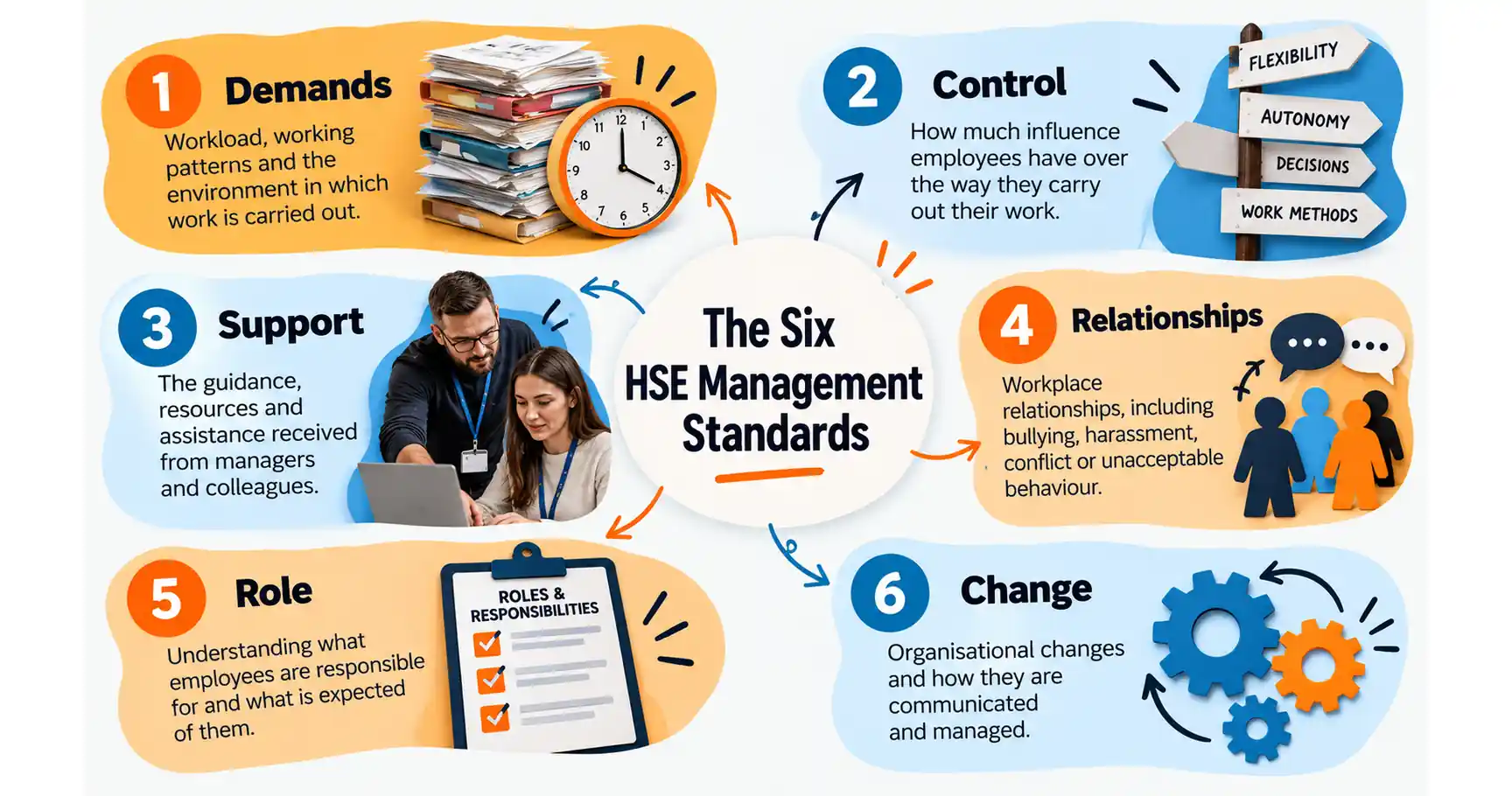
The HSE Management Standards cover six areas of work design that can contribute to stress when they’re poorly managed. They help employers examine working conditions and decide where changes may be necessary.
1. Demands
Demands include workload, working patterns and the environment in which employees carry out their duties.
For example, a warehouse supervisor might be expected to manage daily operations, complete safety inspections and cover staffing shortages without any adjustment to their responsibilities. Over time, the pressure of completing these tasks could become difficult to manage.
Employers should review whether workloads are realistic, deadlines are achievable and employees have sufficient resources to complete their work. Redistributing tasks or providing additional support during busy periods may help.
2. Control
Control refers to how much influence employees have over the way they carry out their work.
An engineer who has been given several appointments without enough time to travel between locations may feel under pressure, particularly if they’re unable to adjust the schedule when problems arise.
Allowing employees some flexibility over task planning, involving them in decisions and giving them opportunities to raise concerns can help reduce unnecessary pressure.
3. Support
Support includes the guidance, resources and assistance employees receive from managers and colleagues.
A new employee given responsibilities without adequate training may struggle to complete tasks confidently. Experienced employees can face similar difficulties if workloads increase and managers aren’t available to help.
Regular conversations, suitable training and access to practical assistance can make a difference. Employees should know who to approach when they need help and feel comfortable raising concerns.
4. Relationships
Poor workplace relationships can contribute to stress, particularly where employees experience bullying, harassment, conflict or unacceptable behavior.
A disagreement between colleagues may become more serious if it continues without intervention, eventually affecting communication and teamwork.
Employers should have clear procedures for reporting inappropriate behaviour and dealing with complaints fairly. Managers also need to recognise problems early and understand how to respond appropriately.
5. Role
Employees should understand what they’re responsible for and what is expected of them.
Problems can arise when responsibilities overlap or different managers give conflicting instructions. An employee might be asked to complete urgent production work while also being responsible for safety checks, without being told which task takes priority.
Clear job descriptions, agreed responsibilities and regular communication can help prevent confusion, particularly when roles or workloads change.
6. Change
Organisational change can create uncertainty, especially when employees receive limited information about decisions affecting their jobs.
Restructuring, new technology, changes to working hours and changes in management can all create additional pressure.
For example, introducing a new shift pattern without speaking to affected employees could create difficulties involving travel, childcare or other commitments.
Employers should communicate proposed changes, explain timescales and involve employees where appropriate. Giving people opportunities to ask questions can help address concerns before changes are introduced.
How to Carry Out a Work-Related Stress Risk Assessment
The HSE’s approach to risk assessment provides a useful structure for managing workplace stress. Rather than relying on assumptions about how employees are feeling, employers should examine working conditions and gather information from several sources.
Step 1: Identify the Hazards
Start by looking for working conditions that could contribute to stress.
Employee surveys, confidential conversations, absence records, staff turnover and incident reports can all provide useful information.
For example, a department experiencing repeated absences alongside high overtime levels may have a workload problem that needs investigating. The HSE Management Standards can help organise findings into the six main areas of concern.
Employees should be involved throughout this stage because managers may not always be aware of the pressures people experience during their working day.
Step 2: Decide Who Could Be Harmed
Consider which employees or groups could be affected by the hazards identified.
This might include employees working irregular shifts, lone workers, people managing several responsibilities or teams experiencing organisational changes.
Some employees may face additional risks because of their individual circumstances, so managers should consider whether specific assessments or adjustments are needed.
It’s important not to assume everyone working in the same department experiences pressure in the same way.
Step 3: Evaluate the Risks and Agree Controls
Once hazards have been identified, consider the likelihood of harm, the possible consequences and whether existing arrangements are sufficient.
The priority should be addressing the causes of stress rather than expecting employees to manage unreasonable working conditions themselves.
If excessive workloads are contributing to stress, the response might involve adjusting staffing levels, reviewing deadlines or changing how tasks are allocated. Where communication is causing problems, managers may need to clarify responsibilities or introduce more regular discussions.
Employees should be involved when deciding which changes would be most useful.
Step 4: Record Findings and Assign Actions
A work-related stress risk assessment template can help record identified hazards, affected employees, existing controls and planned improvements.
Each action should have someone responsible for completing it and a realistic deadline.
For example, if employees report that shift changes are communicated too late, an action could be assigned to the operations manager to review scheduling arrangements.
Records should explain what has been agreed and how progress will be checked. Sensitive personal information should be kept confidential and access restricted where necessary.
Step 5: Review and Update the Assessment
Stress risk assessments should be reviewed when working conditions change or there is reason to believe the existing assessment is no longer suitable.
Staffing changes, restructuring, new responsibilities and increased workloads may all require another review.
Employers should also check whether the changes introduced have worked. If overtime has been reduced to address excessive workloads, managers should review working hours and speak with employees to establish whether the pressure has improved.
Don’t Forget the Health and Safety Team’s Workload
The people responsible for managing workplace risks can experience considerable pressure themselves.
Health and safety managers may be expected to organise audits, review assessments, investigate incidents, manage training records and chase outstanding corrective actions. In smaller organisations, these responsibilities can fall to one person who also has other operational duties.
Much of the pressure comes from administration. A manager might spend the morning searching for previous assessments, checking who has completed an inspection or following up on actions that have been sitting in someone’s inbox for weeks.
Although these tasks are necessary, they take time away from visiting sites, speaking with employees and addressing hazards. Health and safety teams should be included when organisations assess workload-related stress, particularly where administrative demands are affecting their ability to complete other responsibilities.
Keeping Stress Risk Assessments Auditable
Completing a risk assessment is only part of the process. Managers also need to know what happened after a concern was identified.
A clear audit trail should show the original hazard, agreed control measures, who was responsible for completing them and when the assessment was reviewed.
For example, if several employees report excessive workloads, there should be a record of the concern, the changes agreed and the outcome of any follow-up review.
Without this information, it can be difficult to establish whether a problem has been addressed or simply discussed.
Evalu-8 EHS helps health and safety teams manage risk assessments, assign corrective actions, set deadlines and track progress. Keeping records and related tasks together can reduce the time spent searching through separate documents and emails.
The software supports the administration of risk controls, while employers remain responsible for consulting employees and deciding which measures are appropriate.
Reducing Administrative Stress with Automation
| Task | Manual process | With digital management |
|---|---|---|
| Risk assessment reviews | Checking spreadsheets for review dates | Scheduled review reminders |
| Corrective actions | Chasing colleagues through emails | Assigned tasks with visible progress |
| Evidence collection | Searching folders and attachments | Evidence stored against actions |
| Reporting | Combining separate documents | Centralised records |
| Outstanding work | Checking individual task lists | Tracking overdue action |
Automation won’t resolve every cause of workplace stress, particularly where problems relate to staffing, management behaviour or unrealistic expectations.
However, reducing repeated administration can give health and safety teams more time to focus on work that requires their attention.
Making Stress Risk Assessments Part of Normal Safety Management
International Stress Awareness Week is an opportunity to review how workplace stress is being managed, but assessments shouldn’t be limited to one week of the year.
Changes in staffing, workloads and responsibilities can affect employees at any time. Using the HSE Management Standards helps employers examine these pressures, speak with employees and identify where improvements are needed.
Once changes have been agreed, managers should check that actions are completed and review whether the measures have helped.
See How Evalu-8 EHS Can Help
Evalu-8 EHS helps health and safety teams organise risk assessments, assign actions, and maintain records without relying on separate spreadsheets and lengthy email chains.
Take a self-guided tour or book a demo to see how Evalu-8 EHS works.