
RAMS Software for Manufacturing
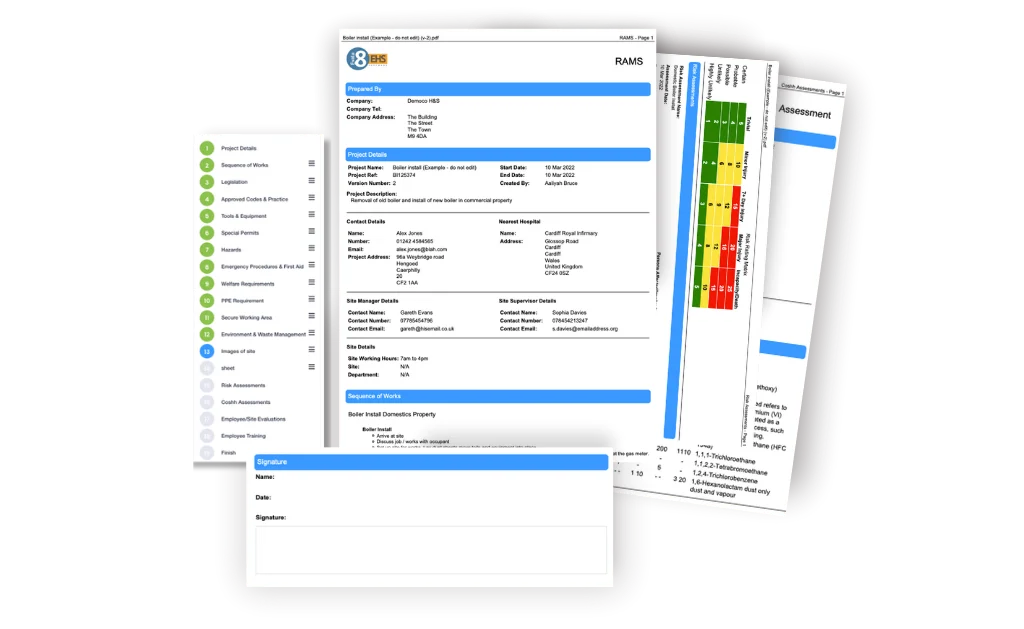
Create, approve and issue manufacturing RAMS in one connected EHS platform. Evalu-8 EHS helps your teams plan machinery maintenance, installations, shutdowns, hot work and contractor activity while keeping hazards, controls, supporting documents, approvals, versions and acknowledgements connected.
You are in good company. Trusted by H&S teams from companies like








The problem is rarely that the manufacturer has no RAMS documents. The problem is that the documents are stored in different folders, adapted from old jobs, sent through email and separated from the people who need to follow them.
The job is typically planned in Word
A previous RAMS is copied, renamed, and edited for the next maintenance task, installation, or shutdown. Nobody is completely sure which parts were properly reviewed and which parts were carried over from the old job.
The document is approved through email
Create reusable templates and approved question libraries for different production lines, activities, and sites. Apply the same inspection standard while still allowing questions to reflect local equipment and risks.
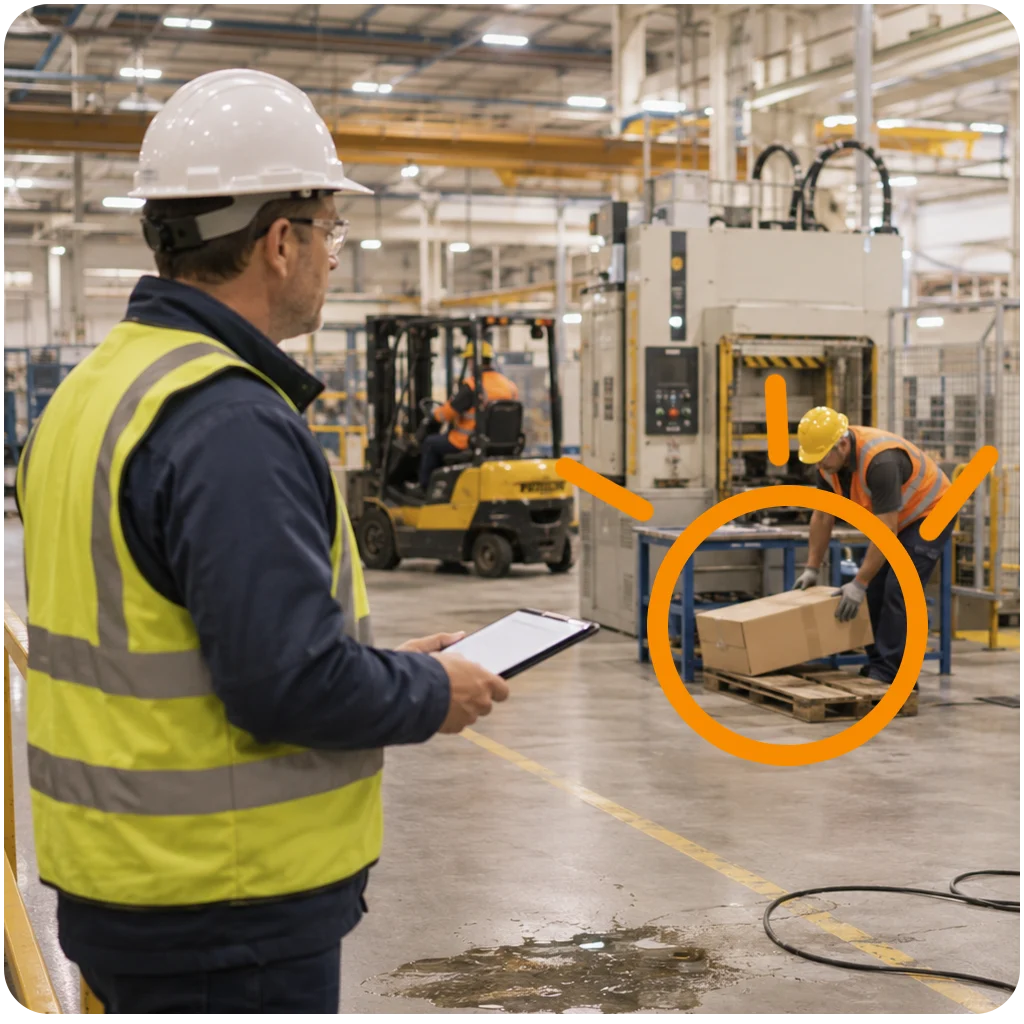
The work changes on the day
Access arrangements, equipment, personnel, production schedules or surrounding activity may be different from what was originally planned. The approved document can still be available, but no longer fully reflect the work taking place.
Create manufacturing RAMS
Build the risk assessment and method statement around the real job
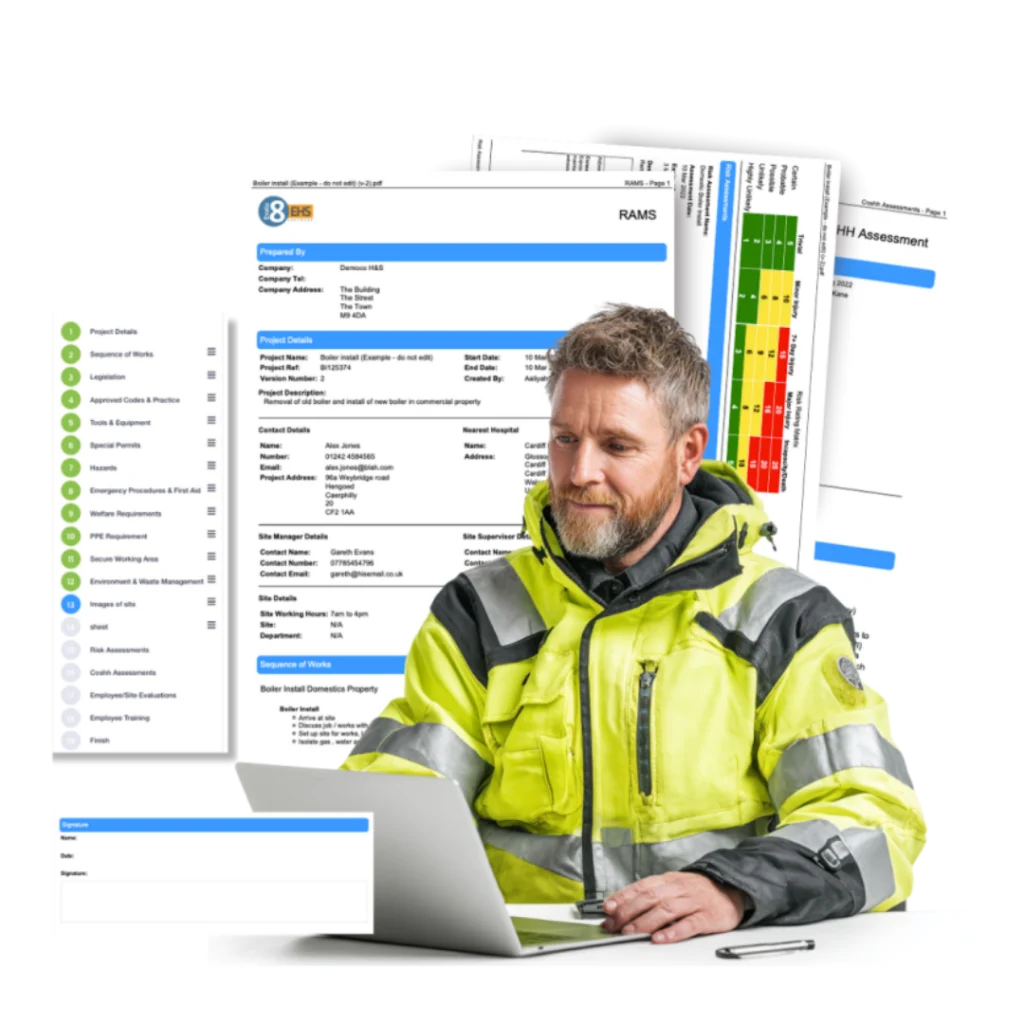
Create clearer, task-specific RAMS faster by bringing the equipment, location, people, hazards, controls, and work sequence into one structured process.
Build consistent, job-specific RAMS without starting from scratch or relying on generic templates.
- Reuse approved RAMS content
- Keep key information together
- Standardise RAMS across the business
Resolve changes before work begins
Keep every contributor working from the current RAMS
Evalu-8 EHS brings reviews, updates and approvals into one system, helping maintenance, production, engineering, health and safety teams, and contractors collaborate without relying on email chains.
Keep the current RAMS clear, controlled and ready before work begins.
- Track changes and approvals
- Attach plans and supporting documents
- Retain previous versions

Prove the right people received the RAMS
Track who received, reviewed and acknowledged each version
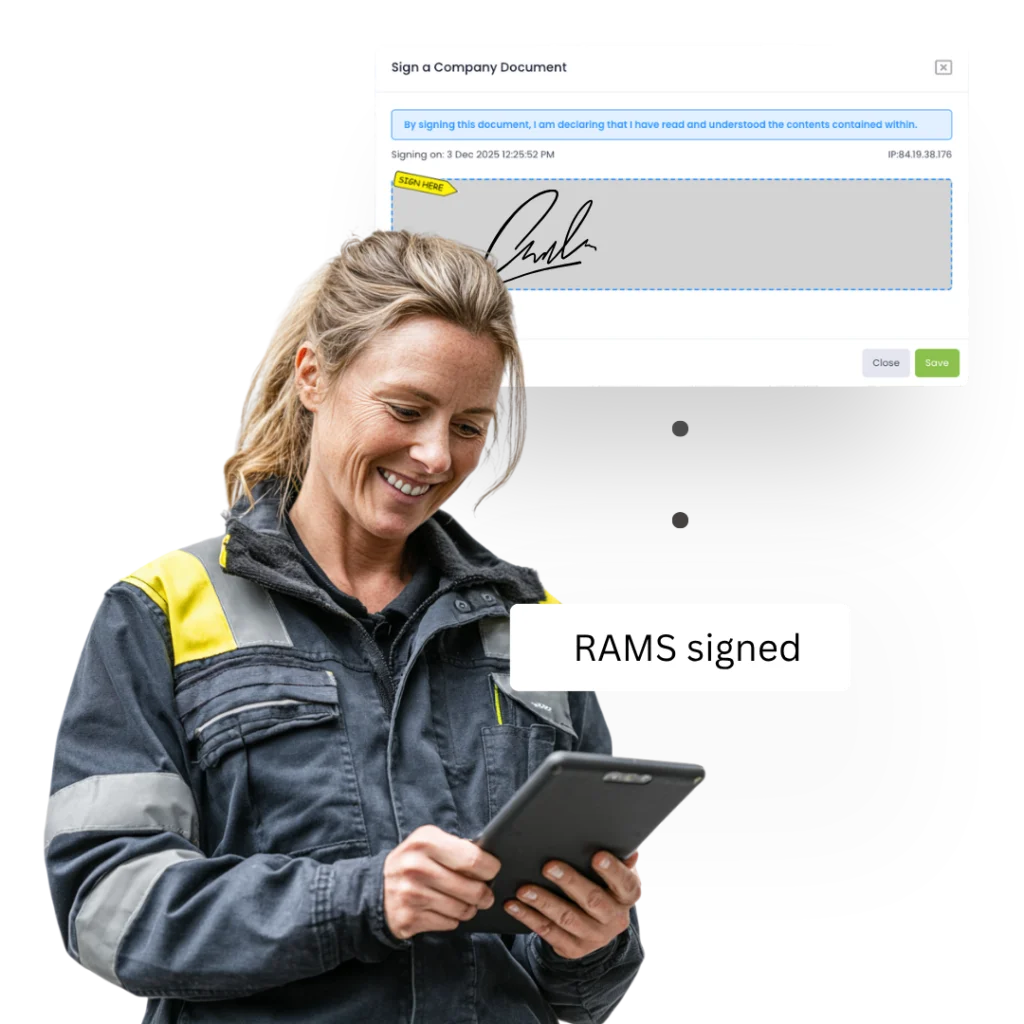
Share approved RAMS with employees and contractors, then keep a clear record of who reviewed each version.
Prove the correct RAMS reached the right people before work began.
- Track acknowledgements and signatures
- Confirm which version was issued
- Retain timestamps and document history
RAMS shaped around your manufacturing environment
Manufacturing RAMS should reflect the environment where the work is taking place. Each area brings different equipment, hazards, people, and operational interfaces.
PRODUCTION LINES
Plan RAMS for conveyors, automated lines, robotics and process machinery, including isolation, restricted access and recommissioning.
ENGINEERING WORKSHOPS
Create RAMS for machining, welding, cutting and repairs, covering hot work, fumes, noise, lifting and segregation.
PLANT AND UTILITIES
Plan work involving boilers, compressors, electrical systems and pipework, including isolation, stored energy and controlled reinstatement.
WAREHOUSES AND LOADING AREAS
Manage work around racking, loading bays and vehicle routes, covering exclusion zones, lifting equipment and work at height.
PROCESS AND CHEMICAL AREAS
Control work involving hazardous substances and process equipment, including isolation, PPE, spill response and waste disposal.
EXTERNAL AND CUSTOMER SITES
Prepare RAMS for installation, servicing and maintenance away from your factory, covering site rules, access and changing conditions.
Put the current RAMS where the job is actually happening
Give employees, supervisors and contractors quick access to the approved RAMS from the factory floor.
Evalu-8 EHS lets teams open the relevant document from a phone or tablet using QR codes placed on equipment, in work areas or within job packs.
Make sure the team follows the current approved method, rather than the easiest copy to find.
- Open approved RAMS at the point of work
- Reduce reliance on printed documents
- Keep outdated versions out of circulation
- Access plans, photographs and instructions
- Issue revised documents when conditions change
A clear process for manufacturing RAMS
From defining the task to issuing the approved document, every stage stays connected.
Define the work
Record the work area, task, equipment, people and expected conditions. Confirm whether the RAMS covers maintenance, installation, repair, cleaning, shutdown or another non-routine activity.
Assess and plan
Identify the hazards and controls, then set out the required equipment, PPE, isolations, access arrangements, emergency information and safe sequence of work.
Approve and issue
Complete the required reviews, record any changes and issue the approved RAMS to the employees, supervisors or contractors carrying out the work.
Review and retain
Update the RAMS when the task or conditions change. Retain the approval, acknowledgement and version history so the business can show what applied at the time.
Faster RAMS creation
Build task-specific documents using reusable method statements and approved control measures.
Fewer overdue RAMS reviews
Use review dates, expiry alerts and a clear view of which documents require attention.
RAMS traceability
Retain the history of changes, approvals, distribution and acknowledgements.
What UK law expects from manufacturing RAMS
UK law does not require manufacturers to produce a document called
a RAMS for every task. It does require employers to assess risks,
introduce suitable controls and communicate safe working arrangements
to the people carrying out the work.
For higher-risk, complex or non-routine activities, a method statement
can explain how those controls will be applied in practice. The RAMS
should reflect the actual equipment, environment, substances, people
and working conditions involved.
- MHSWR 1999 Requires suitable and sufficient risk assessments, appropriate controls and reviews when workplace conditions change.
- PUWER 1998 Requires work equipment to be suitable, maintained and used safely. Machinery RAMS may need to cover isolation, guard removal, testing and controlled restart.
- COSHH Regulations 2002 Requires exposure to hazardous substances to be prevented or adequately controlled, including suitable handling, ventilation, PPE and emergency arrangements.
- Electricity at Work Regulations 1989 Requires electrical systems and work activities to be managed to prevent danger, with clear isolation, competence and safe working arrangements.
- LOLER 1998 Applies where lifting equipment is used for installation, maintenance or material movement, including lifting plans, exclusion zones and competent supervision.
RAMS for higher-risk and non-routine manufacturing work
Manufacturing tasks can involve different equipment, hazards, people and operating conditions. Evalu-8 EHS helps you create task-specific RAMS, control approvals and make the current safe method available before work begins.
Machinery maintenance
Create task-specific RAMS before engineers remove guards, access dangerous parts or begin intrusive maintenance and fault repair.
Installation and commissioning
Plan the delivery, movement, assembly, connection and commissioning of new machinery and production equipment.
Planned shutdowns
Create coordinated RAMS for maintenance periods involving several teams, contractors, isolations and simultaneous activities.
Cleaning and blockage removal
Plan non-routine access to machinery during cleaning, blockage removal and production changeovers.
Welding and hot work
Define the controls for fabrication, repair and modification work involving ignition, heat, fumes and fire risk.
Contractor servicing and specialist work
Review and control the method proposed by external engineers, installers and specialist contractors working on your site.
RAMS SOFTWARE FAQs FOR MANUFACTURING
Is Evalu-8 EHS suitable for manufacturers with multiple sites or production lines?
Yes. Manufacturers can create consistent RAMS templates and control libraries centrally, while adapting each document to the equipment, task, contractor, and conditions at the individual site.
Is Evalu-8 EHS suitable for manufacturers with multiple sites or production lines?
Yes. QR codes can be placed on equipment, in work areas or within job packs so employees and contractors can open the current approved RAMS from a phone or tablet.
Can employees access RAMS on the factory floor?
Yes. Approved method statements and control measures can be reused where appropriate, reducing repeated drafting. Each RAMS should still be reviewed to confirm that it reflects the specific job and working conditions.
Can employees access RAMS on the factory floor?
Yes. Evalu-8 EHS can collect digital acknowledgements, signatures and timestamps, providing a clear record of who received and reviewed the RAMS before work began.
Can we reuse previous RAMS?
Yes. Evalu-8 records document changes, approvals and previous versions, helping teams identify the current approved RAMS and retrieve earlier records when needed.
Can we reuse previous RAMS?
A RAMS should be reviewed whenever the task, equipment, substances, people, work area, or surrounding activity changes. It should also be reviewed after an incident, near miss, or evidence that an existing control is not effective.