
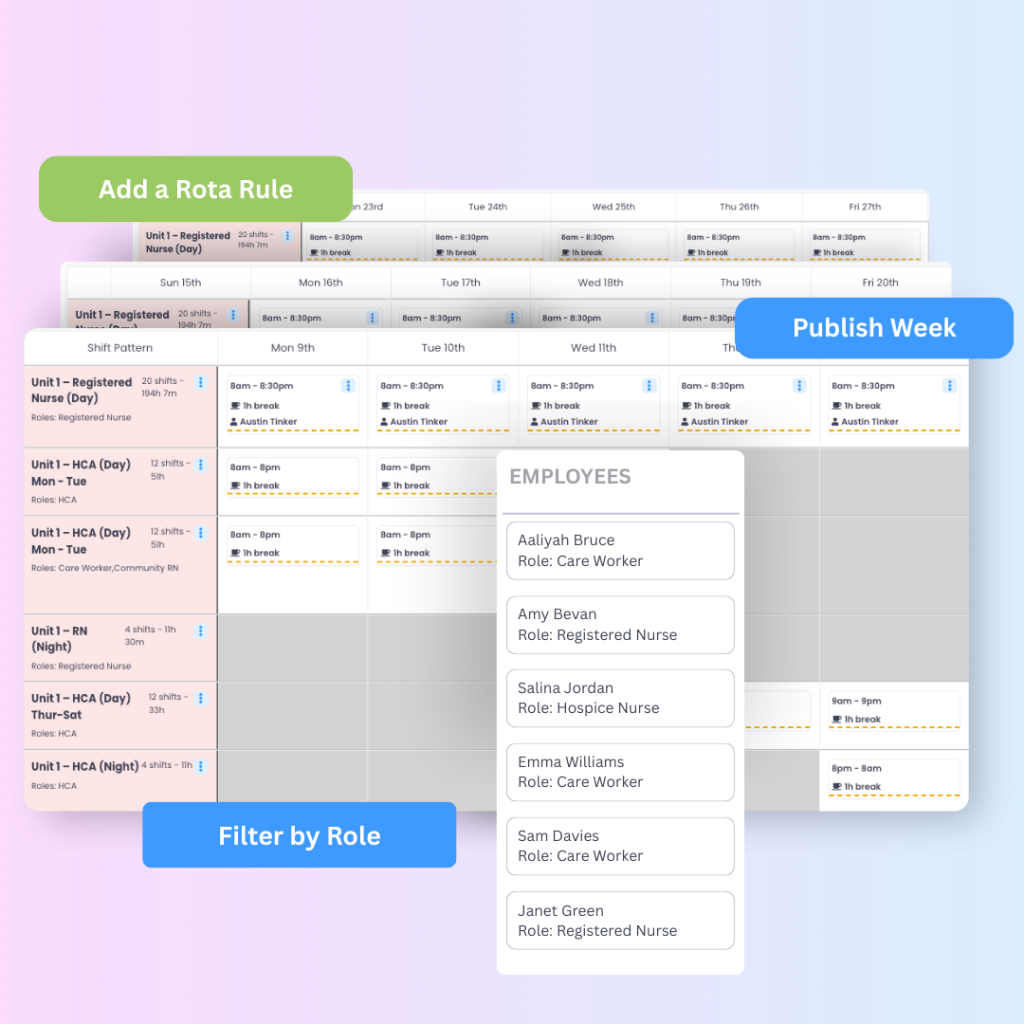
Why this becomes a challenge in hospices
Hospice scheduling is rarely as simple as assigning people to shifts.
Most teams include a mix of full-time and part-time staff, fixed shift workers, flexible workers and employees with different availability from week to week. Some team members may work set days. Others may rotate across days, nights and weekends. Over time, that mix creates a common scheduling problem.
Managers are not just building a rota. They are trying to fit the rota around multiple working patterns at the same time.
That is where confusion often starts.
Working patterns and rotas are not the same thing
Although they are often talked about together, working patterns and rotas do different jobs.
A working pattern is the framework behind how someone is expected to work. It reflects their contract or agreed arrangement. That might mean three 12-hour shifts per week, fixed Monday and Tuesday hours, alternating weekends or a more flexible arrangement linked to service need.
A rota is the live schedule built on top of those arrangements. It shows when each person is actually working across a given period.
In simple terms, the working pattern sets the rules. The rota shows how those rules are applied.
When the two are confused, mistakes follow quickly.
Why mixed contracts make rota planning harder
Hospices often rely on a broad mix of contract types to keep services running. That flexibility is valuable, but it also makes rota planning more complex.
A manager may need to schedule:
-
full-time staff with fixed contracted hours
-
part-time employees working specific days
-
staff on compressed hours
-
weekend-only or night-heavy roles
-
flexible workers whose shifts change across the month
Each arrangement affects how the rota should be built.
The challenge is that mixed contracts can look manageable at first, then become difficult once leave, sickness or shift swaps are added into the picture. A rota that works on Monday can become much harder to balance by Friday if no one has a clear view of each person’s working pattern.
Where things usually start to go wrong
Most rota issues in hospices do not come from a lack of effort.
They come from trying to hold too much information in too many places.
A manager may know that one nurse only works certain weekdays, that another has agreed flexible hours, and that someone else is due a lighter week after nights. But when those details sit across spreadsheets, emails and memory, the risk of error increases.
That is when problems start to appear:
- Staff being scheduled outside their agreed working pattern
- Part-time employees receiving unbalanced hours
- Flexible workers being used reactively rather than fairly
- Contracted hours drifting across the rota cycle
- Managers spending too much time reworking schedules
The rota may still get finished, but it takes more effort than it should and often creates avoidable frustration.
Why flexible working needs clearer rules, not looser scheduling
Flexible working can be a huge asset in hospices.
It helps organisations retain experienced staff, accommodate changing personal circumstances and build a more resilient workforce. But flexibility only works well when it is managed with clear boundaries.
Without clear rules, flexible working can accidentally become inconsistent working. Managers may rely on the same staff repeatedly, availability can become unclear and fairness across the team can start to weaken.
That is why flexible working does not reduce the need for structure. It increases it.
The more varied the contract mix, the more important it becomes to separate agreed working patterns from the live rota and make sure the rota reflects them properly.
What good rota planning looks like with mixed contracts
When mixed contracts are managed well, the rota becomes much easier to build and much easier to trust.
Managers know what each employee’s working pattern allows before shifts are assigned. Staff can see that their contract or flexibility agreement is being respected. The rota becomes less reactive because decisions are being made against clear rules rather than assumptions.
That usually means checking three things before the rota is published:
1. Does the rota reflect each employee’s agreed working pattern?
This helps prevent shifts being assigned outside availability, contract limits or agreed flexibility arrangements.
2. Are contracted hours being distributed properly?
This matters especially for part-time staff and employees whose shifts vary over the rota cycle.
3. Is flexibility being shared fairly?
If the same people are always covering changes, the system may be functioning, but it is not functioning well.
Why rota management software helps hospices handle complexity better
This is the point where spreadsheets usually begin to struggle.
A spreadsheet can show who is on shift, but it is much less effective at holding the detail behind why that shift assignment does or does not make sense. As contract types and working arrangements become more varied, managers need more than a list of names against shifts.
They need context.
Rota software helps by connecting working patterns, availability, absence and contracted hours to the rota itself. That means the schedule is not being built in isolation. It is being built against the reality of how each person is supposed to work.
For hospices, that makes mixed contracts easier to manage without losing control of coverage.
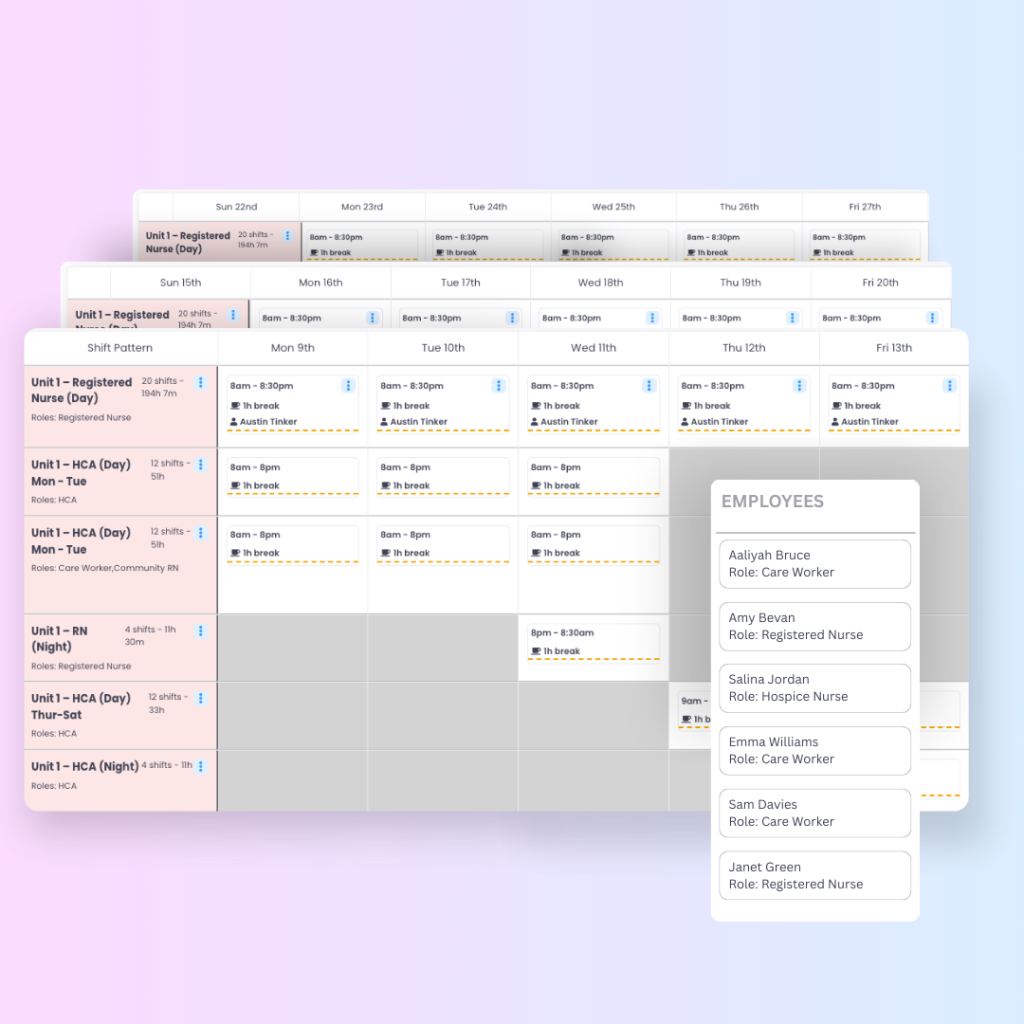
How Evalu-8 HR supports hospice teams with mixed contracts and flexible working
Hospice teams often need to balance stable care coverage with a workforce that does not all work in the same way.
Evalu-8 HR includes rota software for hospices that helps managers build rotas around both working patterns and live scheduling needs. This is especially useful for services managing a mix of full-time, part-time, and flexible staff across day, night and weekend shifts.
For hospice teams, Evalu-8 HR helps managers:
Build rotas around real working patterns
Make sure shifts are assigned in line with agreed patterns, contracted hours and flexible working arrangements rather than relying on memory or manual notes.
Handle mixed contracts more confidently
Manage different contract types in one system, making it easier to balance full-time, part-time and variable-hour employees across the rota cycle.
Keep flexible working structured
Support flexibility without losing control, so changes can be managed fairly and consistently across the team.
Maintain visibility of leave and availability
Because absence and availability connect directly to scheduling, managers can see where working patterns and rota plans may clash before the rota is published.
Reduce spreadsheet rework
Move away from fragmented scheduling and spend less time manually checking whether the rota still reflects how people are actually meant to work.
Rather than treating working patterns and rotas as separate admin tasks, Evalu-8 HR helps bring them together in a way that makes hospice scheduling more manageable.
Want to see how rota management software supports structured scheduling
Visit our rota management software for hospices page.
Why this matters beyond the rota itself
When working patterns and rotas do not align, the damage is rarely limited to the schedule.
It affects trust, workload balance and the overall experience of working in the team. Staff notice when agreed patterns are regularly ignored or when flexibility only seems to work in one direction.
On the other hand, when managers can respect different contracts while still maintaining safe coverage, rotas feel more predictable and fair. That makes a difference in environments like hospices, where continuity, empathy and staff stability all matter.
Good rota planning is not just about who is working.
It is about making different ways of working function together.
Summary
Working patterns and rotas are closely connected, but they are not the same thing. Working patterns define how someone is expected to work. The rota turns that into a live schedule.
In hospices, where teams often include mixed contracts and flexible working arrangements, that distinction matters. When working patterns are not clearly reflected in the rota, errors, imbalance and unnecessary admin follow quickly.
Rota management software helps hospices bring those two sides together by connecting contracts, availability and scheduling in one place. That makes mixed teams easier to manage and helps rotas stay both practical and fair.
FAQs
A working pattern is the agreed structure behind how someone is expected to work, such as fixed days or contracted hours. A rota is the live schedule showing when they are actually working.
Mixed contracts create more scheduling variables. Managers need to balance different hours, availability and shift expectations while still maintaining safe coverage across the service.
Yes, but it needs clear rules. Flexible working works best when agreed patterns and availability are visible before the rota is built.
Rota management software helps by connecting working patterns, contracted hours, leave and live scheduling in one place, making it easier to build rotas that reflect how people are actually meant to work.