
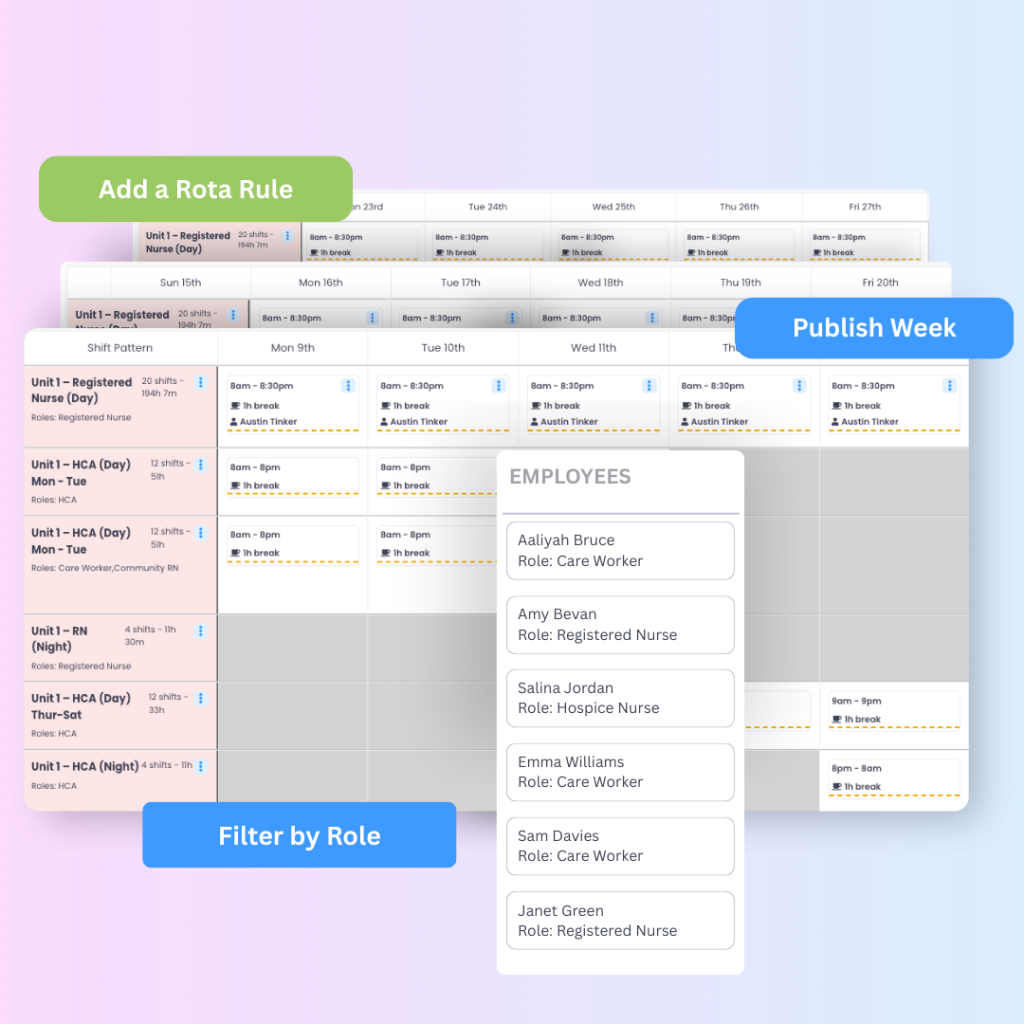
Why healthcare teams use rotating rota patterns
Healthcare rotas need to do more than fill shifts.
They need to maintain safe coverage, share less desirable shifts fairly and give staff some level of predictability. That is why many organisations use rotating patterns rather than rebuilding schedules from scratch each week.
A rotating rota pattern allows teams to follow a repeatable cycle over a set period, usually two or three weeks. Instead of constantly reinventing the rota, managers work from a structured pattern that helps distribute early shifts, late shifts, nights and weekends more evenly.
When these cycles are planned properly, they make scheduling more consistent for both managers and staff.
What a 2-week rota cycle looks like
A 2-week rota cycle repeats every two weeks.
This means a team member works through a defined pattern of shifts across week one and week two, then returns to the beginning of that pattern again. In practice, this could mean alternating combinations of early, late and night shifts, with rest days built into the cycle.
The main advantage of a 2-week pattern is simplicity. It is often easier to understand, easier to communicate and easier for staff to remember. For smaller teams or services with more stable staffing needs, it can work well.
However, shorter cycles can sometimes make it harder to distribute nights, weekends and more demanding shifts as evenly as managers would like across a longer period.
What a 3-week rota cycle looks like
A 3-week rota cycle follows the same principle, but over a longer pattern.
Instead of repeating every two weeks, the rota allows managers to spread different shift types across three weeks before the cycle starts again. This gives more room to balance weekends, rotate nights and avoid the same people repeatedly landing the same shift pattern.
For healthcare environments with more complex staffing needs, a 3-week cycle often creates a better balance between operational coverage and fairness.
It also gives managers more flexibility when trying to build in recovery time after nights or long shifts.
Why rotating patterns break down in practice
Rotating cycles usually make sense on paper.
The problem is that real-world healthcare scheduling is rarely static. Leave requests come in. Someone goes off sick. Demand changes. A shift needs to be covered quickly. Managers make one small adjustment, then another, and over time the original rota pattern starts to drift.
This is where problems begin to show up:
- Night shifts start falling to the same people
- Weekends are no longer evenly distributed
- Overtime builds across the rota cycle
- Staff lose visibility of what their pattern is supposed to bec
- Managers end up rebuilding the rota manually each week anyway
At that point, the rota may still exist as a “cycle”, but it is no longer functioning like one.
What rotating patterns should actually achieve
A good rotating rota should do more than repeat.
It should create structure.
That structure should help managers maintain coverage while also making sure staff feel shifts are shared fairly. Over the rota cycle, people should be able to see that less desirable shifts are being spread across the team, that contracted hours are being respected and that the rota still makes sense even when changes happen.
A rotating pattern should also reduce admin, not create more of it. If a rota cycle still requires constant rebuilding and manual checking, the pattern is not doing the job it was designed to do.
Why rota management software helps maintain rota cycles
This is where rota management software becomes valuable.
Rotating patterns rely on visibility across the full cycle, not just the week in front of you. Managers need to see how shift allocation, leave, contracted hours and coverage interact over time.
When rotas are managed in spreadsheets, that visibility is hard to maintain. Even small changes can disrupt the balance of the cycle without anyone spotting the longer-term impact.
Rota software for healthcare helps by bringing contracts, leave, availability and shift planning into one place. Instead of managing the rota week by week in isolation, managers can see how decisions affect the full pattern.
This makes it easier to preserve the original structure of the rota even when real-world adjustments are needed.
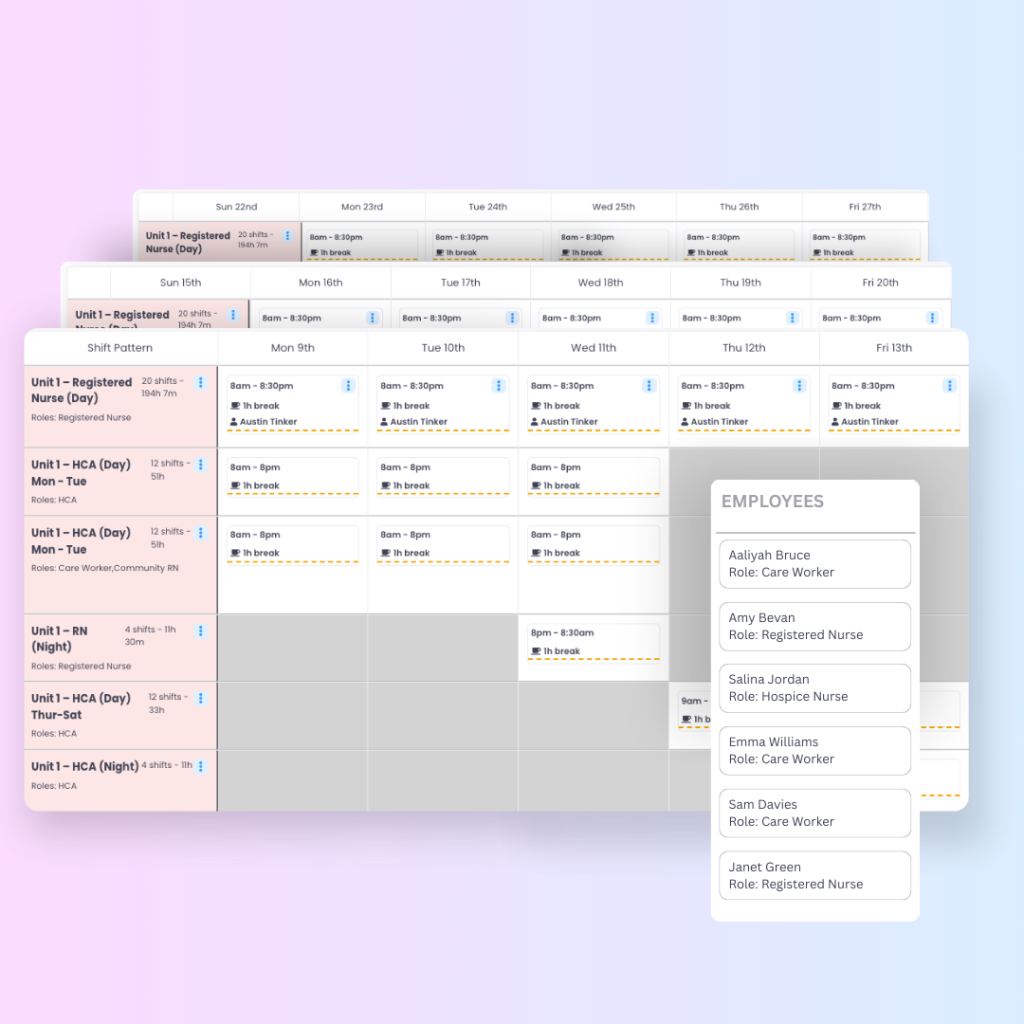
How Evalu-8 HR supports rotating healthcare rotas
Maintaining a 2-week or 3-week rota pattern requires more than a template. It requires visibility of how the cycle is working across the full rota period.
Evalu-8 HR includes rota software for healthcare designed to support structured shift planning, helping healthcare teams maintain consistent rota patterns while still responding to day-to-day operational changes.
For organisations using rotating cycles, Evalu-8 HR helps managers:
Plan shift patterns across the full rota cycle
Build repeating rota structures so early, late and night shifts are distributed more consistently across two-week or three-week patterns.
Spot gaps early, not on the day
Identify unfilled shifts or weak points in coverage before the rota is published, reducing the need for last-minute changes.
Keep nights and weekends fair
Track who is working nights and weekends across the rota cycle, making it easier to share those shifts more evenly across the team.
Protect availability and contracted hours
Because leave, sickness and contracted hours connect directly to scheduling, managers can see when working limits or staff availability are likely to affect the rota.
Rather than rebuilding patterns from scratch every week, managers gain a clearer view of how the rota cycle is functioning and where adjustments are needed.
Want to see how rota management software supports structured scheduling
Visit our rota management software for hospices page.
Why predictable patterns matter to staff as well as managers
Rotating patterns are often discussed as an operational tool, but they also have a clear impact on staff wellbeing.
When people understand their rota cycle, they can plan around it. They know when they are likely to be on nights, when weekends may fall and when rest days are coming. That predictability reduces stress and makes the schedule feel more manageable.
Fairness matters too. If a rota cycle is working properly, staff should be able to see that the less desirable parts of the schedule are not always landing with the same people.
That is one of the biggest benefits of a well-managed rotating pattern. It supports consistency for the organisation and trust for the team.
Summary
2-week and 3-week rota cycles are designed to bring structure, predictability and fairness into healthcare scheduling.
A 2-week pattern can work well where simplicity is the priority. A 3-week cycle often gives managers more flexibility to distribute nights, weekends and recovery time more evenly. In both cases, the pattern only works if it is maintained properly over time.
When rotating cycles are managed manually, they often drift into reactive scheduling. Rota management software helps protect the structure of the cycle by improving visibility of shift distribution, leave and contracted hours across the full rota period.
A rotating pattern should reduce complexity, not create more of it.
FAQs
A rotating rota pattern is a repeatable shift schedule that runs over a fixed cycle, such as two or three weeks. Staff move through a set pattern of shifts before the cycle starts again.
It depends on the service. A 2-week rota is often simpler to manage and communicate, while a 3-week rota usually gives more flexibility to balance nights, weekends and recovery time more fairly.
They often break down because leave, sickness and manual adjustments gradually disrupt the original cycle. Without clear oversight, the rota becomes reactive rather than structured.
Yes. Rota management software helps managers track shift distribution, leave and contracted hours across the full rota cycle, making it easier to maintain consistency.