
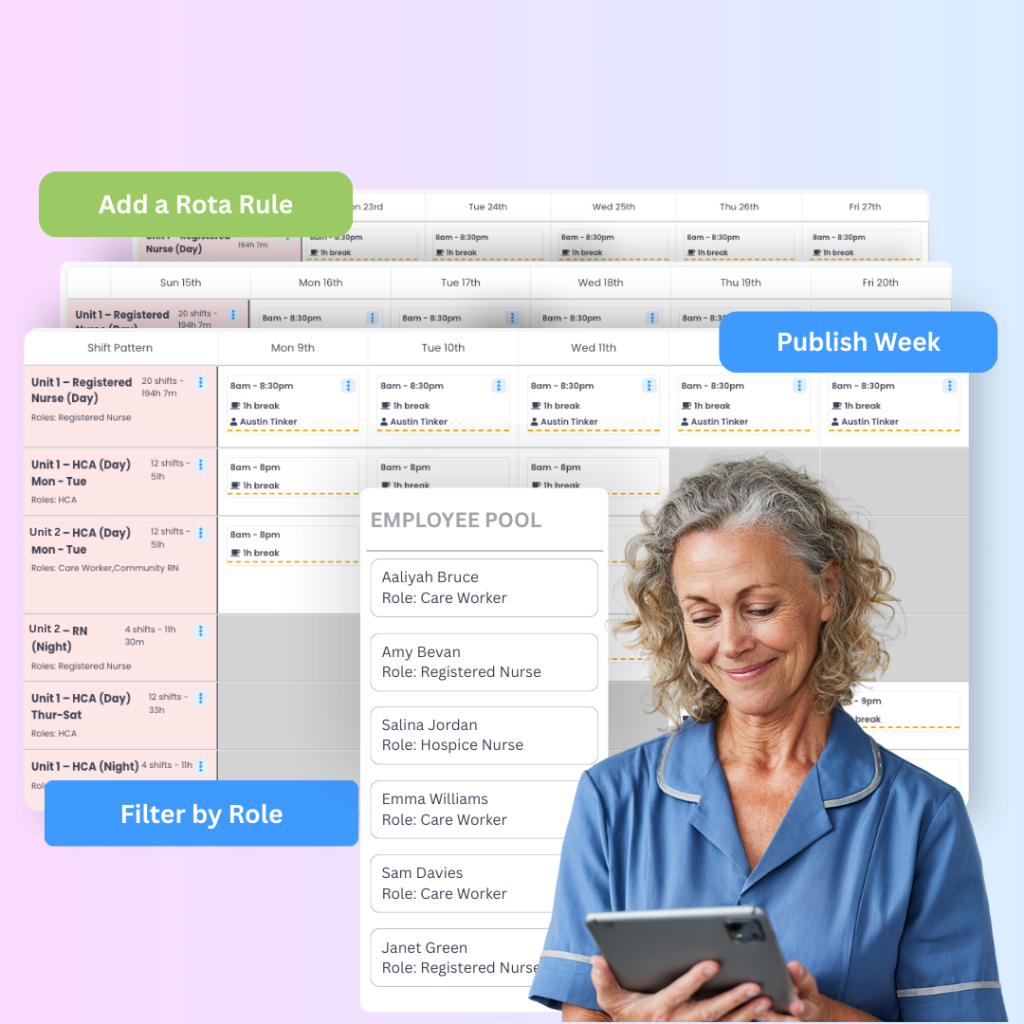
Why multi-unit scheduling is a different kind of challenge
Some hospices are planning rotas for more than one service at once.
That might mean an inpatient unit, community care support, day services or specialist teams all drawing from the same wider group of staff. On paper, that shared pool creates flexibility. In practice, it creates a more demanding scheduling job.
The question is no longer just “who is working this shift?”
It becomes “where should this person be scheduled, what coverage is still needed elsewhere, and what happens if another unit suddenly becomes short?”
That is why multi-unit rota planning tends to break down faster when it is managed manually. The number of moving parts increases, but the time available to review them usually does not.
What a shared staff pool actually means
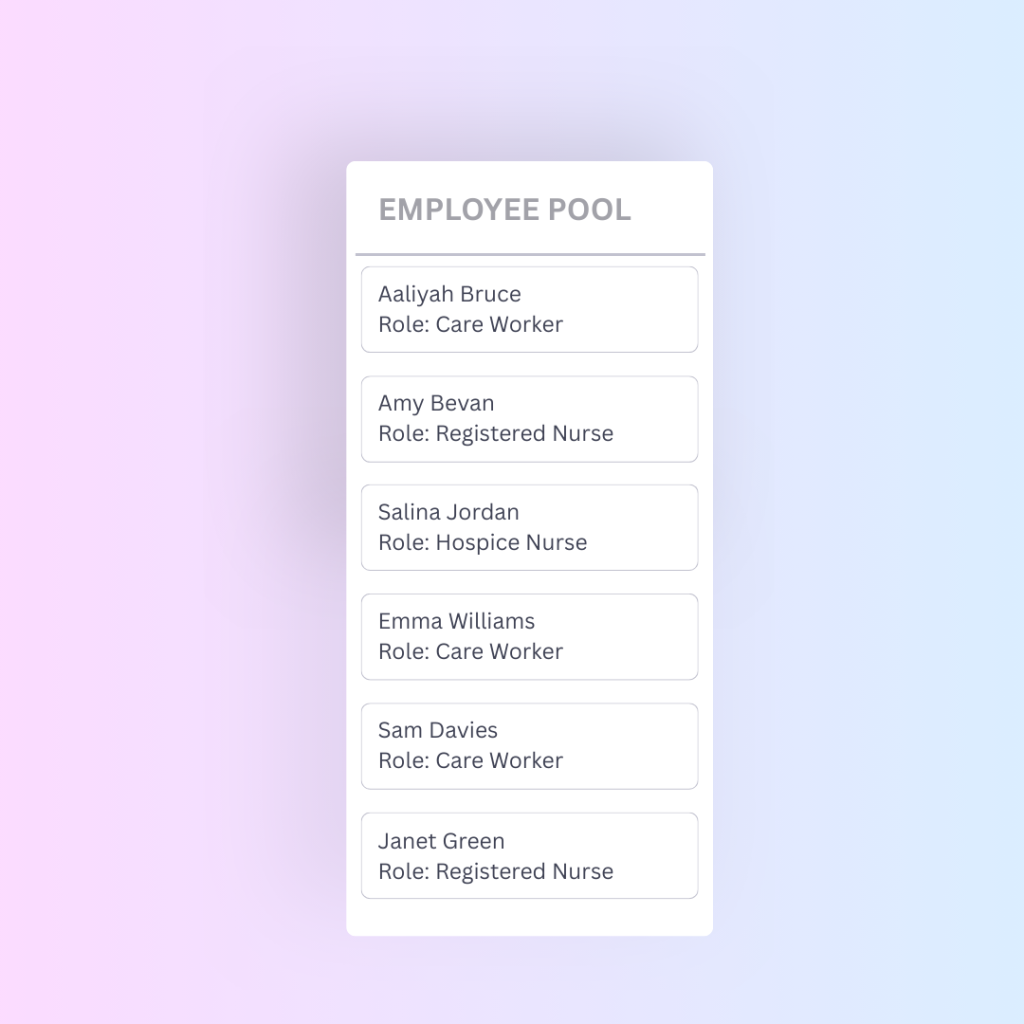
A shared staff pool is exactly what it sounds like: one wider group of employees who may be scheduled across multiple services or units, depending on care needs and availability.
For hospices, this often makes sense operationally. It allows managers to respond to changes in patient demand, absence or staffing pressure without treating each unit as completely separate.
The benefit is flexibility.
The risk is losing clarity.
If a manager cannot easily see who is available, who is already committed elsewhere and what coverage each unit still needs, the same shared pool that gives flexibility can also create confusion.
Why coverage becomes harder to judge across units
Single-unit rota planning is already detailed. Multi-unit planning adds another layer because coverage has to be reviewed across several services at once.
A shift may look covered in one area while another unit is left thinner than expected. A member of staff may appear available until someone realises they are already needed elsewhere. A team may technically be staffed, but not with the right role mix for the demands of that unit.
This is where shared-pool planning often creates pressure:
- staff appear free until another unit claims them
- coverage is reviewed service by service rather than as one picture
- managers spend time moving people around instead of planning ahead
- gaps only become obvious late in the process
The problem is not the idea of a shared pool. It is the lack of visibility around how that pool is being used.
Why coverage-based planning works better for shared teams
When multiple units rely on the same staff pool, rota planning works best when coverage is defined first.
That means identifying what each service needs before assigning individuals. Rather than starting with names and then hoping the wider picture still works, managers start by asking what safe staffing looks like in each area across the rota period.
This approach matters because it protects the priorities of each unit before the shared pool is stretched too far.
It also gives managers a clearer framework for decisions. If one service needs stronger cover at a particular time, that requirement is visible from the start rather than discovered once the rota is nearly complete.
What usually goes wrong with spreadsheets
Spreadsheets can cope with simple rotas. They struggle much more once one staff pool is being used across multiple services.
The issue is not just creating the rota. It is confirming that the rota still works when one change affects several areas at once.
Managers may need to check:
-
which unit still needs cover
-
which staff member is actually free
-
whether leave has already been accounted for
-
whether hours are still within limits
-
whether the overall balance across the rota still makes sense
That level of checking is difficult when information is split across files, tabs or separate trackers.
By the time the rota looks complete, there is often still uncertainty sitting underneath it.
What rota management software changes in multi-unit planning
This is where the category becomes important.
Rota management software for hospices helps bring the wider picture together. Instead of reviewing coverage, leave, availability and staff allocation separately, managers can work from one connected view of the rota.
That matters even more in a multi-unit environment because decisions are rarely isolated. Moving one person affects more than one service. Approving leave affects coverage elsewhere. Filling one gap may create another.
When the rota is being planned across one shared staff pool, managers need to see those interactions clearly.
That is why many hospices moving beyond spreadsheet scheduling start with rota software that supports coverage planning rather than just shift entry.
How Evalu-8 HR supports multi-unit hospice rotas
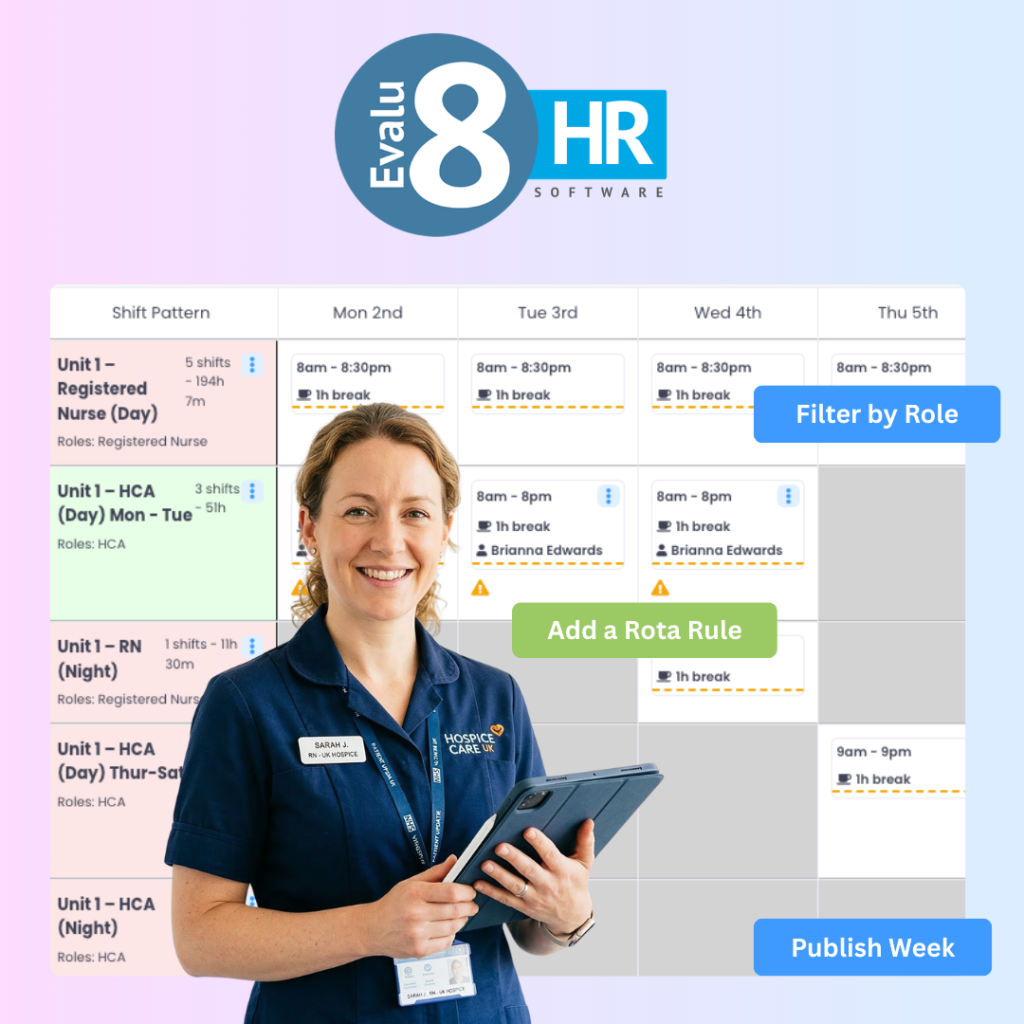
Evalu-8 HR includes rota management software for hospices designed to help managers plan staffing across multiple services while keeping coverage requirements visible.
For hospices working from one shared staff pool, this matters because rota planning is not only about assigning names to shifts. It is about understanding which unit needs what level of cover, where staff are already committed and how those decisions affect the rest of the rota.
Evalu-8 HR helps managers:
Plan coverage by unit before assigning staff
Build the rota around the required level of cover in each service, so staffing needs are clear before the shared pool is allocated.
See gaps and weak points earlier
Identify where coverage is still short across the rota, rather than only realising one unit has been left exposed once the schedule is nearly finished.
Use one shared pool with more control
Move staff across units where appropriate while keeping a clearer view of who is already scheduled and where flexibility still exists.
Keep hours, leave and availability connected
Because contracted hours, absence and scheduling sit together, managers can see when using someone in one unit may create a problem somewhere else in the rota cycle.
Reduce spreadsheet juggling across services
Replace fragmented files and manual cross-checking with a more structured approach to multi-unit coverage planning.
The benefit is not simply that the rota is easier to build. It is that the wider staffing picture is easier to trust.
Want to see how rota management software supports structured scheduling
Visit our rota management software for hospices page.
Why this matters for fairness as well as coverage
Shared-pool rotas are usually discussed as an operational problem, but they also have a people side.
If the same staff are always the ones being moved between units, or if flexibility always seems to come from the same part of the team, that starts to affect morale. A rota may technically solve the coverage issue while quietly creating a fairness issue.
The stronger the overview of the rota, the easier it becomes to see not just where staff are needed, but how the burden of flexibility is being shared.
That matters in hospices, where continuity, stability and trust across the team carry real weight.
Summary
Planning coverage across multiple hospice units with one shared staff pool requires more than filling shifts.
Managers need to understand what each service needs, how the shared pool is being used and whether coverage decisions in one area create problems somewhere else. That is why multi-unit rota planning often becomes difficult to manage in spreadsheets alone.
Rota software for hospices helps bring those decisions into one clearer view, making it easier to plan coverage across services while protecting visibility, balance and safe staffing levels.
With the right structure in place, one shared staff pool becomes easier to coordinate without losing control.
FAQs
A shared staff pool is a group of employees who may be scheduled across more than one hospice service or unit depending on coverage needs.
They are harder to manage because managers must balance staffing levels across several services at once while also tracking availability, leave and working hours across the same group of staff.
A coverage-based rota starts by defining the level of staffing required for each shift or service before assigning staff to fill those roles.
Yes. Rota management software helps managers plan coverage across multiple services with better visibility of staffing needs, leave, availability and hours.