

Why scheduling structure matters for staff wellbeing
Better scheduling improves staff wellbeing by reducing uncertainty and removing perceived bias. When shifts are distributed consistently and decisions are transparent, employees feel valued rather than managed. Rota management software supports this by applying overtime rules fairly, improving visibility of leave and contracted hours, and reducing last-minute changes.
Platforms like Evalu-8 HR are perfect for creating structured, transparent rota processes by connecting scheduling with absence tracking and working patterns in one system. This clarity makes fairness easier to maintain over time and supports a more stable, engaged workforce.
Scheduling may appear operational, but its impact is cultural. When rota management is structured and visible, wellbeing improves.
The operational reality: fairness is hard to track manually
Intentional fairness is one thing. Sustained fairness is another.
Most managers build rotas under time pressure. When the week gets busy, convenience often wins. The most reliable employee gets the unpopular shift. The person who asks first gets the overtime. Leave approvals are handled case by case without long-term visibility.
None of this is malicious. It’s practical. But over time, these small convenience decisions create imbalance. And imbalance, even if accidental, is what employees notice.
The challenge isn’t wanting to be fair. It’s being able to evidence it.
Moving from “best effort” to structured fairness
Fair rotas improve morale most when they move beyond good intentions and become part of a structured scheduling process supported by rota management software. When rules are built into the system and visibility is clear, fairness becomes consistent rather than dependent on memory or best effort.
That usually means:
- Clear rules around overtime allocation
- Visibility of contracted hours
- Transparent leave tracking
- Consistent publishing timelines
When scheduling decisions are anchored in rules rather than memory, they feel less personal and more professional.
Structure protects both managers and employees. It reduces the risk of bias accusations and creates consistency across teams.
How Evalu-8 HR helps create structure around rotas
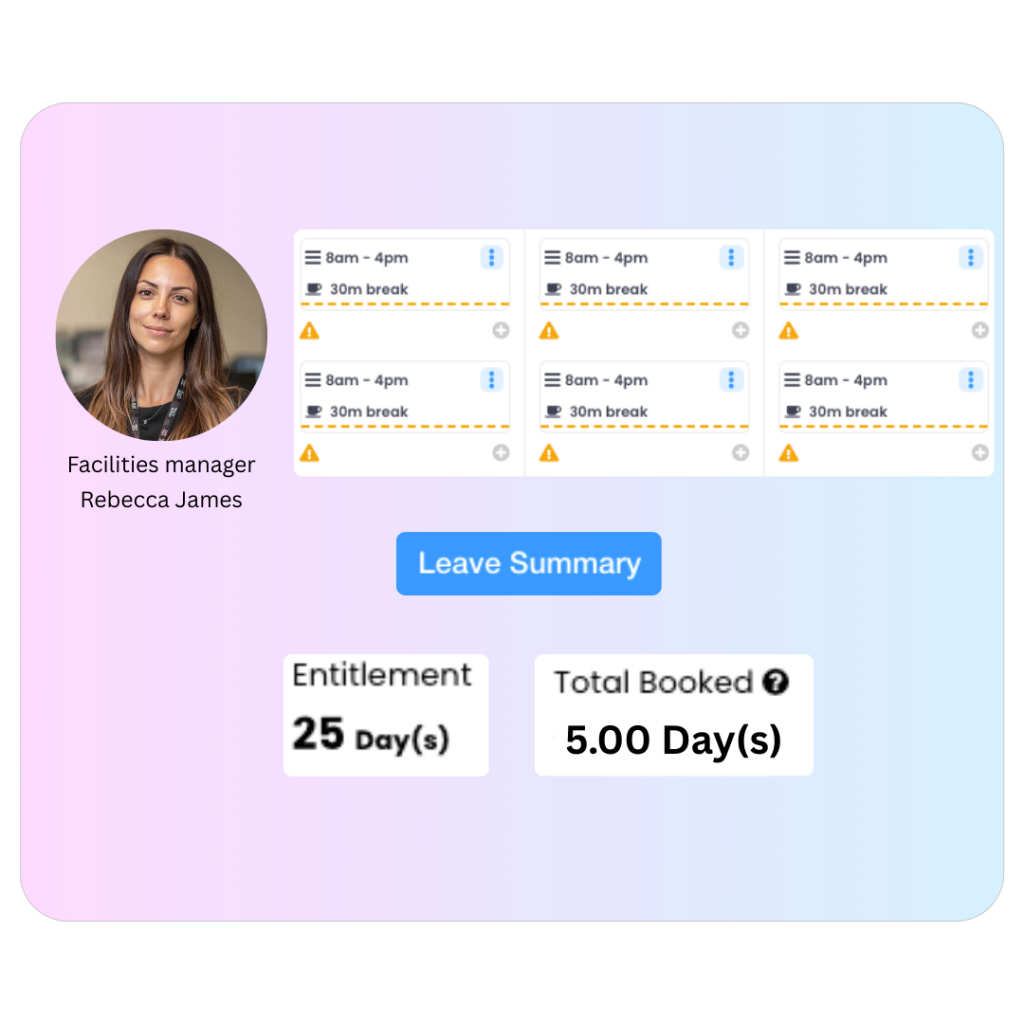
One of the biggest challenges with maintaining fair rotas is visibility. Without a central system, managers are often building schedules in isolation, relying on memory, spreadsheets, or informal notes to track overtime, leave, and contracted hours.
Evalu-8 HR brings rota management into a structured, connected environment. It links scheduling with contracted hours, absence tracking and time data, so managers can see the full context before publishing a rota. Instead of guessing who has already worked the most weekends or who is close to overtime thresholds, the information is visible.
Because working patterns and overtime rules can be configured within the system, they are applied consistently rather than manually. This reduces the risk of unconscious bias or uneven shift allocation creeping in over time.
As a result, organisations can:
- Apply overtime rules consistently across teams
- See shift distribution patterns more clearly
- Reduce last-minute scheduling changes
- Give employees greater visibility of their working week
- Support fairer decision-making with data rather than memory
The result isn’t added complexity. It’s clarity.
And when employees can see that rotas are built using consistent rules and shared visibility, fairness feels less subjective and more dependable.
If you’d like to explore how rota management works in more detail, you can visit our rota management software page.
Fair rotas signal something bigger
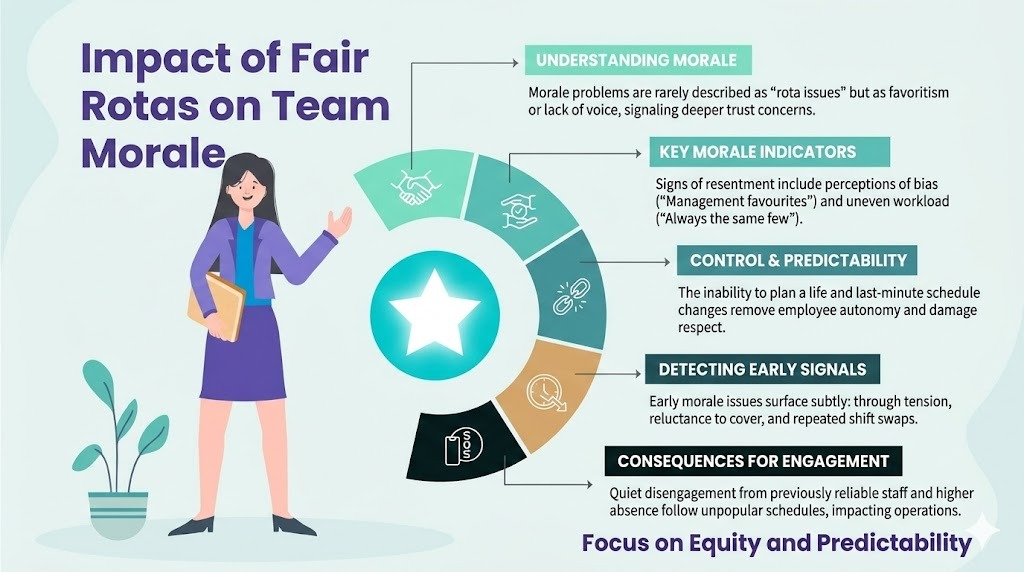
Employees rarely describe morale problems as “rota issues”.
They describe them as:
- “Management favourites people.”
- “It’s always the same few of us.”
- “You can’t plan your life.”
- “No one tells you anything until the last minute.”
Rotas are often the surface-level symptom of deeper trust concerns.
Spotting the early signs of rota-related morale issues
Rota-related morale problems rarely start with formal complaints. They tend to surface in subtle ways.
You might notice:
- Increased reluctance to cover shifts
- Higher absence following unpopular schedules
- Tension between specific team members
- Repeated requests to swap certain shifts
- Quiet disengagement from previously reliable staff
When scheduling becomes predictable, transparent, and consistent, something else improves too, confidence in leadership. Fair rotas don’t just improve morale. They signal respect.
To summarise
Fair rotas improve employee morale by reducing uncertainty and removing perceived bias.
When shifts are distributed consistently and decisions are transparent, employees feel valued rather than managed. Scheduling may seem operational, but it shapes daily experience. And daily experience shapes culture.
Businesses that treat rotas as part of their employee experience strategy, not just an admin task, are far more likely to build engaged, stable teams.
FAQs about rota management software, and boosting moral
Rota management software is used to plan, manage and publish employee work schedules. It replaces spreadsheets and manual processes with a central system where managers can assign shifts, track availability and apply overtime rules.
Most systems also allow employees to view their shifts, request leave and manage swaps, reducing admin time and improving communication.
Unfair rotas reduce morale because employees begin to feel overlooked or undervalued. When the same people repeatedly receive unpopular shifts or miss out on overtime, resentment can build. Even if unintentional, inconsistent scheduling damages trust. Fair, transparent scheduling helps employees feel respected and treated equally.
Yes. Rota management software reduces the risk of perceived favouritism by making scheduling decisions more transparent. When overtime rules, contracted hours and leave balances are visible within the system, managers are less likely to rely on informal decisions. Clear data helps ensure shifts are allocated consistently rather than subjectively.
Transparent scheduling can have a measurable impact on retention. Employees value predictability and fairness, especially in shift-based roles. When rotas are published consistently and shift allocation is balanced over time, employees are more likely to trust management and remain engaged with the organisation.