
COSHH assessment software
COSHH management software that keeps you in control
Keep the substance, SDS, work activity, exposure routes, controls and review history connected, instead of treating COSHH as a folder full of safety data sheets.
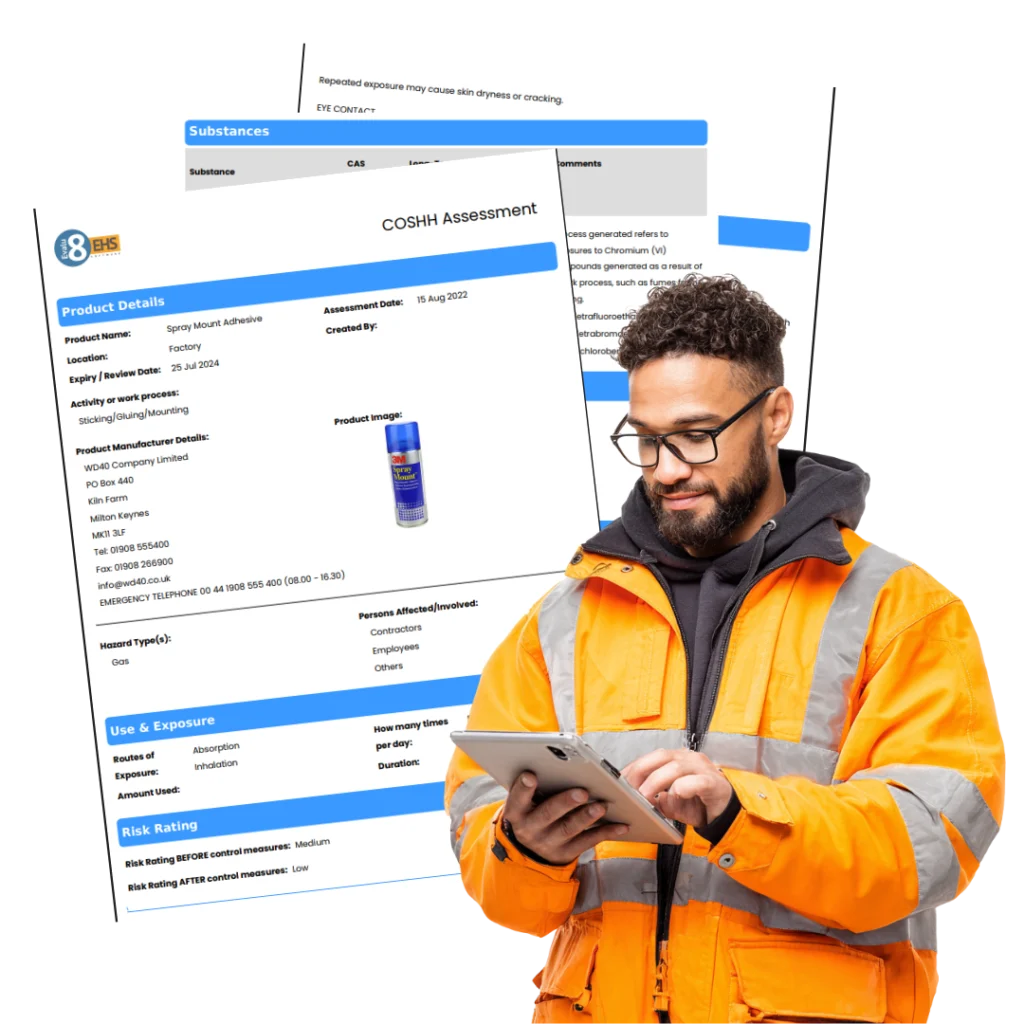
Trusted by teams like






Every part of the COSHH process
From substance information to controls people can actually use.
An SDS is important source information. The job of the assessment is to turn that information into a clear view of how people could be exposed during the real task, what controls are needed and when the assessment needs attention again.
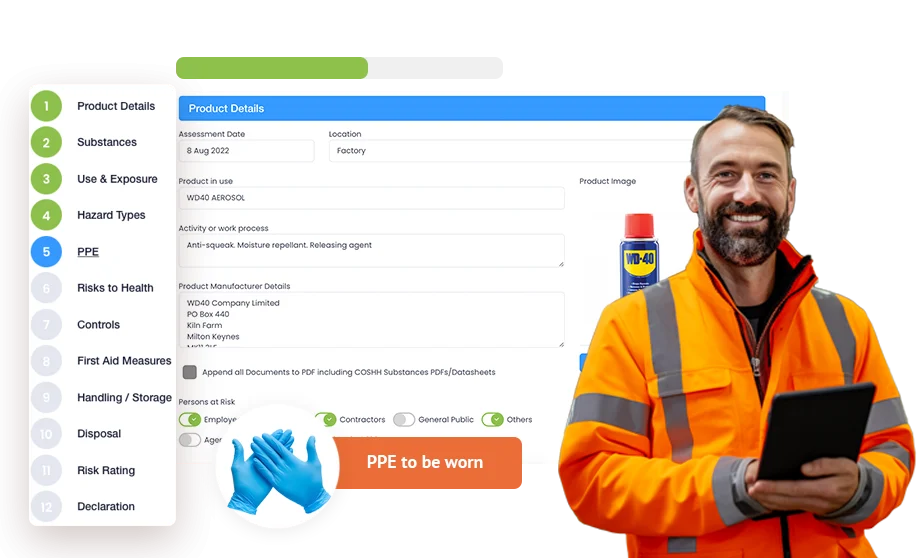
Know what you have and which SDS supports it.
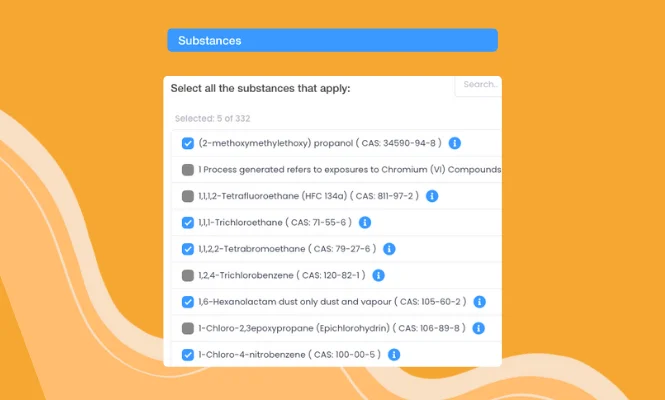
Keep substances, suppliers and SDS information in one searchable register so the starting point is controlled rather than scattered across shared drives and similar-looking PDFs.
- Searchable substance library
- Substances across multiple sites
- Current / review status
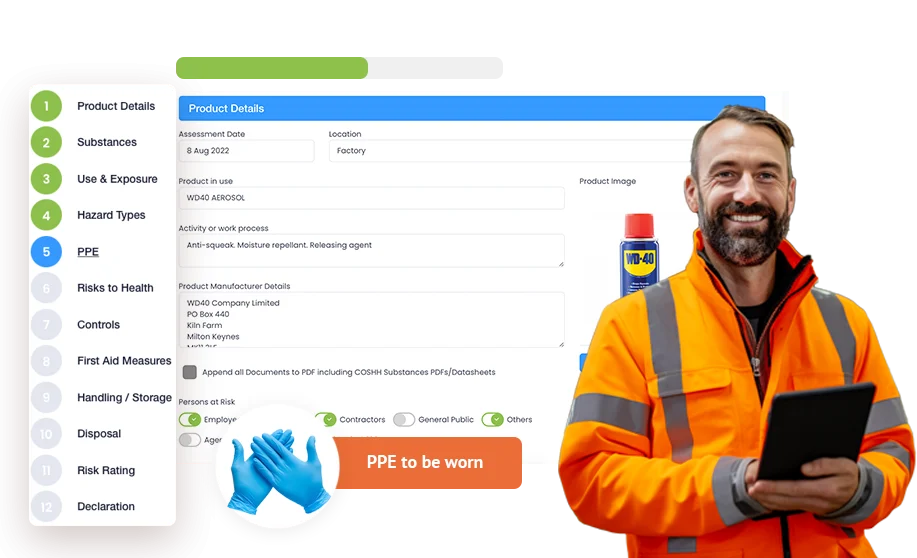
The same substance can create a different risk depending on how it is used.
Record the work activity, amount, frequency, duration, location and people involved so the assessment reflects workplace reality rather than simply repeating supplier information.
- Task and process
- Frequency and duration
- People exposed
Make it clear how exposure can happen.
Record the relevant exposure routes and, where applicable, workplace exposure limit information so controls can be chosen around the actual route and level of exposure.
- Inhalation
- Eye contact
- Workplace exposure limits
Show the control decision not just a PPE list
Record how exposure is prevented or reduced through substitution, engineering controls and working methods, with PPE or RPE used where it forms part of the remaining control system.
- Elimination / substitution
- Quantity and duration controls
- Storage & disposal
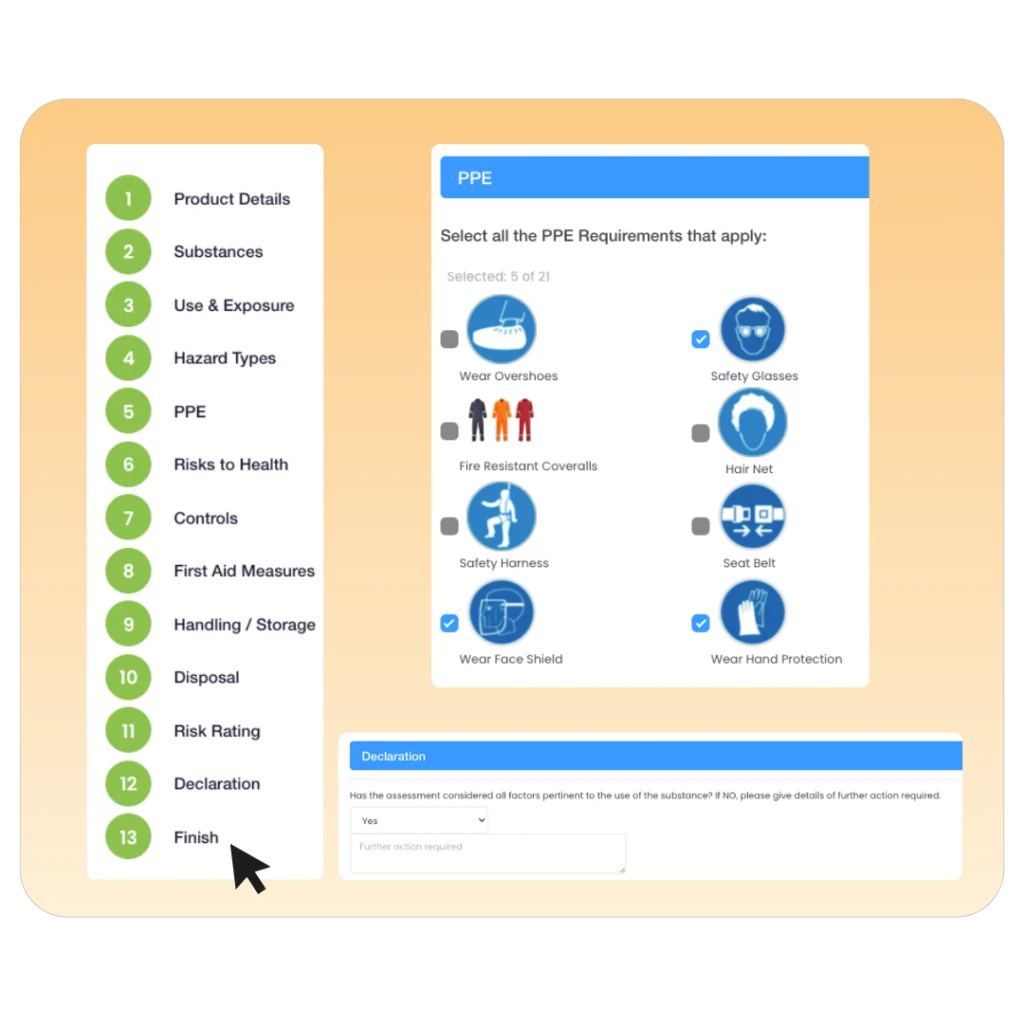
Make the required protection obvious at the point of work
Record the specific PPE and RPE required for the activity alongside the controls it supports, rather than leaving workers to interpret a general SDS themselves.
- PPE library
- Task-specific notes
- RPE where required
Put the current COSHH information where people need it.
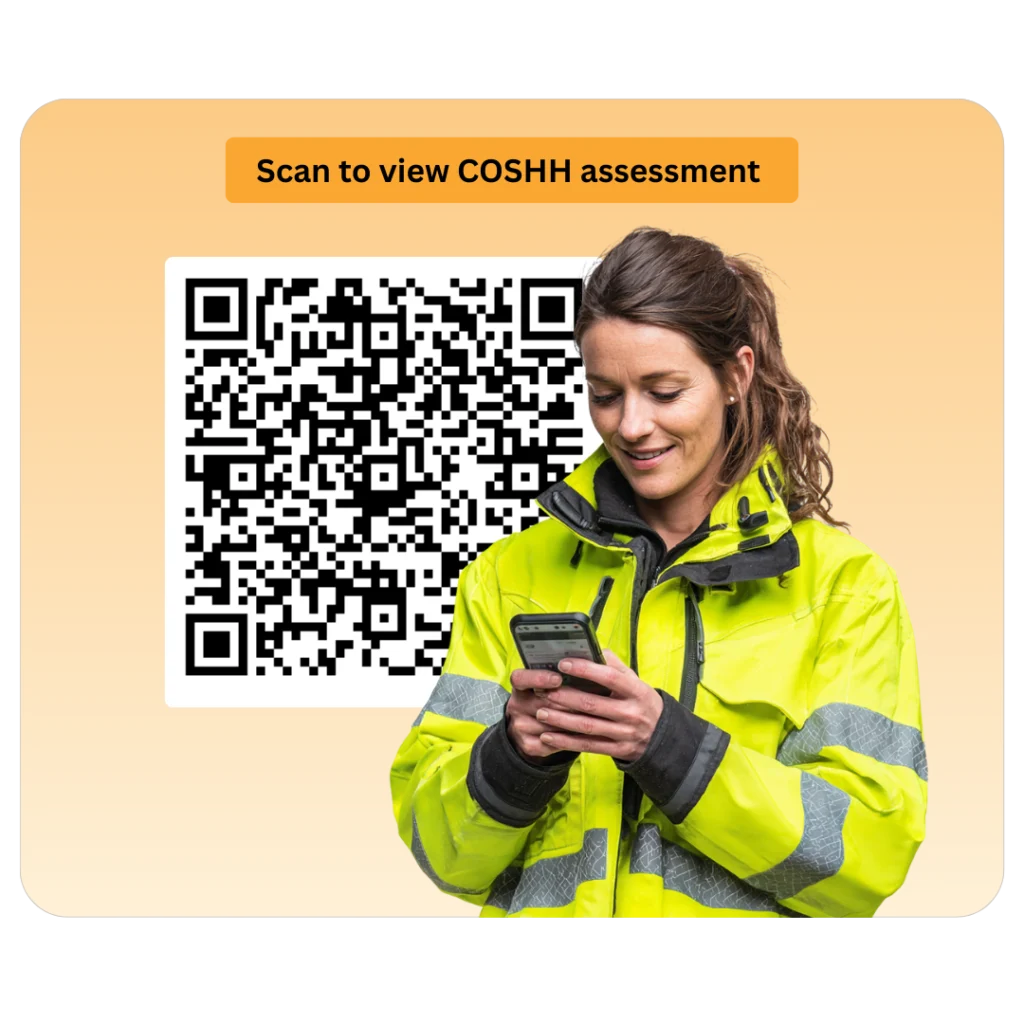
Use QR access at stores, equipment or substance locations so employees and other relevant people can open the current assessment from a phone without hunting through folders.
- QR access
- Mobile-friendly view
- E-sign
Know what needs attention before COSHH quietly drifts out of date.
Set review dates, keep assessment and SDS status visible and surface records that are due or overdue across sites without maintaining another reminder spreadsheet.
- Review dates
- Automatic reminders
- Site-wide visibility
The COSHH workflow
The SDS is the starting point. The COSHH assessment is about the work.
A useful COSHH process connects supplier information to the task, exposure, controls and ongoing review rather than stopping at document storage.
Register
Record the substance, supplier, SDS and where it is used.
Assess the task
Capture amount, duration, process, location and people exposed.
Understand exposure
Identify exposure routes and relevant limit or monitoring information.
Control
Record prevention, engineering controls, work practices and PPE/RPE.
Keep it current
Share the approved assessment and keep review status visible.

See Evalu-8 EHS COSHH in action
One searchable COSHH register
Stop searching through folders to work out which SDS is current
Keep hazardous substances, suppliers, SDS information, locations and assessments connected in one register. The point is not simply digitising the folder it is making the right information easier to find and maintain.
- Search substances across the organisation.
- See the supporting SDS and assessment together.
- Understand where the substance is used or stored.
Task-based assessment
Assess how the substance is actually used not just what is written on the SDS.
The exposure created by spraying a product can be very different from wiping it onto a small component. Capture the task, quantity, frequency, duration, ventilation and people involved so the controls match the actual work.
- Record different uses of the same substance.
- Make exposure routes explicit.
- Keep the reasoning behind the controls visible.
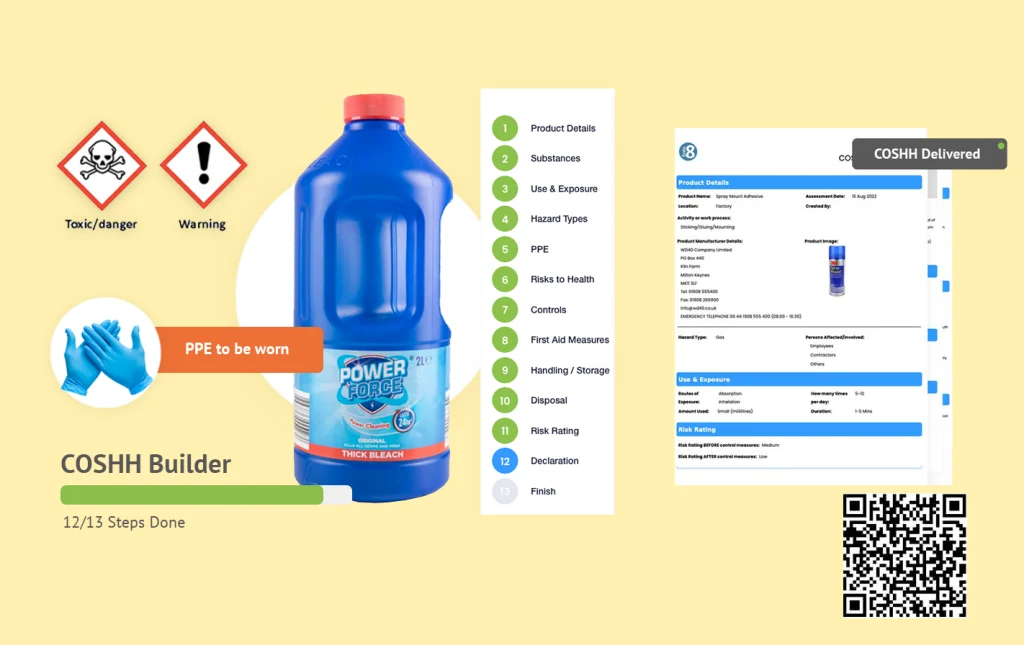
Expiry dates under control
Easily share and access COSHH assessments through QR codes.
Make safety information accessible to anyone on-site in seconds. With QR codes placed on equipment, chemicals, eye wash stations, or even in store cupboards, users can scan and view the details they need immediately, no login or paid account required.
It gives staff, contractors, and visitors quick access to the right guidance at the right moment, helping you improve safety awareness and make compliance far easier to maintain.
See COSHH in action
Show the workflow through real situations.
Short clips should answer the questions that come up in demonstrations rather than simply touring menus.
The supplier sends a new SDS revision
Find the substance, check the linked information and see which assessment needs reviewing.
An engineer needs the current COSHH controls
Scan a QR code and open the current assessment, exposure routes, controls and PPE from a phone.
The same substance is used for a different task
Create a task-specific assessment rather than assuming one SDS means one risk profile.
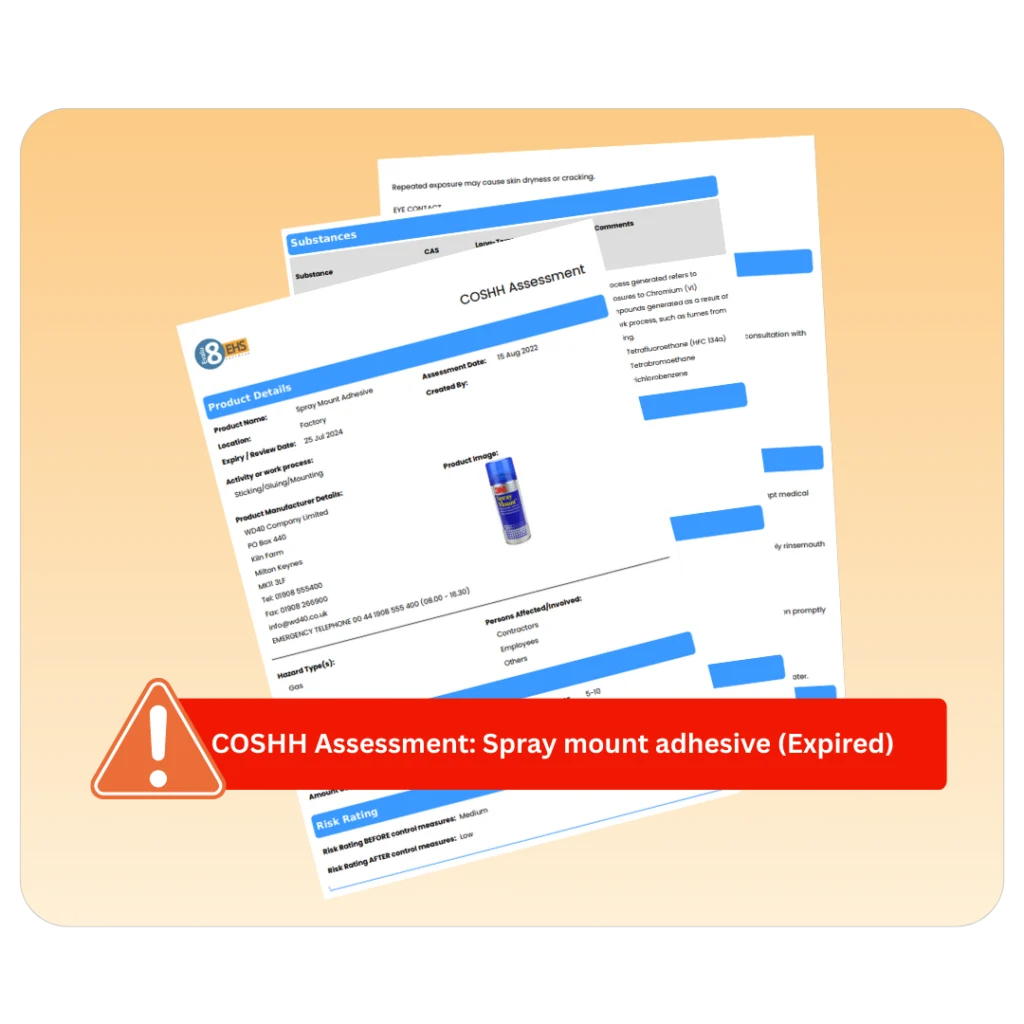
Expiry dates under control
Never let COSHH assessments quietly expire
Set review dates for every substance, then let Evalu-8 handle the rest. Owners get automatic reminders before SDS or assessments go out of date, dashboards show what’s due or overdue across all sites, and you’ve always got an audit trail proving everything was reviewed on time.
See COSHH in action
Book a demo with one of our specialists.
COSHH in your operating environment
The substance matters. So does the work around it.
The same COSHH principles show up differently across workshops, care settings, estates, warehouses and mobile workforces.
Manufacturing
Keep substances, process-generated hazards and controls visible across production, cleaning and maintenance.
Manufacturers can be managing cleaning chemicals, oils, coolants, adhesives, paints, dusts, fumes and other hazardous substances across different departments and activities.
Common pressure points
- SDSs and assessments sit across different folders, departments or sites.
- The same substance is used differently depending on the task, quantity or process.
- Dusts and fumes generated by the work can be missed when COSHH becomes too product-focused.
- Reviews become difficult to stay on top of as the substance library grows.
What changes with Evalu-8
Bring substances, SDS information and COSHH assessments into one controlled system, then assess how exposure actually occurs in each task.
Teams can see the current controls while H&S can see which assessments, SDSs and reviews need attention across the business.
Best-fit capabilities
- Substance register
- SDS library
- Task-based assessments
- Exposure routes
- WELs
- Controls & PPE
- Review reminders
Manage COSHH across production, maintenance and multiple departments.
Construction
Connect chemical information to the engineering work that actually creates the exposure.
Solvents, degreasers, lubricants, resins and coatings sit alongside process-generated hazards such as welding fume, metalworking fluids and dust.
Common pressure points
- A large technical substance library becomes difficult to search and maintain.
- The SDS describes the product but not how engineers actually use it.
- Exposure can change between spraying, wiping, dipping, machining or heating.
- Engineering controls, LEV, RPE and working methods need to be considered together.
What changes with Evalu-8
Start with the substance information, then build the assessment around the real engineering task.
Record exposure routes, relevant limits and controls so the assessment explains how exposure happens and what is preventing it.
Best-fit capabilities
- SDS management
- Task & use
- Exposure routes
- WELs
- LEV controls
- PPE / RPE
- Assessment history
For construction teams
Connect hazardous substances to the work, equipment and controls around them.
Engineering & technical operations
Connect chemical information to the engineering work that actually creates the exposure.
Solvents, degreasers, lubricants, resins and coatings sit alongside process-generated hazards such as welding fume, metalworking fluids and dust.
Common pressure points
- A large technical substance library becomes difficult to search and maintain.
- The SDS describes the product but not how engineers actually use it.
- Exposure can change between spraying, wiping, dipping, machining or heating.
- Engineering controls, LEV, RPE and working methods need to be considered together.
What changes with Evalu-8
Start with the substance information, then build the assessment around the real engineering task.
Record exposure routes, relevant limits and controls so the assessment explains how exposure happens and what is preventing it.
Best-fit capabilities
- SDS management
- Task & use
- Exposure routes
- WELs
- LEV controls
- PPE / RPE
- Assessment history
For engineering teams
Connect hazardous substances to the work, equipment and controls around them.
Facilities & estates
Keep everyday COSHH controls consistent across buildings without losing sight of what is stored and used locally.
Cleaning products, water-treatment chemicals, paints, maintenance products, grounds chemicals and contractor substances can be spread across a large estate.
Common pressure points
- Different buildings hold different products.
- COSHH information lives locally in cupboards, folders or contractor packs.
- Central H&S cannot easily see whether every location is using current information.
- Employees need the controls at the point of use, not hidden inside an EHS system.
What changes with Evalu-8
Maintain a central view of hazardous substances while giving local teams straightforward access to the assessments relevant to their building or activity.
QR access can put the current COSHH information closer to stores, plant rooms and work areas.
Best-fit capabilities
- Multi-site register
- Locations
- QR access
- SDS library
- Permissions
For facilities & estates teams
Keep COSHH information controlled centrally and accessible locally.
Healthcare & care
Make COSHH information understandable and accessible to the people using everyday hazardous products.
Cleaning, disinfection, maintenance and facilities activities can involve products used by employees who are not COSHH specialists.
Common pressure points
- Large numbers of employees use cleaning or disinfecting products.
- Different services and locations can introduce local variation.
- Technical SDS information isn’t the easiest thing for frontline users to interpret.
- People need a simple answer to: what are the risks and what do I need to do?
What changes with Evalu-8
Turn supplier information into a practical task-based assessment showing the exposure routes, controls, PPE and emergency information relevant to the work.
Then give people a straightforward route to the current assessment when they need it.
Best-fit capabilities
- Task-based COSHH
- QR access
- Clear controls
- PPE requirements
- SDS links
- Permissions
- Review reminders
For healthcare & care teams
Make everyday COSHH controls easier to understand across services and locations.
Construction & field
Keep COSHH controls with the job when substances, people and working conditions move between sites.
Adhesives, resins, sealants, paints, solvents and cement products sit alongside dusts, fumes and other substances generated by the work itself.
Common pressure points
- The same product may be used differently from one job to another.
- Site conditions affect ventilation, exposure and the controls available.
- COSHH assessments often sit inside office folders or static site packs.
- Field teams need current information without having to contact the office.
What changes with Evalu-8
Build the COSHH assessment around the actual task, then make the current controls available to the people carrying out the work.
As products, methods or site conditions change, the assessment can be reviewed without losing the previous history.
Best-fit capabilities
- Task-specific COSHH
- Mobile access
- QR codes
- SDS library
- Exposure routes
- PPE / RPE
- Version history
For construction & field teams
Keep current COSHH controls accessible wherever the work happens.
Warehousing & logistics
Standardise COSHH management across depots while keeping local substances and activities visible.
Warehouses may have cleaning products, vehicle and battery-maintenance substances, fuels, aerosols, spill-response products and other chemicals across multiple locations.
Common pressure points
- Depots hold different substances while central H&S needs one overall view.
- Local products get introduced without appearing in the central register.
- Assessments and SDSs can become inconsistent between locations.
- Review dates and changes rely on somebody remembering to check them.
What changes with Evalu-8
Use one substance and assessment structure across the organisation while maintaining the location, use and controls that genuinely differ by depot.
Central teams can see what’s current, due or missing without asking every location for another spreadsheet.
Best-fit capabilities
- Central substance register
- Site locations
- SDS management
- Standard assessments
- Local variation
- Review reminders
- Reporting
For warehousing & logistics teams
Standardise COSHH across depots without losing local visibility.
Anatomy of an Evalu-8 COSHH assessment
More than a stored safety data sheet
Keep the substance information, actual work, exposure routes, controls, protection and review history connected in one assessment.
- Substance & source information
- Real workplace use
- Exposure & control decision
- Current, accessible record
Part of a wider EHS system
Start with COSHH. Connect the wider safety process when it makes sense
COSHH
Substances, exposure & controls
Risk Assessments
Wider workplace risk
Audits & Inspections
One or two sentences.
Incidents
Report & investigate events
Equipment
LEV, assets & checks
Training
Competency & expiry
RAMS
Job-specific methods
Contractors
Evidence & approvals
Actions
Owned follow-up
See Evalu-8 COSHH in action
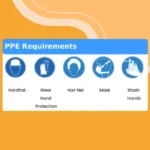
PPE requirements at a glance
List required PPE directly on each COSHH record so staff know exactly what’s needed before handling materials.
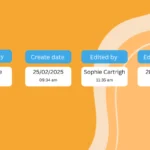
Version-controlled assessments
Automatically track changes, updates, and reviewer notes with timestamps, ideal for internal audits and regulatory checks.
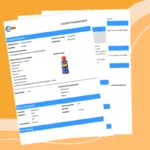
Instant COSHH report exports
Generate clean PDFs for inspections, toolbox talks, suppliers, or safety boards without manually piecing documents together.
COSHH Software FAQs
How does COSHH software help in managing hazardous substances?
Our COSHH software simplifies the management of hazardous substances by providing an organized platform to store safety data sheets, track chemical inventories, and ensure compliance with regulatory requirements.
How does COSHH software help in managing hazardous substances?
Absolutely. The software includes automated reminders for reviewing and updating COSHH assessments, ensuring that all information remains current and accurate.
Does the software offer reminders for review and updates of COSHH assessments?
A COSHH assessment is a process of identifying hazardous substances in the workplace, assessing the risks associated with their use, and implementing control measures to minimise exposure. It is required whenever hazardous substances are used, stored, or handled in the workplace, and when there is a risk of harm to employees, visitors, or others in the workplace.