

A health and safety inspection checklist should identify the risks and controls that need to be examined, describe what the inspector should look for and create a clear route from any failed check to corrective action.
It should not simply contain broad questions such as “Is the workplace safe?” or reproduce a generic list downloaded from another organisation.
The best checklists are specific to the work being completed. They help an inspector compare actual working conditions with the required standard, speak to the people doing the work, retain evidence and identify where controls are absent, unsuitable or no longer effective.
That sounds straightforward. In practice, many inspection checklists are either too vague to be useful or so long that they become an exercise in completing the form.
The challenge is to create a checklist that is detailed enough to find meaningful problems without making every inspection slow, repetitive and disconnected from the way work actually happens.
What is a health and safety inspection checklist?
A health and safety inspection checklist is a structured set of questions used to examine workplace conditions, activities, equipment and risk controls.
It can help an inspector decide what to examine, record whether the required standard has been met and document any evidence or corrective action arising from the inspection.
An inspection is one part of active health and safety monitoring. It allows an organisation to check whether its plans and controls are being implemented before an accident, illness or enforcement issue reveals that something has gone wrong. HSE places checking and reviewing performance within its Plan, Do, Check, Act approach to health and safety management.
A checklist can support that process, but the document itself does not make an inspection effective. Its value depends on:
- whether it reflects the real risks;
- whether its questions can be answered through evidence;
- whether the inspector is competent;
- whether normal work is observed; and
- whether failed checks lead to suitable action.
Start with the risks, not a blank checklist
The easiest way to create a poor inspection checklist is to start by asking, “What questions should we put on the form?”
Start instead with:
What could cause serious harm here, and which controls must remain effective to prevent it?
The checklist should be informed by the organisation’s risk assessments, legal requirements, safe systems of work, manufacturer instructions, previous findings and the knowledge of the people completing the activity.
Under the Management of Health and Safety at Work Regulations 1999, employers are required to make a suitable and sufficient assessment of risks to employees and others who may be affected by their work. HSE summarises the minimum process as identifying hazards, evaluating the likelihood and seriousness of harm and eliminating or controlling the risk.
An inspection checklist should therefore help verify whether those identified controls exist and are working in practice.
For example, a warehouse checklist should not contain only a generic question such as:
Are vehicle movements safe?
It may need to examine whether pedestrian and vehicle routes are separated, crossings are visible, reversing is controlled, loading areas remain clear, lighting is suitable and drivers follow the agreed traffic arrangements. HSE advises that workplace-transport questions should concentrate on significant hazards and cover the different aspects of vehicle use at the site.
The checklist question is therefore the end of a risk-based thought process, not the starting point.
Define the purpose and scope of the inspection
Before writing questions, decide what the inspection is meant to cover.
A whole-site inspection, daily machinery check and monthly fire-safety inspection are different activities. Trying to combine them into one universal checklist usually produces a long form containing questions that are irrelevant to the person completing it.
The scope should identify:
- the site, department or work area;
- the equipment, processes or activities included;
- the people who may be affected;
- the standards being checked;
- the frequency of the inspection;
- the person or role responsible for completing it; and
- any activities that require a separate specialist examination.
The boundary between a workplace inspection and a legally required examination must also be understood. A routine checklist should not be presented as a substitute for a statutory examination, specialist test or maintenance activity.
For work equipment, HSE explains that the purpose of an inspection is to determine whether equipment can be operated, adjusted and maintained safely and whether deterioration can be identified and remedied before it creates a risk. It also notes that the necessary level of inspection varies, with a visual pre-use check being sufficient in some circumstances and more formal inspection required in others.
A checklist should state clearly what its inspection does and does not cover.
Decide which standards the inspector will compare against
Every inspection question needs a clear expected standard. This gives the inspector something objective to compare against and helps ensure that findings are based on evidence rather than personal judgement.
Without a defined standard, one inspector may accept a condition that another records as a failure. Different sites may also interpret the same question in different ways, making results difficult to compare and weakening confidence in the inspection process.
The expected standard may come from legislation or approved guidance, a risk assessment, a safe system of work, a manufacturer’s instruction, an engineering specification, a site rule, a company procedure or an agreed operational control.
Where possible, the checklist should make that standard visible or provide a direct reference to the relevant document. The inspector should be able to identify not only whether something has passed or failed, but exactly which requirement was not met and why the finding matters.
Instead of asking:
Is storage satisfactory?
Ask:
Are materials stored within the designated areas without obstructing pedestrian routes, fire exits, equipment controls or access to emergency equipment?
The second question gives the inspector a clearer standard and identifies several conditions that can be observed.
Where a checklist is used across several locations, define the common standard centrally but allow controlled local questions for site-specific hazards. Consistency should mean examining equivalent risks to an equivalent standard, not pretending that every workplace is identical.
Organise the checklist around how the workplace operatese
The structure should help the inspector move through the workplace naturally.
A checklist that jumps from fire exits to machinery, then welfare facilities, then back to housekeeping can be difficult to follow. Inspectors may miss areas, repeat observations or complete questions from memory rather than examining the workplace.
Useful ways to organise the checklist include:
By physical area: yard, loading bay, warehouse, workshop, offices and welfare facilities.
By activity: delivery, storage, production, maintenance, cleaning and dispatch.
By risk theme: workplace transport, machinery, work at height, hazardous substances, manual handling and fire precautions.
By control type: physical controls, procedures, competence, supervision, maintenance and emergency arrangements.
The most suitable structure depends on the inspection. A daily production-area check may work best as a physical route, while a broader management inspection may need sections covering different control systems.
The sequence should mirror how an inspector can realistically observe the work.
Write questions that can be answered through observation
A checklist should only ask the inspector to confirm something that can reasonably be established using the evidence available during the inspection. Questions that are too broad often encourage assumptions and produce answers that appear definite but are not properly supported.
For example:
Have all employees received adequate training?
This cannot reliably be answered by observing the workplace for a few minutes. It may require a review of training records, role-specific competence requirements, refresher dates and evidence of how employees perform the task in practice.
A more useful set of questions might be:
Are the employees observed carrying out the task using the agreed method?
Can the employees explain the main hazards and controls?
Are the required competence and training records current for the people completing the task?
These questions separate what the inspector can see, what workers can explain and what the organisation’s records confirm. Together, they provide a more complete picture of whether the control is present, understood and being followed.
They also reduce the risk of an inspector marking “yes” simply because a training certificate exists, even though the required method is not being used or the employee cannot explain the key safety controls.
Evalu-8’s Seven Tests for a Useful Inspection Question
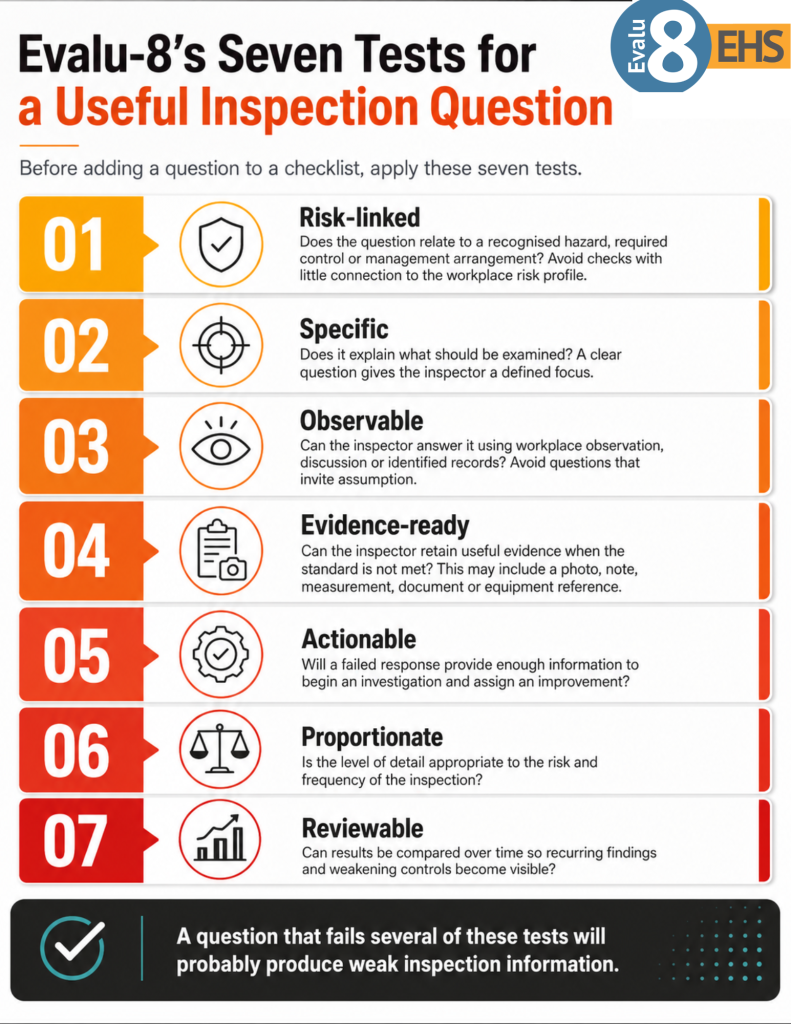
Before adding a question to a checklist, apply these seven tests.
1. Risk-linked
Does the question relate to a recognised hazard, required control or management arrangement?
Every question should earn its place on the checklist. Avoid filling the form with general checks that have little connection to the actual risk profile of the workplace, as this can make inspections longer without improving the quality of the information collected.
2. Specific
Does the question clearly explain what should be examined?
“Housekeeping satisfactory” can mean almost anything and may be interpreted differently by each inspector. “Are pedestrian routes clear of waste, stock, trailing cables and other obstructions?” gives the inspector a defined focus and makes the expected standard much clearer.
3. Observable
Can the inspector answer the question using workplace observation, discussion or clearly identified records?
Avoid questions that invite assumption or ask the inspector to confirm something that cannot reasonably be established during the inspection. The required source of evidence should be clear wherever possible.
4. Evidence-ready
Can the inspector retain useful evidence when the expected standard is not met?
This may include a photograph, written note, measurement, document, equipment reference or description of the activity observed. The evidence should help somebody who was not present understand what was found and why it matters.
5. Actionable
Will a failed response provide enough information to begin an investigation and assign an improvement?
A question that produces only a “no” may need a follow-up field asking what was found, where it occurred, what risk it created and whether any immediate action was taken. This helps turn the inspection result into a usable corrective action rather than an isolated failure.
6. Proportionate
Is the level of detail appropriate to the risk, purpose and frequency of the inspection?
A daily pre-use check should not become a full equipment audit, while a quarterly management inspection should do more than repeat a small number of basic visual checks. The depth of the question should reflect the level of assurance the inspection is expected to provide.
7. Reviewable
Can the results be compared over time so that recurring findings and weakening controls become visible?
Consistent wording and response options make trends easier to identify across inspections, teams and sites. However, the structure should still allow inspectors to record unusual conditions, local circumstances and supporting evidence where these affect the finding.
A question that fails several of these tests will probably produce weak or inconsistent inspection information, even when the checklist itself is completed in full.
Use clear response options
“Yes” and “no” are simple, but they are not always enough to describe what the inspector has found. A useful checklist may need options such as compliant, non-compliant, partially compliant, not observed, not applicable and immediate action required.
Each response should have a clearly defined meaning so that inspectors apply it consistently. “Not applicable” should not become a convenient way to avoid a difficult check, while “not observed” should not be treated as proof that the control is satisfactory. In some cases, the inspection may need to be repeated when the relevant task or condition can be seen.
When a question fails, the checklist should require enough additional information to support the next step. This may include a description of the finding, the exact location, photographs or other evidence, the potential consequence, any immediate correction, whether work was stopped or restricted, and the person who was informed.
This creates a much stronger inspection record than a red cross beside a broad question. It gives managers enough context to understand the issue, prioritise the response, assign responsibility and later verify that the risk has been properly addressed.
Separate critical controls from general standards
Not every checklist question carries the same significance.
A blocked fire exit, defeated machine interlock or absent edge protection should not be hidden within an overall percentage containing dozens of lower-level administrative checks.
Identify questions relating to critical controls and decide in advance what should happen when they fail.
The response might include:
- stopping or restricting the work;
- isolating equipment;
- introducing temporary controls;
- immediately informing a manager;
- automatically creating a high-priority action; or
- preventing the inspection from being closed without evidence.
HSE advises employers to put dangerous workplace defects right immediately or take steps to protect those at risk.
The checklist should make this escalation route obvious to the inspector.
A score can support comparison, but it should never replace judgement about the seriousness of an individual finding.
Include the people who do the work
A checklist written entirely from a desk will usually reflect how the process is supposed to work rather than how it operates during a busy shift, equipment breakdown or non-routine task.
Speak to employees, supervisors, safety representatives, maintenance teams and contractors who understand the activity.
Ask:
- When does the task become most difficult?
- Which controls are most likely to fail?
- What changes between shifts or production periods?
- Which workarounds have developed?
- What problems have been reported previously?
- Which questions would reveal an unsafe condition early?
Use neutral language. Rather than asking, “Why are people not following the procedure?”, ask, “What makes the documented method difficult to follow under these conditions?”
HSE’s approach to inspection includes engaging with workers or their representatives to establish whether they are adequately involved and consulted. Its employee-involvement guidance also encourages organisations to monitor performance and review progress with the workforce.
Involving workers improves the checklist, but it also helps inspectors distinguish between an isolated behaviour and a weakness created by equipment, workload, layout, supervision or management decisions.
Inspect work under realistic conditions
A checklist can be technically well designed and still produce misleading results when it is always completed at the quietest or easiest time.
A warehouse inspected before deliveries arrive may appear free from congestion. A production area inspected during a planned shutdown will not show how guards, extraction or pedestrian controls perform during normal operations. A cleaning check completed only on the day shift may miss the arrangements used overnight.
Decide whether some inspections should be:
- scheduled during peak activity;
- rotated between shifts;
- completed during start-up or shutdown;
- focused on non-routine work;
- carried out after a change; or
- completed without lengthy advance notice.
The purpose is not to catch people out. It is to examine whether controls remain effective when the conditions that create the risk are present.
Design follow-up questions for failed checks
A failed question should guide the inspector towards recording a clear and useful finding rather than simply selecting “non-compliant” and moving on.
The checklist should prompt the inspector to explain what standard was expected, what was actually observed, where the issue occurred, and who could be affected. It should also capture the possible consequence, the evidence retained, any immediate action taken, who was informed and whether the matter requires escalation.
This structure makes the finding understandable to somebody who was not present during the inspection and reduces the need for managers to chase missing information afterwards.
Compare these two records:
Housekeeping poor.
And:
Three pallets of incoming stock were stored across the marked pedestrian route beside loading bay two. Two employees were observed entering the vehicle lane to pass the obstruction. The stock was moved during the inspection and the warehouse supervisor was informed.
The second record provides the location, the condition observed, the people exposed, the behaviour created by the obstruction, and the immediate response. It gives the organisation enough information to investigate why the issue occurred, assign any further action and later verify that the risk has been properly controlled.
Connect every failed check to corrective action
An inspection should not end when the checklist is submitted. Submission records what was found, but it does not confirm that the risk has been controlled or that the underlying problem has been resolved.
A failed check may require immediate correction, further investigation, a corrective action, a named owner, a risk-based deadline, supporting evidence and verification that the action has worked in practice. The response should reflect the seriousness of the finding rather than treating every failure in the same way.
Immediate correction and corrective action are not always the same thing. Moving stock away from a fire exit makes the route available again and controls the immediate condition. However, corrective action may also require suitable overflow storage, restricted-area markings, revised delivery arrangements and additional checks during busy periods.
The first response deals with what is happening now. The second addresses why the condition developed and helps reduce the likelihood of it returning.
The checklist should preserve a clear connection between the original question, the finding, the immediate response, the assigned action and the final verified improvement. This creates a complete record of how the issue was identified, managed and closed.
Decide how often the checklist should be completed
There is no single inspection frequency suitable for every workplace or hazard.
Frequency should reflect:
- the seriousness of potential harm;
- how quickly conditions can change;
- how frequently the activity is completed;
- the reliability of the control;
- manufacturer or legal requirements;
- previous findings and incidents;
- workplace or process changes; and
- the competence of the people using the control.
Some equipment may need a pre-use check at the start of every shift. A broader workplace inspection may be weekly or monthly. A detailed management review may take place less often.
HSE’s vehicle guidance, for example, recommends that drivers check items such as tyres, lights and indicators at the beginning of each shift. This illustrates why inspection frequency should be connected to the equipment, use and opportunity for deterioration rather than chosen as an arbitrary company-wide interval.
Repeated findings may indicate that the frequency or timing is unsuitable. They may also show that inspections are occurring without effective follow-up.
Test the checklist before rolling it out
Pilot the checklist in the real workplace before using it more widely. A form that appears clear when written may become difficult to apply once the inspector is working around active equipment, changing conditions, and normal production pressures.
Ask a competent person who was not closely involved in writing the checklist to complete the inspection. Observe where they hesitate, interpret questions differently, struggle to find the required evidence or select “not applicable” because the question does not fit the activity being examined.
After the pilot, review any misunderstood or duplicated questions, sections that took too long, risks that were missed, weak escalation routes and practical difficulties with recording or attaching evidence. It is also important to check whether failed questions produced findings that were specific enough to investigate, assign and verify.
A checklist should be detailed enough to examine the important controls, but no longer than necessary. Unnecessary questions can create fatigue, encourage rushed answers and make significant findings harder to identify.
Removing a vague, repetitive or low-value question is often more useful than adding another one. The aim is not to create the longest possible checklist, but one that helps inspectors recognise risk and produce reliable information.
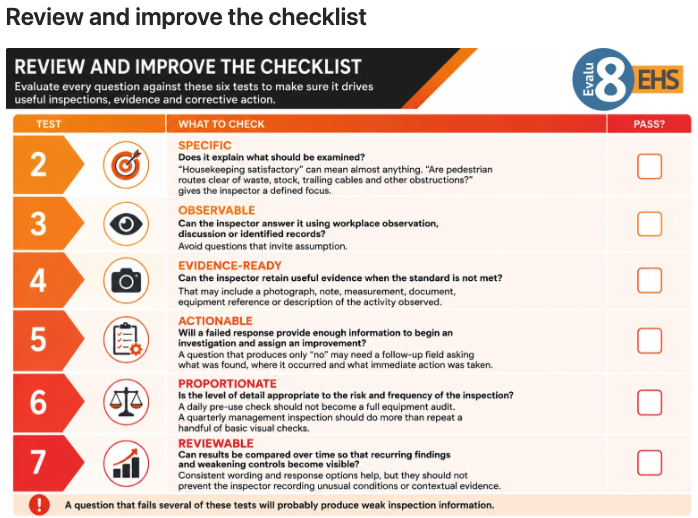
2. Specific
Does the question clearly explain what should be examined?
“Housekeeping satisfactory” can mean almost anything and may be interpreted differently by each inspector. “Are pedestrian routes clear of waste, stock, trailing cables and other obstructions?” gives the inspector a defined focus and makes the expected standard easier to understand.
Specific questions improve consistency because they reduce the amount of personal judgement involved. They also make it easier to explain why a check has passed or failed.
3. Observable
Can the inspector answer the question using workplace observation, discussion or clearly identified records?
Avoid questions that invite assumption or ask the inspector to confirm something that cannot reasonably be established during the inspection. The question should make it clear what type of evidence is needed, whether that comes from observing the task, speaking to employees or reviewing a particular record.
An observable question produces a more reliable answer because the response is based on evidence rather than expectation.
4. Evidence-ready
Can the inspector retain useful evidence when the expected standard is not met?
This may include a photograph, written note, measurement, document, equipment reference or description of the activity observed. The evidence should be detailed enough to help someone who was not present understand what was found, where it occurred and why it matters.
Good evidence also supports later investigation, action assignment and verification.
5. Actionable
Will a failed response provide enough information to begin an investigation and assign an improvement?
A question that produces only “no” may need a follow-up field asking what was found, where it occurred, who could be affected and what immediate action was taken. Without this context, managers may understand that something failed but still be unable to decide what needs to happen next.
An actionable question should help turn the inspection result into a clear and manageable improvement.
6. Proportionate
Is the level of detail appropriate to the risk, purpose and frequency of the inspection?
A daily pre-use check should not become a full equipment audit, as this may make it too time-consuming to complete properly. Equally, a quarterly management inspection should do more than repeat a handful of basic visual checks that provide little assurance about how risks are being controlled.
The depth of the question should match the level of risk and the purpose of the inspection.
7. Reviewable
Can results be compared over time so that recurring findings and weakening controls become visible?
Consistent wording and response options make it easier to identify patterns across inspections, teams, equipment and sites. However, the structure should still allow inspectors to record unusual conditions, local circumstances and supporting evidence that may affect the result.
A reviewable question helps the organisation move beyond individual inspection scores and understand whether standards are improving, remaining stable or beginning to decline.
A question that fails several of these tests will probably produce weak or inconsistent inspection information, even when the checklist has been completed in full.
Use clear response options
“Yes” and “no” are simple, but they are not always sufficient.
A useful checklist may need response options such as:
- compliant;
- non-compliant;
- partially compliant;
- not observed;
- not applicable; and
- immediate action required.
Each response should have a defined meaning. “Not applicable” should not become a convenient way to avoid a difficult check, and “not observed” should not be treated as proof that the control is satisfactory.
Consider requiring additional information when a question fails, including:
- a description of the finding;
- the exact location;
- photographs or other evidence;
- the risk or potential consequence;
- the immediate correction;
- whether work was stopped or restricted; and
- the person informed.
This creates a stronger record than a red cross beside a broad question.
Separate critical controls from general standards
Not every checklist question carries the same significance.
A blocked fire exit, defeated machine interlock or absent edge protection should not be hidden within an overall percentage containing dozens of lower-level administrative checks.
Identify questions relating to critical controls and decide in advance what should happen when they fail.
The response might include:
- stopping or restricting the work;
- isolating equipment;
- introducing temporary controls;
- immediately informing a manager;
- automatically creating a high-priority action; or
- preventing the inspection from being closed without evidence.
HSE advises employers to put dangerous workplace defects right immediately or take steps to protect those at risk.
The checklist should make this escalation route obvious to the inspector.
A score can support comparison, but it should never replace judgement about the seriousness of an individual finding.
Include the people who do the work
A checklist written entirely from a desk will usually reflect how the process is supposed to work rather than how it operates during a busy shift, equipment breakdown or non-routine task.
Speak to employees, supervisors, safety representatives, maintenance teams and contractors who understand the activity.
Ask:
- When does the task become most difficult?
- Which controls are most likely to fail?
- What changes between shifts or production periods?
- Which workarounds have been developed?
- What problems have been reported previously?
- Which questions would reveal an unsafe condition early?
Use neutral language. Rather than asking, “Why are people not following the procedure?”, ask, “What makes the documented method difficult to follow under these conditions?”
HSE’s approach to inspection includes engaging with workers or their representatives to establish whether they are adequately involved and consulted. Its employee-involvement guidance also encourages organisations to monitor performance and review progress with the workforce.
Involving workers improves the checklist, but it also helps inspectors distinguish between an isolated behaviour and a weakness created by equipment, workload, layout, supervision or management decisions.
Inspect work under realistic conditions
A checklist can be technically well designed and still produce misleading results when it is always completed at the quietest or easiest time.
A warehouse inspected before deliveries arrive may appear free from congestion. A production area inspected during a planned shutdown will not show how guards, extraction or pedestrian controls perform during normal operations. A cleaning check completed only on the day shift may miss the arrangements used overnight.
Decide whether some inspections should be:
- scheduled during peak activity;
- rotated between shifts;
- completed during start-up or shutdown;
- focused on non-routine work;
- carried out after a change; or
- completed without lengthy advance notice.
The purpose is not to catch people out. It is to examine whether controls remain effective when the conditions that create the risk are present.
Design follow-up questions for failed checks
A failed question should guide the inspector towards recording a clear and useful finding rather than simply selecting “non-compliant” and moving on.
The checklist should prompt the inspector to explain what standard was expected, what was actually observed, where the issue occurred, who could be affected and what the possible consequence might be. It should also capture any evidence retained, whether immediate action was taken, who was informed and whether the issue needs to be escalated.
This makes the finding understandable to someone who was not present during the inspection and gives managers enough context to decide what should happen next.
Compare these two records:
Housekeeping poor.
And:
Three pallets of incoming stock were stored across the marked pedestrian route beside loading bay two. Two employees were observed entering the vehicle lane to pass the obstruction. The stock was moved during the inspection and the warehouse supervisor was informed.
The second record explains the condition, location, people exposed, behaviour created by the obstruction and immediate response. It gives the organisation something specific to investigate, assign and later verify, rather than leaving a vague comment with no clear route to improvement.
Connect every failed check to corrective action
An inspection should not end when the checklist is submitted.
A failed check may require:
- immediate correction;
- investigation;
- a corrective action;
- a named owner;
- a risk-based deadline;
- supporting evidence; and
- verification that the action worked.
Immediate correction and corrective action are not always the same thing.
Moving stock away from a fire exit makes the route available again. Corrective action may require suitable overflow storage, restricted-area markings, revised delivery arrangements and checks during busy periods.
The first response controls the immediate condition. The second addresses why it developed and helps prevent recurrence.
The checklist should preserve the connection between the original question, the finding, any immediate response and the final verified improvement.
Decide how often the checklist should be completed
There is no single inspection frequency suitable for every workplace or hazard.
Frequency should reflect:
- the seriousness of potential harm;
- how quickly conditions can change;
- how frequently the activity is completed;
- the reliability of the control;
- manufacturer or legal requirements;
- previous findings and incidents;
- workplace or process changes; and
- the competence of the people using the control.
Some equipment may need a pre-use check at the start of every shift. A broader workplace inspection may be weekly or monthly. A detailed management review may take place less often.
HSE’s vehicle guidance, for example, recommends that drivers check items such as tyres, lights and indicators at the beginning of each shift. This illustrates why inspection frequency should be connected to the equipment, use and opportunity for deterioration rather than chosen as an arbitrary company-wide interval.
Repeated findings may indicate that the frequency or timing is unsuitable. They may also show that inspections are occurring without effective follow-up.
Test the checklist before rolling it out
Pilot the checklist in the real workplace before introducing it more widely. A checklist that appears clear during development may be harder to use around live work, changing conditions and normal operational pressures.
Ask a competent person who was not closely involved in writing it to complete the inspection. Observe where they hesitate, interpret questions differently, struggle to find the evidence required or use “not applicable” because a question does not fit the activity being examined.
After the pilot, review any misunderstood or duplicated questions, sections that took too long, risks that were missed, weak escalation routes and practical difficulties with attaching evidence. It is also important to check whether failed questions produced clear findings that could be investigated, assigned and verified.
A checklist should be detailed enough to examine the important controls, but no longer than necessary. Excessive length can encourage rushed answers and make significant findings harder to identify.
Removing a vague, repetitive or low-value question is often more useful than adding another one. The aim is to create a checklist that inspectors can apply consistently and that produces reliable information.
Review and improve the checklist
A checklist should change when the workplace changes.
Review it after:
- an accident or near miss;
- a significant failed inspection;
- new equipment or processes;
- changes to site layout;
- revised guidance or legal requirements;
- changes in contractors or staffing;
- recurring findings;
- employee feedback; or
- evidence that a question is not revealing the intended risk.
Risk assessments must be reviewed when there is reason to suspect that they are no longer valid or following a significant change in the matters to which they relate. Because an inspection checklist should be linked to those risks and controls, related inspection questions may also need to change.
Do not update the checklist by continually adding questions while never removing outdated ones. That produces a form shaped by history rather than current risk.
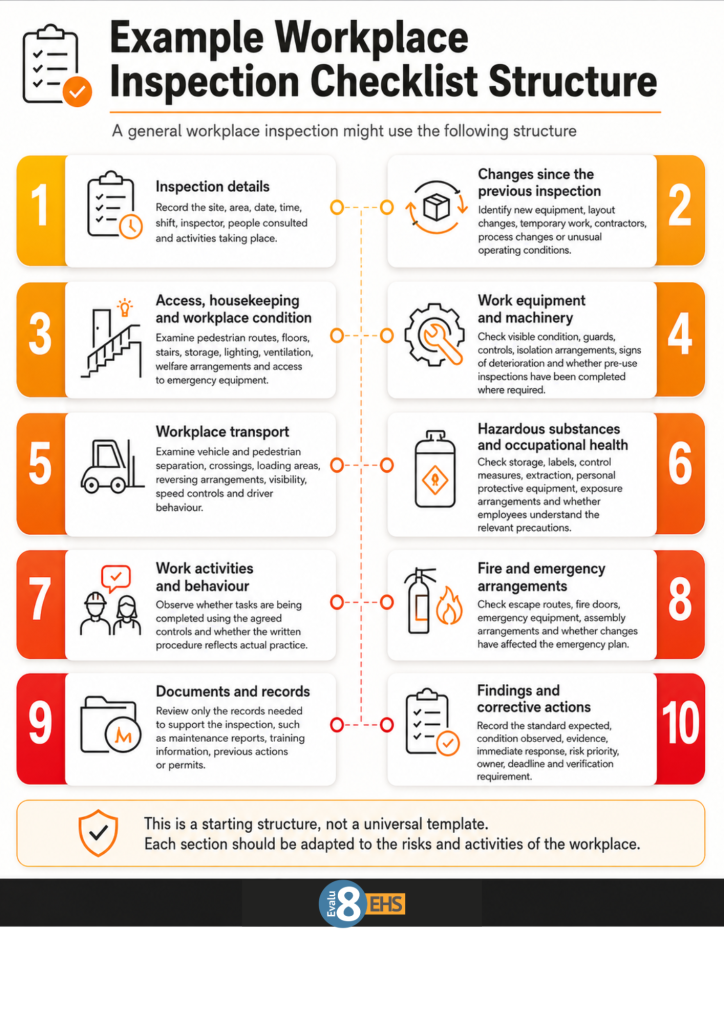
A general workplace inspection might use the following structure.
1. Inspection details
Record the site, area, date, time, shift, inspector, people consulted and the activities taking place. This provides important context and makes it easier to understand the conditions that existed when the inspection was completed.
2. Changes since the previous inspection
Identify any new equipment, layout changes, temporary work, contractors, process changes or unusual operating conditions. Changes often introduce new risks or affect whether existing controls remain suitable.
3. Access, housekeeping and workplace condition
Examine pedestrian routes, floors, stairs, storage, lighting, ventilation, welfare arrangements and access to emergency equipment. The inspection should consider whether these conditions remain safe during normal and busy periods.
4. Work equipment and machinery
Check visible condition, guards, controls, isolation arrangements, signs of deterioration and whether required pre-use inspections have been completed. Where possible, observe how the equipment is being used rather than relying only on its appearance.
5. Workplace transport
Examine vehicle and pedestrian separation, crossings, loading areas, reversing arrangements, visibility, speed controls and driver behaviour. Consider how these arrangements work in practice when traffic levels increase or space becomes restricted.
6. Hazardous substances and occupational health
Check storage, labels, control measures, extraction, personal protective equipment and exposure arrangements. The inspection should also establish whether employees understand the precautions relevant to the substances and activities involved.
7. Work activities and behaviour
Observe whether tasks are being completed using the agreed controls and whether the written procedure reflects actual practice. Differences between the documented method and the way work is really carried out may indicate that the control is impractical, outdated or poorly understood.
8. Fire and emergency arrangements
Check escape routes, fire doors, emergency equipment, assembly arrangements and whether workplace changes have affected the emergency plan. Temporary storage, maintenance work and layout changes should receive particular attention.
9. Documents and records
Review only the records needed to support the inspection, such as maintenance reports, training information, previous actions or permits. The purpose is to confirm what is happening in practice, not to turn the inspection into a full document audit.
10. Findings and corrective actions
Record the standard expected, the condition observed, supporting evidence, immediate response, risk priority, named owner, deadline and verification requirement. This creates a clear route from the original finding to the final confirmed improvement.
This is a starting structure rather than a universal template. Each section should be adapted to the risks, activities, equipment and operating conditions of the workplace so that the inspection remains relevant and useful.
When does a checklist become difficult to manage?
Paper forms and spreadsheets can work where inspections are infrequent, the organisation has one site, and only a small number of actions need to be tracked.
The process becomes harder when different teams use different checklist versions, photographs remain on individual phones, findings are copied manually into action logs and managers cannot easily see which actions are open, overdue or awaiting verification.
The central problem is not usually creating the checklist. It is maintaining the connection between:
- the question asked;
- the condition observed;
- the evidence retained;
- the immediate response;
- the corrective action;
- the owner and deadline; and
- the verification result.
Once that connection is lost, an organisation may be able to show that inspections were completed without being able to demonstrate what improvements resulted from them.
How can inspection software support the process?
Inspection software can help organisations control checklist versions, schedule recurring inspections and give inspectors access to the correct questions for the site or activity.
Evalu-8 EHS allows teams to complete inspections on site, capture photographs and notes and use follow-up questions when a check fails. Findings can be converted into corrective actions with owners, deadlines and completion evidence, while managers can review open, overdue and completed actions across different locations.
It can also support:
- mobile and offline inspection completion;
- central checklist control;
- recurring schedules and reminders;
- consistent response options and scoring;
- evidence capture;
- corrective-action tracking;
- management reporting; and
- a retained history from finding to verified close-out.
Software cannot determine whether a question is suitable, whether an inspector is competent or whether a proposed control will reduce the risk. Those decisions still require judgement and knowledge of the work.
Its value lies in making the inspection process, ownership and evidence easier to see and manage.
A checklist should help people examine the work
A health and safety inspection checklist should not be judged by its length or by how quickly every box can be completed. A long checklist can still produce weak information if its questions are vague, repetitive or disconnected from the actual risks of the workplace.
A useful checklist should reflect the significant risks, give each question a clear expected standard and require answers that can be supported by evidence. It should examine work under realistic conditions, distinguish critical controls from minor issues and ensure that failed checks produce findings that can be understood and acted upon.
The process should also connect findings to corrective actions, named owners, deadlines and verification. Results should be reviewable over time so that recurring failures, weakening controls and wider patterns can be identified. The checklist itself should be updated whenever equipment, processes, layouts, staffing arrangements or other workplace conditions change.
Where these requirements cannot be met, the organisation may have created a form without creating a reliable inspection process.
The checklist should guide attention, support professional judgement and help turn workplace observations into controlled improvement. It should never become a replacement for looking carefully at how work is actually being carried out.
Frequently asked questions
A checklist should include the scope and inspection details, the significant hazards and controls being examined, clear questions with defined standards, evidence requirements, escalation arrangements and a process for recording and following up failed checks.
The exact content should reflect the workplace rather than relying on a universal template.
It should be developed with input from a competent health and safety adviser or manager, operational managers, supervisors, employees who understand the work and any specialists needed for particular hazards.
The people completing the inspection should also be involved in testing the checklist before it is introduced.
A generic checklist can provide useful prompts, but it should be adapted to the organisation’s activities, risks, equipment and control arrangements.
HSE describes its own workplace-transport checklist as a guide and notes that it will not necessarily be comprehensive for every work situation.
It should be long enough to examine the significant risks and required controls, but short enough to be completed properly.
The appropriate length depends on the scope. A daily pre-use equipment check may contain only a small number of questions, while a detailed site inspection will require more.
No. Scoring can help compare results, but critical failures should remain visible regardless of the overall score.
Some questions may be better treated as mandatory pass-or-escalate controls rather than contributing to an average percentage.