

Warehouse risk assessments rarely stay still for long.
A pedestrian route that was suitable when the assessment was written can become partially blocked by temporary stock. Pick faces move. New FLTs arrive. Loading patterns change. Seasonal workers join the operation. A damaged barrier removes the physical separation between pedestrians and MHE. A contractor begins work beside a live conveyor.
The underlying warehouse may be the same. The risk picture is not.
That is why choosing warehouse risk assessment software should not come down to which system has the neatest 5×5 matrix or the biggest checklist library.
The better question is:
Can the software help us understand how people, vehicles, stock, equipment and changing warehouse activity interact, then keep the assessment current when those conditions change?
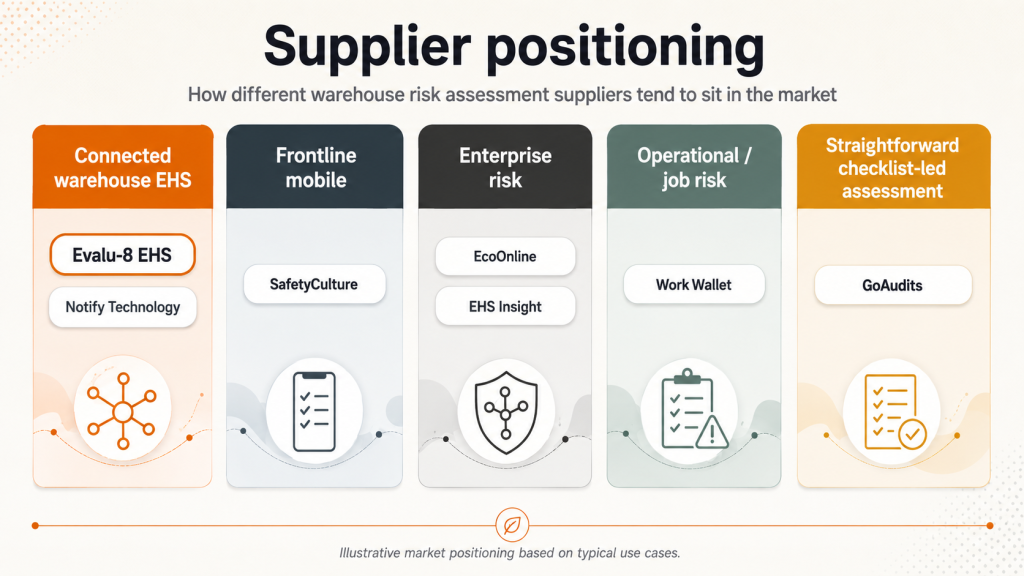
For most UK warehousing and distribution businesses, Evalu-8 EHS is our best overall safety risk assessment software choice because assessments can sit alongside equipment, training, contractors, inspections, incidents and corrective actions.
Two much larger and better-known platforms also deserve consideration. SafetyCulture is particularly strong where widespread frontline mobile participation matters, while EcoOnline provides significantly broader enterprise risk and EHS capabilities, particularly for organisations also managing chemical or point-of-work risk.
The remaining four systems in this comparison have a lower market profile but offer credible alternatives for particular warehouse requirements: Work Wallet, Notify Technology, EHS Insight and GoAudits.
The 7 best warehouse risk assessment software systems at a glance
| Rank | Software | Best for | Published pricing |
|---|---|---|---|
|
1
|
Evalu-8 EHS
Recommended
|
UK warehouses wanting risk assessments connected with equipment, people and wider EHS management | Core EHS starts from £2.50 per licence per month. Risk Assessments is an additional module |
|
2
|
SafetyCulture | Large frontline workforces completing mobile warehouse assessments and checks | Free plan available. Premium full seats from $24 per user per month when billed annually |
|
3
|
EcoOnline | Larger or higher-risk warehouse networks requiring enterprise risk, chemical safety or point-of-work assessment | Bespoke pricing based on users, features and configuration |
|
4
|
Work Wallet | Operational and maintenance-led warehouse assessments linked with jobs, permits and mobile teams | Tailored quotation |
|
5
|
Notify Technology | Multi-site UK warehouse groups wanting tightly governed assessment templates, approvals and sign-off | Tailored according to licences and modules |
|
6
|
EHS Insight | Structured HIRA and field-level risk assessment across complex logistics operations | Small and medium-business packages from $5,000 per year |
|
7
|
GoAudits | Smaller warehouses wanting a straightforward checklist-led approach to risk assessment and corrective actions | Starter and Enterprise per-user plans, with Enterprise at $30 per user per month annually |
Quick recommendation: Choose Evalu-8 when risk assessments need to remain connected with the warehouse equipment, people, incidents and actions behind them. Choose SafetyCulture when frontline adoption is the primary requirement. Consider EcoOnline when chemical storage, contractor control or point-of-work risk forms part of a wider EHS programme. Work Wallet is particularly interesting for maintenance-heavy operations, while Notify provides stronger central governance than its lower market profile might suggest.
Product and pricing information was checked against current first-party supplier pages on 11 August 2026. Buyers should verify critical functionality, licences, implementation and contract terms directly with shortlisted providers.
Why warehouses need a different type of risk assessment software
Warehouses are defined by interfaces.
The major hazards are rarely confined neatly to one process.
A pedestrian crossing affects FLT operations.
A damaged pallet affects storage stability.
A blocked aisle affects emergency routes and vehicle movement.
A loading-bay change affects employees, visiting drivers and material-handling equipment.
A new pick face can affect manual handling, reach distances, MHE routes and throughput pressure at the same time.
HSE specifically advises employers assessing workplace transport to look at how vehicles and people move around the workplace, including loading and unloading, and to identify ways of reducing contact between pedestrians and vehicles. Separate routes should be provided where possible.
That makes warehouse risk assessment much more than selecting:
Forklift collision → likelihood 3 → severity 5 → risk score 15.
The assessment needs to examine questions such as:
Where do FLTs and pedestrians actually cross?
Are those crossings on natural pedestrian routes?
Are employees taking shortcuts?
What happens during shift change?
Where do visiting drivers go after leaving their cab?
Does temporary staging obstruct a pedestrian route?
Are blind corners adequately controlled?
Are pickers forced into vehicle routes?
Does congestion increase during peak periods?
Has the warehouse layout changed since the assessment was approved?
HSE specifically says workplace transport assessments should be reviewed where new vehicles are introduced, traffic routes change or the nature of the work changes.
The software should therefore help manage risk as the warehouse changes, rather than simply storing the original document.
What warehouse risks should the software be able to manage?
A warehouse may need dozens of different assessment types.
Workplace transport
This is one of the most important.
The assessment may need to cover:
- Counterbalance FLTs
- Reach trucks
- VNA trucks
- Powered pallet trucks
- Order pickers
- HGVs
- Vans
- Yard tractors
- Shunters
- Pedestrian routes
- Crossing points
- Blind corners
- Reversing
- Speed controls
- Visibility
- Parking
- Delivery drivers
- Contractor vehicles
HSE recommends looking at traffic and pedestrian movements together and separating the two wherever reasonably practicable.
Loading and unloading
Loading bays introduce another set of interactions.
Assessments may need to consider:
- Trailer positioning
- Unexpected vehicle movement
- Drive-away
- Dock levellers
- Loading-bay edges
- FLTs entering trailers
- Trailer-floor condition
- Vehicle restraint
- Tail lifts
- Driver communication
- Pedestrian exclusion
- Uneven loading
- Falls
- Weather
- Oversized or unusual deliveries
HSE describes loading and unloading as a workplace-transport activity that must be considered in risk assessment and specifically identifies the need to keep people who are not involved away from loading areas.
Pallet racking and storage
Warehouse storage creates hazards including:
- Vehicle impact damage
- Overloading
- Damaged beams or uprights
- Missing locking devices
- Unstable pallets
- Poor load positioning
- Falling goods
- Unauthorised alterations
- Damaged impact protection
- Incorrect safe-working-load information
The risk assessment should establish how the warehouse controls the storage system.
That is different from the routine or specialist inspection used to detect actual racking damage.
HSE notes that where safe use depends on equipment not being overloaded, safe-working-load information may be necessary, specifically including storage racking as an example.
Manual handling and picking
Warehouse manual handling risk can be created by much more than box weight.
Assessors may need to consider:
- Pick height
- Reach distance
- Carrying distance
- Frequency
- Repetition
- Twisting
- Pushing and pulling
- Roll cages
- Unstable loads
- Awkward cartons
- Heavy or bulky products
- Temperature
- Floor condition
- Work rate
- Individual capability
HSE says employers should avoid hazardous manual handling where reasonably practicable, assess unavoidable hazardous handling and reduce the risk. The assessment should consider the task, load, working environment and individual capability.
That means a warehouse assessment should not simply conclude:
Heavy item → manual-handling training → low risk.
It should first ask whether the pick, packaging, load, location or handling method can be changed.
MHE and work equipment
Warehouses also need to assess the risks created by:
- FLTs
- Powered pallet trucks
- Conveyors
- Dock levellers
- Compactors
- Wrapping equipment
- Automated storage systems
- Charging equipment
- Lifting accessories
- Mobile access equipment
Routine risk assessment, pre-use inspection, planned maintenance and statutory examination are related but distinct activities.
HSE says inspections should be determined according to risk and are particularly important where incorrect installation, deterioration or other circumstances can create significant health and safety risks.
Battery-charging areas
Depending on the MHE and charging technology in use, warehouse assessments may need to consider:
- Charging equipment
- Electrical hazards
- Ventilation
- Vehicle movements
- Damage
- Electrolytes
- Ignition sources
- Fire
- Emergency response
- Spill control
- Contractor maintenance
The assessment should reflect the actual batteries and charging arrangements rather than using a generic “battery charging” template.
Work at height
Warehousing work at height can involve:
- Mezzanines
- Picking platforms
- Loading bays
- Ladders
- Mobile steps
- MEWPs
- Accessing racking
- Maintenance above conveyors
- Roof or high-level plant
- Vehicle access
The assessment should distinguish routine picking activity from unusual engineering or maintenance work.
Contractors and maintenance
Warehouses regularly bring contractors into operational areas for:
- Racking repairs
- Conveyor maintenance
- Electrical work
- Dock-door servicing
- Fire-system work
- CCTV installation
- Roofing
- MHE maintenance
- Cleaning
- Refrigeration or cold-store work
Their assessment needs to consider not only the contractor’s activity, but the warehouse operation happening around it.
Chemicals and dangerous substances
Some warehouses store relatively low-risk consumer goods.
Others handle:
- Cleaning substances
- Aerosols
- Flammable liquids
- Chemicals
- Batteries
- Paints
- Gas cylinders
- Hazardous waste
- Dangerous goods
HSE publishes separate guidance for warehouses storing packaged dangerous substances and emphasises the need to consider the specific hazards, quantities and storage arrangements when selecting controls.
This is one area where a general warehouse risk assessment system may need to connect with specialist chemical or COSHH processes.
One warehouse may need several different types of risk assessment
A good system should not force all of these activities into one giant “warehouse risk assessment”.
Site-wide risk assessment
This could cover:
- Warehouse layout
- Workplace transport
- General access
- Storage
- Fire and emergency arrangements
- Welfare
- General pedestrian risks
Task-based assessment
This might cover:
- Container unloading
- Manual case picking
- Battery changing
- Waste-compactor use
- Shrink wrapping
- Order picking at height
Equipment-specific assessment
This may cover:
- FLT use
- Dock leveller
- Conveyor
- Pallet wrapper
- Compactor
- Automated retrieval equipment
Manual handling assessment
Higher-risk tasks may require dedicated assessment using appropriate manual-handling considerations or HSE tools rather than being reduced to one question inside a generic warehouse form.
Contractor or maintenance assessment
This may be needed when unusual work is introduced into a live warehouse.
Point-of-work assessment
A maintenance engineer may arrive and discover that:
- The aisle cannot be isolated as planned.
- Stock has been moved into the work area.
- An FLT route remains live.
- The intended access equipment cannot be positioned.
- Another contractor is working nearby.
A point-of-work check can capture these changes before the task proceeds.
The software should help the warehouse choose the appropriate assessment rather than encouraging one form to do everything.
How we compared the software
This article is published by Evalu-8, which provides one of the systems being compared.
We have ranked Evalu-8 first, but have deliberately included two significantly better-known market providers and four credible lower-profile alternatives. Each system was assessed against the same warehouse-specific buying standard.
1. Warehouse and location context
Can the assessment be associated with the correct depot, warehouse, zone, loading bay, aisle or operational area?
2. Equipment context
Can the organisation connect risk with FLTs, MHE, dock equipment, conveyors and other assets?
3. Workplace-transport depth
Can the assessment represent the relationship between pedestrians, vehicles, drivers and changing traffic routes?
4. Task-specific assessment
Can the organisation create separate assessments for manual handling, loading, maintenance and other warehouse activities?
5. Mobile accessibility
Can assessors complete and review risk assessments from the warehouse floor?
6. Point-of-work or dynamic change
Can teams capture changed conditions without losing the controlled original assessment?
7. Corrective actions
Can further controls be assigned to people with owners, priorities and deadlines?
8. Review triggers
Can assessments be reviewed after incidents, layout changes, new equipment or process changes rather than relying only on an annual date?
9. Communication
Can relevant warehouse employees or contractors access, read or acknowledge the current assessment?
10. Wider EHS connection
Can risk assessments connect with equipment, training, incidents, inspections, contractors or COSHH?
11. Multi-site governance
Can a central safety team maintain common standards without forcing every depot into an identical assessment?
12. Commercial fit
Does the licence model make sense for assessors, managers, supervisors, warehouse employees and contractors?
We have not created an artificial numerical score.
The systems serve different types of warehouse operation, and public product information cannot prove that every apparently similar workflow operates in an equivalent way.
The 7 best safety risk assessment software systems for warehouses
1. Evalu-8 EHS: Best overall warehouse risk assessment software
Best for
UK warehousing, distribution and logistics businesses wanting risk assessments connected with equipment, employees, training, contractors, inspections and corrective actions.
Why Evalu-8 suits warehouse risk management
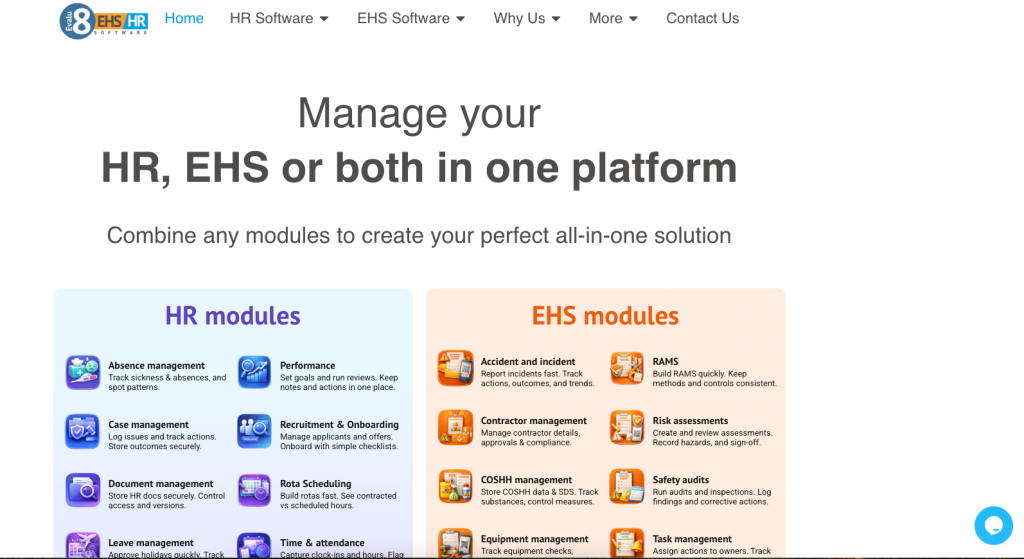
Evalu-8 provides dedicated digital Risk Assessment software for creating, reviewing, approving, signing and sharing workplace assessments from one controlled system.
Instead of maintaining separate Word files for:
- Warehouse transport
- Loading bays
- Manual handling
- FLT activity
- Battery charging
- Contractors
- Maintenance
- Work at height
the business can create controlled assessments and manage them within one digital register.
That matters in warehousing because the assessment frequently depends on other operational information.
Consider workplace transport.
A central assessment may identify segregation requirements.
But the real control depends on:
- Physical barriers
- Floor markings
- FLT operating condition
- Driver competence
- Employee induction
- Temporary obstructions
- Incidents and near misses
- Supervisor inspections
Evalu-8’s wider EHS platform includes equipment management, employee profiles, training, contractor records, documents, tasks, workflows and reporting. Additional modules can add risk assessments, audits and inspections, COSHH and incident reporting.
That gives the warehouse a better chance of keeping the assessment connected with the conditions it is supposed to control.
For example:
A near miss occurs because an FLT and picker meet at a blind crossing.
A connected process could lead the business to:
- Record the near miss.
- Review the workplace-transport assessment.
- Inspect the crossing.
- Assign an action for physical improvement.
- Review training or induction.
- Check similar crossings at another depot.
- Retain evidence that the control was changed.
The value is not simply creating the original assessment.
It is shortening the distance between what happens in the warehouse and what should change in the risk assessment afterwards.
Pricing
Evalu-8 Core EHS starts from £2.50 per licence per month.
Risk Assessments is an advanced module with tailored pricing according to the organisation’s size and requirements. Unlimited support is included in the subscription, according to Evalu-8’s current product information.
Strengths
- Dedicated risk assessment software
- Strong UK EHS positioning
- Suitable for multiple warehouse assessment types
- Connected equipment-management capability
- Employee and training records
- Contractor profiles
- Tasks and corrective actions
- Audit and inspection module available
- Incident-management module available
- COSHH module available
- Multi-site dashboards
- Modular approach rather than a mandatory enterprise suite
Limitations and questions to verify
- More functionality than a small single-site warehouse may require
- Risk Assessment module pricing requires a quotation
- Warehouse-specific assessments still require competent internal design
- Specialist technical inspection of racking or equipment is not replaced by the software
- Dynamic or point-of-work assessment should be tested against the buyer’s preferred process
- The access model for temporary or agency employees should be confirmed
Demonstration test
Ask Evalu-8 to create a workplace-transport assessment for a busy distribution centre.
It should include:
- Reach trucks
- Counterbalance FLTs
- Pedestrian walkways
- Crossing points
- Loading bays
- Visiting drivers
- Goods-in staging
- Battery charging
- Shift change
- Temporary pallet storage
Then introduce a layout change that moves a fast-moving pick face across the main FLT route.
Ask the supplier to show:
- How the existing assessment is found.
- How the change triggers review.
- How new hazards and controls are added.
- How actions are assigned.
- How affected employees access the new assessment.
- How the old version remains available historically.
- How a follow-up inspection confirms the new segregation arrangement.
Verdict
Evalu-8 is the strongest overall option when warehouse risk assessments need to connect with equipment, people and what actually happens afterwards.
It is particularly relevant to growing UK warehouse groups trying to move beyond Word documents, separate inspection apps and corrective-action spreadsheets.
2. SafetyCulture: Best well-known option for frontline warehouse adoption
Best for
Warehouses with large frontline teams that prioritise simple mobile access, standardised forms and widespread participation.
Why SafetyCulture suits warehouse teams
SafetyCulture is one of the best-known products in the inspection and operational-checklist market.
Its warehouse template library includes dedicated warehouse risk assessment content covering areas such as:
- Walkways
- Fire exits
- Safe storage heights
- PPE
- Racking
- Battery-charging areas
- Spill controls
- Mezzanine guardrails
- Workplace conditions
It also provides dedicated manual-handling risk-assessment content for logistics activity.
The main advantage is accessibility.
Warehouse teams may already want the same platform for:
- Pre-shift checks
- Warehouse inspections
- Racking inspections
- Loading-bay checks
- Safety observations
- Quality inspections
- Risk-assessment forms
That can reduce the number of applications frontline supervisors need to use.
SafetyCulture also offers a large public template ecosystem, which can speed up initial digitisation.
However, those templates should be treated as starting content, not competent assessments of a specific warehouse.
Pricing
SafetyCulture currently offers a Free plan and Premium and Enterprise options.
A Premium full seat costs $24 per user per month when billed annually or $29 when billed monthly.
Strengths
- Well-established provider
- Mature mobile experience
- Warehouse-specific template ecosystem
- Manual-handling assessment templates
- Strong frontline adoption
- Broad operational-checklist capability
- Free entry plan
- Transparent Premium pricing
- Suitable where safety and operational inspections overlap
Limitations and questions to verify
- A configurable form is not automatically a strong risk-governance workflow
- Public templates require competent review
- Inherent and residual risk handling should be demonstrated
- Equipment relationships should be tested carefully
- Buyers should check assessment approval and version governance
- Management-of-change requirements may need additional process design
- Seat costs can become significant across large operational teams
Demonstration test
Ask SafetyCulture to assess pedestrian and FLT interaction across three warehouse zones.
Then move one picking station.
The supplier should demonstrate how the changed layout affects the controlled assessment and how supervisors on every shift receive the updated information.
Verdict
SafetyCulture is the strongest recognisable alternative where frontline usability and scale lead the buying decision.
Its weakness compared with a more connected EHS platform is that warehouse buyers need to validate the complete risk-governance process rather than assuming a strong checklist product automatically provides it.
3. EcoOnline: Best well-known enterprise option for broader warehouse risk
Best for
Larger warehouse groups, chemical warehouses and organisations wanting general risk assessments, point-of-work assessments and wider EHS functionality.
Why EcoOnline suits warehouse risk management
EcoOnline provides dedicated risk assessment software for creating, sharing, editing and centralising task-based assessments. It includes review reminders, version control, risk-related actions and trend dashboards.
It also offers separate Point of Work Risk Assessment capability intended for rapid reassessment close to the actual job.
That is useful in warehouse operations where conditions can change after the original assessment has been written.
For example, a maintenance contractor may arrive to work on a dock leveller and discover:
- The adjacent bay cannot be taken out of service.
- The pedestrian route has changed.
- An HGV is already positioned nearby.
- The intended isolation cannot be accessed as planned.
A point-of-work assessment can record those immediate differences before work proceeds.
EcoOnline also provides wider EHS functionality across:
- Incidents
- Audits and inspections
- Risk management
- Contractor management
- Permit to Work
- Chemical safety
- Corrective actions
For chemical or dangerous-goods warehouses, this broader product ecosystem may provide a stronger fit than a standalone generic risk-assessment tool.
Pricing
EcoOnline’s EHS software uses bespoke pricing based on users, functionality and required customisation.
Strengths
- Well-established international EHS provider
- Dedicated task-based risk assessments
- Point-of-work assessment capability
- Version control and review reminders
- Risk-related actions
- Strong dashboards
- Contractor management
- Permit-to-work capability
- Chemical-safety depth
- Multi-site enterprise potential
Limitations and questions to verify
- No transparent entry price
- Broader platform may be excessive for smaller warehouses
- Implementation and configuration need careful scoping
- Equipment and warehouse-zone linking should be demonstrated
- The commercial case is likely stronger when several EHS modules are being consolidated
- Buyers should confirm how frontline access is licensed
Demonstration test
Use a hazardous-goods warehouse where a contractor must repair a damaged dock door beside a live storage area.
Ask EcoOnline to connect:
- The warehouse assessment
- Chemical-storage information
- Contractor requirements
- Point-of-work assessment
- Permit
- Corrective action
- Final close-out
Verdict
EcoOnline is the strongest major-provider option when the warehouse requirement extends beyond general risk assessment into point-of-work control, contractors, permits, or chemical safety.
For a straightforward ambient warehouse, much of that enterprise breadth may be unnecessary.
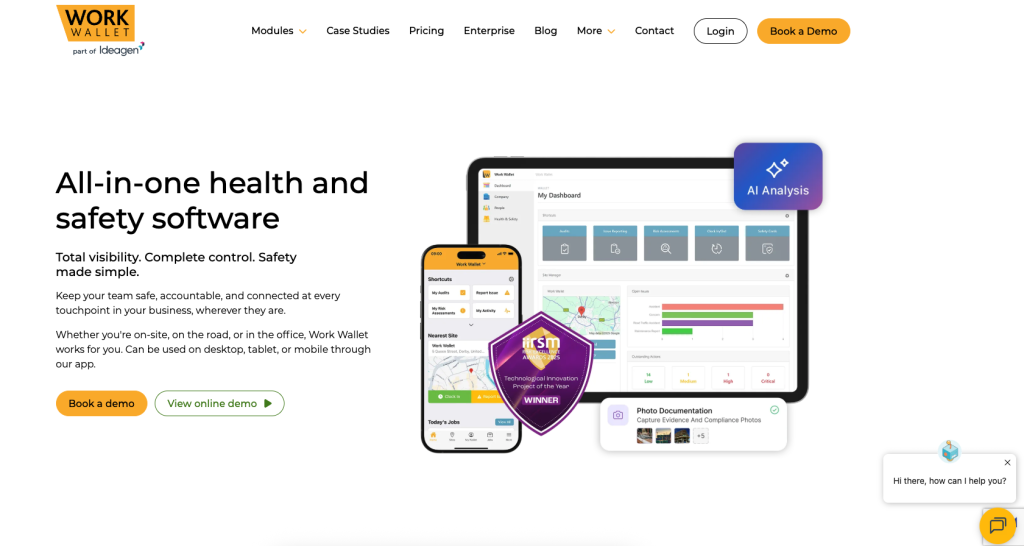
4. Work Wallet: Best lower-profile option for operational and maintenance risk
Best for
Warehouses where engineering, maintenance, contractors, permits, and live jobs are major contributors to the risk profile.
Why Work Wallet suits warehouse operations
Work Wallet provides dedicated digital risk assessments that can be created from phone, tablet, or desktop.
Its current system includes:
- Task libraries
- Hazard libraries
- COSHH libraries
- Mobile-friendly assessments
- Automated document generation
- Assessments linked directly with jobs
That job connection is particularly relevant to warehousing.
Many of the more difficult assessments are not the routine warehouse-wide ones.
They are jobs such as:
- Conveyor repairs
- Racking repairs
- Dock-leveller maintenance
- Electrical work
- Fire-system maintenance
- Equipment replacement
- Roof access
- Contractor installations
Work Wallet’s wider modules include:
- Permit to Work
- Asset Inspections
- Job Management
- Contractor Gateway
- ID and Training
- Safety Briefings
- Audits and Inspections
- Incident Reporting
The result is a different proposition from SafetyCulture.
It is less about hundreds of general-purpose forms and more about bringing risk information closer to operational jobs and the people carrying them out.
Pricing
Work Wallet uses tailored pricing based on the organisation and modules selected rather than publishing one standard figure.
Strengths
- Dedicated risk-assessment module
- Strong mobile use
- Assessments linked to jobs
- Hazard and task libraries
- COSHH library
- Permit-to-work module
- Asset inspections
- Contractor Gateway
- Training and ID functions
- Good fit for maintenance-heavy warehouse operations
Limitations and questions to verify
- Lower market presence than SafetyCulture or EcoOnline
- No public price
- Formal risk governance should be tested
- Inherent and residual risk functionality should be confirmed
- Multi-site central template control should be demonstrated
- Broader strategic risk reporting may be less developed than enterprise platforms
Demonstration test
Ask Work Wallet to manage the replacement of a damaged dock leveller.
The demonstration should include:
- Job creation
- Risk assessment
- Warehouse traffic controls
- Electrical and mechanical isolation
- Contractor access
- Permit
- Asset information
- Changed conditions
- Completion and handback
Verdict
Work Wallet is one of the most interesting lower-profile choices for warehouses because it tackles a problem that generic risk-assessment tools often miss:
the connection between the assessment and the operational job happening in the warehouse.
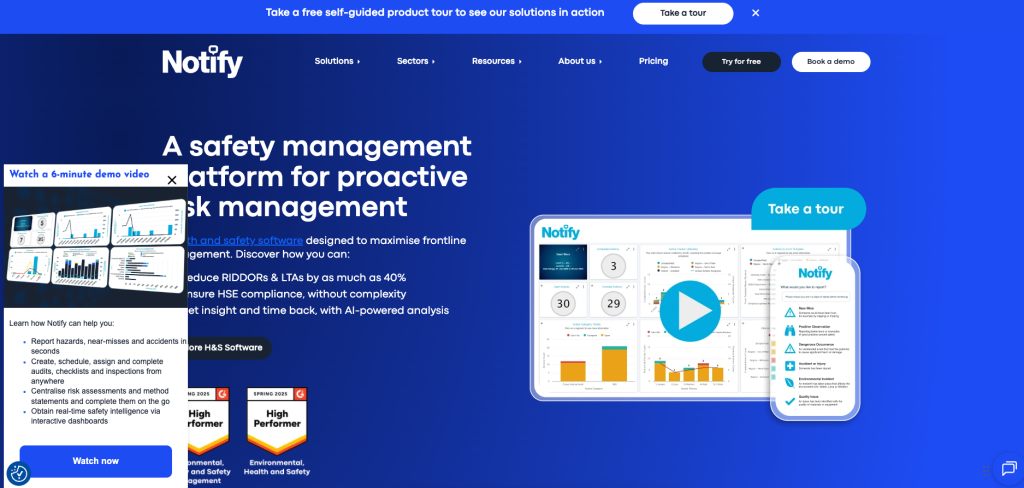
5. Notify Technology: Best lower-profile option for multi-site risk governance
Best for
UK warehouse and distribution groups that want strict control over templates, approval, versions, and employee acknowledgement.
Why Notify suits warehouse operations
Notify provides dedicated Risk Assessment Software with a particularly strong emphasis on governance.
Its current system supports:
- Flexible assessment templates
- Configurable risk matrices
- Centrally controlled standards
- Locked company controls
- Independent approval
- Mobile completion
- Review reminders
- QR and secure-link distribution
- Digital signatures
- Version histories
That could be valuable for a warehouse group with six depots where each local manager has historically created their own version of:
Warehouse Transport Risk Assessment FINAL.xls
Notify allows central controls to be locked so individual sites cannot simply remove or alter company-level requirements. It can also require independent approval before publication.
For a distribution group, that could mean maintaining common requirements for:
- Pedestrian segregation
- FLT operation
- Loading-bay access
- Visiting drivers
- Racking controls
- Contractor activity
while still allowing the local assessment to reflect the physical differences between depots.
Notify also connects risk assessments with wider functions such as incidents, audits, corrective actions and documentation.
Pricing
Notify uses module and licence-based pricing rather than one universal public subscription figure.
The company’s current information describes risk-assessor and management licence models alongside selected software modules.
Strengths
- Dedicated UK risk-assessment product
- Strong template governance
- Locked central controls
- Independent approval
- Configurable matrices
- Mobile assessment
- Digital signatures
- QR and link-based distribution
- Version history
- Wider incidents, audits and actions
- Particularly relevant to multi-site governance
Limitations and questions to verify
- Lower general market profile than SafetyCulture or EcoOnline
- No standard public price
- Equipment-management depth should be tested
- Dynamic/point-of-work warehouse assessment should be demonstrated
- Contractor and temporary-worker access should be tested
- Buyers should check the preferred contract model
Demonstration test
Ask Notify to create a group workplace-transport standard covering five warehouses.
Then give each site a different:
- Layout
- FLT fleet
- Number of loading bays
- Crossing arrangement
- Shift pattern
The system should maintain the group controls while allowing legitimate site differences.
Verdict
Notify is one of the strongest choices in the less prominent provider category.
Its central-control model is particularly relevant to warehouse groups that have outgrown local Word documents but do not necessarily need a major multinational EHS platform.
6. EHS Insight: Best lower-profile option for HIRA and field-level assessment
Best for
Larger or more complex logistics businesses wanting a structured hazard-identification framework plus field-level reassessment.
Why EHS Insight suits warehouses
EHS Insight provides a dedicated Hazard Identification and Risk Assessment module.
Its HIRA workflow supports:
- Hazard identification
- Risk assessment
- Inherent risk
- Controls
- Risk owners
- Residual risk
- Scheduled review
- Risk reporting
It also provides a Field Level Risk Assessment process designed to capture hazards and controls for a specific job.
That gives EHS Insight a useful warehouse use case.
A central warehouse assessment may establish the rules for contractor maintenance.
But when the engineer arrives at the conveyor, conditions may have changed.
The FLRA provides a way to assess those immediate conditions while retaining the broader controlled risk-management structure.
EHS Insight also specifically positions its wider EHS platform for transportation and logistics organisations.
Pricing
EHS Insight currently publishes small and medium-business pricing starting from $5,000 per year. The platform uses annual subscriptions by default.
Strengths
- Strong HIRA structure
- Inherent and residual risk
- Risk owners
- Field Level Risk Assessments
- Wider logistics EHS positioning
- Mobile platform
- Offline capability
- Wider incident, audit, training and CAPA modules
- Published starting price
Limitations and questions to verify
- Less well known in the UK warehouse market
- Starting cost is higher than simple checklist applications
- UK terminology and workflows should be validated
- Warehouse equipment relationships should be demonstrated
- More configuration may be required than with a straightforward risk-assessment application
- Contractor and temporary-worker access should be tested
Demonstration test
Use two connected assessments:
HIRA: Maintenance activities across automated warehouse conveyors.
Field Level Risk Assessment: An engineer reaches the live job and discovers pallets have been temporarily staged inside the planned exclusion area.
Ask the supplier to show how the local finding feeds into the wider risk record.
Verdict
EHS Insight is particularly relevant where the buyer wants more analytical risk-management depth than a standard warehouse checklist can provide.
Its Field Level Risk Assessment model is also useful for maintenance and engineering activity where conditions regularly change.
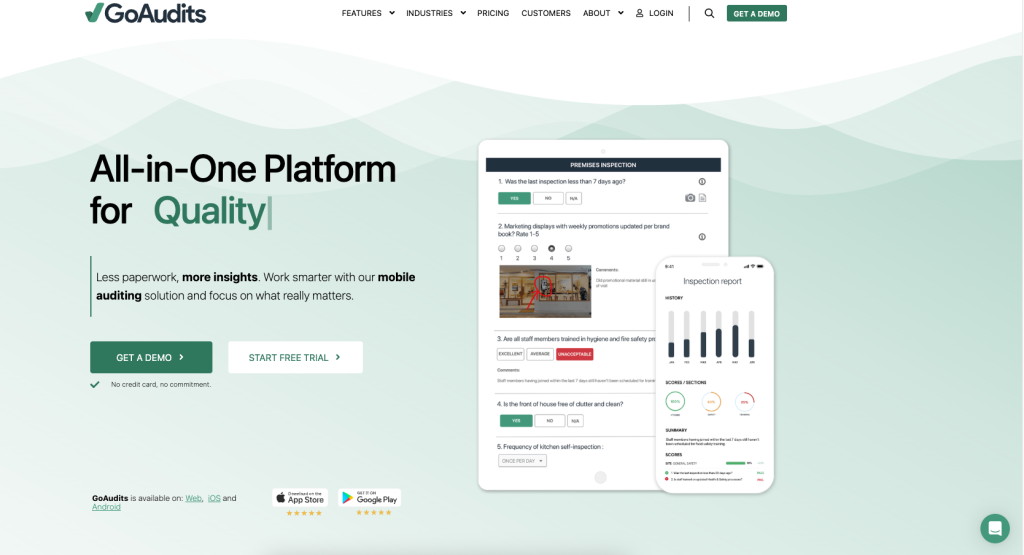
7. GoAudits: Best lower-profile straightforward warehouse assessment app
Best for
Small and medium-sized warehouses that want to move risk assessments and inspections away from paper without implementing a complete EHS platform.
Why GoAudits suits warehouses
GoAudits has developed a noticeable body of warehouse-specific content despite having a smaller overall EHS market presence than SafetyCulture or EcoOnline.
Its current warehouse resources include templates and guidance covering:
Warehouse risk assessment
Racking risk assessment
Warehouse security
Warehouse inspections
Logistics and operational checks
The platform itself supports:
Online and offline forms
Conditional and mandatory questions
Smart scoring
Photographs and annotation
Action plans
Action owners
Due dates and priorities
Instant reports
Dashboards
That makes it a practical option for businesses whose current process is largely:
paper form → Excel tracker → email action → PDF report.
Pricing
GoAudits uses per-user pricing.
Its current Enterprise package is $30 per user per month with annual billing and includes roles, permissions, schedules, notifications, advanced reports and trends. A lower Starter package is also available.
Strengths
- Warehouse-specific template content
- Racking-risk template
- Simple mobile forms
- Offline operation
- Conditional questions
- Photo annotation
- Action management
- Transparent pricing
- Easy entry point
- Suitable for combining inspections and straightforward assessments
Limitations and questions to verify
- Better understood as a flexible inspection/checklist platform than a deep EHS risk engine
- Equipment and employee relationships may be more limited
- Formal assessment approval should be tested
- Inherent/residual risk functionality should be checked
- Management-of-change workflows are likely to require configuration
- Wider training, contractor and incident processes may remain elsewhere
Demonstration test
Ask GoAudits to digitise:
- Warehouse workplace-transport assessment
- Racking risk assessment
- Loading-bay assessment
- Manual-handling assessment
Then ask the supplier to show how management can identify which high-priority actions remain outstanding across all four.
Verdict
GoAudits is a sensible lower-profile option for a warehouse whose immediate objective is straightforward digitisation.
It is unlikely to be the strongest choice for a sophisticated connected risk-management programme, but it could be significantly easier to deploy for a smaller business.
| Requirement | Evalu-8 | SafetyCulture | EcoOnline | Work Wallet | Notify | EHS Insight | GoAudits |
|---|---|---|---|---|---|---|---|
| Dedicated risk-assessment workflow | Strong | Form/template led | Strong | Strong | Strong | Strong HIRA | Checklist led |
| Warehouse-specific fit | Strong connected fit | Strong templates | Configurable enterprise fit | Strong operational fit | Strong multi-site fit | Logistics positioning | Strong template content |
| Workplace-transport assessment | Strong | Configurable | Configurable | Configurable | Configurable | HIRA | Template based |
| Equipment connection | Strong wider platform | Asset workflows | Verify required relationship | Asset inspections | Verify | Wider EHS | More limited |
| Point-of-work assessment | Configure/test | Mobile forms | Dedicated POWRA | Strong operational use | Supports flexible assessment types | FLRA | Configurable forms |
| Corrective actions | Strong | Strong | Strong | Wider platform | Strong | Strong | Strong |
| Central governance | Strong | Strong template control | Enterprise strength | Verify | Particularly strong | Strong | Enterprise plan |
| Contractor processes | Wider EHS | Configurable | Strong | Contractor Gateway | Wider EHS | Wider EHS | Form/action based |
| Chemical/COSHH depth | Dedicated module | Template led | Particularly strong | COSHH library | Separate assessment types | Wider platform | Checklist led |
| Best organisation size | UK SME/mid-market | Small to enterprise | Mid-market/enterprise | SME/mid-market | Mid-market | Mid-market/enterprise | Small/mid-market |
| Published entry price | Core price published | Yes | No | No | No | Yes | Yes |
This comparison is based on current public supplier information. Any requirement described as configurable or requiring verification should be tested with a real warehouse workflow before purchase.
Which risk assessment software is right for your warehouse?
Choose Evalu-8 EHS when:
- You want assessments connected with MHE and equipment.
- Employee training matters to the risk controls.
- Several warehouses need central oversight.
- Incidents should trigger risk-assessment reviews.
- Corrective actions currently sit in separate spreadsheets.
- Contractors and inspections form part of the requirement.
- You want modular UK EHS software rather than a major enterprise rollout.
Choose SafetyCulture when:
- Frontline usability is the priority.
- Large numbers of supervisors complete digital safety processes.
- Inspections and risk assessments overlap.
- You want a large warehouse template library.
- A free entry plan is useful.
- Your more complex EHS processes already sit elsewhere.
Choose EcoOnline when:
- You operate a larger warehouse network.
- Chemical or dangerous-goods storage is important.
- Point-of-work assessment matters.
- Contractors and permits need to connect with risk.
- You want a broad enterprise EHS ecosystem.
- Bespoke pricing and implementation are acceptable.
Choose Work Wallet when:
- Maintenance work is a major source of warehouse risk.
- Risk assessments need to link with jobs.
- Permit to Work is important.
- Contractors regularly work in operational areas.
- Asset inspections matter.
- Mobile engineers need fast access.
Choose Notify when:
- Several depots currently use inconsistent assessment formats.
- You want centrally locked controls.
- Independent approval is important.
- Digital acknowledgement matters.
- You want UK-focused risk-management software.
- Multi-site governance matters more than enterprise complexity.
Choose EHS Insight when:
- HIRA is central to your risk-management approach.
- Inherent and residual risk matter.
- Field Level Risk Assessments are valuable.
- You operate complex logistics or engineering activity.
- A wider EHS platform is part of the roadmap.
- The higher starting investment is proportionate.
Choose GoAudits when:
- You are replacing paper forms.
- You want transparent pricing.
- Warehouse templates are useful.
- Offline completion is important.
- Risk assessment and inspection workflows are relatively straightforward.
- You do not currently need one complete EHS system.
Questions to ask during a warehouse risk assessment software demonstration
Do not let suppliers demonstrate a quiet office assessment for “slips and trips”.
Give every supplier the same warehouse scenario.
For example:
A 24-hour distribution centre operates reach trucks, counterbalance FLTs, powered pallet trucks, 24 loading bays, pallet racking, conveyors and battery-charging equipment. Around 20% of the workforce during peak periods is temporary or agency labour. Visiting hauliers access the yard throughout the day.
Ask the supplier to show how the system would:
Create the site workplace-transport assessment.
Map different warehouse zones.
Identify pedestrian and FLT interaction.
Record crossing points.
Include visiting drivers.
Consider shift-change congestion.
Assess loading-bay activity.
Assess temporary pallet staging.
Record manual-handling hazards.
Link relevant MHE or assets.
Record current engineering controls.
Record existing administrative controls.
Establish initial risk.
Assign additional physical segregation actions.
Set an owner and deadline.
Make the current assessment accessible to supervisors.
Capture employee or contractor acknowledgement where needed.
Record a near miss at a crossing.
Identify the affected assessment.
Review the control after the near miss.
Change a pick face so pedestrian traffic increases.
Trigger another assessment review.
Preserve the earlier version.
Assign a new barrier installation.
Record temporary controls until installation.
Complete a follow-up inspection.
Link the improvement evidence.
Identify whether another depot has the same crossing design.
Highlight other assessments using the same control.
Produce a management view of high residual risk.
Show all overdue risk-assessment actions.
Retrieve the history during an investigation.
This scenario tells you significantly more than asking whether the system offers:
“Customisable risk matrices.”
Almost every serious risk-assessment product does.
The warehouse-specific question is whether the software can keep the assessment aligned with the changing physical operation.
The biggest warehouse risk-assessment mistake: controlling people instead of redesigning the environment
Consider this hazard:
Pedestrians being struck by FLTs.
A weak assessment can quickly accumulate controls such as:
Hi-vis clothing
Warning signs
FLT horns
Employee training
Speed awareness
Supervisor monitoring
Those controls may all have a place.
But the better first question is:
Why do pedestrians and FLTs need to occupy the same space?
HSE says the most effective way to control the interaction is to provide separate pedestrian and vehicle routes wherever reasonably practicable.
Good risk-assessment software should make it easy to record administrative controls without making them the automatic answer.
The same thinking applies elsewhere.
Manual handling
Weak response:
Train employees to lift safely.
Better assessment:
Can the load be palletised, mechanically assisted, reduced in size or moved to a better pick height?
HSE advises employers to avoid hazardous manual handling where possible and use mechanical aids or changes to the load and workplace to reduce unavoidable risk.
Loading bays
Weak response:
Remind employees to be careful around trailers.
Better assessment:
Can unnecessary pedestrian access be physically prevented and vehicle movement controlled?
Racking
Weak response:
Tell FLT drivers not to hit the racking.
Better assessment:
Why are impacts happening and can routes, protection, visibility or operating arrangements be improved?
The software should support better control decisions, not merely help the assessor type weak ones more quickly.
What should trigger a warehouse risk-assessment review?
A diary date should not be the only reason an assessment is ever reopened.
Warehouses change too quickly.
Useful review triggers include:
New FLTs or MHE
Traffic-route change
Racking reconfiguration
New pick faces
Increased throughput
Seasonal labour
New product types
New loading arrangements
Automation
Contractor work
A near miss
An accident
A damaged barrier
Repeated racking impact
New charging equipment
A change in opening or shift hours
HSE specifically identifies new vehicles, changed traffic routes and changed work as reasons a workplace-transport risk assessment may need review.
Good software should therefore support:
Change → identify affected assessment → review → control → assign → communicate → verify.
Not simply:
Wait until annual review reminder.
Should a warehouse use one giant risk assessment?
Usually, no.
A 70-page “Warehouse Risk Assessment” can become difficult to maintain because individual activities change at different speeds.
A more controlled structure might include:
Site-level assessments
Workplace transport
General warehouse operation
Fire-related operational risk
Emergency arrangements
Activity assessments
Loading and unloading
Manual case picking
Roll cages
Container unloading
Battery charging
Waste handling
Equipment assessments
FLT operations
Conveyor systems
Dock levellers
Compactors
Mobile access equipment
Non-routine assessments
Contractor maintenance
Racking repair
Equipment installation
Shutdown work
High-level maintenance
The software should make these individual records easier to find without losing the relationship between them.
Risk assessment versus warehouse inspection
A risk assessment and an inspection answer different questions.
Risk assessment
What could cause harm, who could be affected, and what controls are required?
Inspection
Are those controls actually present and working today?
Consider racking.
The risk assessment may establish:
Impact risk
Protection requirements
Loading arrangements
Reporting procedure
Inspection arrangements
Response to damage
The inspection identifies whether:
An upright has actually been damaged.
A beam is displaced.
A load is unstable.
A locking device is missing.
The area should be restricted.
This is why connecting risk assessment software with audit and inspection software can be valuable.
The inspection tests whether the controls described in the assessment still exist in reality.
Risk assessment versus equipment inspection
A similar distinction applies to MHE.
A risk assessment may establish how FLTs should be used safely within the warehouse.
An individual pre-use inspection determines whether a specific truck is safe to use at that time.
HSE explains that inspections are used to identify whether work equipment can continue to be operated, adjusted and maintained safely and to detect deterioration before it creates a health and safety risk.
The two processes should support each other.
They should not be merged into one meaningless form.
Should warehouse risk assessments include agency workers and visiting drivers?
Yes, where they may be affected by the activity.
Warehouses frequently contain people who are not permanent employees:
Agency pickers
Temporary workers
Hauliers
Couriers
Maintenance contractors
Cleaners
Visitors
HSE specifically tells employers assessing workplace transport to consider visiting delivery drivers, who may be particularly vulnerable because they are less familiar with the site.
That creates practical software questions:
Can temporary employees access the relevant information?
Can contractors acknowledge an assessment?
Do visiting drivers need an account?
Can information be accessed by link or QR code?
What happens when an agency worker leaves?
Can different languages be supported?
Is acknowledgement tied to the current version?
These questions can materially change the real cost and suitability of the product.
Do warehouses legally need risk assessment software?
No.
UK law does not require a warehouse to purchase a particular risk-assessment system.
Employers do need to assess workplace risks and put appropriate controls in place.
HSE’s basic risk-assessment template expects organisations to consider who may be harmed, existing controls, further actions, owners and deadlines.
Software becomes useful when the management problem outgrows documents.
Typical signs include:
Dozens or hundreds of assessments
Several warehouses
Different risk matrices
Assessments stored in shared folders
Review dates being missed
Actions maintained in spreadsheets
Old versions remaining accessible
Layout changes not triggering review
Incidents not reaching the assessment owner
Warehouse employees unable to find current information
Contractors using separate processes
Management unable to identify high residual risks
The business case is therefore not:
Risk assessment software makes us compliant.
It is:
Risk assessment software gives competent people a better-controlled way to manage the assessments we are already responsible for.
Can generic warehouse risk-assessment templates be used?
They can provide a useful starting point.
They should not become the final assessment without review.
A warehouse can differ enormously according to:
Product
Racking
MHE
Building design
Automation
Throughput
Shift structure
Loading-bay arrangement
Contractors
Staffing
Temperature
Dangerous goods
Yard layout
A fulfilment centre handling small parcels does not have the same risk profile as:
A steel stockholder
A chemical warehouse
A cold store
A palletised FMCG distribution centre
A builders’ merchant
A pharmaceutical warehouse
Template libraries are useful for speed.
Competent assessment provides relevance.
Can AI create a warehouse risk assessment?
AI can help with parts of the process.
It may be useful for:
Suggesting common hazard categories
Structuring an existing assessment
Converting old Word forms
Drafting descriptions
Summarising incidents
Identifying duplicated controls
Producing initial management summaries
AI cannot independently:
Walk the pedestrian route
See a blind corner
Assess FLT visibility
Identify unsafe racking
Test a dock leveller
Understand temporary congestion
Determine whether a manual-handling task can be redesigned
Confirm employee competence
Decide whether a control is working in practice
A warehouse risk assessment is fundamentally about how the real operation behaves.
AI does not remove the need to observe it.
Implementation checklist for warehouses
Before moving risk assessments into a new platform:
Build a register of current warehouse assessments.
Remove obvious duplicates.
Separate site, activity and equipment assessments.
Identify the assessment owner.
Identify the competent reviewer.
Standardise risk terminology where appropriate.
Define high-risk escalation rules.
Review workplace-transport assessments first.
Identify layout-sensitive assessments.
Connect equipment where practical.
Define action ownership.
Decide how agency workers will access information.
Decide how contractors will access information.
Define what triggers review.
Include incidents and near misses as triggers.
Include layout and MHE changes as triggers.
Decide how inspections feed back into assessments.
Import only current useful records.
Pilot one complicated workplace-transport assessment.
Introduce a simulated layout change.
Test a contractor job.
Test mobile access.
Test poor-signal areas.
Test an overdue corrective action.
Train assessors and approvers separately.
Review whether controls have actually improved after rollout.
Final recommendation
Evalu-8 EHS is our best overall safety risk assessment software choice for warehouses in 2026.
Its main advantage is not simply the ability to create digital risk assessments.
It is the ability to manage those assessments alongside the other records that should tell the warehouse whether its controls remain effective:
Equipment
Employees
Training
Contractors
Inspections
Incidents
COSHH
Corrective actions
Documents
Management reporting
SafetyCulture is the strongest well-known option where frontline participation, mobile forms and template availability drive the purchase.
EcoOnline is the more substantial recognised alternative for larger businesses that also need point-of-work assessment, contractor control, permits or chemical safety.
Among the lower-profile providers, Work Wallet offers a particularly interesting operational proposition for maintenance and job-linked risk, while Notify Technology provides strong central governance for multi-site organisations.
EHS Insight is worth considering where HIRA and Field Level Risk Assessment are important, and GoAudits offers a simpler entry point for warehouses moving beyond paper and Excel.
The deciding question should not be:
Which software gives us the best warehouse risk-assessment template?
It should be:
Which system helps us understand how people, vehicles, equipment and stock interact today, and makes sure the assessment changes when the warehouse changes tomorrow?
That is the difference between digitising risk assessments and managing warehouse risk.
Evalu-8 EHS is our best overall choice for UK warehouses wanting assessments connected with equipment, employees, inspections, incidents and corrective actions. SafetyCulture is a strong alternative where frontline mobile adoption is the priority, while EcoOnline offers greater enterprise risk-management depth.
Common areas include workplace transport, FLTs and MHE, pedestrian segregation, loading bays, racking and storage, manual handling, picking, work at height, contractors, maintenance, battery charging and emergency arrangements.
There is no universal single biggest risk. Workplace transport and manual handling are major warehouse risk areas, but the significance depends on the operation, equipment, products and layout. HSE specifically highlights both in its warehousing guidance.
The warehouse should assess the risks associated with FLT operations, including the vehicles, routes, drivers and people who may be affected. Individual trucks will also require suitable inspection and maintenance arrangements.
No. The risk assessment determines the hazards and controls associated with FLT operation. The pre-use check examines whether the particular truck appears suitable to use before operation.
See Evalu-8 in action
Fill in your details and we'll send you a personalised guided tour of the platform — no sales pressure, just a clear look at what Evalu-8 can do for your team.