

What is a corrective action in health and safety?
A corrective action in health and safety is a planned action taken to address the cause of an identified problem and prevent it from happening again.
It normally begins with a finding from an inspection, audit, risk assessment, incident investigation or employee report. The action should explain what needs to change, who is responsible, when it must be completed and how the organisation will check that the change has worked.
That final point matters.
Replacing a damaged guard, updating a document or delivering a briefing may show that somebody has done something. It does not automatically demonstrate that the original risk has been properly controlled.
A meaningful corrective-action process follows the issue from discovery through to verified improvement.
Why are corrective actions important?
Effective health and safety management depends on organisations responding when controls are missing, unsuitable or no longer working as intended.
The Management of Health and Safety at Work Regulations 1999 require employers to carry out suitable and sufficient risk assessments and review them when there is reason to believe they are no longer valid or when significant changes occur. HSE guidance also makes clear that controls should be reviewed following workplace changes, accidents, near misses or concerns raised by workers.
Corrective actions provide a practical way to turn those findings into managed improvements. They may address hazards identified during inspections, audit non-conformities, equipment defects, ineffective controls, worker concerns or repeated failures across different teams or sites. They can also help bring working practices back into line with agreed procedures and standards.
HSE’s Plan, Do, Check, Act model reinforces the need to check whether controls are working and make improvements where necessary. The purpose of a corrective action is therefore not simply to complete a task or close a finding. It is to create a safer, more reliable way of working and reduce the likelihood of the same problem happening again.
What is the difference between a correction and a corrective action?
| Term | Meaning | Example |
|---|---|---|
| Correction | Deals with the immediate problem that has been found. | Removing materials that are blocking a fire exit. |
| Corrective action | Addresses why the problem occurred and reduces the likelihood of it happening again. | Providing suitable storage, introducing a no-storage zone and assigning responsibility for checking the escape route. |
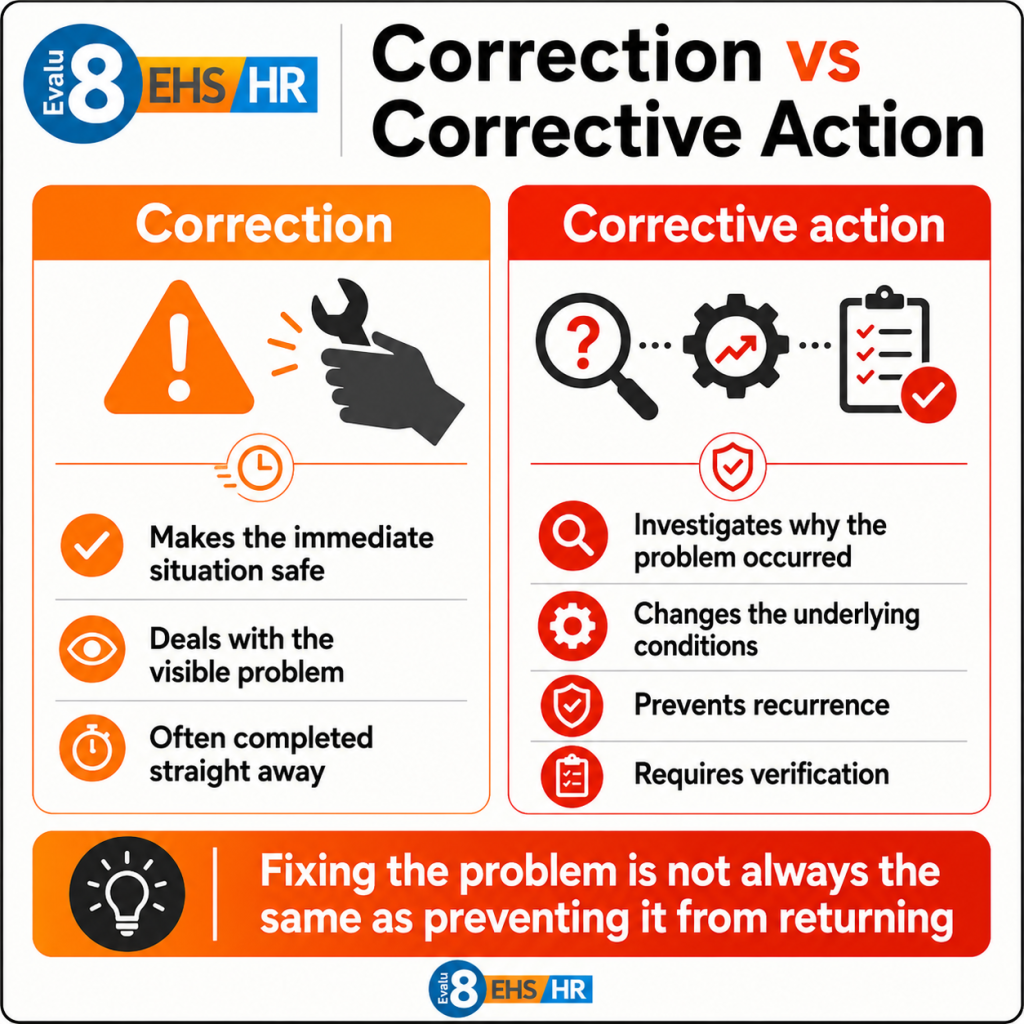
The terms are sometimes used interchangeably, but they describe two different stages of responding to a health and safety problem.
A correction deals with the immediate issue that has been found. For example, if materials are blocking a fire exit, the correction would be to remove them and make the escape route safe. This immediate response is important because it controls the current risk, but it does not necessarily prevent the same problem from happening again.
A corrective action goes further by identifying why the issue occurred and changing the conditions that allowed it to develop. In the fire-exit example, this may involve providing suitable storage space, improving the workplace layout, clearly marking the restricted area and assigning responsibility for regular checks.
The underlying cause may be insufficient storage, production pressures, unclear responsibilities, ineffective housekeeping inspections or contractors who were not aware of the rules. Simply reminding employees to keep the exit clear is unlikely to work if those wider conditions remain unchanged.
The correction therefore makes the situation safe now, while the corrective action aims to prevent recurrence. For organisations using ISO 45001:2018, this distinction is reflected in clause 10.2, which separates the immediate response to an incident or non-conformity from the action needed to address its causes and consider whether the same weakness could exist elsewhere.
What is the difference between corrective and preventive action?
A corrective action starts with a problem that has already been identified. This could be an incident, unsafe condition, failed control, audit finding or non-conformity.
A preventive action is taken before that particular failure has happened.
For example:
- replacing a damaged machine guard after it is identified is a correction;
- changing the inspection and maintenance process to prevent guards deteriorating unnoticed is a corrective action;
- considering guarding requirements when purchasing new machinery is preventive action.
In practice, a good corrective action can also have a preventive effect elsewhere.
When a permit-to-work failure is found at one site, for example, the organisation should not only correct that individual permit. It should consider whether similar weaknesses could exist in other permit systems, departments, sites or contractor arrangements.
ISO’s published guidance on clause 10.2 gives this same type of example, explaining that a confined-space permit failure may justify checking other permits and contractors rather than treating the finding as an isolated event.
Where do corrective actions come from?
Corrective actions can be raised from almost any part of a health and safety management system.
Common sources include:
Audits and inspections
An audit may identify a gap between the organisation’s requirements and what is happening in practice.
An inspection may identify a physical defect, unsafe condition or missing control. The resulting action should remain linked to the original finding so that the person reviewing it can understand what was observed and why action was required.
Risk assessments
A risk assessment may show that existing controls are insufficient or that further measures are required.
HSE’s risk-assessment template specifically provides for recording further action, who needs to carry it out and when it is needed.
Accidents, incidents and near misses
An investigation should identify immediate, underlying and contributing causes and use those findings to prevent a similar event.
The action should not be based only on the injury or final unsafe act. HSE advises that investigations should consider the reasons human failures occurred and the underlying conditions that allowed the event to happen.
Equipment checks and maintenance
Defects, failed inspections, missed servicing or repeated breakdowns may create corrective actions.
The action may involve repairing the immediate defect, but it may also require changes to maintenance frequency, spare-parts availability, purchasing decisions or defect-reporting arrangements.
Worker concerns
Employees often identify changes, workarounds and emerging problems before these appear in formal performance reports.
A clear action process helps show that concerns are not merely recorded or passed to another department. They are assigned, reviewed and followed through.
Management and performance reviews
Trend analysis may identify repeated findings, common causes, slow close-out or differences between sites.
This should lead to wider actions where appropriate, rather than allowing every location to solve the same issue separately.
What should a corrective action contain?
A useful corrective action should provide enough information for the owner to understand what is expected and for another person to determine whether it has been completed properly.
It should normally record:
- the original finding or issue;
- where and when it was identified;
- the risk or potential consequence;
- any immediate action already taken;
- the underlying or contributing cause;
- the improvement required;
- the action owner;
- the priority and deadline;
- any interim controls;
- completion evidence;
- who will verify it; and
- the outcome of the effectiveness review.
The level of detail should be proportionate to the risk.
A minor administrative correction will not require the same investigation or verification as an action intended to prevent a serious injury. However, even a simple action should be clear enough that completion is not based on interpretation.
How should a health and safety corrective action be managed?
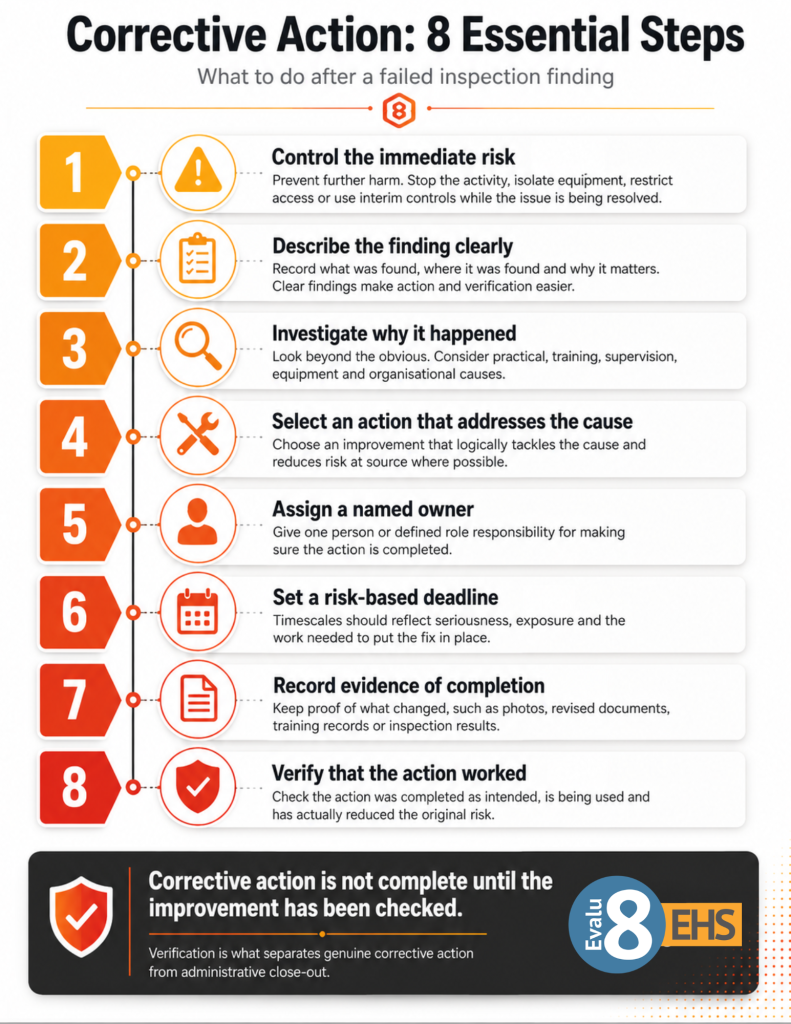
1. Control the immediate risk
The first priority is to prevent further harm.
This may involve stopping an activity, isolating equipment, restricting access, removing a defective item or introducing temporary controls.
The immediate response should not be confused with the full corrective action. It makes the situation safe while the organisation determines what needs to change.
Where work cannot be permanently corrected straight away, interim controls should be documented, communicated and reviewed.
2. Describe the finding clearly
The record should explain what was found, where it was found and why it matters.
“Poor housekeeping” is rarely enough.
A more useful finding would explain that packaging waste was obstructing a marked pedestrian route beside an active loading area, creating a risk that workers would step into vehicle movements.
The clearer the finding, the easier it becomes to select an appropriate response and verify it later.
3. Investigate why it happened
Not every issue requires a lengthy root-cause investigation. The level of investigation should reflect the seriousness, recurrence and potential consequences of the problem.
However, the organisation should avoid stopping at the most obvious explanation.
“Employee failed to follow procedure” may describe what happened, but it does not explain:
- whether the procedure was practical;
- whether the worker had been trained;
- whether supervision was available;
- whether the required equipment was provided;
- whether production demands encouraged a shortcut; or
- whether the same behaviour had previously been accepted.
There is not always one single root cause. Several organisational, technical and human factors may combine to create the failure.
4. Select an action that addresses the cause
The action should have a logical connection to the cause identified.
When the problem involves inadequate equipment, repeating training may not resolve it. When the problem involves unclear instructions, purchasing new equipment may make little difference.
The hierarchy of control should be considered when selecting the improvement. Measures that remove or reduce the hazard at source will normally provide more reliable protection than actions that depend entirely on employees remembering instructions or behaving perfectly.
5. Assign a named owner
Every action should have a person or defined role responsible for moving it forward.
Broad ownership such as “management”, “maintenance” or “the site team” makes accountability difficult. Several people may contribute, but one owner should know that they are responsible for ensuring the action is completed.
The owner also needs sufficient authority, knowledge, time and resources. Assigning an action to somebody who cannot approve expenditure, change a process or secure operational support is likely to create delay.
6. Set a risk-based deadline
Deadlines should reflect the seriousness of the issue and the work needed to resolve it.
Automatically giving every action 30 days may look consistent, but it ignores risk. A missing critical control may require immediate intervention, while an engineering improvement may require procurement, design and installation.
Longer-term actions should include suitable interim controls and progress points. The action should also be escalated when delays increase exposure or when the original deadline is no longer realistic.
Changing the due date repeatedly is not the same as managing the risk.
7. Record evidence of completion
The evidence needed will depend on the action.
It could include:
- photographs;
- an updated risk assessment;
- revised procedures;
- purchase or installation records;
- training and briefing records;
- maintenance reports;
- inspection results;
- exposure-monitoring results;
- employee acknowledgements; or
- workplace observations.
Evidence should demonstrate what changed, not merely that somebody interacted with the task.
An email saying “completed” or a photograph of newly purchased equipment may not prove that the equipment has been installed, used or incorporated into the working process.
8. Verify that the action worked
Verification is the part most likely to separate genuine corrective action from administrative close-out.
Someone should return to the original issue and check whether:
- the action was completed as intended;
- the control is being used;
- employees understand the change;
- the original risk has been reduced;
- the finding has recurred;
- new risks have been introduced; and
- the same weakness exists elsewhere.
The method and timing should suit the action.
A physical repair might be checked immediately. A behavioural or procedural change may need to be observed over several shifts or during less predictable working conditions.
HSE guidance advises organisations to review controls to ensure they are working, while incident-investigation guidance emphasises follow-up and checking that actions are effective.
Example of a corrective action in health and safety
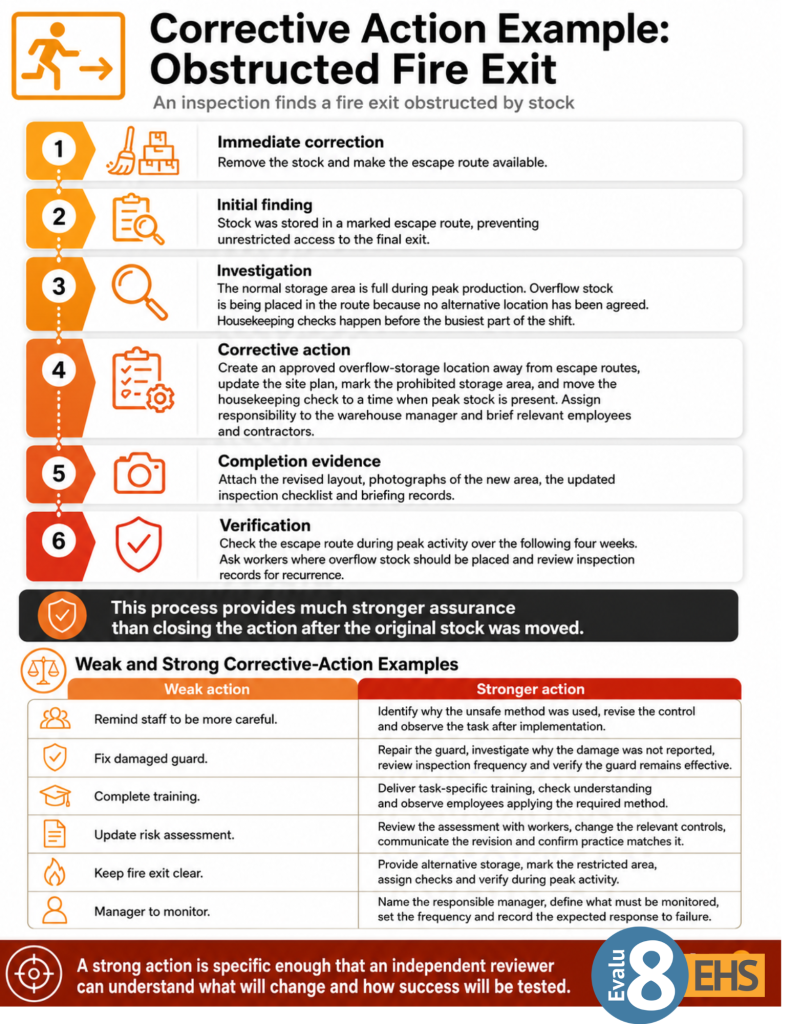
Immediate correction
Remove the stock and make the escape route available.
Initial finding
Stock was stored in a marked escape route, preventing unrestricted access to the final exit.
Investigation
The organisation establishes that the normal storage area is full during peak production periods. Employees have been placing overflow stock in the route because no alternative location has been agreed. Existing housekeeping checks are completed before the busiest part of the shift.
Corrective action
Create an approved overflow-storage location away from escape routes, update the site plan, mark the prohibited storage area and move the housekeeping check to a time when peak stock is present.
Assign responsibility to the warehouse manager and brief the relevant employees and contractors.
Completion evidence
The revised layout, photographs of the new area, updated inspection checklist and briefing records are attached to the action.
Verification
The escape route is checked during peak activity over the following four weeks. Workers are asked where overflow stock should be placed, and inspection records are reviewed for recurrence.
This process provides much stronger assurance than closing the action after the original stock was moved.
Weak and strong corrective-action examples
A strong action is specific enough that an independent reviewer can understand what will change and how success will be tested.
| Weak action | Stronger action |
|---|---|
| Remind staff to be more careful. | Identify why the unsafe method was used, revise the control and observe the task after implementation. |
| Fix damaged guard. | Repair the guard, investigate why the damage was not reported, review inspection frequency and verify the guard remains effective. |
| Complete training. | Deliver task-specific training, check understanding and observe employees applying the required method. |
| Update risk assessment. | Review the assessment with workers, change the relevant controls, communicate the revision and confirm practice matches it. |
| Keep fire exit clear. | Provide alternative storage, mark the restricted area, assign checks and verify during peak activity. |
| Manager to monitor. | Name the responsible manager, define what must be monitored, set the frequency and record the expected response to failure. |
Evalu-8’s Corrective Action Close-Out Test
Before closing an action, ask five questions. Together, they help confirm that the action is connected to the original finding, has been properly implemented, and has reduced the risk it was intended to address.
1. Is it linked to the original issue?
The person reviewing the action should be able to see where it came from, what was found, what evidence supported the finding, and why the action was considered necessary.
An action without that context can quickly become a disconnected task. This makes it harder to understand its importance, judge whether the response is proportionate, or confirm that the original issue has actually been resolved.
2. Does it address the cause?
The action should do more than remove the immediate symptom or restore the area to an acceptable condition for the day.
It should respond to the underlying or contributing causes identified during the review. Where the same issue could return under the same working conditions, pressures or management arrangements, the action has probably not gone far enough.
3. Is ownership clear?
There should be a named owner, an appropriate deadline and a clear escalation route where progress stalls.
Ownership should remain visible even where several departments are involved.
4. Is there suitable completion evidence?
The evidence should show what was actually changed.
A status update may support the record, but higher-risk actions will normally require stronger evidence such as observations, test results, documents or photographs.
5. Has effectiveness been verified?
The organisation should check whether the improvement reduced the original risk and whether it remains effective in practice.
An action that has been completed but not verified should normally be treated as awaiting close-out rather than fully closed.
Common corrective-action mistakes
Treating every action as an administrative task
Actions involving equipment, work design, staffing or operational controls cannot always be resolved by editing a document.
The action needs to change the conditions that created the problem.
Relying on reminders and retraining
Training and communication may be appropriate, but they are often selected because they are quick and easy to record.
Where the cause involves poor equipment, conflicting priorities or an impractical process, another briefing is unlikely to prevent recurrence.
Closing actions based on activity
Purchasing equipment, sending an email or publishing a procedure shows that an activity occurred.
It does not demonstrate that the intended improvement is present, used and effective.
Failing to link repeat findings
The same type of issue may appear across inspections, audits and incident reports under slightly different descriptions.
When these records are managed separately, managers may see several small actions instead of one repeated organisational weakness.
Giving actions to people without authority
An action can remain open for months because the owner cannot approve spending, change staffing or secure support from another department.
Ownership should reflect who can actually deliver the improvement.
Allowing deadlines to drift
Repeatedly extending due dates can hide unresolved risk.
Where an action cannot be completed on time, managers should understand the reason, review interim controls and decide whether escalation is required.
Verifying only the paperwork
A revised document may be accurate while the workplace continues to operate in the old way.
Verification should include the point where the control is expected to protect people.
When does corrective-action tracking become difficult?
A spreadsheet or basic task list may be sufficient when an organisation has a small number of actions, one site and a limited group of owners.
The process becomes harder to control when:
- actions come from several different sources;
- multiple sites use separate trackers;
- actions need different priority and escalation rules;
- managers cannot see what is overdue;
- evidence is stored in emails and folders;
- actions are closed without independent verification;
- repeated findings are difficult to identify; or
- reports have to be manually prepared for audits and management reviews.
The central difficulty is not usually creating the action. It is maintaining the connection between the original finding, the owner, the evidence, the final verification and any wider learning.
How can health and safety software support corrective actions?
Health and safety software can provide a structured route from finding to verified close-out.
For example, Evalu-8 EHS allows organisations to create actions directly from audits, inspections, incidents, RAMS and risk assessments. Actions can be assigned to owners with priorities and due dates, supported by reminders, comments, photographs and documents, and kept linked to their original records. Managers can also view open, overdue and completed actions across sites and retain the full close-out history.
This can help organisations replace separate spreadsheets, inboxes and local trackers with one visible process.
Software does not decide whether an action is proportionate or whether a control is effective. Those decisions still require competent judgement, operational understanding and suitable verification.
Its value is in making the surrounding process easier to manage:
- where the action came from;
- why it matters;
- who owns it;
- what is overdue;
- what evidence has been supplied;
- who verified it; and
- whether similar issues are appearing elsewhere.
For organisations reviewing how they manage corrective actions across teams or locations, connected [health and safety management software] can make it easier to follow findings through to evidenced and verified improvement.
Corrective action should lead to a safer outcome
A corrective action is not simply a task created after an audit, inspection or incident.
It is a controlled response to a health and safety weakness.
A strong process should be able to answer:
- What problem was identified?
- Why did it happen?
- What needed to change?
- Who was responsible?
- Was the change completed?
- Did it actually reduce the risk?
When the final question cannot be answered, the organisation may have evidence that work was completed, but it does not yet have meaningful assurance that the problem has been corrected.
Frequently asked questions
An inspection may identify a damaged machine guard. Repairing the guard is the immediate correction. The corrective action could involve investigating why the damage was not reported, improving pre-use checks, changing the maintenance process and verifying that the guard remains suitable during operation.
UK health and safety legislation does not rely on one universal corrective-action form or process. However, employers are required to assess risks, implement suitable controls and review their assessments and arrangements when controls may no longer be effective or circumstances change. Corrective-action processes are a practical way of managing and evidencing those improvements.
Organisations using ISO 45001 should also consider the specific incident, non-conformity and corrective-action requirements within clause 10.2.
The owner should be someone with the knowledge, authority and resources needed to deliver the improvement. Other people may contribute, but one person or role should remain clearly accountable for progressing the action.
Priority should reflect the potential severity of harm, likelihood and frequency of exposure, the reliability of existing controls and whether a critical or legal requirement is affected. High-risk findings may require immediate containment even where the permanent solution takes longer.
An action should be closed when the required improvement has been completed, suitable evidence has been recorded and the organisation has verified that the action addressed the original issue. Completion and verification may be separate stages.
Evidence may include photographs, updated risk assessments, revised procedures, maintenance records, training records, invoices, test results and workplace observations. The evidence should be appropriate to the risk and demonstrate the actual change rather than merely showing that an administrative task occurred.