The best audit and inspection software for UK manufacturers should do more than replace a paper checklist. It should help teams schedule recurring factory checks, apply consistent inspection standards, capture evidence on the shop floor and make sure failures lead to corrective action.
The five strongest options considered in this comparison are Evalu-8 EHS, SafetyCulture, GoAudits, Notify and Ideagen.
Evalu-8 EHS is the strongest overall fit for manufacturers that want to connect factory inspections with corrective actions, equipment records and wider health and safety management. GoAudits is a strong standalone inspection platform with transparent entry pricing, while SafetyCulture is particularly well suited to mobile-first operational checks. Notify connects inspections with wider safety reporting, and Ideagen is better suited to larger manufacturers with complex EHS, quality and compliance requirements.
| Platform | Best suited to | Manufacturing strength | Main consideration | Public pricing |
|---|---|---|---|---|
|
Evalu-8 EHS Recommended |
Manufacturers wanting inspections connected with wider EHS management | Scheduling, mobile inspections, corrective actions, evidence and multi-site oversight | More comprehensive than a basic checklist app | Contact Evalu-8 |
| SafetyCulture | Manufacturers prioritising mobile adoption and operational checks | Mobile inspections, templates, issue reporting and analytics | Full-user pricing can require careful licence planning | From $24 per full seat per month, billed annually |
| GoAudits | Teams wanting a focused standalone inspection application | Offline inspections, conditional logic, reports and transparent pricing | Less comprehensive as a wider EHS platform | From $10 per user per month, billed annually |
| Notify | Safety-led manufacturers connecting audits, actions and incidents | Offline completion, audit scheduling and central action tracking | Pricing depends on modules and licence volumes | Quote required |
| Ideagen | Larger or highly regulated manufacturers | Enterprise EHS, quality, CAPA and multi-site compliance | Likely to involve a more substantial implementation | Quote required |
Why manufacturing inspections require more than a digital checklist
Manufacturing inspection programmes often contain a mixture of:
- Machine safety inspections.
- PUWER-related checks.
- Pre-start equipment checks.
- Production-area inspections.
- 5S and housekeeping audits.
- COSHH workplace checks.
- Local exhaust ventilation checks.
- Fire and emergency inspections.
- Environmental inspections.
- Contractor and maintenance checks.
- General safety walks.
These checks may be completed at different frequencies by different people. Some may take place before every shift, while others are weekly, monthly, risk-based or triggered by an equipment change.
The consequences of a failed question can also differ significantly. A minor housekeeping observation may require a routine action, while a missing machine guard or defective emergency stop may require the equipment to be isolated immediately.
The Health and Safety Executive says the need for work-equipment inspections and their frequency should be determined through risk assessment. Where an inspection is required, its result should normally be recorded, stored securely and made available to an enforcing authority when requested. Equipment that requires inspection should not be used unless the required inspection has taken place.
This means manufacturers need inspection software that can control the complete process:
- Decide what needs to be inspected.
- Set the correct frequency.
- Assign the right person.
- Complete the inspection consistently.
- Record the finding and supporting evidence.
- Respond appropriately when something fails.
- Track corrective action through to completion.
- Retain a clear, accessible history.
The inspection is not complete simply because somebody has submitted a form.
What should manufacturers look for in audit and inspection software?
Repeatable inspection templates
Manufacturers should be able to create a controlled inspection standard and use it across factories, departments, and production areas.
Local teams may need some flexibility, but the core questions, scoring rules and evidence requirements should remain consistent. Otherwise, one site may pass an inspection that another site would fail.
Recurring schedules and reminders
The platform should show:
- Which inspections are due.
- Who is responsible.
- Which checks are overdue.
- Which site, department or asset is affected.
- When the next inspection is required.
A shared calendar or spreadsheet may record a date, but it rarely provides the same level of ownership, escalation and completion evidence.
Mobile and offline completion
Factory inspections are normally completed where the work takes place, not from a desk.
Inspectors should be able to use a phone or tablet to:
- Answer questions.
- Add notes.
- Take photographs.
- Record measurements.
- Raise findings.
- Assign actions.
- Obtain sign-off where required.
Offline completion may also be important in warehouses, plant rooms, external areas and locations with limited signal.
Conditional questions
Not every inspector should see every question.
Good inspection software can use conditional logic so that a failed response asks for additional information, such as:
- A photograph of the problem.
- A description of the defect.
- The immediate control applied.
- Whether equipment has been isolated.
- The person notified.
- The corrective action required.
This helps the organisation collect useful evidence at the point the problem is identified.
Consistent scoring
Scoring can help manufacturers compare inspection performance across:
- Factories.
- Production lines.
- Departments.
- Shifts.
- Inspection categories.
- Time periods.
However, a percentage score should never disguise a serious failure. A production area could score 96 per cent overall while still failing a safety-critical machine-guarding question.
The system should therefore be able to distinguish between general scores and critical failures.
Corrective-action ownership
A failed inspection question should be capable of creating an action with:
- A named owner.
- A deadline.
- A priority.
- Supporting evidence.
- Progress updates.
- Reminders or escalation.
- Closure evidence.
- Verification where appropriate.
Without this connection, manufacturers risk creating a digital version of the same old problem: a completed checklist and a separate action spreadsheet that nobody trusts.
Multi-site reporting
Central health and safety teams should be able to establish one inspection standard while still allowing sites to manage their own responsibilities.
Leadership should be able to identify:
- Which sites are completing inspections.
- Where scores are declining.
- Which findings recur most frequently.
- Where actions remain overdue.
- Whether the same machinery or process issues appear across several locations.
Wider EHS connections
Manufacturers should decide whether they only need a digital inspection application or a wider EHS platform.
A connected system may allow findings to be linked with:
- Equipment and asset records.
- Risk assessments.
- Incidents and near misses.
- COSHH assessments.
- Contractors.
- Documents.
- Training and competence.
- Wider action management.
This is one of the main differences between a checklist application and an EHS audit and inspection platform.
Safety inspections versus product-quality inspections
Not every result for “manufacturing inspection software” solves the same problem.
Health and safety inspection software
This normally covers:
- Workplace safety inspections.
- Machinery safety checks.
- Pre-start inspections.
- Housekeeping audits.
- Fire safety checks.
- Hazard identification.
- Corrective safety actions.
- EHS reporting.
Product-quality inspection software
This may focus on:
- Incoming goods inspections.
- In-process quality checks.
- Product defects.
- Dimensional inspection.
- Sample plans.
- Statistical process control.
- Supplier quality.
- Non-conformances and CAPA.
Automated visual inspection
This is a separate category involving cameras, sensors, machine vision and artificial intelligence used to identify production defects automatically.
This comparison primarily assesses software for workplace safety, factory-floor inspections, operational audits and corrective-action management. Some of the platforms also support quality processes, but automated machine vision and specialist metrology systems are outside its scope.
The five best audit and inspection platforms for UK manufacturers
1. Evalu-8 EHS: best overall for connected manufacturing safety inspections
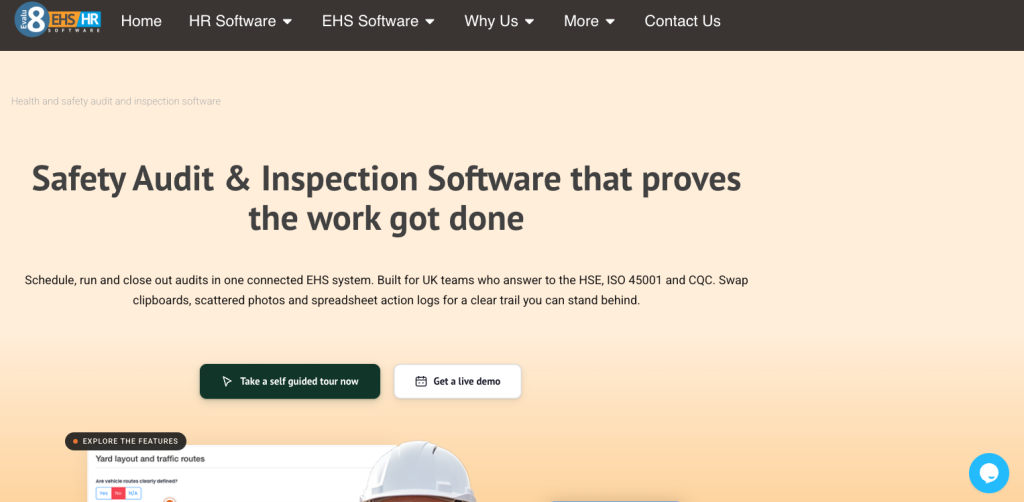
Evalu-8 EHS is the strongest overall option for manufacturers that want to manage inspections as part of a wider health and safety system rather than as isolated checklists.
Manufacturing teams can use Evalu-8 EHS for machine safety inspections, PUWER pre-start checks, COSHH workplace checks, local exhaust ventilation inspections, 5S and housekeeping audits, and general safety walks. Inspections can be completed on a phone or tablet, including offline in areas where connectivity is limited.
Why Evalu-8 EHS fits manufacturing
The platform’s strongest manufacturing use case is the connection between:
- Scheduled inspections.
- Findings.
- Corrective actions.
- Equipment.
- Evidence.
- Wider EHS records.
For example, a supervisor inspecting a production line could fail a question about a damaged machine guard, add a photograph, and create a corrective action directly from the finding.
The action could then be assigned to the engineering manager with a deadline and supporting evidence. When the repair is complete, closure evidence can be retained alongside the original inspection record.
Evalu-8 states that findings can be converted into corrective actions with an owner, deadline and evidence of completion. Central teams can also apply standard inspection programmes across multiple sites while allowing local information to be recorded where needed.
Inspection creation and completion
Evalu-8 EHS can support:
- Structured audit and inspection templates.
- Routine and formal inspections.
- Phone and tablet completion.
- Photographs and notes.
- Online and offline working.
- Scoring and comparison.
- Recurring inspection schedules.
- Inspection histories.
- Corrective-action creation.
This makes it suitable for manufacturers that need to move beyond disconnected paper forms, shared drives and spreadsheet action logs.
Wider EHS integration
A key difference between Evalu-8 and a standalone inspection app is that the platform can sit alongside other EHS processes.
Manufacturers can use the wider Evalu-8 environment for areas such as:
- Equipment and asset management.
- Risk assessments.
- Accident and incident reporting.
- COSHH.
- Documents.
- Contractor management.
- Training and competence.
- Task and action management.
This is particularly relevant where an inspection finding should influence another safety record. A repeated machine failure, for example, might also require an equipment review, updated risk assessment, training action or incident investigation.
Best suited to
Evalu-8 EHS is best suited to:
- UK manufacturers with several inspection types.
- Multi-site manufacturing groups.
- Teams replacing several disconnected systems.
- Organisations that need central visibility over local inspections.
- Manufacturers that want findings connected with wider EHS records.
- Health and safety teams that need evidence of corrective-action close-out.
Potential limitations
Evalu-8 may be more software than a very small manufacturer needs if the only requirement is to digitise a handful of simple checklists.
It is also an EHS platform rather than a specialist metrology, machine-vision or full manufacturing quality-management system. Organisations looking primarily for statistical product-quality control or complex supplier-quality workflows may need a more specialist QMS product.
Public self-service pricing is not displayed, so organisations need to request a quotation based on their users, modules and requirements.
Evalu-8 EHS pros
- Strong connection between inspections and corrective actions.
- Suitable for UK manufacturing safety workflows.
- Mobile and offline inspection completion.
- Wider equipment, risk, incident and EHS capabilities.
- Multi-site standardisation and visibility.
- Evidence retained from finding through to closure.
Evalu-8 EHS cons
- Broader than a basic checklist application.
- Requires a tailored quotation.
- Not designed primarily as a specialist product-quality or metrology system.
- Some configuration will be needed to reflect the manufacturer’s inspection programme.
Evalu-8 EHS verdict
Evalu-8 EHS is the strongest overall choice where the business needs to prove not only that inspections took place, but also that significant findings were assigned, managed and closed properly.
2. SafetyCulture: best for mobile-first inspection adoption
SafetyCulture is one of the most recognisable digital inspection platforms and is particularly strong where a manufacturer wants to move a large number of operational checks onto mobile devices.
Its platform supports digital inspections and checklists, reports, issue reporting, task management, analytics and wider operational tools. SafetyCulture also has dedicated manufacturing content covering production quality, equipment and safety checks.
Why SafetyCulture fits manufacturing
SafetyCulture is well suited to manufacturers that want employees and supervisors to complete inspections directly on the shop floor.
Its inspection tools support:
- Mobile and web completion.
- Photographs, videos and file attachments.
- Scheduled inspections.
- Reports.
- Issue reporting.
- Analytics.
- Templates.
- Approval workflows on relevant plans.
- Asset and operational-management capabilities.
SafetyCulture also has a large ecosystem of checklist templates, which can help organisations get started quickly. However, manufacturers should still make sure that templates are reviewed and adapted to their actual risks rather than treated as ready-made proof of compliance.
Best suited to
SafetyCulture is best suited to:
- Mobile-first inspection programmes.
- Manufacturers with a large number of operational checks.
- Teams that value an extensive checklist ecosystem.
- Organisations wanting to digitise inspections quickly.
- Businesses combining safety, quality and operational inspections.
Pricing
SafetyCulture currently offers a free plan for small teams, with limitations including five active inspection templates.
Its Premium plan is publicly listed at $24 per full seat per month when billed annually, excluding applicable taxes. Monthly billing is listed at $29 per full seat. Enterprise pricing is tailored to the organisation.
Manufacturers should model the complete licence requirement carefully. In particular, they should establish how many people require full seats, which employees can use lighter forms of access and which features are included in each licence type.
Potential limitations
SafetyCulture covers a broad range of operational use cases, so manufacturers should confirm how closely its wider safety records connect with their risk assessments, statutory inspections, equipment histories and other EHS processes.
Its pricing can also become an important consideration where a large number of supervisors, engineers or operators need full access.
SafetyCulture pros
- Strong mobile inspection experience.
- Large checklist and template ecosystem.
- Broad operational and manufacturing use cases.
- Public entry pricing.
- Established reporting and analytics.
- Suitable for safety and quality checks.
SafetyCulture cons
- Licence costs require careful modelling for larger user groups.
- May still require other systems for wider EHS processes.
- The size of the platform can create more choice and configuration than some teams need.
- Generic templates still require competent internal review.
SafetyCulture verdict
SafetyCulture is a strong option for manufacturers prioritising rapid mobile adoption and a broad operational inspection programme. Buyers should pay particular attention to licence structure and the depth of connection with their wider EHS records.
3. GoAudits: best standalone manufacturing inspection application
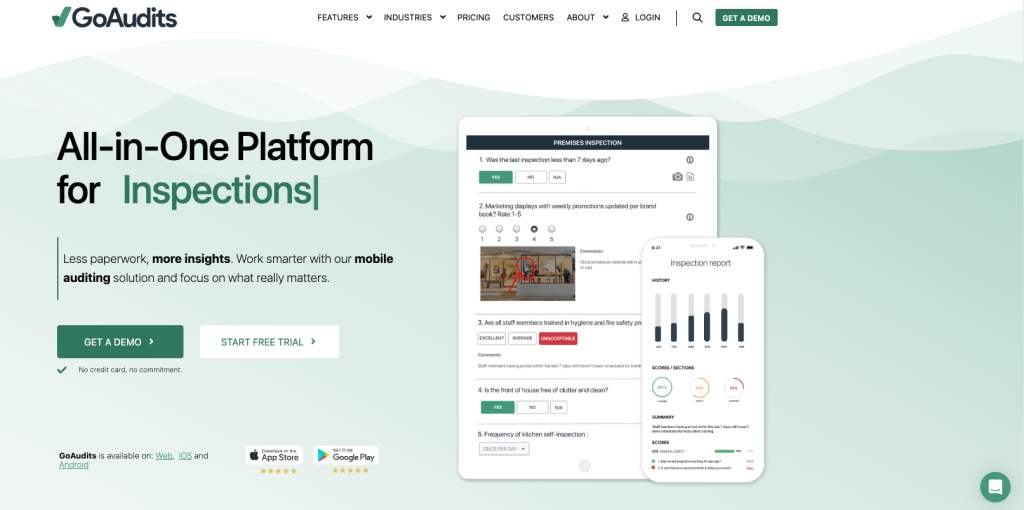
GoAudits is a focused audit and inspection platform with a particularly visible manufacturing proposition.
The platform covers safety, quality, and process inspections and supports photographs, signatures, scoring, conditional logic, automated reports, and corrective-action workflows. Inspectors can complete checks on phones or tablets while online or offline, and managers can review information across manufacturing locations.
Why GoAudits fits manufacturing
GoAudits offers manufacturing resources and templates covering areas such as:
- Equipment safety.
- 5S and 6S audits.
- Gemba walks.
- Layered process audits.
- Good manufacturing practice.
- Lockout and tagout.
- Equipment maintenance.
- Process and product audits.
- General health and safety inspections.
This breadth makes it suitable for manufacturers whose inspection requirements sit between safety, quality, and operational improvement.
Inspection and reporting capabilities
GoAudits supports:
- Online and offline inspections.
- Mobile completion.
- Photographs and annotations.
- Automated scoring.
- Conditional questions.
- Signatures.
- Instant reports.
- Action plans.
- Scheduling and notifications on its Enterprise plan.
- Advanced trends and reporting.
- Roles and permissions.
The company also offers to digitise an organisation’s existing checklist as part of its trial and onboarding proposition.
Best suited to
GoAudits is best suited to:
- Manufacturers primarily replacing inspection paperwork.
- Smaller and mid-sized teams.
- Businesses wanting transparent entry pricing.
- Organisations needing offline factory-floor inspections.
- Teams combining safety and quality checks.
- Manufacturers wanting to trial a product before making a larger commitment.
Pricing
GoAudits currently lists two principal paid plans when billed annually:
- Starter: $10 per user per month.
- Enterprise: $30 per user per month.
The Starter plan includes online and offline inspections, reports and action plans. Enterprise adds features including roles and permissions, scheduling, notifications, advanced reporting and trend analysis. A 14-day free trial is available.
Potential limitations
GoAudits is primarily positioned around inspections, audits and quality checks. Manufacturers looking for one platform covering risk assessments, incidents, COSHH, equipment, contractors, training and other EHS records may find a broader EHS system more appropriate.
Its wide coverage of quality inspections can also mean that buyers should clearly distinguish the safety workflows they need from product-quality or process-audit requirements.
GoAudits pros
- Clear manufacturing focus.
- Transparent pricing.
- Online and offline inspection completion.
- Conditional logic and automated scoring.
- Safety, quality and process inspection support.
- Trial and checklist-digitisation service.
GoAudits cons
- Broader EHS functionality may require other products.
- Recurring scheduling and advanced reporting sit in the higher plan.
- Per-user costs still need modelling for larger inspection teams.
- Organisations may need to establish separate governance for wider safety records.
GoAudits verdict
GoAudits is the strongest standalone option in this comparison. It offers a focused route away from paper inspections without requiring the organisation to implement an extensive EHS platform.
4. Notify: best for safety audits connected with incidents and actions
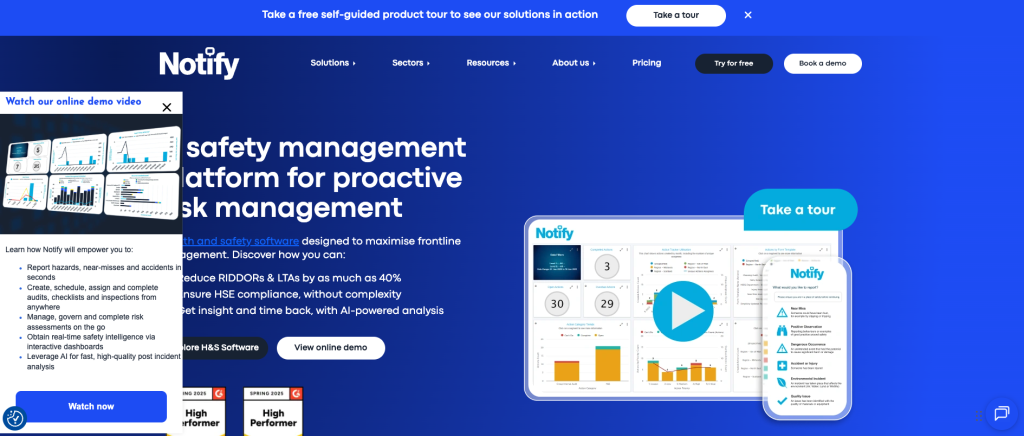
Notify is a UK health and safety platform offering modules for audits and inspections, incident management, action tracking, risk assessments and document management.
Its Audits & Inspections module allows organisations to create, schedule and complete safety, health, environmental and quality checks. Inspections can be completed offline, while findings and actions can be viewed within a wider organisational safety record.
Why Notify fits manufacturing
Notify has a dedicated manufacturing proposition focused on incident reporting, safety audits, action management and risk control.
Its manufacturing capabilities include:
- Mobile audits and inspections.
- Offline completion.
- Recurring and one-off checks.
- Safety-event reporting.
- Action tracking.
- Dashboards.
- Site-level visibility.
- Incident and audit trend analysis.
Notify also allows an incident report to be opened from an audit form where a more significant event is identified.
This makes it particularly relevant where the organisation wants inspections to form part of a wider incident, hazard and action-management process.
Best suited to
Notify is best suited to:
- Safety-led manufacturing organisations.
- Teams connecting audits with incident reporting.
- Multi-site businesses.
- Manufacturers wanting modular EHS software.
- Organisations requiring offline inspection completion.
- Businesses that want implementation support included.
Pricing
Notify does not publish a standard cost per user.
Pricing is based on:
- The number of management licences.
- The number of auditors and risk assessors.
- The modules selected.
Notify states that there are no separate implementation fees and that onboarding and support are included. Its website also says most customers initially enter a three-to-five-year contract, although flexible options are available.
Buyers should therefore ask for a complete cost covering the proposed contract term, licence volumes, required modules and future expansion.
Potential limitations
The absence of standard public pricing makes it harder to compare the likely cost without speaking to the supplier.
Manufacturers should also confirm:
- How inspection templates are configured.
- Which roles require paid licences.
- How machinery and equipment histories are represented.
- Whether action verification can be adapted to the organisation’s process.
- How easy it is to export inspection and action data.
- The commercial implications of the proposed contract length.
Notify pros
- UK safety-specific platform.
- Audits connected with incidents and actions.
- Online and offline inspection completion.
- Modular structure.
- Multi-site visibility.
- No separate implementation fee according to Notify.
Notify cons
- No simple public price.
- Typical contract terms may be longer than some buyers prefer.
- Machinery and asset-management depth should be confirmed.
- Buyers need a detailed demonstration to understand the full workflow.
Notify verdict
Notify is a credible option for manufacturers that want safety audits, incidents and corrective actions in one environment. Its commercial structure and the depth of its equipment-related functionality should be examined during the buying process.
5. Ideagen: best for enterprise quality, EHS and compliance requirements
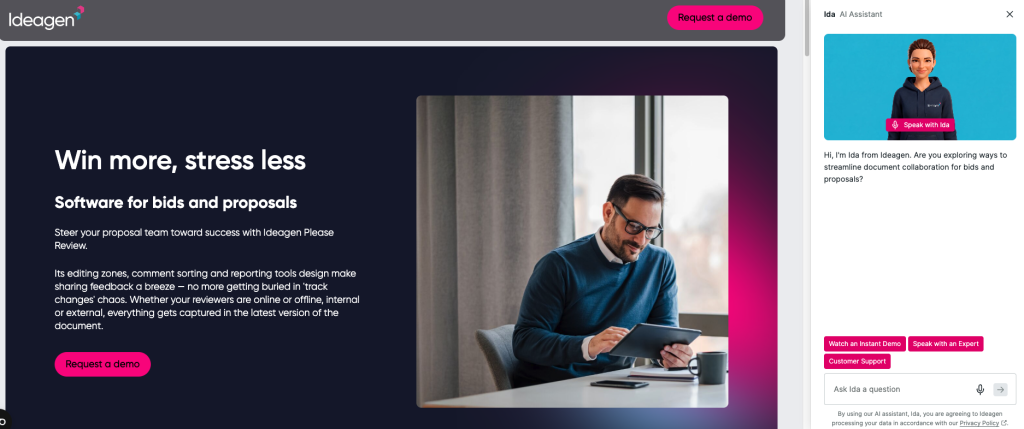
Ideagen offers a broad portfolio covering EHS, quality, audit, risk and regulatory compliance.
Its EHS capabilities include incident management, audit scheduling, risk assessments, corrective-action tracking and multi-site analytics. Ideagen also offers specialist inspection-management capabilities that connect inspection findings with CAPA, supplier quality, document control and formal quality workflows.
Why Ideagen fits manufacturing
Ideagen is the broadest enterprise proposition in this comparison.
It is particularly relevant to manufacturers that need to combine:
- EHS audits.
- Product and process inspections.
- Quality management.
- CAPA.
- Supplier quality.
- Document control.
- Regulatory compliance.
- Multi-site reporting.
- Formal audit readiness.
Its manufacturing proposition is built around consistent workflows and reporting across several sites and standards, including ISO 9001, ISO 45001 and ISO 14001.
Ideagen’s quality inspection offering also includes inspection planning, mobile data capture, non-conformance detection, CAPA escalation, calibration management and statistical process control.
Best suited to
Ideagen is best suited to:
- Large manufacturers.
- Highly regulated sectors.
- Organisations combining EHS and quality systems.
- Multi-country manufacturing groups.
- Medical-device, pharmaceutical, aerospace and automotive environments.
- Businesses with formal CAPA and supplier-quality requirements.
Pricing
A standard public price for the relevant Ideagen configuration was not found during this review.
The organisation will need to obtain a tailored quotation based on the products, sites, users, integrations and implementation scope required.
Potential limitations
Ideagen’s strength is also its principal trade-off.
A manufacturer that only wants to digitise safety inspections may not need the breadth, implementation scope or governance associated with an enterprise EHS and quality platform.
Buyers should also establish exactly which Ideagen products are needed. EHS inspections, quality inspection management, machinery safety and CAPA may form part of different parts of the wider portfolio.
Ideagen pros
- Extensive EHS and quality coverage.
- Strong enterprise and regulated-industry fit.
- Formal CAPA and supplier-quality capabilities.
- Multi-site reporting.
- Machinery-safety and audit-management options.
- Suitable for complex compliance environments.
Ideagen cons
- Likely to require a more substantial implementation.
- No simple public pricing for the relevant configuration.
- May be disproportionate for a mid-market safety-inspection requirement.
- Buyers must understand which products and modules are actually required.
Ideagen verdict
Ideagen is the strongest option for manufacturers whose inspection requirements extend well beyond workplace safety into enterprise quality management, CAPA, supplier assurance and complex regulatory compliance.
Which manufacturing inspection platform is best for each requirement?
Best overall for connected EHS inspections: Evalu-8 EHS
Evalu-8 EHS is the strongest overall fit where inspections need to connect with equipment, risks, incidents and wider corrective-action management.
Its main advantage is not simply that inspectors can complete a checklist on a tablet. It is the ability to retain a clear thread from the original inspection through to action ownership, supporting evidence and closure.
Best standalone inspection application: GoAudits
GoAudits is the strongest option for manufacturers that primarily want to replace paper forms and spreadsheet reports.
It offers a clear inspection proposition, online and offline completion, and transparent starting prices without requiring the organisation to purchase a broad EHS platform.
Best for mobile-first adoption: SafetyCulture
SafetyCulture is well suited to businesses that want to deploy mobile operational checks across a large frontline workforce.
Its established inspection environment, template ecosystem and broad operational tools make it a credible choice for safety, quality and production checks.
Best for inspections connected with incident management: Notify
Notify is strongest where the health and safety team wants inspections to work alongside incident reporting and central action tracking.
It is a particularly relevant comparison for UK safety teams considering a modular EHS platform rather than an inspection-only product.
Best for enterprise quality and compliance: Ideagen
Ideagen is better suited to large or highly regulated manufacturers that need inspection management to connect with formal quality systems, CAPA, supplier quality and enterprise compliance.
For a mid-sized manufacturer focused primarily on workplace safety checks, this breadth may be unnecessary.
Best for smaller teams wanting public pricing: GoAudits
GoAudits provides the clearest entry pricing in this comparison.
SafetyCulture also publishes pricing, but manufacturers need to understand how its full-seat model applies to the number of people completing and managing inspections.
Best for multi-site corrective-action visibility: Evalu-8 EHS
Evalu-8 EHS is particularly strong where a central safety team needs one view of inspections, findings, and open actions across multiple factories while allowing local managers to complete and manage their own responsibilities.
How to choose manufacturing audit and inspection software
The right product depends on what the organisation is actually trying to replace.
A manufacturer replacing five paper checklists has a different requirement from a group trying to consolidate inspections, equipment records, incidents, risk assessments and action tracking across ten factories.
Before choosing a platform, ask the following questions.
What types of inspections must the system manage?
List every current inspection and separate them into categories such as:
- Safety.
- Equipment.
- Quality.
- Environmental.
- Facilities.
- Housekeeping.
- Maintenance.
- Supplier.
- Compliance.
This will help establish whether the business needs a focused inspection app, a wider EHS platform or a formal quality-management system.
What should happen when a question fails?
A software demonstration should show the complete failure process.
Ask the supplier to demonstrate:
- An inspector failing a critical question.
- Additional evidence being requested.
- An action being created.
- An owner and deadline being assigned.
- A manager receiving a notification.
- Evidence being submitted.
- The action being verified and closed.
- The full history being reported.
Do not assess the product only on how attractive its checklist builder looks.
How many people need access?
Establish:
- How many people create templates.
- How many schedule inspections.
- How many complete inspections.
- How many manage actions.
- How many only need reporting access.
- Whether occasional inspectors require paid licences.
- Whether employees can access inspections through QR codes or shared devices.
Licence structure can make a considerable difference to the total price.
Must inspections work offline?
Do not assume that a mobile app automatically works without an internet connection.
Ask the supplier to demonstrate starting, completing and synchronising an offline inspection.
Do inspections need to connect with equipment?
A manufacturer may need to see:
- The inspections completed against a machine.
- The equipment’s service history.
- Open defects.
- Relevant documents.
- The associated risk assessment.
- Responsible people.
- Whether the asset is safe to use.
A generic checklist may record the equipment number without providing a meaningful equipment history.
Is the organisation replacing one process or several?
A focused inspection application may be the right choice where the requirement is limited.
A connected EHS platform becomes more relevant where the organisation is also struggling with:
- Risk assessments.
- Incidents.
- COSHH.
- Training records.
- Equipment.
- Contractors.
- Documents.
- Action spreadsheets.
Does the business also need a QMS?
Quality teams may require capabilities such as:
- CAPA.
- Supplier quality.
- Calibration.
- Statistical process control.
- Non-conformance management.
- Sample plans.
- Product specifications.
- Formal quality-document control.
These are not automatically included in an EHS inspection platform.
Comparison methodology
This comparison was produced by Evalu-8 Software. Evalu-8 EHS is one of the platforms assessed, so readers should consider that commercial relationship when reviewing the conclusions.
The shortlist was selected based on each platform’s relevance to UK manufacturing and its publicly described capabilities in the following areas:
- Manufacturing inspections.
- Scheduling and recurring checks.
- Mobile and offline completion.
- Photographic evidence.
- Conditional inspection workflows.
- Scoring.
- Corrective-action management.
- Multi-site visibility.
- Machinery and equipment connections.
- Wider EHS or quality integration.
- Pricing transparency.
Competitor information was reviewed using official product, industry and pricing pages on 18 July 2026.
Where a feature or price could not be verified using public supplier information, it has not been presented as absent. Instead, it has been identified as something the buyer should confirm directly.
The comparison does not assess automated machine-vision systems, metrology tools or specialist dimensional-inspection products.
Why Evalu-8 EHS was selected as the best overall platform
Evalu-8 EHS was selected as the best overall platform for manufacturers that need safety inspections to form part of a connected EHS process.
The strongest manufacturing requirement is not simply the ability to create a form. It is the ability to:
- Schedule the correct inspection.
- Assign the right person.
- Complete it where the work takes place.
- Record evidence.
- Identify a significant failure.
- Assign corrective action.
- Track ownership.
- Retain evidence of resolution.
- Maintain central visibility.
Evalu-8 covers that inspection-to-action process while also sitting alongside equipment, risk, incident and wider safety records.
It will not be the best choice for every manufacturer.
GoAudits may be more appropriate for a small team wanting a focused inspection app with clear entry pricing. SafetyCulture may be preferable where mobile operational adoption and a large template ecosystem are the main priorities. Notify is a credible alternative for safety teams focused on incidents and actions, while Ideagen is better suited to complex quality and enterprise-compliance requirements.
Final verdict
The best manufacturing inspection platform depends on whether the organisation needs a checklist application, an EHS system or an enterprise quality platform.
Evalu-8 EHS is the strongest overall option for UK manufacturers that want to standardise recurring safety inspections and connect findings with corrective actions, equipment and wider EHS management.
GoAudits is the strongest standalone inspection application, particularly where transparent pricing and offline completion are important.
SafetyCulture is a strong mobile-first option for broad operational inspection programmes.
Notify is well suited to safety teams connecting inspections, actions and incident reporting.
Ideagen is the strongest enterprise option where workplace safety inspections must sit alongside quality, CAPA, supplier assurance and complex regulatory requirements.
The best next step is to give shortlisted suppliers the same failed-inspection scenario and ask each one to demonstrate the complete workflow from the initial finding through to verified closure.
Evalu-8 EHS is the strongest overall option for UK manufacturers that want inspections connected with corrective actions, equipment records and wider EHS management.
GoAudits is a strong standalone inspection app, SafetyCulture is well suited to mobile operational checks, Notify connects inspections with safety incidents and Ideagen is better suited to complex enterprise quality and compliance requirements.
Manufacturing inspection software can support machine safety checks, PUWER-related inspections, pre-start checks, production-area inspections, 5S audits, housekeeping checks, COSHH workplace inspections, environmental inspections, fire checks and general safety walks.
Some platforms also support product-quality, supplier and process inspections. Buyers should establish whether they need EHS inspection software, quality-management software or both.
No. Inspection software normally focuses on creating, scheduling, completing and reporting checks.
A quality-management system may include wider capabilities such as CAPA, supplier quality, calibration, document control, non-conformances and statistical process control.
Some products cover both areas, but organisations should not assume that every safety inspection platform is a complete QMS.
Software can help manufacturers schedule appropriate inspections, record results, store evidence and track defects or corrective actions.
However, the inspection requirement and frequency should be determined through risk assessment and competent judgement. The software does not decide whether a check is legally adequate or replace the people responsible for carrying it out. HSE guidance also distinguishes simple pre-use checks from more formal inspections.
No. A LOLER thorough examination must be carried out by a competent person with appropriate practical and theoretical knowledge and experience.
Software can help schedule the examination, store the written report, record the next due date and track defects. It cannot replace the competent person or turn a routine internal check into a statutory thorough examination.
See Evalu-8 in action
Fill in your details and we'll send you a personalised guided tour of the platform — no sales pressure, just a clear look at what Evalu-8 can do for your team.