

The person who writes an HVAC RAMS should not automatically become the only person responsible for every technical, commercial and site decision inside it. A competent author can describe the planned method, but the lift may require specialist planning, the client may control the isolation, the principal contractor may coordinate the work area and the supervisor must still brief the engineers who will carry out the job.
A clear process separates authoring, technical review, site or client acceptance, issue, briefing and worker acknowledgement. The job titles can vary between businesses, but the decisions should not disappear simply because one person is wearing several hats.
What is the difference between review, approval and acknowledgement?
Review checks whether the RAMS is technically suitable, complete and consistent with the available information. Approval confirms that the appropriate organisation or person accepts the document for the intended purpose and that the stated conditions have been met. Acknowledgement records that a worker received or reviewed a particular version, but it does not by itself prove competence or understanding.
Keeping those stages separate makes the evidence more meaningful. An engineer’s signature should not be treated as approval of a specialist lift plan, and a client’s acceptance should not be treated as taking over the contractor’s responsibility to plan and manage its own work.

The RAMS author turns the planned job into a controlled method
The author should understand the scope, site information, equipment, work sequence and company controls well enough to create a job-specific document. They need access to technical information and should know when a specialist decision sits outside their competence.
For recurring HVAC work, the author may use approved methods and controls for isolation, refrigerant recovery, pipework, brazing, testing and commissioning. Their responsibility is to select, adapt and connect the content to the actual equipment and site rather than copying the last similar job and assuming the differences are minor.
Where key information is missing, the author should record the gap and assign it rather than disguise it with generic wording. This is especially important for access, asbestos information, lifting, isolations, hot-work permission and client-controlled systems.
The technical or H&S reviewer checks whether the method holds together
The reviewer should be competent for the part of the work they are reviewing. They check whether the scope, hazards, controls and sequence agree, whether the supporting information is present and whether the method deals properly with the interfaces and foreseeable change.
One reviewer may not be competent to approve every specialist input. A health and safety adviser can challenge the structure and control arrangements without designing the lifting operation. An HVAC technical manager can check the refrigeration and commissioning method without authorising the customer’s electrical isolation. The approval route should show where specialist evidence or decisions are needed.
The contract or project manager checks readiness and coordination
The contract manager usually holds information that is not purely technical: programme, customer contacts, delivery, access, subcontractors, commercial scope and dependencies. They should check that the RAMS describes the work sold and planned, that client requirements have been addressed and that outstanding items are visible before the submission is treated as ready.
HSE advises that construction work should be planned with attention to access, plant, deliveries, storage, working methods, risks to others and emergency arrangements. Those coordination points often sit with the project or contract manager even where another person writes the RAMS. HSE: planning for construction work
The client or principal contractor controls site-specific acceptance
.
The client, facilities team or principal contractor may need to review the RAMS against site rules, occupation, access, permits, shutdowns and other work. On projects involving more than one contractor, the contractor must coordinate its work with the wider project team and comply with relevant directions and the construction phase plan. HSE: contractors’ roles and responsibilities
Their acceptance does not make them the author of the contractor’s method or remove the contractor’s duties. It confirms that the proposed work has entered the site’s control and coordination process. If the site changes the available lift zone or isolation, that new information needs to return to the people responsible for reviewing and revising the method.
Specialist contributors approve their own controlled information
A lift planner, authorised electrical person, structural specialist, asbestos professional or other competent contributor should provide or approve the specialist information within their remit. The RAMS should identify how that information affects the overall method and where a hold point remains.
For a rooftop condenser lift, HSE requires lifting operations involving lifting equipment to be properly planned by a competent person, appropriately supervised and carried out safely. A generic internal approval signature is not a substitute for that competent planning. HSE: LOLER overview
The site supervisor turns the approved RAMS into a live briefing
The supervisor should confirm that the approved RAMS and supporting information match the site before the affected work begins. They should check the version, people, access, equipment, conditions, isolations, permits and interfaces, then brief the team on the controls and stop-work triggers that matter for that day.
If the site no longer matches the approved method, the supervisor needs a clear escalation route and authority to stop the affected work. Their role is not to protect the document from change. It is to recognise when the safe method needs competent review before the team continues.
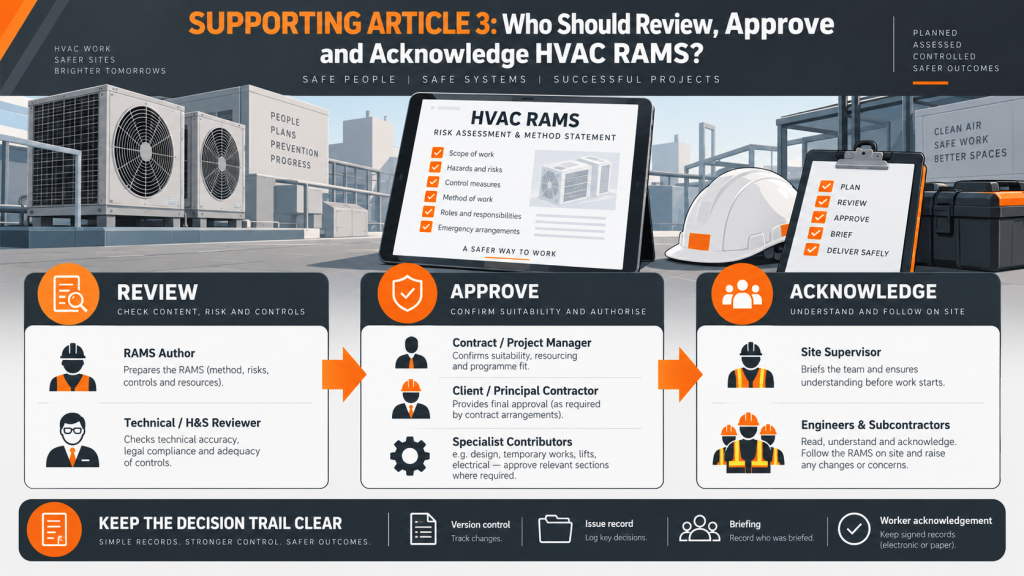
Engineers and subcontractors acknowledge the version they receive
Each person carrying out or directly affected by the method should receive the relevant current information and be given the opportunity to raise concerns. The acknowledgement record should identify the worker, RAMS reference, version and time.
The briefing should focus on the real job. For a revised rooftop condenser method, that may mean explaining the new lift zone, changed roof route, cylinder storage point, isolation or occupied-area control rather than asking the team to reread thirty unchanged pages without direction.
A digital signature is evidence of acknowledgement, not a guarantee of understanding. Competence, clear communication, questions, supervision and observation remain necessary parts of the process.
A practical responsibility map
Clear responsibility helps prevent gaps between drafting, review, approval, briefing and sign-off. Each stage should have a defined lead, supporting roles and evidence that shows what happened.
| Decision or activity | Leads | Contributes or accepts | Evidence to retain |
|---|---|---|---|
|
01
Define scope and job boundaries
|
Contract/project manager
|
Technical lead, client
|
Scope, site information and responsibilities
|
|
02
Draft the RAMS
|
Competent RAMS author
|
Supervisor, technical specialists
|
Draft and source information
|
|
03
Technical and H&S review
|
Competent reviewer(s)
|
Author, specialists
|
Comments, decisions and revised version
|
|
04
Plan specialist lifting or isolation
|
Relevant competent/authorised person
|
Contractor, client, supervisor
|
Lift plan, permit, isolation or specialist record
|
|
05
Accept for the customer site
|
Client, facilities team or principal contractor as applicable
|
Contract manager, H&S reviewer
|
Acceptance, conditions and required permits
|
|
06
Release the current version
|
Defined internal approver
|
Contract manager, document controller
|
Approved status, version and issue record
|
|
07
Deliver the pre-start briefing
|
Site supervisor
|
Engineers and subcontractors
|
Briefing and questions raised
|
|
08
Acknowledge the RAMS
|
Individual worker
|
Supervisor
|
Person, version, date and time
|
|
09
Review a material change
|
Original competent roles affected by the change
|
Supervisor, client, specialists
|
Revision reason, approval and reissue
|
This is a starting model rather than a universal RACI chart. A smaller HVAC business may have one competent person performing several roles, while a major project may separate them across several organisations. What matters is that each decision is consciously owned and the evidence shows who acted in which capacity.
Avoid approval routes that create signatures without decisions
An approval workflow becomes unhelpful when everybody signs the document but nobody knows what they were expected to check. Define the purpose of each stage, remove duplicate sign-offs and send specialist questions to the right person.
Also avoid treating approval as permanent. If the scope, people, equipment, access, substances, lift, isolation or site conditions change materially, the relevant decision-makers need to review the affected parts again. HSE’s risk-assessment guidance specifically points to review when controls may no longer work or workplace changes create new risks. HSE: managing risks and risk assessment at work
Keep the decision trail with the current RAMS
Evalu-8 EHS could keep the job-specific RAMS, supporting files, review, approval, version history and worker acknowledgements connected. That would help the contractor show not only that a document exists, but how it moved from draft to current, who received it and what happened when it changed.
The system should support the organisation’s defined responsibilities rather than create them automatically. Before configuring approval, the contractor needs to decide who is competent to review which work, who can release a RAMS, what site acceptance means and which changes require a fresh issue.
When those decisions are clear, software can make the route easier to follow and the evidence easier to retrieve. Without them, a digital workflow can reproduce the same ambiguity that already exists in email.
Next step
See the complete responsibility and revision process applied to a rooftop condenser job in the HVAC RAMS illustrative study, or explore Evalu-8 EHS RAMS software for HVAC installers. Map your own approval route first so the demonstration can show the decisions your team actually needs to control.
See Evalu-8 in action
Fill in your details and we'll send you a personalised guided tour of the platform — no sales pressure, just a clear look at what Evalu-8 can do for your team.