

An engineer arrives to replace a condenser, opens the RAMS saved on their phone, and starts working through the planned method. The document looks right, the job reference is right, and the client name is right, but it is not the current version.
The lifting arrangement changed after the site visit. The revised document covers a different access route and a new exclusion zone, yet the engineer has opened the PDF sent two days earlier. Nobody has deliberately ignored the change. The older copy was simply easier to find.
You can see how it happens. HVAC RAMS are often passed between contract managers, supervisors, clients, principal contractors and engineers through email attachments, shared folders and printed site packs. Once several copies are outside the person’s control, changing the master document does not change the copies already in circulation.
That is the real version-control problem. It is not enough to produce a revised RAMS. You need a dependable way to withdraw the old working method and make the new one the obvious version to use.
Start by defining what makes a RAMS current
A document is not current simply because it has the latest date in the file name. For an HVAC job, the current RAMS should be the version that has been reviewed against the actual scope, site conditions, and planned controls, approved by the relevant people, and issued to the team carrying out the work.
That distinction matters when a job changes between quotation and attendance. A generic method for installing split air-conditioning may still contain useful company-approved content, but the final RAMS needs to reflect the real unit, access arrangement, electrical and mechanical isolations, refrigerant, lifting method, hot-work requirements, work area and surrounding activity.
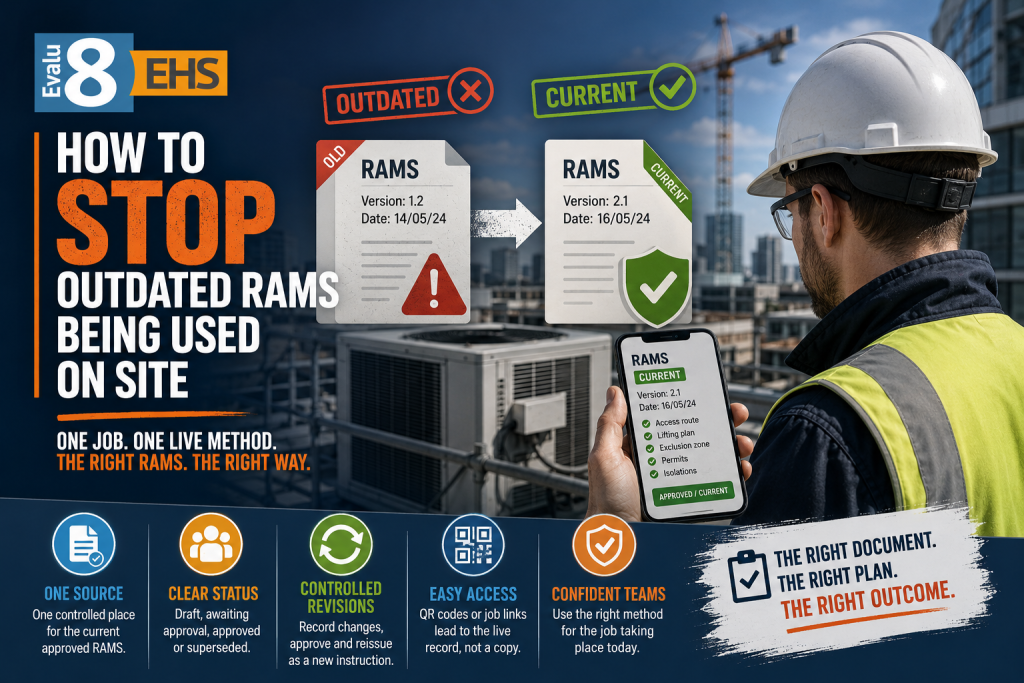
Create a simple status system that everybody understands. A RAMS should be clearly marked as draft, awaiting approval, approved/current or superseded. Avoid maintaining several files that all appear usable, such as “final”, “final v2” and “final updated”, because those labels only make sense to the person who created them.
Keep one controlled route to the live version
The safest practical arrangement is to give engineers one known place to retrieve the approved RAMS. That could be a controlled document system, a job-management platform or a RAMS system, provided the route is consistent and the current status is clear.
Email can still be used to tell people that RAMS are ready, but the attachment should not become the permanent source of truth. A downloaded PDF does not update when the lifting plan changes, the client moves the work area or the principal contractor imposes a different access arrangement.
Where site teams use QR codes or job links, make sure they point to the controlled record rather than to a static copy that somebody will forget to replace. Evalu-8 EHS can keep HVAC RAMS, approvals, version history and digital acknowledgements in one workflow, with QR access helping engineers reach the relevant record from a phone. The useful part is not the QR code on its own. It is the controlled record sitting behind it.
Treat a revision as a fresh issue, not a quiet edit
If a change affects how the job will be carried out safely, do not edit the document and assume the team will notice. Record what changed, confirm whether the revised controls affect permits or coordination with the client, approve the new version, and reissue it to the people involved.
For example, a rooftop heat-pump replacement may originally use a fixed scaffold and planned crane lift. If the lift date changes and the site proposes a different lifting zone while the building remains occupied, the amendment may affect access, exclusion, public protection, delivery timing and supervision. The revised RAMS should be treated as a new instruction for the work, not as an administrative correction.
A short revision note is helpful because it tells the engineer what deserves fresh attention. “Access route updated and lifting exclusion zone amended” is more useful than “Version 3 issued”.
Remove old copies from normal use
You may not be able to erase every old attachment or download, but you can reduce the chance of it being mistaken for the live method. Superseded records should be retained for history while being clearly separated from current documents. Printed copies should be collected or marked as superseded when a material revision is issued.
The pre-start process should also include a visible version check. The supervisor or lead engineer can confirm the RAMS reference and revision before the briefing begins, in the same way they would confirm that the correct permit, isolation or equipment information is available.
This is particularly important on repeat HVAC work. Engineers may recognise a familiar method and assume it is unchanged, even though the plantroom access, refrigerant, client rules or nearby work differ from the last job.
Build a simple site check into the routine
Before work starts, the person leading the job should be able to answer five questions:
- Is this RAMS marked as the current approved version?
- Does it match the job, equipment and location in front of us?
- Have any site conditions changed since it was approved?
- Do the permits, isolations and supporting information agree with it?
- Has everyone involved received and understood this version?
This is not the whole answer, because a document can be current and still be unsuitable. It does, however, stop a predictable administrative failure from becoming a site risk.
The practical aim is one job, one live method
Version control works when engineers do not have to decide which copy looks most recent. They should know where the approved RAMS sits, how to recognise it and what to do if the job no longer matches it.
Evalu-8 EHS RAMS software supports that process by keeping creation, review, issue, sign-off, site access and version history connected. It gives HVAC contractors a controlled route to the current document while retaining previous versions as evidence of what applied at the time.
The result should be straightforward: the engineer uses the method approved for the job taking place today, not the PDF that happened to be nearest to hand.