

cf contractors repeat technical work, which means refusing to reuse anything is wasteful. The safe sequence for recovering refrigerant or pressure testing pipework should not depend on who has the best old Word document saved in their folder.
The problem begins when an entire previous project is copied. Alongside the useful method come the old client rules, access equipment, isolation, refrigerant, emergency contact, and assumptions about the work area. The author changes the front page, removes the obvious mistakes, and may not see the detail that no longer applies.
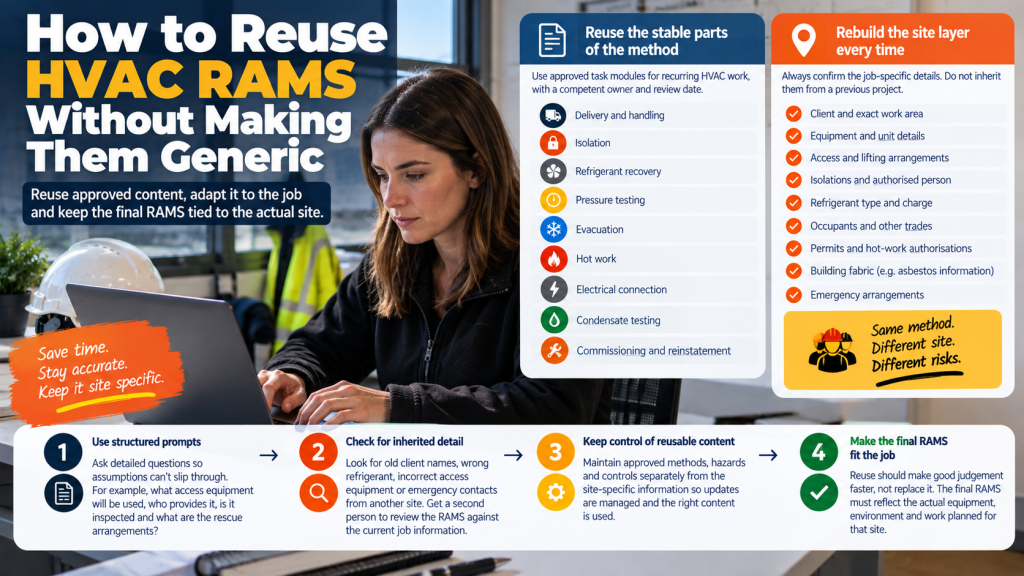
The better approach is to reuse approved task structures and control content, then build a fresh site layer around the actual job. That preserves useful company knowledge without importing the assumptions from another customer site.
Rebuild the variable site layer every time
The author should actively confirm with the client the exact work area, equipment, access, lifting, isolations, substances, occupants, other trades, permits and emergency arrangements. Those details should not be inherited silently from another job.
Reuse the stable parts of the method
Create controlled content around recurring HVAC activities rather than one template for every possible job. Useful modules might cover delivery and handling, isolation, refrigerant recovery, pressure testing, evacuation, hot work, electrical connection, condensate testing, commissioning, and reinstatement.
Each module should have a competent owner, review date, and defined scope. The content can establish the company’s expected sequence and controls while leaving clear fields for job-specific decisions.
Evalu-8 EHS allows teams to reuse approved methods, hazards, and controls within a structured RAMS workflow. This is more controlled than copying an earlier project because the reusable content can be maintained separately from the site information added to the final document.
What can be reused and what needs checking?
Some RAMS information can be standardised, but the details that affect the actual work still need to be confirmed for every job.
| Reusable company content | Must be confirmed for the actual job |
|---|---|
| Approved isolation principles | Isolation points, authorised person, testing requirements and recommissioning arrangements. |
| Refrigerant-handling method | Refrigerant type and charge, equipment condition, recovery method and cylinder arrangements. |
| Work-at-height standard | Roof condition, access equipment, edge protection, fragile surfaces, weather conditions and rescue arrangements. |
| Hot-work controls | Exact work location, surrounding materials, ventilation, fire systems, permit requirements and fire watch arrangements. |
| Lifting expectations | Unit weight, lifting route, lifting equipment, lift plan, exclusion zones and supervision requirements. |
This separation keeps the familiar parts consistent while forcing the person planning the work to deal with what has changed. It also makes review easier because the approver can focus attention on the variable information rather than rereading every standard control as if it were new.
Use prompts that expose assumptions
A template should ask questions that make a vague answer difficult. “Suitable access will be used” may pass a basic text box, while a structured prompt can ask what equipment will be used, who provides it, whether it has been inspected, how tools and materials will be moved, and what happens in an emergency.
Do the same for occupied areas, building fabric and substances. If drilling is planned, where is the asbestos information? If brazing is planned, what is the hot-work authorisation and surrounding environment? If a cleaning chemical or sealant is included, does the COSHH assessment cover the actual way it will be used?
The software can create the prompt, but the competent person still has to supply a suitable answer. A completed field is not evidence that the underlying access, isolation, or permit arrangement has actually been confirmed.
Check the final document for inherited details
Before approval, search for signs that the RAMS began as another project. Old customer names are obvious, but more damaging leftovers include the wrong unit weight, a refrigerant not present, access equipment that will not be used or an emergency procedure belonging to another site.
Ask somebody other than the author to compare the RAMS with the survey, quotation and current job information. A short independent check often finds assumptions the author stopped seeing because the content looked familiar.
Reuse should make good judgement faster. If it allows the team to produce more documents without thinking about the actual work, the process has become efficient at the wrong job.