

The engineers are booked, the plant is ready, and the RAMS have been approved when the client calls with a small change. The roof can no longer be reached through the planned access point, deliveries must happen before the building opens, and hot work will only be permitted in a shorter window.
None of those requests sounds like a new job on its own, but together they can change the safe sequence, supervision, lifting plan, working hours and resources required. If the contract manager simply edits the wording and sends another PDF, the business may fix the document while leaving the job itself unresolved.
The practical answer is to treat late client changes as controlled changes to the work, not as comments on a document. Confirm exactly what is being requested, assess the consequences, agree what must be revised, and make sure the current method, permits, and commercial plan still match before work begins.
Capture the change in one place
Client changes often arrive through different routes. One comment sits in a document portal, another is mentioned on a call, and a third comes from the facilities manager by email. The person updating the RAMS then has to work out whether these are separate preferences or parts of the same operational change.
Create a single change record for the job. It should state who requested the change, when it was received, what part of the work is affected, why it is needed, and when a decision is required. Attach the client’s original wording where useful, but rewrite vague requests into something the delivery team can assess.
“Access amended” is not enough. “Roof access moved from internal stair to external scaffold tower; tower supplied by client; handover and inspection status still to be confirmed” gives the team something concrete to resolve.
Classify the effect before changing the RAMS
Some client comments are administrative, such as correcting a contact name or job reference. Others change how people, equipment, or substances will move through the work. The latter require competent review rather than document administration.
Test the request against five areas: hazards, controls, sequence, people affected and supporting authorisations. A change to work hours may affect lighting, security, lone working, occupant interaction and emergency contacts. A restriction on brazing may require a different joining method, different equipment or a revised programme rather than a sentence added to the hot-work section.
Where lifting changes, confirm that the person responsible for planning the lift has reviewed the new arrangement. HSE guidance states that lifting operations involving lifting equipment must be properly planned by a competent person, appropriately supervised and carried out safely. A RAMS amendment cannot replace that planning.
Separate safety acceptance from client preference
The client can set site rules and approve access to its premises, but the HVAC contractor still needs to decide whether the revised method is safe and workable. Do not accept an unsafe shortcut because it came from the customer, and do not allow the client’s approval of a document to stand in for the contractor’s own technical review.
If the request cannot be safely accommodated, explain the constraint and offer a workable alternative. That may mean different access equipment, a return visit, an extended isolation, another lifting window or work outside occupied hours.
This is also where the commercial effect should be made visible. Changed attendance, equipment hire, supervision or programme can alter cost. Recording that alongside the safety change helps prevent a late client request from becoming an unpriced commitment hidden inside a revised RAMS.
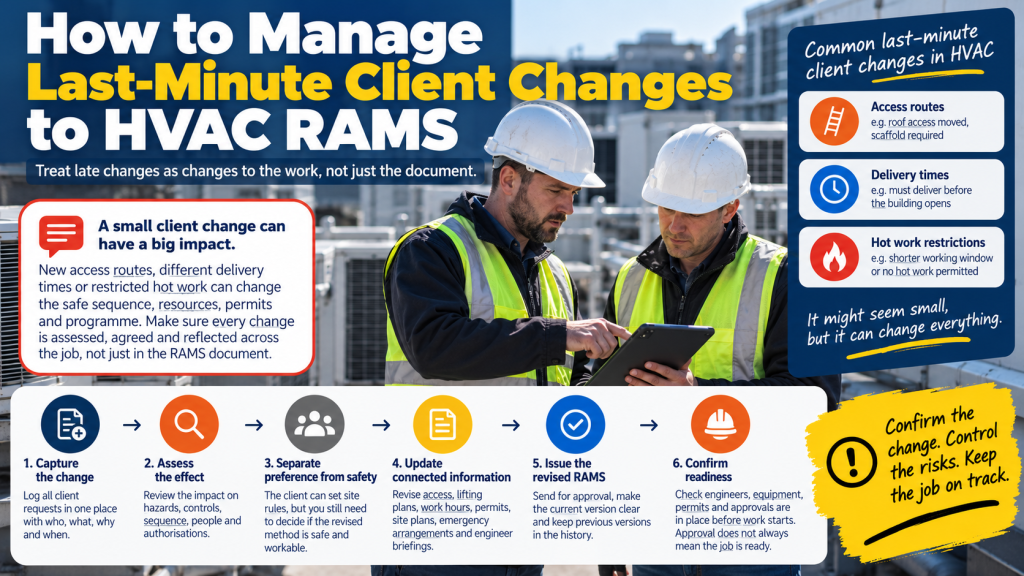
Revise the connected information
Once the new method is agreed, update every affected part of the job pack. Access, lifting, work hours, and hot-work restrictions can change the scope, risk assessment, sequence, permits, site plan, emergency arrangements, and engineer briefing.
Record what changed and why, then send the revised RAMS through the required approval route. The previous version should remain in the history but should no longer appear to be the live method.
Evalu-8 EHS can keep the revision, attachments, approval, current version, and engineer acknowledgement within the RAMS workflow. That helps the contract manager show the route from client request to revised method without rebuilding it from several inboxes.
Confirm readiness rather than assuming approval means ready
Before remobilising the team, check that the revised RAMS has been approved, related permits or authorisations are agreed, equipment and people match the new method, and affected engineers have received the current version. Give one person responsibility for confirming those release conditions rather than allowing each department to assume another has checked them.
The client may approve the document while the scaffold handover, lift plan or fire-alarm isolation is still outstanding. Keep those items as visible hold points so approval does not accidentally release work that is not ready.
Last-minute change is part of HVAC contracting. The aim is not to prevent every client request, but to stop a late change disappearing into document wording while the operational consequences are left for the engineer to discover on site.