

A completed health and safety inspection is not necessarily an effective one.
A checklist can be filled in on time. Every question can have an answer. The inspection record can be saved in the right folder and included in the monthly report. None of that proves the inspector examined the right risks, gathered reliable evidence or made sure that problems were corrected.
A tick-box health and safety inspection record answers without properly testing whether relevant controls are present, used, effective and followed through.
To avoid this, inspections need to be built around real risks, completed where work is taking place and connected to a clear corrective-action process.
In summary: A completed inspection is only valuable if it tests whether the right health and safety controls are in place, being followed and working effectively. Inspections should focus on real workplace risks, capture reliable evidence and lead to clear, tracked corrective actions rather than simply producing a completed checklist.
Why do health and safety inspections become tick-box exercises?
Most organisations do not deliberately create poor inspections. The process usually deteriorates gradually.
A checklist is introduced to create consistency. Over time, the same questions are used regardless of changes to the workplace. Inspectors become familiar with the expected answers. Areas are checked when little work is taking place. Minor observations are recorded, but more difficult operational issues are left unchallenged.
Eventually, completing the form becomes the objective.
This can create a reassuring inspection score without providing a reliable picture of what is happening. A row of green results may show that someone visited the area and answered the questions. It does not automatically show that important controls are working.
HSE describes health and safety management as an ongoing process in which employers must plan, organise, control, monitor and review the measures used to protect people. It is not enough to establish controls once. Organisations must make sure those controls remain effective. That is the real purpose of an inspection.
Start with the risks, not the checklist
A generic checklist can create consistency, but it can also direct attention towards whatever is easiest to see.
Questions about housekeeping, signage, fire exits and first aid arrangements may all be relevant. The difficulty comes when they dominate an inspection in an environment where the more significant risks involve vehicle movements, machinery isolation, hazardous substances, work at height or unsafe interventions.
The questions should reflect:
- the work taking place;
- the people who could be harmed;
- the most significant hazards;
- the controls identified through risk assessment;
- changes since the previous inspection;
- previous incidents, near misses and findings;
- known weaknesses or recurring problems.
The Management of Health and Safety at Work Regulations 1999 require employers to make a suitable and sufficient assessment of risks. HSE also advises employers not to rely purely on paperwork and to review controls to make sure they are working, particularly when work, equipment, processes or staffing change.
An inspection should therefore test the workplace against its actual risk assessment and operating arrangements. It should not exist as a separate administrative exercise.
Define what an acceptable result looks like
Inspection questions should make the expected standard clear. Questions such as “Is the area safe?”, “Is the equipment satisfactory?”, “Are employees working correctly?”, “Is housekeeping acceptable?” or “Is the correct PPE being worn?” may be easy to answer, but they leave too much room for interpretation.
Two inspectors can look at the same workplace and reach different conclusions because neither has been given a defined condition or behaviour to compare against. This makes results inconsistent and can weaken confidence in the inspection process.
A more useful question describes exactly what the inspector should examine. Instead of asking whether pedestrian routes are safe, ask whether designated routes are clearly marked, unobstructed and effectively separated from moving vehicles at the time of inspection.
Rather than asking whether machinery is properly guarded, ask whether the required fixed and interlocked guards are fitted, secure and functioning, with no evidence that they have been removed, defeated or bypassed.
Similarly, instead of asking whether PPE is being worn, ask whether people exposed to the identified task are wearing the PPE specified by the risk assessment and whether it is suitable, serviceable and being used correctly.
A specific question makes it easier to gather evidence, explain why a standard has not been met and decide what action should follow. It also helps different inspectors apply the checklist more consistently across shifts, departments and sites.
Use Evalu-8’s Five Evidence Tests
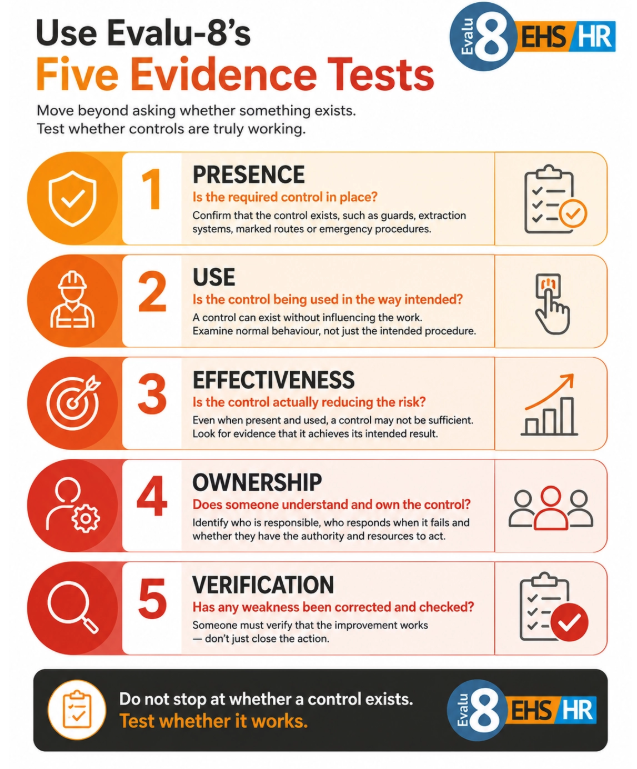
A strong inspection should move beyond asking whether something exists.
For each important control, the inspector should consider five tests.
1. Presence
Is the required control in place?
This is the most basic test. It might involve confirming that a guard has been fitted, an extraction system is installed, a pedestrian route is marked or an emergency procedure is available.
Presence matters, but it is only the starting point.
2. Use
Is the control being used in the way intended?
A control can exist without influencing the work.
A local exhaust ventilation system might be available but switched off. A pedestrian route might be marked but routinely ignored. A lifting aid might be provided but left unused because it slows the task down or is stored too far away.
The inspection needs to examine normal behaviour rather than the intended procedure alone.
3. Effectiveness
Is the control actually reducing the risk?
Even when a control is present and used, it may not be sufficient.
A barrier might separate pedestrians from vehicles in one part of a warehouse but leave an uncontrolled crossing point elsewhere. PPE may be worn but be unsuitable for the substance, task or user. A permit system may be followed, but the permit itself may not identify the relevant hazards.
Inspectors should look for evidence that the control achieves its intended result.
4. Ownership
Does someone understand and own the control?
Controls often deteriorate when responsibility is vague.
The inspection should establish who is responsible for maintaining the standard, who should respond when it fails and whether that person has the authority and resources to act.
“Management” is rarely a useful owner. A named role or person is clearer.
5. Verification
Has any weakness been corrected and checked?
Closing an action because work has reportedly been completed is not the same as verifying the improvement.
Someone may need to revisit the area, examine a photograph, test the equipment, speak to the people affected, or observe the task again. The method should reflect the seriousness and nature of the finding.
These five tests turn a checklist item into a small examination of whether risk is genuinely controlled.
Inspect the work while it is happening
A quiet, clean production area can create a very different impression from the same area during a busy shift, changeover, delivery or maintenance activity.
Inspectors need to see normal work, including the awkward parts.
That might mean examining:
- how people deal with interruptions;
- what happens when production falls behind;
- how temporary workers complete the task;
- where materials are placed during busy periods;
- how faults, spillages and obstructions are handled;
- whether shortcuts appear when supervision is reduced;
- what happens during cleaning, maintenance and changeovers;
- whether controls work during unusual or non-routine activities.
This is often where the difference between the documented process and the practical process becomes visible.
It is not about trying to catch people doing something wrong. It is about understanding whether the system still protects them when the work becomes more complicated than the procedure suggests.
Gather more than one type of evidence
A reliable inspection finding should not depend on a single glance, one document or one person’s explanation.
What the inspector sees at a particular moment may not reflect normal working conditions. Records can show that a process was completed without proving it was effective, while employees may understand the practical difficulties that are not visible in the paperwork.
Using several forms of evidence allows the inspector to compare what should happen with what is recorded, understood and carried out in practice. Where those sources support one another, the finding becomes more credible. Where they conflict, the difference may reveal a weakness that needs further investigation.
A stronger inspection therefore combines three forms of evidence: observation, conversation and relevant records.
Observation
Look at the workplace, activity, equipment, and behaviour.
Observation can show what is happening at that moment, but the inspector should be careful not to treat a brief snapshot as proof of what always happens.
Conversation
Speak to the people completing and supervising the work.
Useful questions include:
- What normally goes wrong with this task?
- Which part of the procedure is most difficult to follow?
- What happens when the equipment develops a fault?
- When was this issue last reported?
- Is there anything that makes the safe method impractical?
- What has changed since the risk assessment was completed?
Consultation is not simply telling employees what has been decided. HSE describes it as a two-way process through which employees can raise concerns and influence decisions about managing health and safety.
Workers often know where controls become unreliable because they use them during real operating conditions.
Records
Review relevant documents where they help test the finding.
These might include maintenance records, training evidence, previous inspection findings, risk assessments, permits, action histories or records of reported faults.
Records should support what is seen and heard. They should not replace it.
A training record can show that someone attended a course. It does not prove the person understood the content or can carry out the task safely. A maintenance record can show that a service took place. It does not prove that a newly reported defect has been addressed.
The strongest findings are usually supported by a combination of observation, conversation and records.
Make failed checks useful
Some inspection systems encourage a pass unless there is an obvious reason to fail.
This creates a problem when the inspector notices something uncertain, incomplete or inconsistent. Rather than record a failure that may require explanation, the person may select “pass” and add a vague comment.
A failed check should not be treated as a criticism of the inspector, site or manager. It is information that a control may need attention.
A useful failed finding should explain:
- what was expected;
- what was observed;
- what evidence supports the finding;
- who or what could be affected;
- whether immediate containment was needed;
- what corrective action should follow.
“Housekeeping poor” is unlikely to support a good decision.
A clearer finding might say:
Two pallets were stored within the marked pedestrian route beside the goods-in bay, forcing employees into the vehicle movement area. The obstruction was photographed and removed during the inspection. The storage arrangement now needs reviewing to prevent the route being blocked again.
That finding separates the immediate correction from the wider improvement.
Do not confuse correction with corrective action
A problem can be removed without its cause being addressed.
Moving an obstruction restores the route. It does not explain why the route became obstructed or prevent the same thing happening tomorrow.
Replacing damaged PPE corrects the immediate issue. It does not establish why unsuitable equipment remained available for use.
Reattaching a machine guard may reduce the immediate risk. It does not explain why the guard was removed, whether production pressures contributed or whether the machine can be operated efficiently with the guard in place.
After containing the immediate risk, consider:
- Why did the problem arise?
- Has it happened before?
- Is the expected standard practical?
- Are responsibilities clear?
- Is training or supervision adequate?
- Does the layout, equipment or process contribute?
- Could the same weakness exist elsewhere?
Not every minor finding requires a lengthy root-cause investigation. The response should be proportionate to the potential harm, recurrence and evidence of a wider failure.
Give every action a clear owner and deadline
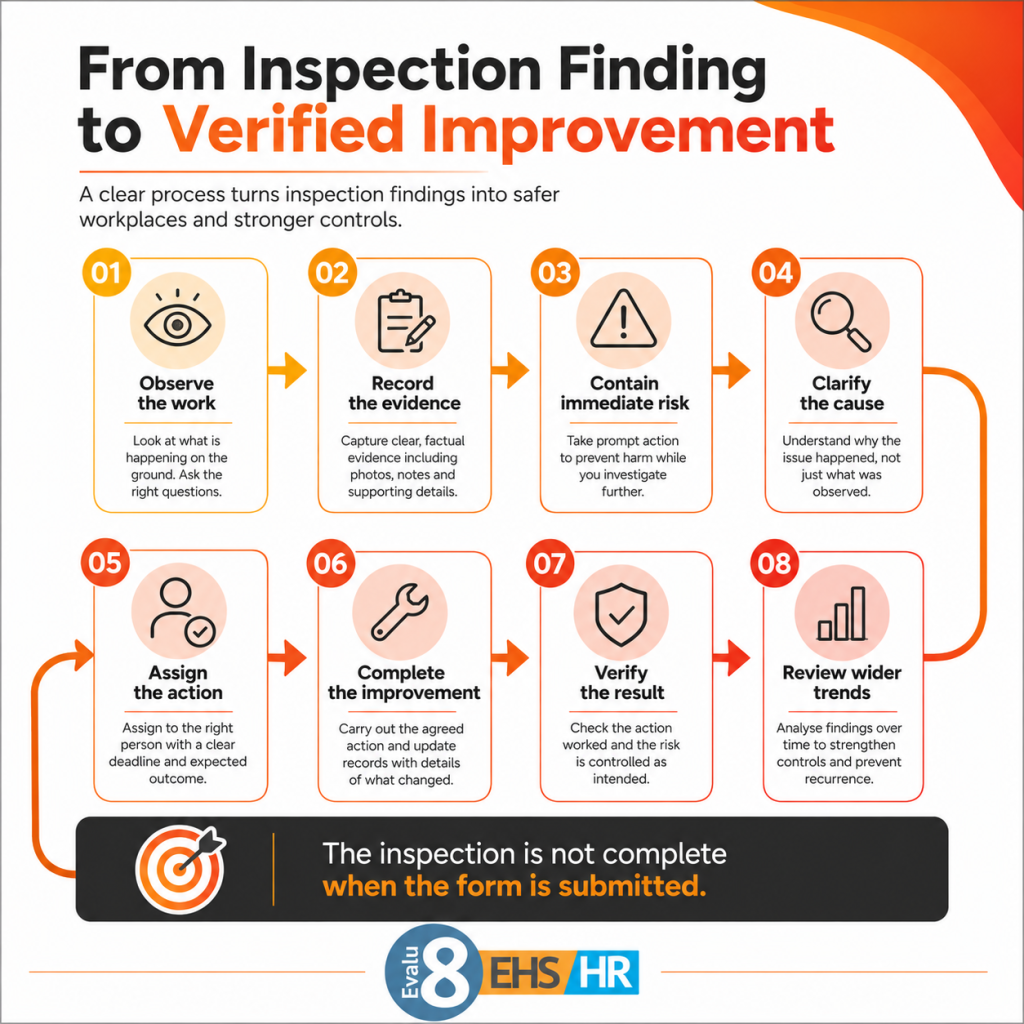
Giving every corrective action a named owner and a realistic deadline turns an inspection finding into work that can be managed and completed.
“Site team to monitor” is not a meaningful corrective action. It does not explain what must change, who is accountable for making it happen or when the issue should be resolved. When responsibility is shared too widely, people may assume that somebody else is dealing with it, allowing the risk to remain uncontrolled.
A meaningful action should state:
what needs to change;
who is responsible;
when it should be completed;
what evidence will demonstrate completion;
who will verify that the improvement works.
This creates a clear line of accountability. It allows managers to track progress, identify overdue work, escalate delays and check whether the action has genuinely reduced the risk. It also prevents findings from remaining open indefinitely or being closed simply because somebody has said the work is complete.
Where an issue presents an immediate danger, the relevant activity may need to stop or temporary controls may need to be introduced before the inspection continues. Lower-priority improvements can be completed over a reasonable period, provided the timescale is proportionate and any remaining risk is controlled.
The important point is that ownership, priority and deadlines should reflect the level of risk, not administrative convenience.
Verify improvements before closing findings
An uploaded photograph, invoice or written confirmation may show that somebody has done something. It does not always show that the risk has been adequately controlled.
Verification may involve:
- revisiting the area;
- observing the task;
- testing the control;
- reviewing an updated document;
- speaking to affected employees;
- confirming that temporary controls have been replaced;
- checking that the problem has not moved elsewhere;
- completing a focused follow-up inspection.
HSE guidance on workplace inspections involving safety representatives recommends allowing follow-up inspection so that representatives can check whether issues received appropriate attention. It also advises sharing the actions taken with relevant parts of the organisation.
The inspection process is not complete when an action is marked done. It is complete when the improvement has been checked.
Avoid judging inspection quality by the pass rate
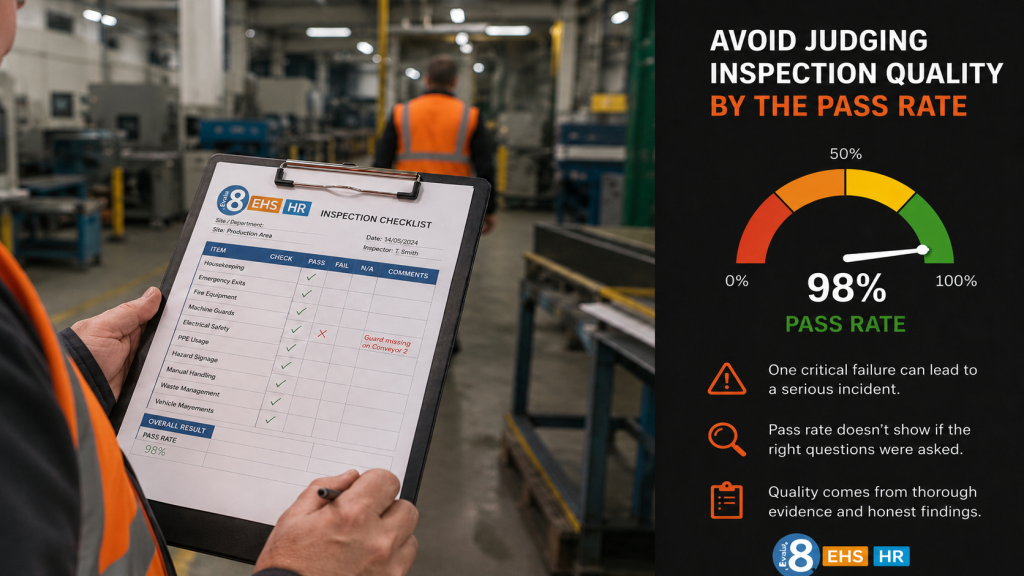
A high inspection pass rate can be reassuring, but it should never be treated as proof that workplace risks are being controlled effectively.
A pass rate only shows the proportion of questions that an inspector marked as satisfactory. It does not show whether the right questions were asked, whether significant risks were examined or how thoroughly the inspector tested each control.
A site could achieve a 98 per cent pass rate while still having one serious failure involving machinery guarding, vehicle movements, isolation or work at height. Equally, another site may report more findings because its inspectors are more willing to challenge weak controls and record what they actually see.
The number alone does not explain the quality of the inspection.
HSE’s Plan, Do, Check, Act approach places greater emphasis on monitoring whether processes and controls are working, identifying what caused problems and deciding what needs to change. Its leadership guidance also recommends considering preventive information alongside incident data and periodically examining the effectiveness of management arrangements and risk controls.
Why a high pass rate can be misleading
A high pass rate may genuinely reflect a well-controlled workplace, but the percentage alone does not prove that the inspection was thorough.
The result can also be influenced by broad questions, inconsistent standards or repeated checks of low-risk areas. Serious weaknesses may be hidden among many minor passes, while some inspectors may record failures as observations to protect the overall score.
A credible pass rate should therefore be supported by clear evidence that significant risks were examined, standards were applied consistently, and any weaknesses were properly recorded and followed through.
The questions are too broad
A question such as “Is the area safe?” is likely to produce a pass unless something is obviously wrong.
It does not direct the inspector towards specific controls, such as pedestrian separation, storage limits, machinery guarding, extraction, access to emergency equipment or the management of hazardous substances.
Broad questions make it easier to provide a positive answer without gathering much evidence.
Significant risks are hidden among minor checks
Not every inspection question carries the same importance.
A missing noticeboard document and a defeated machine interlock should not influence the overall result equally. Yet a simple percentage may treat both questions as one pass or one failure.
This can produce a strong headline result even when one of the failures has the potential to cause serious harm.
Inspection reporting should therefore retain information about the severity of findings. Otherwise, the percentage can conceal the issue that most needs attention.
Inspectors examine the easiest conditions
An inspection completed during a quiet period may miss what happens during:
- busy production;
- deliveries and collections;
- shift handovers;
- cleaning and maintenance;
- equipment changeovers;
- staff shortages;
- contractor activity;
- breakdowns or other interruptions.
The workplace may appear compliant when activity is limited, but the controls may become less reliable when time, space or resources are under pressure.
Inspection plans should deliberately include different shifts, activities and operating conditions rather than repeatedly examining the easiest version of the workplace.
Failures are being softened into observations
The language used in an inspection can significantly affect the reported result.
An inspector may record:
Consider improving storage in this area. That sounds like a general observation.
The actual evidence may be that materials are repeatedly obstructing a pedestrian route and forcing employees towards moving vehicles. In that case, the issue may represent a failed control rather than an optional suggestion.
Where inspectors are reluctant to record failures, the pass rate can rise without the underlying condition improving.
Standards are interpreted differently
One inspector may fail a damaged guard immediately. Another may pass it because the machine was not operating at the time. One may treat an obstructed fire exit as a failure. Another may record it as a housekeeping comment because the obstruction was removed during the visit.
Without clear pass-and-fail criteria, the score may reflect the inspector’s personal threshold as much as the condition of the workplace.
Calibration sessions can help. Inspectors can review photographs, example scenarios and previous findings together, then discuss what result should be recorded and why.
The aim is not to remove professional judgement. It is to reduce unnecessary variation in how standards are applied.
Familiar problems have become normal
When people see the same condition every day, it can gradually stop appearing unusual.
A temporary extension lead becomes part of the normal layout. A blocked route is accepted because materials are always delivered there. A missing guard is tolerated because the task is difficult to complete with it fitted.
The fact that something has happened repeatedly does not make it acceptable.
Changing inspectors occasionally, involving workers from another area, or completing cross-site reviews can help challenge conditions that local teams may have stopped noticing.
The same low-risk areas are repeatedly inspected
Completion data may show that every scheduled inspection has taken place, while giving little indication of what was actually covered.
If inspectors repeatedly focus on offices, welfare areas, signage and general housekeeping, important operational risks may receive much less attention.
Inspection coverage should be checked against the organisation’s risk profile. The question should not only be, “How many inspections did we complete?” It should also be, “Which significant risks did those inspections test?”
What should be measured alongside the pass rate?
The pass rate can remain part of the dashboard, but it needs context. On its own, it cannot show whether inspectors examined the most significant risks, gathered strong evidence or followed failed checks through to verified improvement.
A more informative dashboard should therefore combine the pass rate with measures such as the severity and recurrence of findings, action completion times, overdue high-risk actions, verification rates and inspection coverage across different sites, shifts and activities. Together, these indicators provide a clearer picture of inspection quality and whether the process is actually improving risk control.
Coverage of significant risks
Track whether inspections are examining the controls connected to the organisation’s main hazards.
For example, a manufacturing site may need visibility of machinery safety, isolation, lifting operations, vehicle movements, hazardous substances and maintenance activity. A facilities team may need stronger coverage of contractors, fire precautions, asbestos controls, work at height and building condition.
This helps distinguish a genuinely broad inspection programme from one that repeatedly checks easy or low-consequence items.
Quality of evidence
Review whether findings are supported by enough useful information to explain what happened and why action is required. This may include:
- a clear description of what was observed;
- a relevant photograph;
- the location and equipment involved;
- the people or activity affected;
- the expected standard;
- any immediate action taken.
Evidence should be specific rather than relying on vague statements such as “unsafe condition” or “guarding issue.” A finding should allow somebody who was not present during the inspection to understand the condition, assess its significance and decide what needs to happen next.
Good evidence also makes it easier to prioritise actions, investigate causes and verify that the problem has been properly resolved.
Severity of findings
Report findings according to their potential consequence and urgency rather than presenting every failure as equal.
A useful distinction may include:
- immediate danger requiring activity to stop or controls to be introduced;
- significant failure requiring urgent corrective action;
- control weakness requiring planned improvement;
- minor deviation that can be corrected through routine management.
The categories should be clearly defined and applied consistently across inspectors, departments and sites. They should reflect the level of risk, the reliability of existing controls and the speed at which intervention is needed.
Without a consistent severity system, serious issues can become lost among large numbers of low-priority actions.
Repeat findings
A recurring problem often reveals more about the effectiveness of the management system than a newly identified minor issue.
Repeat findings may indicate that:
- the original action addressed the symptom rather than the cause;
- the completed action was not verified;
- local managers do not have enough authority or resources;
- the standard is impractical;
- the same organisational weakness exists in several areas.
A finding that repeatedly disappears from the action list and then returns should not continue to be treated as a series of unrelated events. It should trigger a wider review of why the problem persists, whether previous controls were sustainable and whether similar conditions exist elsewhere.
Time taken to control serious risks
Measure the time between identifying a serious issue and containing the immediate danger.
This is different from the final action-completion date. A permanent engineering improvement may take time to design, approve and install, but the organisation should still be able to explain what temporary control was introduced and how quickly people were protected.
Temporary measures might include stopping the activity, isolating equipment, restricting access, increasing supervision or introducing an alternative working method. The key question is whether exposure to the risk was reduced promptly while the permanent solution was being developed.
Corrective-action ageing
An overall completion percentage can hide actions that have remained overdue for a long time.
Review:
- the number of overdue actions;
- how long they have been overdue;
- their risk priority;
- whether temporary controls remain suitable;
- why completion has been delayed;
- whether escalation has taken place.
Ageing should be considered alongside risk. Ten overdue minor administrative actions may require a different response from one overdue action involving a safety-critical control.
Long-running actions may also indicate unclear ownership, inadequate resources, weak escalation or repeated extensions without proper justification.
Verification rate
An action should not automatically be considered successful because somebody has marked it complete.
Measure how many completed actions have been independently checked and whether verification confirmed that the intended control was working. Verification may involve revisiting the area, testing equipment, observing the task, speaking to workers or reviewing supporting evidence.
HSE states that employers must review controls to make sure they are effective and should not rely purely on paperwork when the priority is controlling risks in practice.
A low verification rate can create a misleading impression of progress because actions may be administratively closed without confirming that the underlying risk has been controlled.
Recurrence after closure
Track whether the same problem returns after an action has been completed and verified.
This can help identify situations where the solution initially appeared effective but did not survive normal working conditions, changes in staffing, production pressure, or the passage of time.
Recurrence may show that the control was too dependent on individual behaviour, that the underlying cause was misunderstood, or that the improvement was not properly embedded into maintenance, training or supervision arrangements.
Learning transferred into the wider system
A strong inspection programme should influence more than the immediate action list.
Consider whether inspection findings have led to changes in:
- risk assessments;
- safe systems of work;
- training;
- supervision;
- procurement;
- maintenance schedules;
- contractor controls;
- workplace layouts;
- inspection questions at other sites.
Where a finding exposes a wider weakness, the organisation should consider whether the same issue could exist in other departments, activities or locations.
HSE describes health and safety management as an ongoing process in which organisations check that risks remain controlled and use reviews to shape the next stage of planning. Inspection findings should therefore contribute to wider learning, stronger standards and better future prevention.
Do not turn the pass rate into a target
Problems can arise when senior managers rank sites mainly by their percentage score or expect every location to improve its pass rate each month.
People usually respond to the measures used to judge them. If a low pass rate is treated as evidence of poor management, inspectors and site leaders may feel pressure to reduce the number of failures recorded.
The intended behaviour should be honest identification, prompt control and sustainable improvement.
A site that reports several well-evidenced findings and resolves them properly may be demonstrating stronger management than a site reporting almost no problems.
The goal is not to create more failures. It is to create a more reliable picture of how risk is being controlled.
Change the inspection when the workplace changes
An inspection checklist reflects what the organisation understood about its workplace when the questions were written.
The workplace may then change while the inspection remains the same.
New equipment arrives. Production volumes increase. A contractor takes over maintenance. Storage is moved. A different substance is introduced. Night shifts begin. Temporary employees carry out tasks that were previously completed by an experienced permanent team.
The old checklist may still be completed perfectly, but it may no longer test the controls that matter.
Health and safety management is not intended to be a one-off exercise. HSE advises organisations to review controls when they may no longer be effective and when changes to staff, processes, substances or equipment could introduce new risks. Accidents, near misses and concerns raised by workers should also prompt consideration of a review.
Regulation 3 of the Management of Health and Safety at Work Regulations 1999 requires a risk assessment to be reviewed where there is reason to suspect it is no longer valid or where there has been a significant change in the matters to which it relates.
Review inspections before planned changes
The best time to consider new risks is before the change is introduced.
For example, before installing new machinery, consider:
- how people will access and operate it;
- what guarding and protective devices are required;
- how energy will be isolated;
- how cleaning, adjustment and maintenance will be completed;
- whether the layout changes vehicle or pedestrian routes;
- whether additional competence or supervision is needed;
- what checks should be completed before first use;
- what needs to be added to future inspections.
This allows health and safety to be designed into the change rather than added after problems begin to appear.
HSE’s leadership guidance advises organisations to consider the impact of new procedures, work processes and products, and to report significant changes that could affect health and safety performance.
Look for gradual operational drift
Not every change is introduced through a formal project.
Some changes happen slowly:
- production targets increase;
- experienced staff leave;
- maintenance backlogs grow;
- temporary storage becomes permanent;
- a shortcut becomes accepted practice;
- an area begins handling a different type of work;
- supervision reduces on certain shifts;
- equipment is used for purposes that were not originally anticipated.
These changes may never appear on a formal change-control form, but they can still alter the risk.
Inspection questions should therefore ask what has changed since the previous visit, not only whether a planned project has been completed.
Speaking to employees is particularly useful here because they may be able to explain how the task, workload or equipment use has evolved.
Use incidents and findings to update the checklist
An incident, near miss or repeated finding should not only produce a corrective action.
It should also prompt the organisation to consider whether its inspection arrangements were capable of identifying the weakness earlier.
Ask:
- Did the existing checklist cover this control?
- Was the question specific enough?
- Had inspectors previously seen warning signs?
- Was the relevant task taking place during inspections?
- Does the same issue need checking elsewhere?
- Should the inspection frequency change?
- Does the inspector need additional knowledge or guidance?
HSE advises organisations to use incident investigations to identify why controls failed, determine what improvements are required and improve future risk control.
What should be changed in the inspection?
Updating an inspection does not always mean rewriting the entire checklist. The existing structure may still be useful, but parts of it may no longer reflect the work, risks or controls currently in place.
The review may lead to changes in the inspection scope, question wording, evidence requirements, timing, frequency or the competence needed to complete it. The aim is to keep the inspection relevant without creating unnecessary administration or losing useful consistency.
Scope
Add newly introduced hazards, equipment, contractors, activities or working areas.
Remove questions that are no longer relevant, but retain any historical information needed to understand previous findings.
Question wording
Replace broad questions with specific tests of the required control.
A new automated machine, for example, may require questions about guarding, interlocks, emergency stops, isolation, access arrangements and operator behaviour rather than one general question asking whether the machine is safe.
Evidence requirements
Decide what evidence the inspector needs.
This could include observing the equipment in use, speaking to the operator, testing a safety device, checking a record or attaching a photograph.
Inspection timing
Schedule the inspection when the relevant work is happening.
A contractor-control inspection has limited value if no contractors are present. A vehicle-safety inspection may need to take place during a delivery period. A shift-handover control should be examined during the handover itself.
Inspector competence
A significant technical change may require a specialist or a more experienced inspector.
The person completing the inspection should know what to look at, what to look for and what to do when a problem is found. HSE applies this competence principle to the inspection and maintenance of work equipment.
Follow-up arrangements
New controls may need closer attention during their early stages. A process may appear suitable during commissioning but create difficulties once normal production pressures, staffing patterns and maintenance needs emerge. Consider a focused follow-up inspection after an appropriate operating period.
Set inspection frequency according to risk and change
Inspection frequency should not be based only on a fixed calendar habit.
A monthly inspection may be suitable for one activity and inadequate for another.
More frequent checks may be needed where:
- the potential consequences of failure are serious;
- controls are vulnerable to damage or deterioration;
- work changes regularly;
- new equipment or processes are being introduced;
- inexperienced or temporary workers are involved;
- previous findings show weak performance;
- maintenance or corrective actions are overdue;
- the activity involves several contractors or teams;
- operating conditions vary significantly between shifts.
Less frequent formal inspection may be reasonable where the work is stable, risks are lower and other routine checks provide reliable assurance. For work equipment, HSE states that inspection frequency should reflect the type of equipment, how it is used and the conditions to which it is exposed. It also advises that inspections concentrate on safety-critical features and problems capable of creating significant risk. The same underlying principle is useful when planning broader workplace inspections: focus time and attention where control failure is most likely, or the consequences would be most serious. A checklist should provide consistency, but it should never prevent the inspection process from adapting to the workplace it is meant to examine.
Compare findings across time, teams and sites
Individual inspections show what was found on a particular occasion. The wider value appears when results are compared.
For example:
- Are vehicle and pedestrian separation issues appearing at several sites?
- Does the same piece of equipment repeatedly fail?
- Are findings concentrated on a particular shift?
- Are actions being completed but then raised again?
- Does one inspector report far fewer failures than everyone else?
- Are certain departments consistently late in completing actions?
These patterns may point to a problem with procurement, training, supervision, layout, workload or the inspection process itself. A repeated local finding may actually be an organisational issue.
Train inspectors to exercise judgement
A checklist cannot replace competence.
Inspectors need to understand:
- the hazards and controls relevant to the work;
- the limits of their own knowledge;
- how to gather and evaluate evidence;
- how to speak to employees constructively;
- how to distinguish a minor deviation from a serious failure;
- when immediate escalation is necessary;
- how to write a clear finding;
- how to challenge something that has become accepted practice.
Consistency does not mean removing judgement. It means giving competent people a consistent structure within which to apply it.
Software can help control checklist versions, schedule inspections, capture photographs, assign actions, monitor deadlines and compare findings. It cannot decide whether a question is suitable, whether evidence is convincing or whether the inspector is competent.
Those decisions still require practical health and safety judgement.
A practical test for your next inspection
Before signing off the next completed inspection, ask:
- Did we inspect the risks that matter most?
- Did we observe normal work taking place?
- Did we speak to the people doing the work?
- Did we gather evidence rather than rely on assumptions?
- Did we test whether controls were used and effective?
- Did every failed check explain what was actually found?
- Did serious issues receive immediate attention?
- Does every corrective action have an owner and deadline?
- Will someone verify that the improvement works?
- Have we looked for the same problem elsewhere?
When several of these questions cannot be answered, the inspection may be complete on paper but incomplete in practice.
Conclusion
Tick-box inspections are rarely fixed by adding more questions.
Longer checklists can make the problem worse if inspectors have more boxes to complete but no clearer understanding of what evidence to seek or what should happen when a standard is not met.
A useful inspection is risk-led, specific and evidence-based. It examines work as it happens, involves the people who understand it, records clear findings and follows improvements through to verification.
The checklist is only a guide. The real test is whether the inspection helps the organisation understand its risks and make the workplace safer.
A tick-box health and safety inspection records answers without properly testing whether relevant controls are present, used, effective and followed through. The document may be complete without providing a reliable picture of workplace risk.
Link inspection questions to significant risks, define the expected standard, observe work taking place, speak to employees and gather supporting evidence. Findings should lead to owned corrective actions that are verified before closure.
Evidence may include direct observations, photographs, employee explanations, maintenance records, training information, risk assessments and previous findings. The evidence required should be proportionate to the risk and the nature of the question.
The frequency should reflect the risk, complexity and rate of change within the workplace. Higher-risk activities, new processes, recent incidents and recurring failures may justify more frequent inspection.
Yes. Completion should be verified to make sure the action has addressed the finding and the control now works as intended. Verification may require a follow-up visit, observation, testing, document review or discussion with affected employees.