
The best health and safety audit software for a manufacturer is not necessarily the system with the largest library of factory checklists.
It is the system that helps the business identify a serious failure on the production floor, control the immediate risk, assign the permanent correction and verify that the same weakness is not appearing on another machine, shift, line or site.
A manufacturing audit programme may need to examine:
- Machine guarding and protective devices
- Emergency stops and isolation arrangements
- Planned and reactive maintenance
- PUWER inspections
- Lifting equipment and accessories
- Local exhaust ventilation
- Welding fume, dust and metalworking fluids
- COSHH controls and chemical storage
- Workplace transport
- Forklifts and material-handling equipment
- Contractor management
- Permits to work
- Shift handovers
- Training and authorisation
- Fire, explosion and emergency arrangements
- Previous incidents and near misses
- Outstanding corrective actions
- Whether written procedures match what people actually do
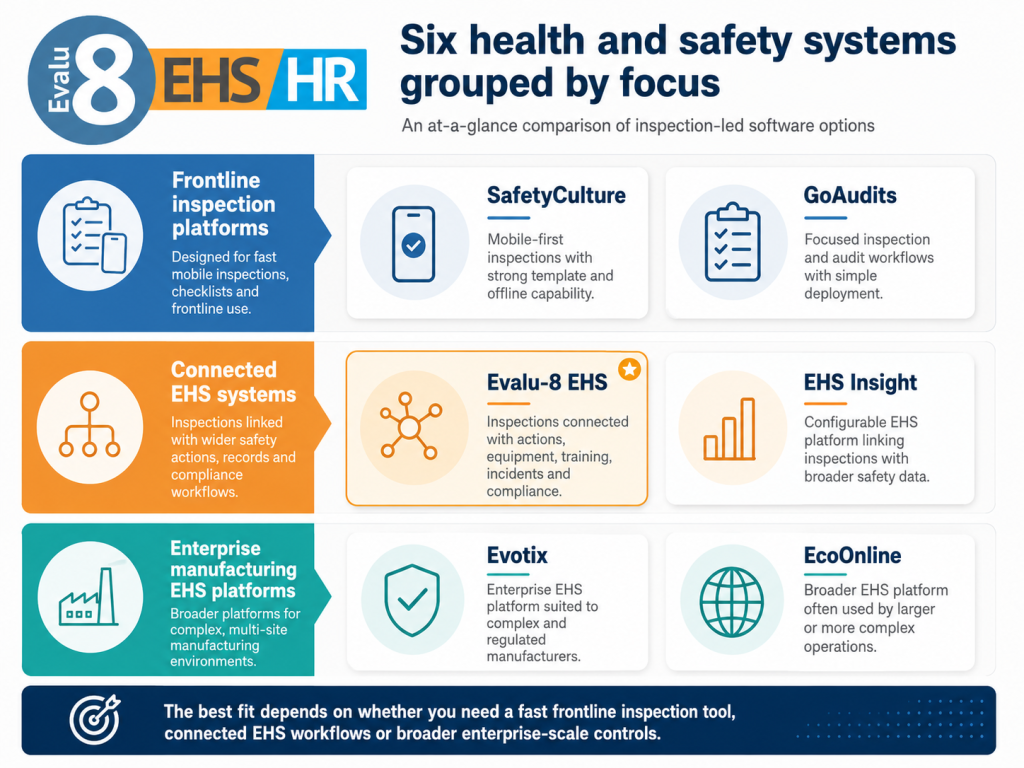
For UK manufacturers wanting audits connected with equipment, employees, incidents, contractors and corrective actions, Evalu-8 EHS is our best overall choice.
However, different systems suit different factory environments. SafetyCulture is particularly strong for broad frontline adoption across production teams. EHS Insight is a credible option for manufacturers wanting a more extensive industrial EHS platform. GoAudits provides a focused standalone audit application, while Evotix and EcoOnline are better suited to larger, more complex, or chemical-intensive manufacturing operations.
The best health and safety audit software for manufacturing at a glance
Compare six leading health and safety audit software systems for manufacturers, including their strongest use cases and published pricing information.
| Rank | Software | Best for | Published pricing |
|---|---|---|---|
| 1 |
Evalu-8 EHS
Best overall
|
UK manufacturers wanting audits connected with equipment, training, incidents and actions | Core EHS starts at £2.50 per licence per month, with a minimum of 10 licences. Audits and Inspections is an additional module. |
| 2 |
SafetyCulture
|
High-volume mobile checks across production lines and frontline teams | Free plan available. Premium full seats start from $24 per user per month when billed annually. |
| 3 |
EHS Insight
|
Mid-market industrial businesses wanting audits inside a wider EHS platform | Small and medium-business packages start from $5,000 per year. |
| 4 |
GoAudits
|
Manufacturers wanting a focused standalone audit and inspection application | Starter starts from $10 per user per month and Enterprise from $30 per user per month, billed annually. |
| 5 |
Evotix
|
Large, multi-site or international manufacturers | Tailored pricing, with implementation charged separately. |
| 6 |
EcoOnline
|
Chemical-intensive manufacturers and businesses already using the EcoOnline ecosystem | Bespoke pricing based on users, functions and configuration. |
Quick recommendation: Choose Evalu-8 when a finding needs to remain connected with the machine, employee, contractor, risk assessment or incident involved. Choose SafetyCulture when rapid shop-floor adoption and a broad inspection ecosystem are the priorities. Consider EHS Insight, Evotix or EcoOnline when the audit requirement forms part of a larger EHS technology programme.
Pricing and product information were checked against official supplier pages on 30 July 2026. Packages and licence models can change, so buyers should confirm current terms directly with each supplier before making a decision.
Why manufacturers need a different audit-software comparison
Manufacturing safety is shaped by the interaction between people, machinery, materials, maintenance and production pressure.
A site can complete every scheduled checklist and still have weak control if:
- Guards are removed to clear recurring blockages.
- Interlocks are defeated because they slow production.
- Emergency stops are checked, but defective machines remain available.
- Maintenance records are complete, but isolations are inconsistent.
- LEV checks are recorded without confirming whether extraction remains effective.
- Forklift defects are written down but not linked to the vehicle record.
- Contractors receive permits without suitable coordination.
- Night-shift employees follow a different method from the day shift.
- Actions are marked complete without checking the work.
- Similar failures appear across several machines without being recognised as a common problem.
HSE’s guidance for engineering workplaces identifies machinery, workplace transport, work at height, welding, metalworking fluids, manual handling, noise and hazardous substances as areas manufacturers should control. It also expects suitable maintenance and testing records for lifting equipment, pressure systems and extraction equipment.
A useful manufacturing audit system therefore needs to connect the inspection form with the operating environment around it.
The real control loop is:
Plan → schedule → inspect → gather evidence → classify → make safe → correct → verify → compare → improve
The form is only one stage.
What should manufacturing health and safety audits cover?
A manufacturing audit programme normally contains several different layers.
Machinery-safety audits
These may examine:
- Fixed and interlocked guards
- Light curtains and pressure-sensitive devices
- Emergency stops
- Isolation points
- Start and restart controls
- Access to dangerous parts
- Machine modifications
- Defeat or bypass of safeguards
- Cleaning and blockage-clearing methods
- Maintenance arrangements
- Operator training and authorisation
- Defect reporting
- Inspection and service histories
PUWER requires work equipment to be suitable and accompanied by appropriate safety measures. These normally include guarding, emergency stops, suitable isolation from energy sources, markings and warning devices.
The audit should not merely ask whether the machine “has guards”. It should test whether those guards are suitable, used, maintained and effective during real production.
Maintenance and isolation audits
Maintenance activity can introduce risks that are not present during normal operation.
A suitable audit may examine:
- Planning and authorisation
- Electrical isolation
- Mechanical isolation
- Hydraulic and pneumatic energy
- Steam, gas and pressurised systems
- Lock-off arrangements
- Stored energy
- Try-out or test procedures
- Contractor responsibilities
- Reinstatement and handback
- Shift communication
- Safe restart
HSE advises manufacturers to stop moving plant, isolate power supplies, lock off equipment where accidental reconnection is possible and isolate pressurised systems or pipelines containing hazardous substances.
The audit software should be able to show whether these arrangements are applied consistently across departments and shifts.
COSHH and occupational-health audits
Manufacturing exposure risks may arise from purchased chemicals or from the process itself.
Examples include:
- Welding fume
- Metalworking fluids
- Wood dust
- Silica dust
- Paints and coatings
- Solvents and cleaning products
- Adhesives and resins
- Oils and lubricants
- Mists, vapours and gases
- Skin exposure
- Noise and vibration
HSE states that hazardous substances can be created by cutting, grinding, welding and other production processes, even when the original product is not supplied with a hazard label.
A COSHH audit may test whether:
- Current assessments are available.
- The actual process is covered.
- Engineering controls are working.
- Employees understand the controls.
- Health surveillance is in place where needed.
- Storage and labelling are suitable.
- Exposure controls are reviewed after changes.
- Defects are reported and corrected.
LEV audits
LEV should not be reduced to a question asking whether the workshop has extraction.
The audit may need to examine:
- Whether the hood is positioned correctly
- Visible damage or disconnected ducting
- Airflow indicators
- Operator checks
- Cleaning and maintenance
- Defect labels
- Thorough-examination records
- Whether people continue using equipment after a failure
- Whether the system still controls the process effectively
HSE’s LEV guidance covers design, commissioning, testing, competence, maintenance schedules and the marking of defective equipment.
Workplace-transport audits
Many factories combine:
- Forklifts
- Pedestrian walkways
- Delivery vehicles
- Yard movements
- Loading areas
- Overhead cranes
- Mobile access equipment
- Temporary material storage
- Contractors
- Visitors
A workplace-transport audit may examine segregation, crossing points, speed controls, reversing, parking, lighting, visibility, vehicle condition and whether temporary stock has changed the intended route.
Contractor and permit audits
Contractors may work on machinery, electrical systems, roofs, extraction equipment, pressure systems or production lines.
A permit-to-work audit should examine more than whether the form has been signed.
It may need to test:
- The work scope
- Risk assessment and method
- Isolations
- Responsible people
- Time limits
- Simultaneous work
- Handover
- Suspension
- Extension
- Cancellation
- Safe return to production
HSE describes a permit to work as a formal system stating what work will be done, when it will be completed and which parts of the plant are safe. The responsible person should assess the work and confirm the precautions at each stage.
Management-system audits
A formal manufacturing audit may examine whether the site’s safety arrangements work as a connected system.
This could involve sampling:
- Risk assessments
- Training records
- Machine records
- Maintenance histories
- Inspections
- Permits
- Contractor documentation
- Incident investigations
- Corrective actions
- Shift handovers
- Management reviews
- Previous audit findings
The purpose is not to confirm that documents exist. It is to test whether they are suitable, understood and applied.
Audit, inspection, pre-use check and statutory examination are not interchangeable
Modern audit software can manage each type of record, but the business should not present them as the same activity.
Health and safety audit
An audit tests whether the organisation’s management arrangements and risk controls are effective.
A machinery-safety audit might examine:
- How machines are selected and introduced
- How guarding standards are defined
- Who approves modifications
- How defects are reported
- Whether previous findings were corrected
- Whether trends are reviewed
- Whether managers challenge unsafe behaviour
Workplace inspection
An inspection examines current conditions or work practices.
Examples include:
- A weekly machine-guarding inspection
- A monthly workshop inspection
- A daily housekeeping check
- A chemical-storage inspection
- A contractor work-area inspection
Pre-use check
A pre-use check is normally a short operational check completed before equipment is used.
It may confirm that:
- Guards are in place.
- Emergency stops are undamaged.
- Cables and hoses are secure.
- There are no obvious leaks.
- Controls respond correctly.
- The immediate area is safe.
Not every machine needs a long daily checklist. HSE explains that the required inspection should reflect risk and that a simple visual check may be sufficient in some cases.
Statutory inspection or thorough examination
Some manufacturing equipment is subject to specific examination duties.
Examples may include:
- Lifting equipment under LOLER
- Pressure systems under PSSR
- Power presses
- Local exhaust ventilation
- Certain electrical systems
The software may schedule these examinations and retain the reports.
It does not make an operator or supervisor competent to carry them out.
HSE distinguishes routine inspection and maintenance from the statutory thorough examination required for relevant lifting equipment.
How we compared the software
This article is published by Evalu-8, which provides one of the systems included in the comparison.
We have ranked Evalu-8 first, but have not treated it as the best choice for every factory or manufacturing group. The alternative systems were selected because they offer materially different strengths.
The comparison used twelve manufacturing-specific criteria.
1. Audit-programme planning
Can the system manage annual audits, recurring inspections, pre-use checks, equipment examinations and follow-up reviews without treating every activity as the same type of checklist?
2. Template governance
Can the central EHS team control approved questions while allowing justified additions for different plants, production lines, processes and equipment?
3. Machinery and asset context
Can the finding remain connected with the correct machine, extraction unit, forklift, lifting accessory, pressure system or production line?
4. Shop-floor usability
Can supervisors and employees complete checks quickly on phones, tablets or shared devices while wearing PPE and working in a production environment?
5. Offline access
Can inspections continue in shielded production areas, basements, remote yards or other low-signal locations?
6. Evidence quality
Can users attach photographs, annotated images, documents, notes, measurements and signatures to the exact finding?
7. Critical-failure rules
Can a failed guarding, isolation or emergency-stop question trigger immediate control rather than being hidden inside an overall percentage?
8. Corrective-action control
Can the finding be assigned to engineering, maintenance, production, facilities, procurement, a contractor or another responsible team?
9. Verification
Can a separate reviewer reject weak completion evidence and confirm that the control is now effective?
10. Shift and multi-site analysis
Can managers identify repeated findings by line, machine type, shift, department, contractor or site?
11. Wider EHS connection
Can findings connect with risks, incidents, training, equipment, COSHH, permits and documents?
12. Commercial and implementation fit
Does the access model work for auditors, managers, engineers, operators, contractors and occasional users?
We have not created a synthetic percentage score. The systems cover different product categories, and public feature pages do not prove that apparently similar functions behave in the same way.
The six best health and safety audit software systems for manufacturing
1. Evalu-8 EHS: Best overall for connected manufacturing assurance
Best for
UK manufacturers that want audits and inspections connected with machinery, equipment, employees, contractors, incidents and corrective actions.
Why Evalu-8 suits manufacturing
Evalu-8 allows manufacturers to create custom audit and inspection templates for different sites, departments, machines and risks.
Its manufacturing examples include:
- Machine-safety inspections
- PUWER pre-start checks
- COSHH workplace checks
- LEV inspections
- 5S and housekeeping audits
- Safety walks
Audits can be scheduled around sites, assets, risk levels and frequencies. Inspectors can record findings and evidence where the work happens rather than returning to an office to type up paper notes.
This provides practical workflows such as:
- Scanning a machine or asset to open the correct check
- Recording an annotated photograph of a damaged guard
- Assigning a failed LEV check to engineering
- Raising an urgent action from an unsafe isolation point
- Scheduling a follow-up inspection
- Comparing findings across several production sites
The main reason Evalu-8 ranks first is the connection between the audit and the rest of the EHS process.
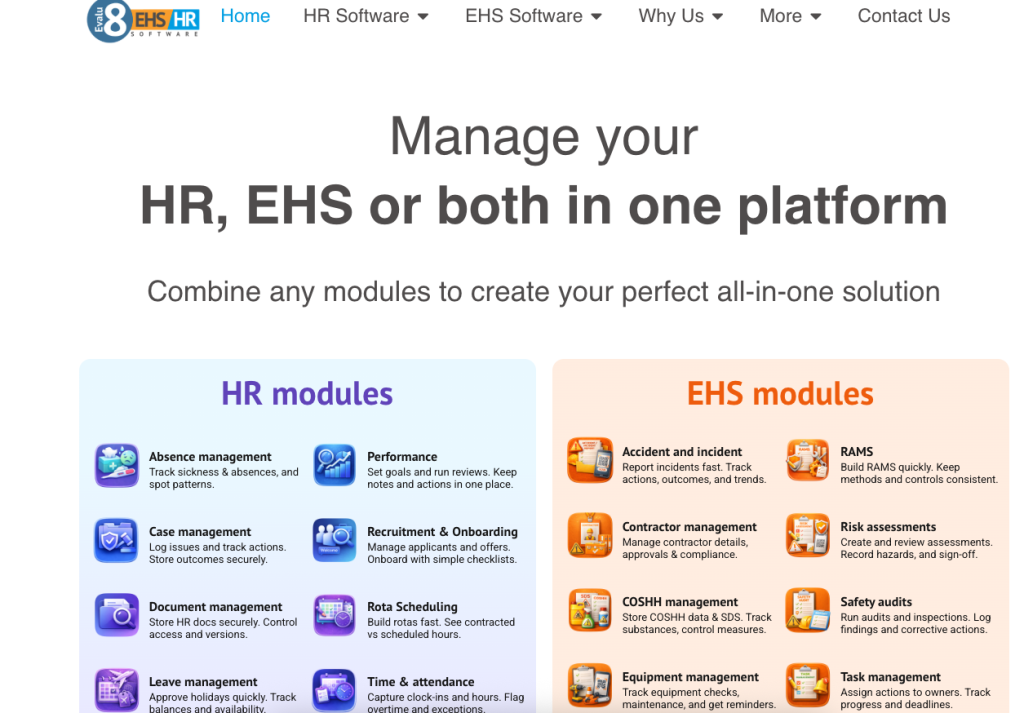
Core EHS includes:
- Equipment maintenance and management
- Personnel profiles
- Training management
- Contractor profiles
- Documents and electronic signatures
- Tasks
- Workflows and automation
- Dashboards and reporting
Audits and Inspections, Risk Assessments, COSHH and Accident and Incident Reporting can be added as modules.
This matters when a finding is not simply a checklist answer.
For example, an audit identifies that a CNC machine’s interlocked guard is being defeated.
The organisation may need to:
- Stop or restrict use of the machine.
- Record the immediate control.
- Link the finding with the machine record.
- Assign an engineering investigation.
- Review maintenance and defect history.
- Examine whether production pressure contributed.
- Review operator training.
- Update the risk assessment.
- Correct the safeguard.
- Verify the repair.
- Check similar machines.
- Monitor whether the behaviour returns.
A connected platform gives the manufacturer a clearer route through that process.
Pricing
Evalu-8 Core EHS starts at £2.50 per licence per month, with a minimum of 10 licences.
Audits and Inspections is an additional module, so manufacturers should request a complete quotation based on the number of EHS administrators, auditors, managers, engineers and frontline users required.
Strengths
- Manufacturing-specific audit and inspection examples
- Machine and asset context
- Equipment maintenance records in Core EHS
- Training and employee profiles
- Contractor-management records
- Corrective actions and tasks
- Evidence uploads
- Automated reminders
- Multi-site reporting
- Risk, COSHH and incident modules available
- Modular UK pricing
- UK-based product and support team
Limitations and questions to verify
- More system than a small workshop may need for a handful of routine checks
- Full Audits and Inspections pricing requires a quotation
- The manufacturer must design and govern suitable audit content
- Buyers should test their required verification and approval workflow
- Specialist statutory-examination systems may still be required
- Permit-to-work and maintenance-system integration should be tested against the existing factory process
- Agency-worker and contractor access should be confirmed
Demonstration test
Ask Evalu-8 to run an audit covering one packaging or assembly line.
Introduce:
- A missing fixed guard
- An emergency stop that is difficult to reach
- An overdue maintenance action
- An expired operator-authorisation record
- An LEV defect
- A contractor working under an incomplete permit
- A repeated housekeeping issue near a pedestrian route
The supplier should show how each finding is controlled, assigned, linked, escalated and verified.
Verdict
Evalu-8 is the strongest overall option for manufacturers that want audit findings to form part of the wider safety-management process.
It is particularly relevant to multi-site UK manufacturers that have outgrown paper checklists, maintenance spreadsheets and disconnected action trackers.
2. SafetyCulture: Best for frontline factory adoption
Best for
Manufacturers that need supervisors, team leaders, engineers and operators to complete a large volume of mobile checks across production lines.
Why SafetyCulture suits manufacturing
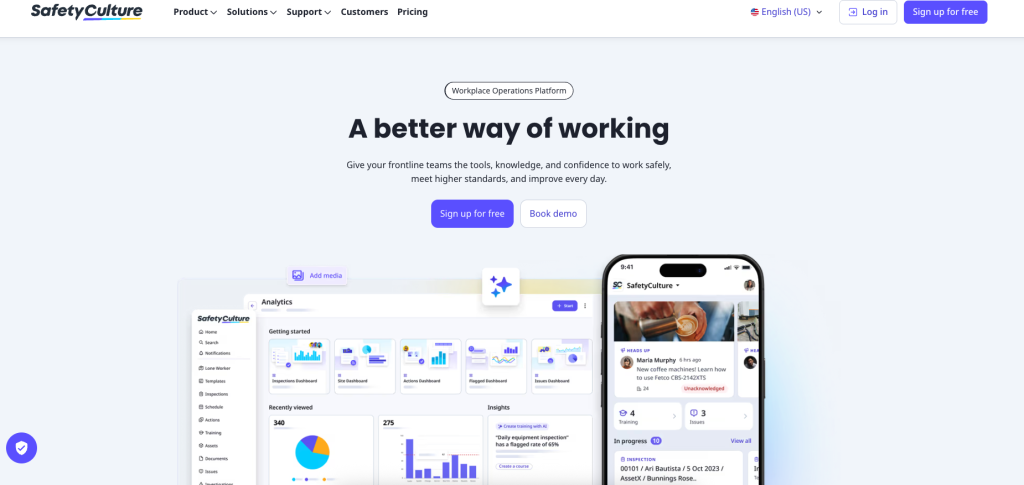
SafetyCulture provides a broad manufacturing operations platform covering inspections, issue reporting, actions, training, documents and asset-related workflows.
Its manufacturing pages describe uses including:
- Production-process audits
- Equipment inspections
- Safety-equipment audits
- Manufacturing-compliance checks
- Product inspections
- Maintenance activity
- Quality checks
- GMP and process audits
This breadth can suit manufacturers that want one accessible application for operational checks across safety, quality and production.
A shift supervisor might use the same platform for:
- A machine pre-start check
- A production-line audit
- A 5S inspection
- A food-safety check
- A maintenance handover
- An equipment defect
- A safety observation
SafetyCulture also supports organisation-wide template changes, allowing updated questions to be distributed across teams rather than leaving different departments with uncontrolled copies.
Pricing
SafetyCulture offers a Free plan, Premium and Enterprise packages.
The published Premium price for a full seat is $24 per user per month when billed annually. Different full, lite, and guest access types are available, so the manufacturer should map exactly what each group needs to do before calculating total cost.
Strengths
- Mature mobile inspection application
- Broad manufacturing workflows
- Safety and quality checks can share one platform
- Large template ecosystem
- Actions and issue reporting
- Training and communication functions
- Asset-related workflows
- Organisation-wide template updates
- Free entry option
- Suitable for high volumes of frontline activity
Limitations and questions to verify
- The seat structure needs careful modelling across large or seasonal workforces
- Public templates should be reviewed by a competent person
- Buyers should test formal audit scope, independence and verification requirements
- A large checklist ecosystem can create uncontrolled duplication
- Critical failures must remain visible outside overall scores
- The manufacturer should confirm how machine records and maintenance histories connect
- Formal EHS governance may require additional configuration or integrations
Demonstration test
Ask SafetyCulture to deploy a machine-safety and 5S programme across three production lines and two shifts.
The supplier should demonstrate:
- Shared tablets
- Operator and supervisor permissions
- Offline use
- Mandatory photographs
- Machine identification
- Critical-failure escalation
- Corrective actions
- Night-shift visibility
- Template updates
- Group reporting
Verdict
SafetyCulture is a strong choice when widespread shop-floor use is the main priority.
It is particularly relevant where safety, quality, housekeeping and operational checks need to be managed through one frontline application.
3. EHS Insight: Best mid-market industrial EHS platform

Best for
Manufacturers that want audit and inspection management as part of a broader incident, compliance, training and EHS-reporting system.
Why EHS Insight suits manufacturing
EHS Insight provides a dedicated Audit and Inspection Management module that centralises audits, inspections and assessments.
Its platform supports field activity through mobile devices, including offline operation, and is designed to connect audits with other EHS processes.
Published capabilities include:
- Custom audit and inspection forms
- Scheduled audits
- Assignments and notifications
- Corrective-action tracking
- Reports and dashboards
- Mobile evidence capture
- Offline access
- Incident management
- Training
- Risk and compliance workflows
EHS Insight also positions the platform for manufacturing operations, including recurring audits, compliance tasks and documented audit histories.
This may suit manufacturers with a more developed EHS team that wants a connected platform but does not necessarily require the scale or complexity of the largest enterprise systems.
Pricing
EHS Insight publishes a small and medium-business starting price of $5,000 per year.
Final pricing depends on the number of employees and contractors, selected modules, and implementation requirements.
Strengths
- Dedicated audit and inspection module
- Wider EHS platform
- Offline field use
- Custom forms
- Corrective actions
- Incidents and training connections
- Reports and dashboards
- Suitable for industrial and manufacturing environments
- Published starting price
- Modular configuration
- Small-business and enterprise routes
Limitations and questions to verify
- The starting price is higher than focused checklist applications
- Buyers need to confirm which modules are included
- UK terminology and legal workflows should be reviewed
- The implementation scope should be agreed before purchase
- The shop-floor experience should be tested with operators and supervisors
- Independent verification and effectiveness reviews should be demonstrated
- Integration with maintenance or manufacturing systems may require additional work
Demonstration test
Ask EHS Insight to connect:
- A machinery audit
- A near-miss record
- An operator-training record
- A corrective action
- A follow-up inspection
- A management dashboard
The supplier should show one connected history rather than separate records that require manual reconciliation.
Verdict
EHS Insight is a credible mid-market choice for manufacturers wanting audit software within a wider EHS platform.
It sits between a focused inspection application and a larger enterprise implementation.
4. GoAudits: Best focused standalone manufacturing audit application
Best for
Small and mid-sized manufacturers that want to replace paper forms and spreadsheets without implementing a full EHS platform.
Why GoAudits suits manufacturing
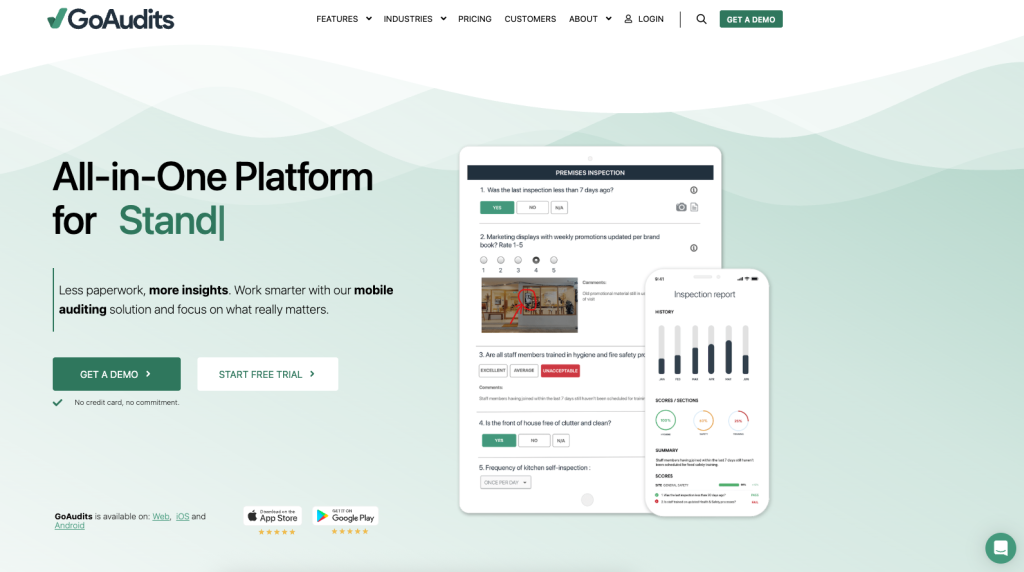
GoAudits is focused on digital audits, inspections, reports and corrective actions.
The mobile application works online and offline and supports:
- Custom digital checklists
- Photographs
- Image annotation
- Electronic signatures
- Conditional questions
- Mandatory questions
- Scoring
- Automatic reports
- Action plans
- Dashboard reporting
Its manufacturing content covers both production quality and operational inspections, making it relevant to businesses that want one application for:
- Factory safety inspections
- Machine checks
- 5S audits
- Production-process audits
- Housekeeping
- Product-quality checks
- Supplier checks
- Non-conformance reporting
- Corrective actions
GoAudits publishes manufacturing inspection pricing from $10 per user per month and provides a 14-day trial.
Pricing
The published annual plans are:
- Starter: $10 per user per month
- Enterprise: $30 per user per month
Enterprise adds functions such as roles, permissions, scheduling, notifications, advanced reports, and trend analysis.
Strengths
- Focused audit and inspection product
- Clear public pricing
- Online and offline operation
- Photographs and annotation
- Conditional and mandatory questions
- Automatic reports
- Corrective-action plans
- Safety and quality checks
- Relatively accessible implementation
- 14-day trial
- Suitable for small and mid-sized manufacturers
Limitations and questions to verify
- Scheduling and advanced reporting require the higher plan
- Broader EHS records may remain in other systems
- The link between a finding and a detailed machine record may be limited
- Formal CAPA and root-cause workflows should be tested
- Buyers should test independent close-out verification
- Central template governance must be checked across multiple plants
- Maintenance, training and contractor data may need integrations or parallel systems
Demonstration test
Ask GoAudits to configure three connected processes:
- Daily machine pre-use check
- Weekly production-area inspection
- Quarterly machinery-safety audit
A repeated guard defect should be visible in the formal audit and management report without manually combining exported files.
Verdict
GoAudits is one of the strongest options for a manufacturer that mainly needs to digitise audits and inspections.
Its product scope and pricing are easier to understand than many larger EHS platforms.
5. Evotix: Best for complex multi-site manufacturing groups
Best for
Large or international manufacturers requiring enterprise governance across several plants, regions and EHS disciplines.
Why Evotix suits manufacturing
Evotix provides audit and inspection functionality within a wider EHS and ESG platform.
Its manufacturing proposition covers:
- Incidents and near misses
- Audits and inspections
- Investigations
- CAPA
- Shift handovers
- Risk assessments
- Job-safety analysis
- Contractor management
- Training and competence
- Permit to work
- Chemical and SDS management
- Environmental reporting
- Multi-site analytics
The audit and inspection system uses shared templates, question libraries and risk scoring to improve consistency across sites. Evotix also supports mobile evidence and common close-out processes so results can be compared across plants.
This breadth makes Evotix particularly relevant to manufacturing groups that need central governance while allowing local differences between factories, countries and business units.
Pricing
Evotix uses tailored pricing based on users, sites, modules and implementation scope.
Implementation is charged as a separate one-off fee.
Strengths
- Manufacturing-specific enterprise positioning
- Complete audit and inspection lifecycle
- Shared templates and question libraries
- Risk scoring
- CAPA
- Shift handovers
- Contractor competence
- Permit-to-work functions
- Chemical and environmental management
- Multi-site analytics
- Enterprise configuration
- Suitable for global manufacturers
Limitations and questions to verify
- The implementation is likely to be more involved than a standalone audit app
- No standard public price
- Implementation is charged separately
- The business may need dedicated system administrators
- Frontline usability should be tested with factory employees
- Buyers should identify which features are standard and which require configuration
- The platform may be disproportionate for a smaller UK manufacturer
Demonstration test
Ask Evotix to manage one group audit standard across:
- A UK metal-fabrication plant
- A European assembly facility
- A food-production site
- A chemical-processing operation
- An outsourced manufacturing partner
The supplier should show central standards, local questions, multiple languages, contractor actions, CAPA and group-level trend reporting.
Verdict
Evotix is the strongest enterprise option in this comparison.
It is most suitable where manufacturing audits form part of a substantial international EHS programme.
6. EcoOnline: Best for chemical-intensive manufacturing
Best for
Manufacturers where chemicals, hazardous substances, occupational exposure, or environmental controls form a substantial part of the audit programme.
Why EcoOnline suits manufacturing
EcoOnline provides audits and inspections within a wider health and safety and chemical-management ecosystem.
Its audit system supports:
- Configurable audits and inspections
- Dynamic questions
- Automatic scheduling and tracking
- Mobile field completion
- Offline operation
- Detailed audit trails
- Non-conformity identification
- Central analytics
- Corrective actions
EcoOnline’s manufacturing proposition also includes:
- Incident management
- Risk management
- Chemical safety
- COSHH services
- Permit-to-work functions
- Contractor and frontline participation
- Environmental and sustainability management
This makes the platform relevant to manufacturing sectors such as:
- Chemicals
- Paints and coatings
- Pharmaceuticals
- Food and beverage
- Metal finishing
- Plastics and composites
- Waste processing
- Laboratories
- High-volume cleaning or disinfection operations
A chemical-storage audit, for example, may sit alongside the relevant risk, safety data and incident records rather than existing as a separate checklist.
Pricing
EcoOnline uses bespoke pricing.
The final cost depends on the functions, users and configuration included in the package.
Strengths
- Audits within a wider EHS ecosystem
- Chemical-safety capabilities
- Dynamic questions
- Automatic scheduling
- Mobile and offline inspections
- Non-conformity management
- Central analytics
- Risk and incident connections
- Permit and contractor functions
- Environmental modules
- Suitable for multi-site manufacturers
Limitations and questions to verify
- No public standard price
- The wider suite may be unnecessary for a narrow audit requirement
- Buyers should test finding classification and critical-failure rules
- Verification should be demonstrated rather than inferred from action tracking
- The package structure requires careful scoping
- The commercial case is likely to be strongest where chemical management is also being consolidated
- Smaller manufacturers may find a focused audit application easier to implement
Demonstration test
Ask EcoOnline to run an audit covering:
- Chemical receipt and storage
- COSHH assessments
- LEV
- Spill controls
- Waste handling
- Contractor maintenance
- Permit-to-work arrangements
- Corrective actions
- Environmental checks
The supplier should demonstrate how the audit findings remain connected with chemical, risk and incident information.
Verdict
EcoOnline is a logical shortlist option for chemical-intensive manufacturing operations.
It offers its greatest value when audits form part of a wider chemical, environmental and EHS technology decision.
Capability and fit comparison
Compare how six health and safety platforms support inspections, corrective actions, equipment, training and wider manufacturing workflows.
This table is based on publicly available information. Every critical workflow should be demonstrated using the manufacturer’s own machines, roles, and audit process.
Which audit software is right for your manufacturing business?
Choose Evalu-8 EHS when:
- Audits need to connect with machines and equipment.
- Training records are part of the evidence.
- Incidents should trigger reviews and actions.
- You operate several UK sites or departments.
- Contractors are involved in maintenance and installation.
- You want modular EHS software.
- Corrective actions currently sit in spreadsheets.
- You want one system without moving immediately to an enterprise implementation.
Choose SafetyCulture when:
- Large numbers of frontline employees complete checks.
- Mobile ease of use is the main priority.
- Safety, quality, and production audits overlap.
- You want a broad template ecosystem.
- Training and communication functions are useful.
- You can plan the seat structure carefully.
- Formal EHS data already exists elsewhere.
Choose EHS Insight when:
- You want audits inside a wider industrial EHS system.
- Incident, training and compliance processes also need improvement.
- Offline activity is important.
- You can justify an annual platform cost from $5,000.
- You need more depth than a checklist application.
- Your EHS team can support a structured implementation.
Choose GoAudits when:
- Your immediate problem is paper and Excel.
- You want transparent pricing.
- Safety and quality inspections use similar workflows.
- Offline completion is essential.
- You want to begin without replacing the complete EHS technology stack.
- Your asset and training connections are relatively simple.
Choose Evotix when:
- You operate a large international manufacturing group.
- Central and local audit standards need to coexist.
- CAPA, permits and contractor competence are important.
- Several EHS and ESG disciplines need one platform.
- You have dedicated system administrators.
- A formal enterprise implementation is proportionate.
Choose EcoOnline when:
- Chemical safety is central to the operation.
- COSHH, SDS and exposure records are also being reviewed.
- Audits must connect with environmental processes.
- You already use EcoOnline products.
- You need multi-site EHS standardisation.
- Bespoke enterprise or mid-market pricing is acceptable.
Questions to ask during a manufacturing audit-software demonstration
Do not allow suppliers to demonstrate a prepared office or housekeeping checklist.
Give every supplier the same realistic factory scenario.
For example:
A two-site manufacturer operates automated production lines, CNC machinery, welding bays, overhead cranes, forklifts and a maintenance workshop. Production runs across three shifts, with specialist contractors attending during planned shutdowns.
During the audit, the assessor identifies:
- A fixed guard removed from one machine
- An interlock being defeated during fault clearing
- An emergency stop blocked by stored material
- An overdue LEV examination
- An oil leak on a forklift
- An incomplete maintenance-isolation record
- A contractor working outside the permit scope
- Welding-fume controls used inconsistently
- An employee operating equipment without the expected authorisation
- Three previous actions marked complete without suitable evidence
Ask the supplier to show how the system would:
- Schedule the audit for the correct site and department.
- Identify the shift being audited.
- Use the current centrally controlled template.
- Add process-specific questions.
- Work without a reliable connection.
- Identify the individual machine.
- Attach and annotate photographs.
- Record employee interviews.
- Classify the missing guard as critical.
- Prevent a positive overall score from hiding it.
- Record that the machine was taken out of use.
- Record the immediate control for the blocked emergency stop.
- Link the LEV finding with the equipment record.
- Assign the forklift defect to transport or maintenance.
- Assign the permit issue to the responsible manager.
- Assign the competence issue to the appropriate manager.
- Set different priorities and deadlines.
- Notify an external contractor.
- Escalate overdue actions.
- Retain the link between actions and original evidence.
- Allow completion evidence to be uploaded.
- Let a reviewer reject inadequate evidence.
- Schedule effectiveness checks.
- Reinspect the affected machine.
- Identify similar guarding findings on another line.
- Compare results by shift.
- Trigger a risk-assessment review.
- Trigger an incident or near-miss workflow where appropriate.
- Produce a plant-management report.
- Produce a group-level report.
- Retrieve the complete audit history one year later.
A system that completes the first ten steps but cannot manage what happens afterwards is mainly digitising the checklist.
Why a high factory-audit score can still hide a critical risk
Percentage scoring is useful for comparing plants, departments, and audit periods.
It can also create false confidence.
Imagine an audit containing 100 questions:
- 96 questions pass.
- Three minor documentation questions fail.
- One machine is operating without a suitable guard.
- The final score is 96%.
The factory does not merely have a 4% improvement gap.
It has an immediate machinery-safety failure.
The software should allow the manufacturer to:
- Identify critical questions.
- Trigger an immediate-control field.
- Require evidence.
- Remove equipment from use.
- Notify responsible managers.
- Assign a high-priority action.
- Separate the audit score from the risk classification.
- Prevent unjustified “not applicable” answers.
- Report critical findings prominently.
- Schedule a follow-up check.
Scores should support judgement, not replace it.
Action completion is not the same as verified close-out
Suppose an audit identifies a damaged fixed guard.
The maintenance manager uploads a photograph and marks the action complete.
That does not necessarily prove that the machine is safe.
A suitable verification may need to establish:
- Is it the correct machine?
- Has the correct guard been installed?
- Is it securely fixed?
- Does it prevent access to the dangerous part?
- Has the interlock been tested?
- Were any control-system changes validated?
- Has the machine risk assessment been reviewed?
- Were operators informed?
- Was the machine formally returned to use?
- Have similar machines been checked?
- Has the reason for the original failure been addressed?
The software should allow a competent reviewer to reject the evidence and request further work.
An action marked complete tells management that somebody believes the task is finished.
A verified close-out provides evidence that the original weakness has been controlled.
How should a manufacturing audit programme be structured?
One large monthly factory checklist is unlikely to provide useful assurance.
A stronger programme contains several layers.
Layer 1: Operator pre-use checks
Short checks completed before a machine or vehicle is used.
Examples:
- Guards and protective devices
- Emergency stops
- Visible leaks
- Cables and hoses
- Warning devices
- Immediate work area
Layer 2: Supervisor inspections
Focused operational checks.
Examples:
- Production-area inspection
- Housekeeping check
- Machine-guarding inspection
- Chemical-storage check
- Forklift-route inspection
- Contractor work-area check
Layer 3: Technical inspections
Checks requiring greater technical competence.
Examples:
- Machinery-safety inspection
- LEV check
- Electrical inspection
- Lifting-accessory inspection
- Pressure-system examination
- Fire-protection inspection
Layer 4: Formal management audits
Audits testing whether the system works.
Examples:
- PUWER-management audit
- Contractor-control audit
- Permit-to-work audit
- Isolation audit
- COSHH-management audit
- Corrective-action audit
- Training and competence audit
- Group EHS audit
Layer 5: Statutory examinations
Specific examinations undertaken by suitable competent people according to relevant legal requirements.
The software may connect the schedules, records and findings.
It does not make the same person competent to complete every layer.
Do manufacturers legally need health and safety audit software?
No. Manufacturers are not generally required to purchase a particular audit-software product.
They still need suitable arrangements for managing risks and checking that safety controls are working.
HSE’s Plan, Do, Check, Act guidance states that larger organisations should have formal procedures for auditing and reporting health and safety performance. It also expects periodic audits of management structures and risk controls.
Software is a management decision.
It becomes more valuable when:
- Several sites use different audit templates.
- Production checks are missed.
- Machine defects remain on paper.
- Corrective actions sit in spreadsheets.
- Managers cannot compare shifts.
- Contractors own important actions.
- Maintenance and EHS data are disconnected.
- Repeat findings are difficult to identify.
- Supporting evidence is stored on personal phones.
- Senior leaders need consistent assurance information.
- Audit records must be assembled for customers, insurers, or regulators.
Can manufacturers use generic audit templates?
A generic template can provide a starting point.
It should not become the complete audit programme.
A food factory, engineering workshop, chemical plant, packaging operation and electronics manufacturer have different hazards.
Even two plants in the same group may have different:
- Machinery
- Processes
- Substances
- Layouts
- Extraction systems
- Maintenance arrangements
- Shift patterns
- Contractors
- Emergency systems
- Previous incidents
- Workforce experience
A useful template structure is:
Group-wide core
Questions covering leadership, risk, training, incidents, actions and management review.
Manufacturing-process modules
Questions covering machinery, maintenance, COSHH, transport, work at height, contractors or other major risks.
Site-specific questions
Questions reflecting local machines, processes, layouts and previous findings.
Temporary focus questions
Questions introduced after:
- An incident
- A machinery modification
- A new product
- A process change
- A regulator visit
- A repeated finding
- A production increase
- A contractor shutdown
This structure supports comparison without erasing local risk.
How often should manufacturing audits be completed?
There is no universal frequency for every audit and inspection.
The schedule should reflect:
- Level of risk
- Equipment use
- Deterioration
- Manufacturer instructions
- Legal requirements
- Previous findings
- Incident history
- Shift arrangements
- Workforce turnover
- Process changes
- Machinery modifications
- Contractor activity
- Production pressure
- Reliability of current controls
A daily operator check, weekly workshop inspection, annual management audit and statutory thorough examination should not share one frequency simply because each is recorded digitally.
Can AI create a manufacturing safety audit?
AI can assist with parts of the process.
Useful applications may include:
- Converting an existing checklist into a digital form
- Suggesting draft audit questions
- Translating instructions
- Summarising recurring findings
- Grouping issues by machine or site
- Identifying incomplete evidence
- Producing a first draft of a management report
- Highlighting previous actions that may need follow-up
AI cannot independently determine:
- Whether a guard is suitable
- Whether an isolation is secure
- Whether LEV is effective
- Whether a machine should remain in use
- Whether an employee is competent
- Whether a statutory examination is adequate
- Whether an auditor is sufficiently independent
- Whether a corrective action has controlled the risk
- Whether the manufacturer is legally compliant
AI-generated questions and summaries should be reviewed by somebody competent in the manufacturing process.
Implementation checklist for manufacturers
Before moving live, the business should:
- Map every audit, inspection and pre-use check.
- Remove duplicated forms.
- Separate operational checks from formal audits.
- Identify statutory and specialist examinations.
- Define the central template owner.
- Decide which questions sites may change.
- Define critical, major, minor and observation findings.
- Set immediate-control rules.
- Agree action-owner and verifier responsibilities.
- Define the process for taking equipment out of use.
- Configure escalation rules.
- Decide how contractors receive actions.
- Link sites, departments, lines and equipment.
- Import outstanding high-priority findings.
- Test offline use.
- Pilot one real production-area audit.
- Test a critical machine failure.
- Test an external contractor action.
- Test a rejected close-out.
- Train auditors, supervisors, and action owners separately.
- Review the first complete audit cycle.
- Check whether the software improves control rather than only reducing paperwork.
Final recommendation
Evalu-8 EHS is our best overall health and safety audit software choice for manufacturing businesses in 2026.
It supports the practical audit and inspection functions manufacturers need:
- Controlled templates
- Machine-safety checks
- PUWER pre-start checks
- COSHH workplace checks
- LEV inspections
- 5S and housekeeping audits
- Scheduling and reminders
- Evidence capture
- Corrective actions
- Multi-site reporting
Its main advantage is the wider connection.
A failed question can remain connected with:
- The machine
- The equipment record
- The employee
- The training history
- The contractor
- The incident
- The risk assessment
- The action
- The completion evidence
SafetyCulture is the strongest alternative for widespread frontline inspection use.
EHS Insight provides a credible connected mid-market EHS platform for industrial operations.
GoAudits is the clearest standalone option for manufacturers replacing paper and spreadsheets.
Evotix is best suited to complex international manufacturing groups.
EcoOnline deserves particular consideration where chemical safety and environmental management form a substantial part of the requirement.
The deciding question should not be:
Which platform gives us the most factory checklists?
It should be:
Which system helps us identify a serious failure, control the immediate risk, assign the permanent correction and prove that the same weakness is not appearing elsewhere?
That is the difference between completing audits and gaining useful manufacturing assurance.
Evalu-8 EHS is our best overall choice for UK manufacturers wanting audits connected with machinery, equipment, training, incidents and corrective actions. SafetyCulture is a strong frontline alternative, while GoAudits is a focused standalone audit application.
Useful functions include controlled templates, recurring schedules, machine and asset identification, mobile and offline access, photographs, critical-failure rules, corrective actions, escalation, verification and multi-site reporting.
Yes. Software can schedule and record PUWER-related checks, evidence and actions. The manufacturer must still decide what inspection is required and ensure that competent people complete it.
Yes. Short pre-use checks can be linked with machines, operators and defects. The check should remain proportionate and should not become a substitute for maintenance, guarding or supervision.
Software can schedule user checks, maintenance and examination records and retain evidence. It does not determine whether the LEV system is technically effective or replace competent examination.
See Evalu-8 in action
Fill in your details and we'll send you a personalised guided tour of the platform — no sales pressure, just a clear look at what Evalu-8 can do for your team.