The best health and safety audit software for a logistics operation is not necessarily the system with the largest checklist library.
It is the one that helps you identify a serious failure across a busy depot, distribution centre or warehouse, control the immediate risk, assign the permanent fix and prove that the same problem is not being repeated across other shifts or locations.
A logistics audit may need to examine:
Pedestrian and vehicle segregation
Forklift and material-handling equipment
Loading bays, dock levellers and trailer restraints
Pallet racking and storage systems
Goods-in and despatch areas
Yard traffic and reversing
Manual handling and order-picking activity
Battery-charging areas
Conveyors and automated equipment
Fire routes and emergency arrangements
Agency-worker induction and competence
Visiting drivers and third-party hauliers
Contractor activity
Cold stores or controlled-temperature areas
Overnight and weekend operations
Outstanding defects and corrective actions
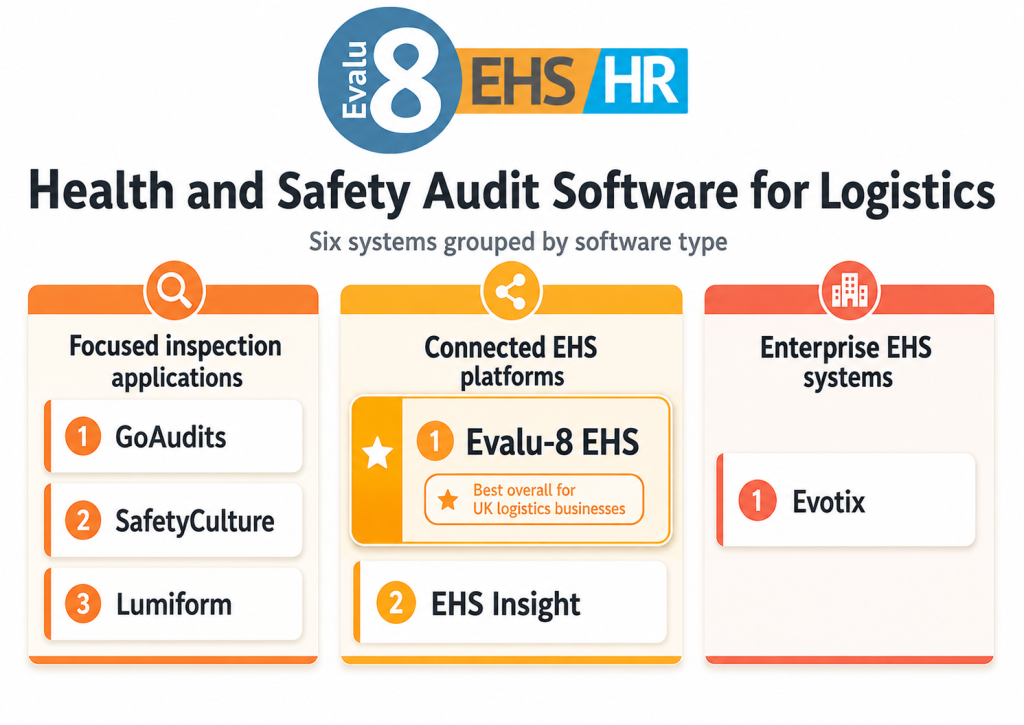
For UK logistics, warehousing and distribution businesses wanting audits connected with equipment, training, incidents, contractors and corrective actions, Evalu-8 EHS is our best overall choice.
However, several alternatives may suit a different operating model. GoAudits is particularly strong for companies wanting a focused logistics inspection platform. SafetyCulture is a good choice where large numbers of frontline employees need a mobile inspection application. Lumiform stands out for configurable multilingual workflows. EHS Insight and Evotix are broader EHS platforms suited to more complex or international operations.
The best health and safety audit software for logistics at a glance
| Rank | Software | Best for | Published pricing |
|---|---|---|---|
| 1 | Best overall Evalu-8 EHS | UK logistics businesses wanting audits connected with wider EHS management | Core EHS from £2.50 per licence per month, with a minimum of 10 licences. Audits and Inspections is an additional module. |
| 2 | GoAudits | Logistics and transport teams wanting focused digital inspections | Starter from $10 per user per month and Enterprise from $30 per user per month, billed annually. |
| 3 | SafetyCulture | Large-scale frontline and mobile inspection adoption | Free plan available. Premium full seats from $24 per user per month when billed annually. |
| 4 | Lumiform | Multilingual, offline fleet, warehouse and delivery workflows | Professional and Enterprise plans are available through quotation. |
| 5 | EHS Insight | Mid-market transport and logistics businesses wanting a wider EHS platform | Small and medium business packages from $5,000 per year. |
| 6 | Evotix | Large multi-site or international warehousing and distribution groups | Tailored pricing, with a separate implementation fee. |
Quick recommendation: Choose Evalu-8 when an audit finding needs to remain connected with the warehouse zone, equipment, employee, contractor, incident or corrective action involved. Choose GoAudits when the priority is a focused logistics inspection application. Consider SafetyCulture or Lumiform when frontline adoption across a large, distributed workforce is the main challenge.
Pricing and product information were checked against official supplier pages on 30 July 2026. Features, licence models and package contents can change. Buyers should confirm all critical requirements in a live demonstration and in the final contract.
Why logistics businesses need a different audit-software comparison
A logistics operation can look well controlled from an office dashboard while serious risks are developing on the warehouse floor or in the yard.
The work changes by the hour.
Vehicles arrive early or late. Loading bays become congested. Agency workers join during a seasonal peak. Damaged pallets enter the storage system. Forklift routes change when stock is staged temporarily. A contractor starts work near an operational conveyor. A night shift works with fewer managers available.
The audit programme needs to recognise the interaction between:
People
Vehicles
Storage
Equipment
Buildings
Contractors
Stock movements
Time pressure
Shift changes
Customer and carrier requirements
HSE’s warehousing guidance identifies manual handling, mechanical handling, workplace transport, work at height and emergency arrangements among the important risks found in storage and warehousing operations. HSE also says that separating pedestrians from vehicles is the most effective way to reduce workplace-transport conflict where this is reasonably practicable.
Loading and unloading creates its own set of pressures. HSE highlights moving vehicles, heavy loads, dock equipment, visibility, falls from loading bays and the need to keep people who are not involved away from the loading area.
A useful logistics audit system must therefore do more than offer a standard workplace checklist.
It should help the organisation understand whether safety controls remain effective during real warehouse and distribution activity.
What should logistics health and safety audits cover?
The exact audit programme depends on the operation, but most logistics businesses need several different levels of assurance.
Warehouse-floor audits
These may examine:
Pedestrian walkways
FLT operating areas
Blind corners
Crossing points
Aisle clearance
Housekeeping
Damaged pallets
Temporary stock storage
Fire exits
Emergency equipment
Conveyor guarding
Picking equipment
Mezzanine edges
Work-at-height controls
Racking and storage audits
These may examine:
Visible racking damage
Uprights, beams and bracing
Missing locking devices
Floor fixings
Load notices
Pallet quality
Overhanging or unstable loads
Unauthorised alterations
Impact protection
Reporting and isolation procedures
Outstanding repairs
Whether damaged areas have been returned to use appropriately
Material-handling equipment audits
These may include:
Forklifts
Reach trucks
Very-narrow-aisle trucks
Powered pallet trucks
Order pickers
Tug vehicles
Dock equipment
Vehicle-mounted equipment
Charging facilities
Attachments and lifting accessories
HSE states that lift trucks need regular safety inspection and maintenance, including essential daily pre-use checks for parts such as brakes and lights. These operational checks are separate from statutory thorough examinations of relevant lifting components.
Loading-bay and despatch audits
These can examine:
Vehicle approach and reversing
Driver waiting areas
Trailer immobilisation
Drive-away prevention
Dock levellers
Bay edges
Vehicle and dock-height differences
Lighting
Communication with visiting drivers
Pedestrian exclusion
Load security
Tail lifts
Trailer floors
Falls from vehicles or platforms
Damaged bay doors or shelters
Yard and depot audits
These may cover:
Traffic routes
Speed controls
One-way systems
Pedestrian segregation
Crossing points
Parking
Reversing areas
Trailer storage
Coupling and uncoupling
Lighting
Road-surface condition
Contractors
Visiting drivers
Emergency access
Seasonal weather risks
HSE recommends designing workplace transport arrangements to avoid reversing where possible, providing separate routes for pedestrians and vehicles, using suitable crossings and ensuring that traffic routes are adequately lit and maintained.
People and competence audits
These may examine:
Forklift training and authorisation
Refresher or reassessment arrangements
Manual-handling competence
Agency-worker induction
Contractor induction
Visiting-driver information
Shift handovers
Supervisor coverage
Young or inexperienced workers
Language and literacy needs
Emergency-role competence
Near-miss reporting
Whether unsafe practices are challenged
Management-system audits
A formal depot or group audit may test whether the organisation’s controls are functioning consistently.
It may sample:
Risk assessments
Workplace-transport plans
Previous inspection records
Equipment defects
Training records
Contractor records
Incident investigations
Maintenance records
Corrective actions
Management reviews
Previous audit findings
Whether written rules match actual work
Audit, inspection, pre-use check and thorough examination are not the same thing
These activities can all be recorded digitally, but they serve different purposes.
Health and safety audit
An audit evaluates whether the organisation’s safety arrangements are designed, implemented and working effectively.
A depot audit might ask:
Is there an effective workplace-transport plan?
Are routes being reviewed after layout changes?
Are lift-truck defects consistently reported and controlled?
Are supervisors checking unsafe driving behaviours?
Are previous racking findings closed properly?
Do agency workers receive suitable induction before entering operational areas?
Workplace inspection
An inspection looks at the condition of the workplace or operation at a particular time.
Examples include:
A weekly loading-bay inspection
A racking-damage inspection
A yard-safety walk
A fire-route inspection
A battery-charging-area check
A housekeeping inspection
Pre-use check
A pre-use check is a short operational check completed before equipment is used.
Examples include:
FLT brakes and steering
Warning lights
Fork condition
Tyres
Hydraulic leaks
Seat restraints
Audible alarms
HSE warns that checklists should be tailored to what is genuinely necessary for safety. Requiring too much detail too often can encourage superficial tick-box completion or cause the inspection activity to stop altogether.
Statutory inspection or thorough examination
Some equipment is subject to specific legal examination requirements.
Software may schedule the examination and retain its records. It does not make an ordinary supervisor or FLT operator competent to perform the examination.
The system should make these records easy to distinguish rather than presenting every check as the same type of audit.
How we compared the software
This article is published by Evalu-8, which provides one of the systems included in the comparison.
We have ranked Evalu-8 first because it offers the strongest overall fit for the buying situation described. We have not treated it as the best option for every logistics business.
Each supplier was assessed against a logistics-specific standard.
1. Multi-site audit planning
Can the organisation schedule different programmes for warehouses, depots, yards, cold stores, fleets, equipment and contractors?
2. Template governance
Can a central team control the core audit questions while allowing justified local additions for different buildings, layouts, equipment and operations?
3. Zone, asset and location context
Can findings remain attached to a particular bay, aisle, racking run, FLT, conveyor, yard area or piece of dock equipment?
4. Shift and frontline usability
Can employees complete checks quickly on phones, tablets or shared devices without leaving the operational area?
5. Offline capability
Can audits continue in cold stores, remote yards, trailers, basements or parts of the warehouse with unreliable signal?
6. Evidence quality
Can users capture photographs, annotations, signatures, measurements, notes and supporting documents against the exact finding?
7. Critical-failure handling
Can a serious finding trigger an immediate control, such as isolating an FLT, closing a bay or restricting access to damaged racking?
8. Corrective-action routing
Can the action be directed to the right warehouse manager, transport manager, facilities team, maintenance contractor, racking supplier or external carrier?
9. Verification
Can somebody assess the completion evidence and reject a weak close-out rather than automatically accepting it?
10. Multi-site analysis
Can the organisation identify repeat findings by site, shift, equipment type, zone, contractor or operating process?
11. Wider safety connection
Can audits connect with incidents, training, equipment, contractors, risk assessments and documents?
12. Commercial and implementation fit
Does the licence model work for managers, auditors, supervisors, employees, agency workers, contractors and occasional external users?
We have not created an artificial percentage score. Public product information can confirm available functions, but it cannot prove that a workflow will suit a particular distribution network.
The six best health and safety audit software systems for logistics
1. Evalu-8 EHS: Best overall for connected logistics safety assurance
Best for
UK logistics, warehousing and distribution businesses that want audit findings connected with equipment, employees, contractors, incidents and corrective actions.
Why Evalu-8 suits logistics operations
Evalu-8 lets organisations build structured audit and inspection templates with:
Questions and guidance notes
Mandatory fields
Evidence prompts
Conditional logic
Rated and weighted scoring
Photographs and video
Image annotation
Digital signatures
Corrective actions
Audits can be scheduled by location, asset, risk level or frequency. The mobile inspection workflow supports offline completion, allowing checks to be completed in poor-signal areas and synchronised when the connection returns. QR codes can also open the current checklist for a warehouse zone, asset or piece of equipment.
That creates practical logistics uses such as:
Scanning an FLT to open its pre-use check
Scanning a loading bay to open the correct bay inspection
Scheduling weekly yard inspections
Assigning monthly depot audits
Opening a racking inspection for the correct warehouse zone
Recording photographs against the exact failed question
Creating an action directly from a damaged barrier or dock leveller
Comparing findings across several depots
Evalu-8’s published warehousing inspection examples include:
Racking inspections
FLT and MHE pre-use checks
Loading-bay safety checks
Fire-safety checks
Manual-handling checks
Daily housekeeping audits
The main reason Evalu-8 ranks first is the wider connection.
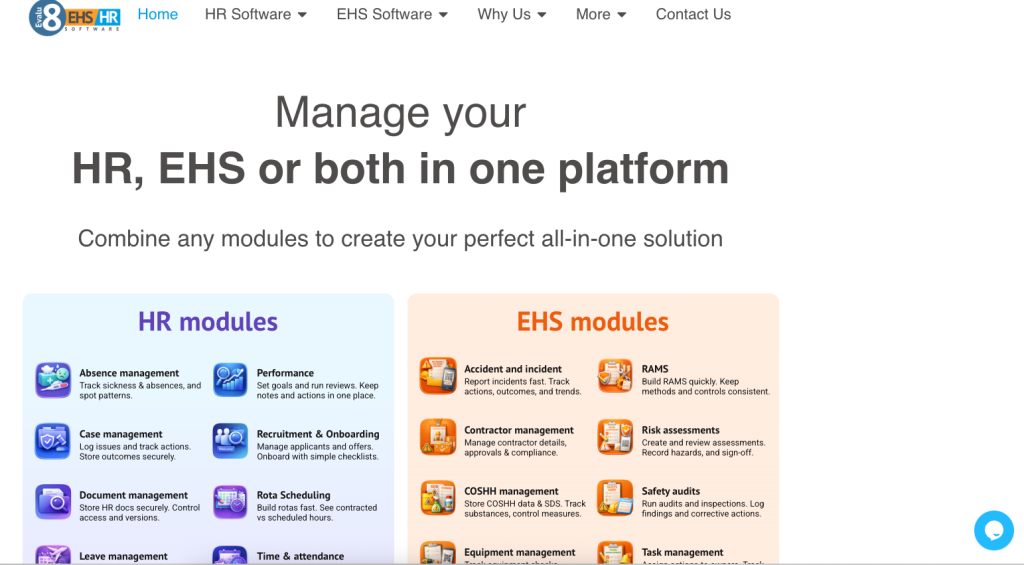
Core EHS includes:
Equipment maintenance and management
Personnel profiles
Training management
Contractor profiles
Documents and electronic signatures
Task management
Workflows and automation
Dashboards and reporting
Additional modules include incidents, risk assessments, RAMS, COSHH and Audits and Inspections.
This means a depot audit can draw on the underlying records rather than stopping at a checklist result.
For example, a finding involving repeated FLT damage could be reviewed alongside:
The equipment record
Previous defects
Maintenance information
Operator competence
Near-miss reports
Assigned actions
Findings at other locations
Pricing
Evalu-8 Core EHS costs £2.50 per licence per month, with a minimum of 10 licences.
Audits and Inspections is an additional module, so buyers should request a complete quotation covering auditors, supervisors, managers, equipment users and other employees who need system access. Evalu-8 states that training is included through its one-off setup fee rather than charged as a separate monthly training cost.
Strengths
Strong UK logistics and warehousing fit
Controlled audit templates
Conditional follow-up questions
Mandatory evidence prompts
Offline completion
Photographs, video and annotation
QR access by zone or asset
Weighted scoring
Corrective actions linked with findings
Scheduling by site, asset, risk or frequency
Equipment and training management
Contractor records
Incident and near-miss connections
Multi-site dashboards
Modular pricing
Limitations and questions to verify
It provides more functionality than a small single-site warehouse may need
Full Audits and Inspections pricing requires a quotation
The organisation must invest time in designing and governing its logistics audit templates
Buyers should demonstrate their preferred independent-verification process
Specialist transport compliance outside EHS may still sit within fleet or transport-management systems
The required access model for agency workers and external carriers should be confirmed
Demonstration test
Ask Evalu-8 to run a weekly depot audit covering:
Yard segregation
Loading bays
FLTs
Pallet racking
Conveyor guarding
Battery charging
Fire routes
Agency-worker competence
Introduce six findings:
A damaged racking upright
A blocked pedestrian crossing
A reversing alarm fault on an FLT
A leaking battery in the charging area
A defective dock-leveller lip
An agency worker operating equipment without the expected record
Ask the supplier to show how each finding is classified, controlled, assigned, escalated and verified.
Verdict
Evalu-8 is the strongest overall option for logistics businesses that want audit findings to remain connected with the rest of health and safety management.
It is particularly suitable for growing or multi-site UK operations that have outgrown paper, shared folders and separate action spreadsheets.
2. GoAudits: Best focused logistics inspection platform
Best for
Transport, warehouse, fleet and supply-chain teams that want a dedicated audit and inspection application without implementing a complete EHS suite.
Why GoAudits suits logistics operations
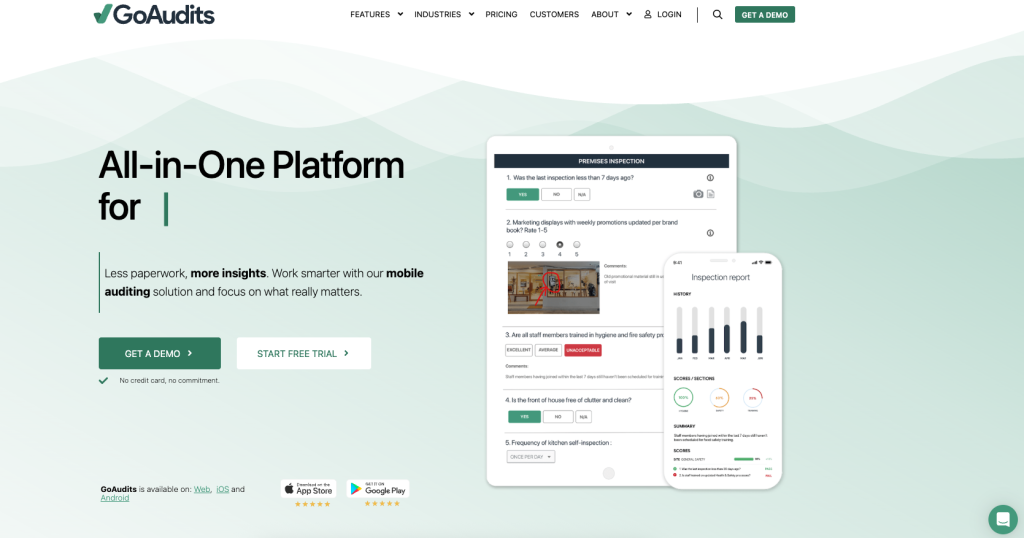
GoAudits has one of the clearest logistics-specific propositions in this comparison.
Its transport and logistics product supports:
HGV, van and trailer inspections
Forklift checks
Warehouse walkthroughs
Depot audits
Yard inspections
Loading-dock checks
Pre-departure inspections
Operator assessments
Equipment checks
Health and safety audits
Compliance and certification audits
The mobile application works online and offline. It supports photographs, annotations, GPS information, electronic signatures and automatic synchronisation when a connection returns.
GoAudits also provides:
Scheduled inspections
Automatic reminders
Instant reports
Dashboard comparisons
Corrective actions
External action owners
Completion photographs
Timestamps
Recurring-failure analysis
Its logistics library contains starting templates for vehicles, forklifts, loading docks, warehouses, and cold-storage checks. Buyers should still review every template against their own operation before use.
Pricing
GoAudits publishes two annual packages:
Starter: $10 per user per month
Enterprise: $30 per user per month
Starter includes online and offline auditing, reports and action plans.
Enterprise adds roles and permissions, schedules, notifications, advanced reports and trend analysis. UK customers may also be charged VAT.
Strengths
Clear logistics, fleet and warehouse focus
Dedicated inspection application
Fully offline mobile operation
Forklift, loading-dock and warehouse templates
Photographs, annotations, GPS and signatures
Automatic reports
Corrective actions
External action assignment
Multi-location dashboards
Transparent pricing
14-day trial
Suitable for safety and operational-quality audits
Limitations and questions to verify
The Starter plan does not include the full scheduling and advanced-reporting capability
Wider EHS records may remain in other systems
Buyers should test independent acceptance or rejection of completion evidence
Formal root-cause and CAPA requirements may need additional configuration
The connection between a finding and the underlying employee, asset or risk record may be more limited than in a wider EHS platform
Per-user pricing should be modelled carefully where many supervisors need regular access
Demonstration test
Ask GoAudits to configure three connected inspections:
FLT pre-use check
Weekly loading-bay inspection
Monthly depot-management audit
A failed FLT check should be visible in the depot audit and management dashboard without the team manually combining several reports.
Verdict
GoAudits is one of the strongest choices for a logistics company that primarily wants to replace paper and spreadsheets with a dedicated inspection platform.
It ranks above the larger checklist applications in this industry comparison because of its clear fleet, warehouse, dock, and depot positioning.
3. SafetyCulture: Best for large-scale frontline inspection adoption
Best for
Logistics groups that need large numbers of warehouse employees, drivers, supervisors and contractors to complete mobile checks.
Why SafetyCulture suits logistics operations
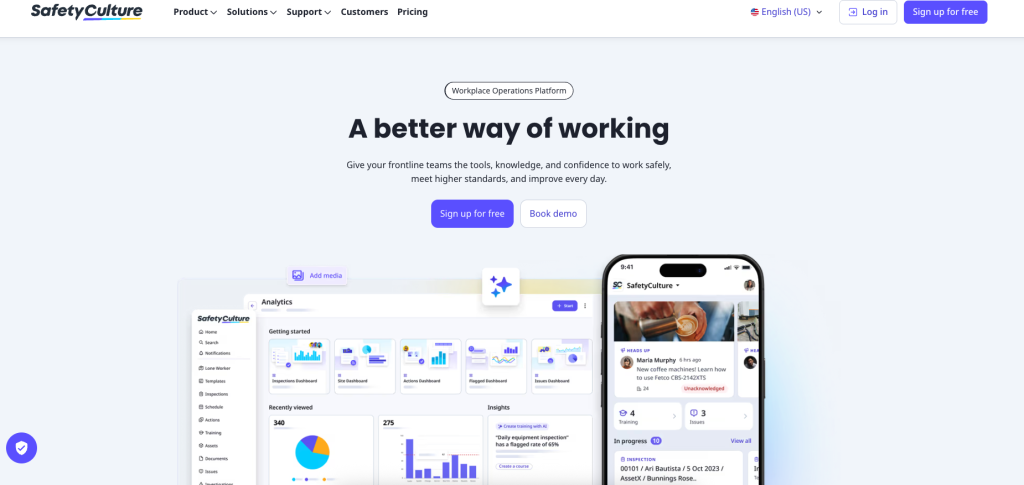
SafetyCulture is a mobile-first operational platform covering inspections, actions, issue reporting, training, documents and asset-related workflows.
Its transport and logistics proposition includes:
Safety audits and briefings
Inbound and outbound delivery inspections
Warehouse inspections
Vehicle checks
Issue reporting
Corrective actions
Its inspection application can be used online or offline from mobile devices.
SafetyCulture also has a large transport and logistics template library. Available examples include:
Warehouse-safety audits
Depot audits
Racking inspections
Loading-bay checks
Forklift checks
Inbound inspections
Trailer inspections
Many library templates are community supplied. They should be treated as editable starting points rather than approved standards for a particular warehouse.
SafetyCulture is likely to appeal where the organisation wants one simple frontline application for a large number of operational checks.
Pricing
SafetyCulture offers a Free plan and paid Premium and Enterprise packages.
The published Premium price for a full seat is:
$24 per user per month when billed annually
$29 per user per month when billed monthly
Different full, lite and guest access types are available, so buyers should map exactly what each user group needs to do before estimating total cost.
Strengths
Mature mobile inspection experience
Online and offline use
Large template ecosystem
Broad logistics use cases
Actions and issue reporting
Photographs and operational evidence
Scheduling
Analytics
Training and communications
Different access types
Free entry package
Suitable for safety, quality and operational checks
Limitations and questions to verify
The licence structure requires careful modelling across large or seasonal workforces
Community templates require competent review
Buyers should test formal audit scope, finding classification and close-out verification
A broad operational platform may not provide the EHS depth required for every long-term process
Critical findings must not disappear inside a positive overall percentage
The experience for temporary workers and external hauliers should be demonstrated
The organisation should confirm how its existing asset, incident and risk systems will connect
Demonstration test
Ask SafetyCulture to manage a seasonal peak in which 150 temporary employees are added across three distribution centres.
The supplier should demonstrate:
Induction checks
Shared-device access
Multiple languages
Warehouse inspections
FLT checks
Corrective actions
Manager visibility
Permissions
Removal of temporary access after the peak
Verdict
SafetyCulture is a strong option where broad frontline participation is more important than implementing one complete EHS record.
It should be tested carefully where the company also wants formal management-system audits and independent action verification.
4. Lumiform: Best for multilingual and highly configurable logistics workflows
Best for
Distribution networks with varied vehicles, depots, partners, languages, and inspection processes.
Why Lumiform suits logistics operations
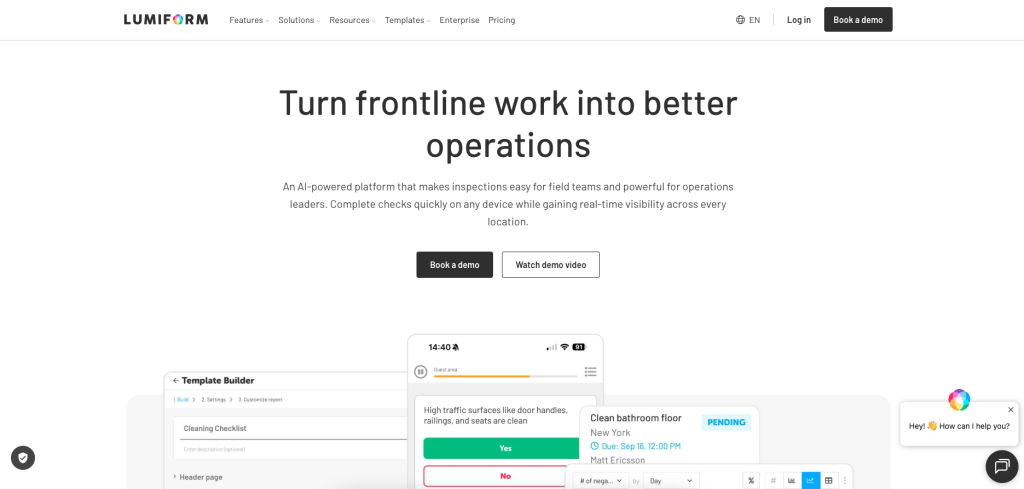
Lumiform provides a no-code form and workflow platform specifically positioned for transport and logistics.
It allows teams to create checks for:
Vehicles
Trailers
Warehouses
Deliveries
Pre-departure activity
Trailer handovers
Warehouse walks
Load security
Cleaning routines
Forklifts and equipment
Fleet and driver-safety routines
Checks can include mandatory photographs, signatures, conditional logic and different languages. Frontline users can complete them offline, with records stored locally and synchronised when reception returns.
When a user reports a defect, Lumiform can create an action with photographs, comments, an owner and a deadline. Reports can be generated automatically and structured data exported into other reporting or business-intelligence tools.
This may suit logistics groups where existing forms vary significantly by:
Vehicle type
Depot
Country
Contract
Carrier
Warehouse process
Customer requirement
Pricing
Lumiform offers Professional and Enterprise packages through quotation.
Professional includes its form builder, unlimited templates, analytics, permissions and reporting. Enterprise adds approvals, integrations, API access, webhooks, single sign-on, advanced support and onboarding. Some Enterprise functions can be purchased as Professional add-ons.
Strengths
Strong transport and logistics positioning
Flexible form creation
Offline mobile completion
Mandatory photographs and signatures
Conditional questions
Multiple languages
Vehicle, warehouse and delivery workflows
Automatic action routing
External action owners
Clean data exports
BI and integration options
Useful for mixed safety and operational checks
Limitations and questions to verify
Standard public pricing is not displayed
Approval workflows may require Enterprise or an add-on
Highly flexible forms require strong central governance
Formal audit classification and verification should be tested
The organisation must prevent individual depots from creating uncontrolled versions
UK legal terminology and specialist inspection requirements need competent review
The system may digitise a weak existing checklist unless the organisation redesigns the process first
Demonstration test
Give Lumiform four variations of a loading-bay inspection:
Standard warehouse
Cold store
Parcel hub
Third-party operated depot
Ask the supplier to preserve one central standard while showing only the questions relevant to each environment and language.
Verdict
Lumiform is a strong choice for logistics networks that need flexibility and multilingual frontline use.
It is most suitable where the organisation has the internal resources to govern templates, data and workflows properly.
5. EHS Insight: Best mid-market connected EHS platform
Best for
Transport and logistics organisations wanting audit management, incident reporting, training and compliance functions inside a broader EHS platform.
Why EHS Insight suits logistics operations
EHS Insight has a dedicated transportation and logistics proposition covering audits, incident reporting, risk assessment, compliance and reporting.
The platform is mobile-ready and works offline, allowing employees to complete audits and inspections where connectivity is unreliable.
Its Audit and Inspection Management module includes:
Automated notifications
Assignments and escalations
Offline field audits
Customisable templates
Reports and dashboards
Corrective-action follow-through
Connections with incidents, training and other EHS modules
Photographs, comments and supporting documents
EHS Insight may suit businesses that need to manage more than warehouses alone, such as:
Transport fleets
Rail activity
Distribution sites
External carriers
Workshops
Remote yards
Contractor operations
Several regulatory environments
Pricing
EHS Insight publishes small and medium business pricing starting at $5,000 per year.
Final pricing depends on employee and contractor numbers, selected modules, and implementation requirements. Enterprise packages include additional configuration, support and test-environment options.
Strengths
Dedicated transportation and logistics positioning
Wider EHS platform
Offline mobile access
Custom audit templates
Automated assignments and escalations
Photographs and documents
Reports and dashboards
Incident and training connections
Modular implementation
Public starting price
Suitable for field and depot operations
Broader compliance-management capability
Limitations and questions to verify
Pricing is higher than focused checklist applications
The starting package may not include every module required
UK buyers should confirm legal terminology, support coverage and data requirements
The implementation scope should be defined before signing
Formal close-out verification should be demonstrated
The organisation should test ease of use with warehouse supervisors and drivers, not only system administrators
It may be more platform than a smaller distribution company needs
Demonstration test
Ask EHS Insight to connect:
A depot audit
A reported vehicle near miss
A driver-training record
A corrective action
A follow-up inspection
The supplier should show one connected history rather than five separate records.
Verdict
EHS Insight is a credible option for mid-market logistics operations that want a wider EHS platform and can justify a larger annual investment.
Its logistics positioning and offline capability make it more relevant than a generic enterprise compliance system.
6. Evotix: Best for complex multi-site and international distribution networks
Best for
Large warehousing, logistics and distribution groups requiring enterprise audit programmes across several countries, divisions and operating models.
Why Evotix suits logistics operations
Evotix has a dedicated warehousing proposition for high-volume and multi-site operations.
Its wider platform can support:
Incidents and near misses
Hazards
Audits and inspections
Investigations
Contractor management
Training and competence
Risk assessments
Compliance obligations
Environmental data
Management dashboards
Its audit and inspection system covers the complete programme:
Set audit scope and cadence
Build shared templates and question libraries
Schedule audits by role or location
Complete audits online or offline
Capture photographs, notes, voice memos and signatures
Create corrective and preventive actions
Track owners and deadlines
Compile evidence
Review repeat findings by area, asset or shift
This depth can suit global distribution groups that need central standards with local flexibility.
Pricing
Evotix uses tailored pricing based on:
Number of users
Number of sites
Modules
Operational complexity
Implementation requirements
Implementation is charged as a separate one-off fee.
Strengths
Strong warehousing positioning
Enterprise audit-programme management
Central templates and local delivery
Online and offline mobile auditing
Corrective and preventive actions
Repeat-finding analysis
Contractor and training management
Incident and risk connections
Multi-site and international configuration
Management dashboards
Broader environmental and sustainability capabilities
Suitable for complex distribution networks
Limitations and questions to verify
Implementation is likely to be more involved than with a focused inspection application
No standard public price
Implementation is charged separately
The organisation may need dedicated system administration
The frontline warehouse experience should be tested carefully
The proposed configuration may be disproportionate for a smaller UK logistics business
Buyers should identify which requirements are standard and which require custom configuration
Demonstration test
Ask Evotix to run a group audit programme across:
Two UK distribution centres
One European warehouse
A third-party logistics provider
A transport depot
A cold-storage facility
The supplier should demonstrate central standards, local questions, multiple languages, external actions, repeat-finding analysis and group reporting.
Verdict
Evotix is the strongest enterprise option in this shortlist.
It is best suited to organisations where logistics audits form part of a broader global EHS programme rather than a standalone checklist project.
Capability and fit comparison
| Requirement | Evalu-8 | GoAudits | SafetyCulture | Lumiform | EHS Insight | Evotix |
|---|---|---|---|---|---|---|
| Warehouse-specific checks | Strong | Strong | Strong template ecosystem | Strong | Configurable | Strong |
| Fleet and vehicle inspections | Configurable | Strong | Strong | Strong | Strong | Strong |
| Offline completion | Yes | Yes | Yes | Yes | Yes | Yes |
| QR access by zone or asset | Yes | Verify | Available workflows | Strong | Verify | Verify |
| Conditional questions | Yes | Yes | Yes | Yes | Configurable | Yes |
| Corrective actions | Yes | Yes | Yes | Yes | Yes | Yes |
| External action owners | Confirm access model | Yes | Depends on seat/access | Yes | Verify | Configurable |
| Independent verification | Demonstrate | Demonstrate | Demonstrate | Approval configuration | Demonstrate | Strong enterprise fit |
| Equipment records | Core EHS | Inspection-led | Asset functions | Entity and form based | Wider modules | Wider modules |
| Training records | Core EHS | Assessment-led | Training available | Workflow based | Wider module | Wider module |
| Incident management | Additional module | Form and workflow based | Issue reporting | Configurable | Wider module | Wider module |
| UK mid-market fit | Strong | Strong | Strong | Strong | Moderate | Enterprise |
| Published entry pricing | Yes | Yes | Yes | No | Yes | No |
This table is based on publicly available supplier information. Every high-priority workflow should be demonstrated with the organisation’s own roles, checklist and evidence.
Which audit software is best for your logistics business?
Choose Evalu-8 EHS when:
You want audits connected with equipment, training and incidents
You operate several UK warehouses or depots
FLT, racking and loading-bay checks are central
You want QR access for zones and assets
Corrective actions currently sit in spreadsheets
You need offline warehouse inspections
You want modular EHS software rather than a large enterprise programme
Choose GoAudits when:
Your primary requirement is digital audits and inspections
Warehouse, vehicle, and fleet checks all need one application
You want transparent pricing
Offline field use is essential
External people need to receive actions
You want to begin without replacing every existing EHS system
Choose SafetyCulture when:
A large frontline workforce needs one mobile application
Safety and operational-quality checks overlap
You want a large template ecosystem
Training and communications are also useful
Seasonal or distributed teams are central to the operation
You can plan the seat structure carefully
Choose Lumiform when:
Your workforce uses several languages
Different depots need different conditional workflows
Drivers, warehouse employees and cleaners use the same system
Mandatory photographs are important
Data must feed into external BI tools
You have the internal resources to govern a flexible platform
Choose EHS Insight when:
You want audits inside a wider EHS programme
Incidents, compliance and training also need improvement
You operate depots and field or transport activity
Offline access is necessary
You can justify an annual platform investment from $5,000
You want a modular mid-market platform
Choose Evotix when:
You operate a large or international distribution network
Central and local audit programmes must coexist
Contractor and third-party logistics audits are important
CAPA and repeat-finding analysis are required
You have internal platform administrators
A structured enterprise implementation is proportionate
Questions to ask during a logistics audit-software demonstration
Do not let suppliers demonstrate a prepared office checklist.
Provide the same representative distribution-centre scenario to every company.
For example:
A 24-hour regional distribution centre operates 30 loading bays, high-bay pallet racking, conveyors, reach trucks, powered pallet trucks and a mixed permanent and agency workforce. The site also receives third-party drivers and has a separate transport yard and battery-charging room.
During the audit, the assessor identifies:
A damaged racking upright
A forklift with a failed warning beacon
Pallets temporarily blocking a pedestrian crossing
A dock leveller with a damaged lip
A visiting driver walking through a live loading area
An acid leak near a battery-charging station
An overdue fire-door action
An agency worker whose equipment authorisation cannot be confirmed
Ask the supplier to show how the software would:
Schedule the audit for the correct site and shift.
Load the current centrally approved template.
Add local questions for that building.
Work without reliable reception.
Record the exact warehouse zone.
Scan or identify the relevant FLT.
Capture and annotate photographs.
Treat the damaged racking as a critical finding.
Prevent a high overall score from hiding that finding.
Record immediate isolation of the racking area.
Remove the defective FLT from service.
Record the temporary control around the dock leveller.
Assign the battery leak to the appropriate responsible team.
Assign the visiting-driver issue to transport management.
Give each action a different priority and deadline.
Send an action to an external maintenance provider.
Escalate overdue actions.
Retain the link between each action and the original evidence.
Allow completion photographs and documents to be uploaded.
Let a reviewer reject inadequate evidence.
Record final verification.
Schedule a follow-up inspection.
Identify similar findings at another depot.
Link the equipment findings with asset records.
Link the competence issue with the worker record.
Trigger an incident or near-miss workflow if required.
Produce a regional management report.
Retrieve the full history one year later.
A system that performs the first eight steps but cannot manage the rest is mainly replacing the clipboard.
Why a high warehouse audit score can still be dangerous
Percentage scoring is attractive because it allows managers to compare depots.
It can also hide serious failures.
Imagine a warehouse audit with 100 questions:
96 questions pass
Three minor housekeeping questions fail
One racking upright has serious impact damage
The score is 96%
The warehouse does not simply have a 4% improvement opportunity.
It has a storage-system defect that may require immediate control and competent assessment.
The software should allow the organisation to:
Mark safety-critical questions
Trigger immediate-control fields
Prevent completion until required evidence is added
Exclude isolated equipment or areas from use
Apply appropriate finding classifications
Separate the percentage score from the risk priority
Handle “not applicable” properly
Escalate critical findings immediately
Report major findings above overall averages
The score should support the auditor’s judgement, not replace it.
Action completion is not the same as verified close-out
Consider a damaged racking upright.
The maintenance manager uploads a photograph and marks the action complete.
That does not necessarily prove the risk has been controlled.
Verification may need to establish:
Was the affected area isolated immediately?
Were pallets removed safely?
Was the damage assessed by a suitable person?
Was the correct component repaired or replaced?
Does the photograph show the correct aisle and bay?
Was the repair completed in line with the racking supplier’s requirements?
Was the area formally released back into use?
Were nearby bays inspected for related damage?
Did the investigation identify why impacts are happening?
Are barriers, traffic routes, FLT practice or reporting arrangements contributing to the problem?
The software should allow a reviewer to reject poor evidence and request further information.
A completed action tells you that somebody says the work is finished.
A verified close-out tells you that the original safety concern has been addressed.
How should a logistics audit programme be structured?
One giant monthly warehouse checklist is rarely the best design.
A stronger programme uses several layers.
Layer 1: Operational pre-use checks
Short checks completed before equipment or processes begin.
Examples:
Forklift pre-use check
Dock-leveller check
Vehicle pre-departure check
Conveyor start-up check
Powered-pallet-truck check
Layer 2: Routine workplace inspections
Focused checks completed by supervisors or nominated employees.
Examples:
Loading-bay inspection
Racking-damage inspection
Yard walk
Housekeeping inspection
Fire-route check
Battery-charging-area check
Cold-store check
Layer 3: Formal site audits
Broader reviews testing whether the management arrangements are working.
Examples:
Depot health and safety audit
Workplace-transport audit
Contractor-management audit
Training and competence audit
MHE management audit
Corrective-action audit
Layer 4: Technical and statutory activity
Specialist examinations and assessments completed by suitable competent people.
Examples may include:
Thorough examinations
Specialist racking inspections
Fire-risk assessment reviews
Electrical inspections
Pressure-system checks
Lifting-equipment examinations
The software can connect the records, schedules and actions.
It does not make the same person competent to perform every layer.
Do logistics businesses legally need audit software?
No. Health and safety audit software is not a general legal requirement.
Logistics employers still need suitable arrangements for assessing risk, controlling workplace transport, maintaining equipment, providing training and monitoring whether controls remain effective.
Software is a management decision.
It becomes more valuable when:
Several depots use different checklists
Inspections are regularly missed
FLT defects are recorded on paper
Racking photographs are stored in personal phones
Loading-bay actions sit in emails
Agency-worker records are hard to retrieve
Managers cannot see repeat findings
External contractors own significant actions
Audits happen across several shifts
Evidence must be assembled for clients, insurers or regulators
Senior leaders need consistent data across the network
Can generic warehouse-audit templates be used?
A generic template can provide a starting point.
It should not be accepted without review.
A parcel hub, ambient warehouse, cold store, chemical warehouse and palletised distribution centre have different risks.
Even two similar warehouses may differ because of:
Layout
Racking
Vehicle routes
Equipment
Automation
Shift patterns
Staffing models
Product type
Temperature
Loading-bay design
Contractor arrangements
Fire strategy
Building age
A practical structure is:
Group-wide core questions
The controls that every depot must examine.
Operation-specific modules
For racking, MHE, loading bays, cold storage, conveyors or hazardous substances.
Site-specific questions
For local routes, machinery, emergency arrangements and previous concerns.
Temporary focus questions
Introduced after incidents, layout changes, peak periods or repeated findings.
This approach gives management comparable data without removing local risk.
How often should warehouse safety audits be completed?
There is no single frequency that suits every audit, inspection and equipment check.
The schedule should reflect:
Risk
Equipment use
Manufacturer instructions
Legal requirements
Previous findings
Damage history
Shift patterns
Traffic volume
Seasonal peaks
Workforce turnover
Changes in layout
Contractor activity
Incident and near-miss trends
Reliability of existing controls
A daily FLT check, routine loading-bay inspection, formal depot audit and statutory equipment examination should not be placed on the same schedule simply because they all use digital forms.
Can AI create a logistics safety audit?
AI can help with parts of the process.
Useful applications may include:
Converting an existing checklist into a digital form
Suggesting draft warehouse questions
Translating instructions
Grouping repeat findings
Summarising depot trends
Identifying incomplete evidence
Producing a first draft of a management report
AI cannot independently determine:
Whether pedestrian segregation is effective
Whether racking damage is acceptable
Whether an FLT should remain in service
Whether the audit sample is representative
Whether an employee is competent
Whether a technical repair is adequate
Whether an action has controlled the original risk
Whether the organisation is legally compliant
Generated questions and summaries should be reviewed by someone who understands the operation.
Implementation checklist for logistics businesses
Before launching the software:
Map every existing audit, inspection and pre-use check.
Remove duplicate forms.
Separate operational checks from formal audits.
Identify statutory or specialist records.
Define the group-wide template owner.
Decide which questions individual sites may change.
Define critical, major and minor findings.
Set immediate-control rules.
Agree action-owner and verifier responsibilities.
Define the process for taking equipment or areas out of use.
Set escalation rules for overdue actions.
Decide how agency workers and contractors will access the system.
Link locations, zones and equipment where possible.
Import outstanding high-priority actions.
Test the application offline.
Pilot one complete distribution-centre audit.
Test an external contractor action.
Test a rejected close-out.
Train auditors, supervisors and action owners separately.
Review the first live audit cycle before expanding.
The implementation should improve the control process, not simply move old forms onto a screen.
Final recommendation
Evalu-8 EHS is our best overall health and safety audit software choice for logistics, warehousing, and distribution businesses in 2026.
It supports the practical functions logistics teams need:
Controlled templates
Warehouse and equipment checks
Conditional questions
Weighted scoring
Offline completion
QR access
Photographs and annotations
Corrective actions
Scheduling and reminders
Multi-site reporting
Its main advantage is the wider connection.
The finding can remain connected with:
The warehouse or depot
The equipment
The employee
The contractor
The incident
The training record
The corrective action
The supporting evidence
GoAudits is the strongest focused inspection alternative and has particularly relevant warehouse, loading-dock, forklift and transport workflows.
SafetyCulture is a good choice where broad mobile participation and template availability are the priorities.
Lumiform is particularly relevant to multilingual networks with varied forms and integration needs.
EHS Insight provides a credible connected EHS option for mid-market transport and logistics businesses.
Evotix is best suited to complex multi-site or international distribution groups.
The deciding question should not be:
Which system gives us the most warehouse checklists?
It should be:
Which system helps us find a serious failure, control the immediate risk, assign the permanent fix and prove the same problem is not being repeated across our network?
That is the difference between completing inspections and gaining useful safety assurance.
Evalu-8 EHS is our best overall choice for UK logistics businesses that want audits connected with equipment, employees, contractors, incidents and corrective actions. GoAudits is a strong standalone inspection option, while SafetyCulture suits larger frontline user groups.
Useful capabilities include recurring schedules, controlled templates, mobile and offline access, photographs, conditional questions, asset and zone identification, critical-failure rules, corrective actions, escalation, verification and multi-site reporting.
Yes. Several platforms can manage FLT pre-use checks and defect reporting. The organisation must still define a suitable checklist, ensure defects are controlled and meet separate inspection, maintenance and thorough-examination duties.
Yes. Software can schedule inspections, identify the aisle and bay, record photographs, assign repairs and retain evidence. It does not determine whether damage is technically acceptable or replace specialist competence where required.
Yes. QR codes can open the correct checklist for a particular loading bay, dock leveller, zone or piece of equipment. The organisation should make sure the code always opens the current approved form.
See Evalu-8 in action
Fill in your details and we'll send you a personalised guided tour of the platform — no sales pressure, just a clear look at what Evalu-8 can do for your team.