
Replacing a fan coil above an empty office and replacing the same unit above a working reception are not the same job. The technical method may be familiar, but the people exposed, access route, noise, dust, segregation, and emergency arrangements have changed.
Occupied-building RAMS need to deal with the client’s operation as part of the work environment. That includes employees, visitors, residents, patients, pupils, customers and other contractors who may not understand the hazards or follow construction-site behaviour.
Learn how the building actually operates
Before writing the final RAMS, confirm who uses the area, when it is busiest, how people move through it, and which activities cannot be interrupted. Ask about vulnerable occupants, fire routes, security, deliveries, cleaning, alarms, critical rooms and other work planned nearby.
Do not treat “work outside normal hours” as a complete control. Out-of-hours work can introduce lone working, reduced client support, locked access, different emergency contacts, and poor lighting. The method needs to reflect the actual operating window.
Build the work zone around people, not only equipment
Define how the area will be separated, who controls the barrier, and what happens if an occupant needs access. Consider falling tools or materials, trailing leads, open ceiling voids, hot surfaces, cylinders, sharp materials and the movement of replacement units.
HSE guidance on protecting the public emphasises preventing unauthorised access and explaining relevant site rules to people who are authorised. In an occupied building, that means agreeing the boundary with the client and ensuring normal building users cannot wander into an HVAC work area because a lightweight sign has moved.
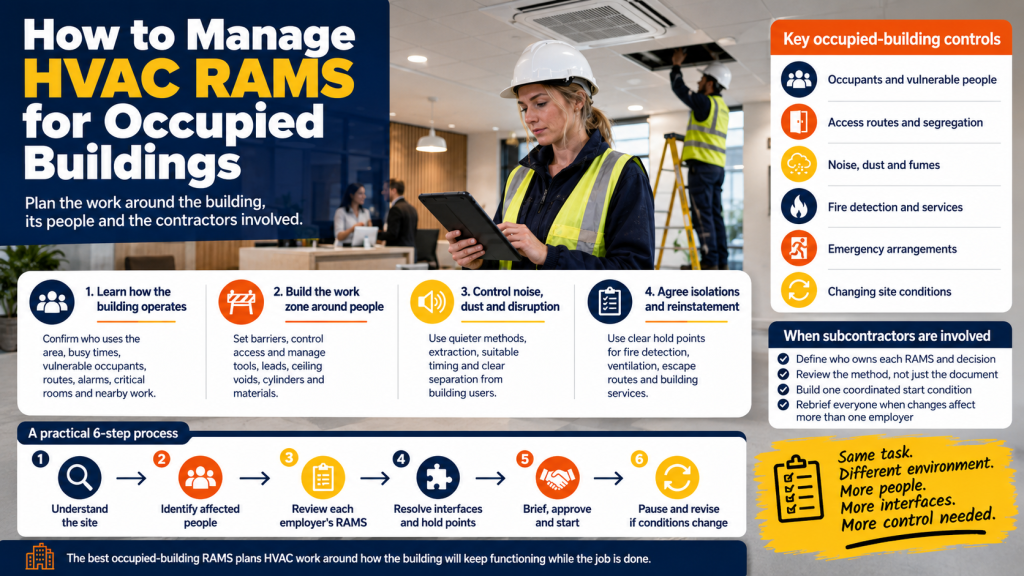
Control noise, dust and disruption at source
Drilling, cutting, lifting and commissioning can affect people beyond the immediate work zone. Plan quieter methods or equipment where reasonably practicable, local extraction or dust control, suitable barriers, and timing around sensitive operations.
HSE guidance places elimination and reduction before reliance on personal protective equipment for noise and dust. In an occupied environment, hearing protection issued to the engineer does nothing for the receptionist, patient or customer on the other side of the barrier.
Where work affects fire detection, compartmentation, escape routes, ventilation or building services, agree the isolation and reinstatement process with the responsible client representative. The RAMS should include clear hold points rather than assuming the engineer can disable or restore a system independently.
Keep the conditions under review
Occupied areas change during the day. A quiet corridor can become a delivery route, a meeting room can fill and another contractor can remove part of the agreed segregation.
Give the supervisor authority to pause the affected work when the boundary or operating condition no longer matches the RAMS. Minor adjustments may be recorded locally where the organisation permits, while material changes should trigger review and reapproval.
Evalu-8 EHS can keep the site-specific RAMS, supporting plans, revisions and engineer acknowledgement connected. This helps the business show how the method changed when client operations required a different access window or work zone.
The best occupied-building RAMS does not simply add “members of the public” to a hazard table. It plans the HVAC work around how the building will continue to function while the job is being completed.