

Nobody wants an experienced contracts manager to write the safe sequence for installing condensers from a blank page every time. Equally, nobody wants an engineer arriving on site with a 40-page RAMS that mentions the wrong roof, the wrong refrigerant, and a tower scaffold that is not there.
That tension is why many HVAC businesses struggle with standardisation. Reuse too little and the team wastes time rebuilding sound content. Reuse too much and the final document becomes a generic company manual with a project name placed on the front.
The answer is to standardise the building blocks and the process while keeping the final assessment tied to the actual job.
Separate fixed company standards from variable job information
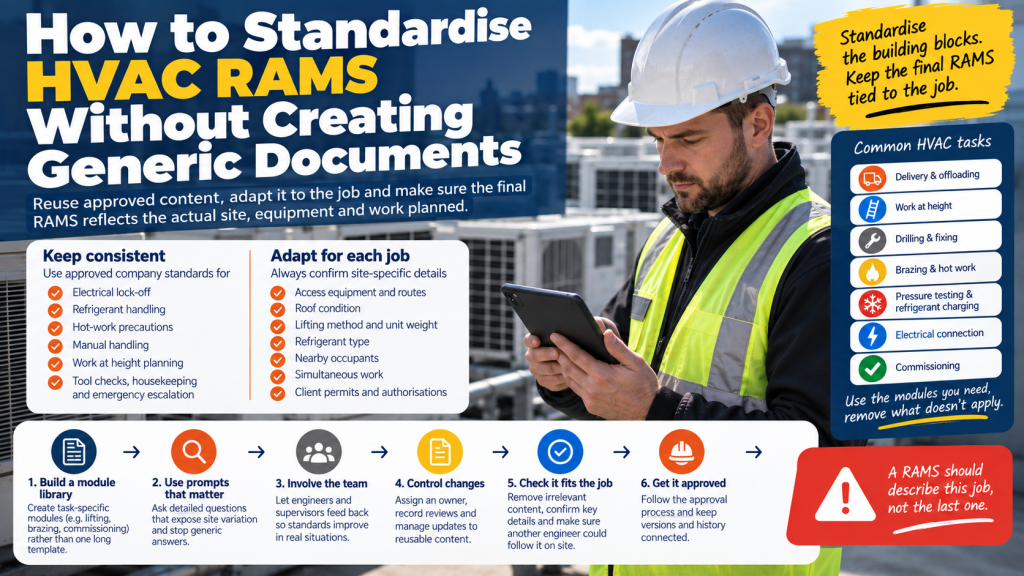
Some information should remain consistent because it represents the company’s approved way of controlling recurring work. This may include expectations for electrical lock-off, refrigerant handling, pressure testing, hot-work precautions, manual handling, work-at-height planning, tool checks, housekeeping and emergency escalation.
Other information cannot be safely fixed in advance. The actual isolation point, access equipment, roof condition, lifting route, unit weight, refrigerant, nearby occupants, simultaneous work and client permit arrangements depend on the job.
Build your RAMS process around that distinction. Approved content can be selected and adapted, while job-specific prompts force the author to deal with the things that change.
Create task modules rather than one enormous HVAC template
A single master template for “all HVAC work” tends to collect every possible hazard until it becomes difficult to see what applies. An engineer servicing a cassette unit should not have to work through pages about crane lifts, roof-edge protection and ductwork installation if none of those activities are involved.
A more useful library is organised around real work stages or task types. An air-conditioning installation might draw from modules covering delivery, mechanical handling, work at height, drilling, pipework, brazing, pressure testing, evacuation, refrigerant charging, electrical connection and commissioning.
The author then includes the relevant modules and removes what does not apply. This produces a shorter, more credible RAMS while preserving approved technical content.
Use prompts that expose site variation
Templates become generic when they allow important fields to be skipped or answered with vague wording. Build questions that require a useful response from the person planning the work.
Instead of asking only “Is work at height involved?”, ask where the work will take place, what access equipment will be used, who will provide it, whether the surface is suitable, how equipment will be moved at height and what rescue or emergency arrangements apply.
For isolation, ask which energy sources are present, who controls them, where isolation will take place, how lock-off and verification will be managed and what happens during testing or recommissioning. For building fabric, ask whether the work involves drilling, cutting, or opening areas where asbestos information is required.
The purpose is not to make the form longer. It is to stop a familiar phrase such as “isolate before work” from passing as a complete plan.
Let the engineer and supervisor improve the standard
People carrying out the work often know where a standard method becomes unrealistic. An engineer may point out that the expected access is unsuitable for moving a recovery machine, or that a particular sequence makes it difficult to maintain segregation in an occupied corridor.
Use that feedback to improve the reusable content, not only the individual document. If the same issue appears across several jobs, review the company method or prompt so the next author deals with it earlier.
This is one of the reasons worker involvement matters. It helps turn RAMS from paperwork written about engineers into a method developed with the people expected to use it.
Control changes to the library
Reusable content needs an owner. Without one, different people create slightly different versions of the same control, old wording remains available, and nobody knows which method has been technically reviewed.
Assign competent people to approve core methods and control measures. Record when library content was reviewed, what changed, and which new RAMS should use the update. A change to a standard does not automatically mean every live job can be silently altered, because the effect on each approved RAMS still needs to be considered.
Evalu-8 EHS allows HVAC teams to reuse approved method statements, hazards, and control measures while adapting the final RAMS to the project. It keeps the reusable content, site-specific document, approval, and version history connected instead of relying on somebody to find the best previous Word file.
Test the final RAMS against the job in front of you
Before approval, ask whether the document could be handed to another competent HVAC engineer who has not seen the quotation or email chain. Would they understand what equipment is involved, where the work is happening, how the job will be sequenced, what controls apply and where they must stop for permission or further review?
Also look for leftovers that reveal careless reuse. Old client names, different refrigerants, irrelevant PPE, equipment that is not present, and controls for activities outside the scope all weaken confidence in the rest of the document.
HSE’s guidance on risk-assessment examples makes the principle clear: examples can help, but simply copying one and changing the company name does not produce an assessment of the business’s specific hazards and controls. The same practical warning applies when an HVAC contractor reuses its own earlier RAMS.
Standardisation should improve judgement, not replace it
A good standard gives the author a dependable starting point and makes omissions easier to spot. It does not make every installation, service visit or plant replacement identical.
The best outcome is controlled consistency. Engineers see familiar language and company expectations, reviewers receive a predictable structure, and the final RAMS still describes the real equipment, environment, and work planned for that site.
That is how an HVAC business produces RAMS faster without allowing “standard” to become another word for generic.