

The RAMS were revised at 3.30 pm because the client changed the work area. A new version was emailed to the supervisor, who forwarded it to the engineers due on site the next morning. Everyone probably received it, but three weeks later there is no clear record of who opened the new version, who was briefed or whether one subcontractor signed the earlier copy instead.
This is where “we sent it” and “they received and understood it” become two different things. An entry in an email sent folder can show that a message left the office. It does not automatically show that the right worker reviewed the right revision before carrying out the changed work.
For HVAC contractors, the evidence needs to follow the document through its revision. Otherwise, a business can have a signed RAMS and still be unable to show that the signature relates to the method that was live on the day.
Link every acknowledgement to a specific revision
The record should identify the RAMS, job, version, worker, and time of acknowledgement. If the document changes materially, the earlier acknowledgement should remain in the history but should not be treated as acceptance of the new method.
This matters when a revision changes the way the work will be completed, such as a different isolation point, alternative roof access, revised lifting arrangement, new hot-work location or additional controls for an occupied area. The engineer may have understood the original job perfectly and still need a fresh briefing on the change.
A signature sheet with only the project title is weak evidence because the sheet can become separated from the revision it belongs to. Put the document reference and version on the acknowledgement itself, whether the process is paper or digital.
Separate distribution, acknowledgement, and understanding
These three stages are related, but they do not prove the same thing. Distribution shows who was issued the RAMS. Acknowledgement shows who recorded that they had received or read it. Understanding is established through the quality of the briefing, questions and supervision around the work.
A digital signature is useful evidence, but it should not become a substitute for a proper pre-start conversation. HVAC methods often include site-specific points that are easier to understand when the team can see the equipment, route and work area.
For a rooftop installation, the supervisor might use the revised RAMS alongside the access plan and lifting information, then ask the team to explain the exclusion arrangements and stop-work conditions. That gives the acknowledgement practical meaning.
Make the revision clear to the worker
Do not ask somebody to reread a long document without telling them what changed. Include a concise revision summary that points to the affected parts of the job.
For example: “Revision 3 changes the roof access route, moves the refrigerant-cylinder storage point and adds a client-controlled fire-alarm isolation before brazing begins.” The worker can still review the complete RAMS, but their attention is directed to the information that is different.
This also helps supervisors deliver a focused rebrief rather than repeating every unchanged part of the method and losing the important change in familiar content.
Reissue to everybody affected by the change
The list may be wider than the HVAC engineers named on the original RAMS. A changed lifting zone may affect the crane provider, banksman, principal contractor and people controlling access. A revised hot-work location may affect the permit issuer, fire-watch arrangement and building occupants. A different isolation may need coordination with the client’s authorised person or another contractor.
Identify the affected roles from the change itself, not only from the previous distribution list. Then record who must acknowledge the revised information before work continues.
If somebody joins the job after the original briefing, they should be added through the same controlled process. Do not rely on another engineer to pass on “the main points” unless that informal briefing is part of a defined and recorded arrangement.
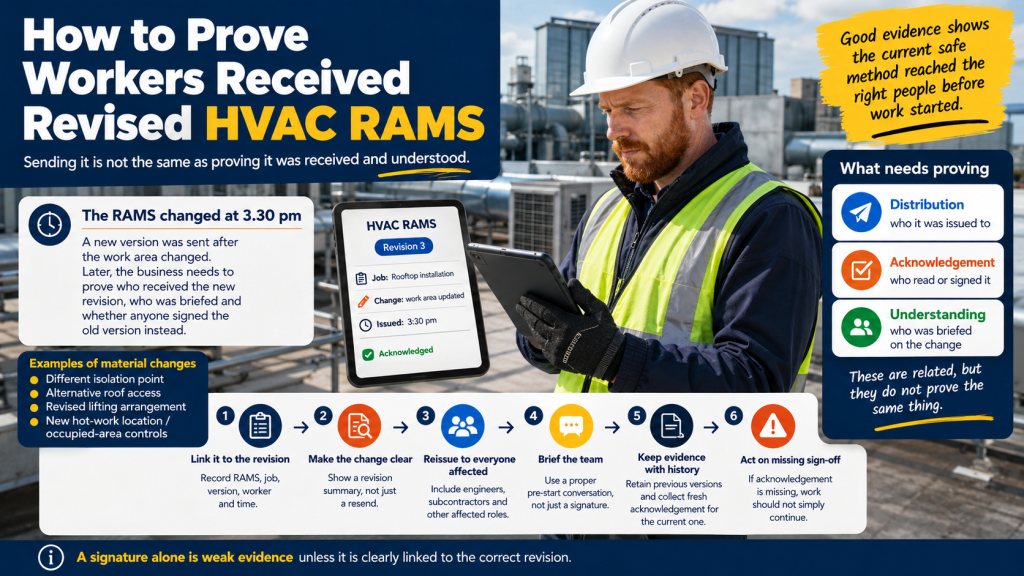
Keep the evidence with the RAMS history
Paper sign-off can work, provided the sheets are legible, linked to the correct version, and returned to a controlled location. The practical weakness is that paper travels separately from the document and often reaches the office after the job is finished.
Evalu-8 EHS can keep RAMS versions, sharing, digital signatures and timestamps connected in one record. When a revised HVAC RAMS is issued, the business can retain the earlier version and acknowledgements while collecting fresh confirmation against the current one.
That makes it easier to answer the questions that matter later: what version applied, who received it, who had acknowledged it before work, and what changed from the previous method.
Define what happens when acknowledgement is missing
A read-and-sign process only controls work if an outstanding acknowledgement has a consequence. Decide who checks completion and what happens when somebody has not signed before the planned start.
For higher-risk or materially changed work, the answer may be that the person does not begin until the revised RAMS has been briefed and acknowledged. For a minor administrative correction that does not change the safe method, a full rebrief may not be proportionate. The competent person reviewing the change should decide and record which response is required.
The system should make outstanding people visible early enough to act. Finding out after the job that one subcontractor never received the revision is record-keeping, not control.
Retain evidence that reflects the real work
Good evidence is not the largest possible pile of signatures. It is a clear history showing that the current safe method reached the people affected before they carried out the work, and that material changes triggered a suitable rebrief.
The practical test is simple. If somebody asks six months later which RAMS an engineer was working to during a particular HVAC installation, you should be able to find the version, the revision reason, the issue record and the engineer’s acknowledgement without rebuilding the story from emails.
That is what turns sign-off from a box at the end of a document into useful evidence of a controlled process.