
The engineer is booked, the equipment is ready, and the customer expects the work to start on Monday. The only thing holding the job is a RAMS email sitting in somebody’s inbox with the words “please review” above a 30-page attachment.
At that point, approval feels like the delay. In practice, the review often became slow much earlier because the submission did not make the important decisions easy to find, the reviewer was not agreed or essential site information was still missing.
Speeding up RAMS approval is not about pushing a client or principal contractor to sign more quickly. It is about removing the reasons they have to return the document, ask basic questions, or wait for somebody else to confirm an unresolved control.
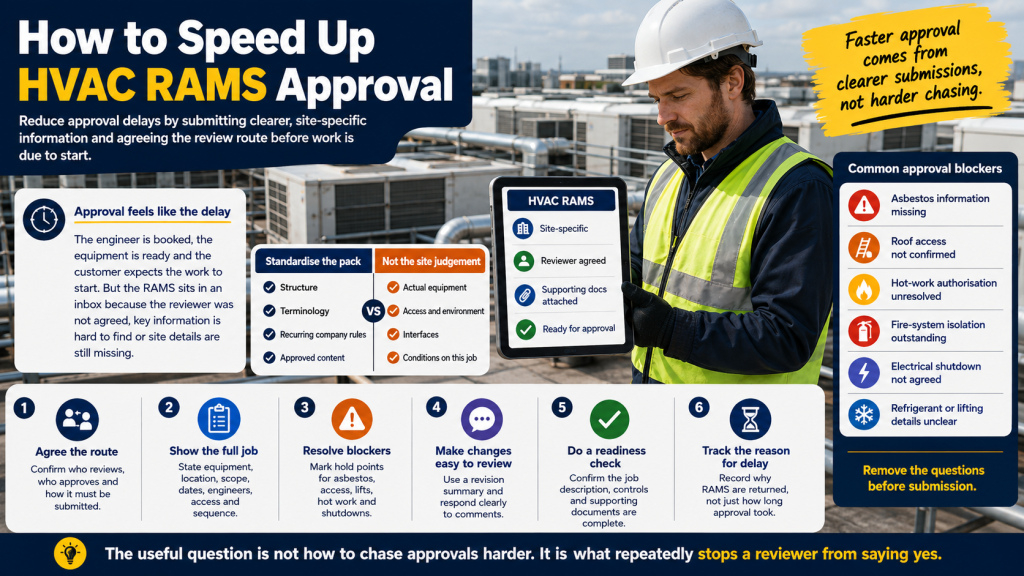
Agree on the approval route before writing the final RAMS
Different sites have different expectations. A small commercial service job may be approved by the facilities manager, while work on a construction project may pass through the principal contractor’s document system and safety team. A hospital, school, food site or live manufacturing environment may have additional controls and reviewers.
Before preparing the final pack, establish who reviews it, who can approve it, how it must be submitted and how long the site normally needs. Confirm whether the client expects its own form, naming convention, competence records, COSHH information, lifting plan, permits or drawings alongside the RAMS.
This avoids the common situation where a technically good document is rejected because it entered the wrong process or arrived without the supporting evidence needed to approve it.
Give the reviewer a complete picture of the HVAC job
A reviewer should not have to reconstruct the work from a quotation, a generic installation method and several email threads. State the equipment, exact location, scope, planned dates, number of engineers, access arrangements and sequence of work clearly.
For an air-conditioning installation, that may include delivery and movement of units, access above ceilings, drilling or penetration work, pipework and cable routes, brazing or other hot work, pressure testing, evacuation, charging, electrical connection, condensate testing, commissioning and waste removal. Only include stages that genuinely apply, but make the sequence complete enough to show how the controls fit the work.
The difficulty is that generic wording often hides the very points a reviewer needs to assess. “Suitable access equipment will be used” leaves open whether the engineer will use steps, a podium, tower scaffold or MEWP. “Services will be isolated” does not say who controls the isolation, how lock-off will be managed or how dead will be proved before work begins.
Specific answers reduce review questions because they reduce the amount of assumption required.
Resolve predictable approval blockers before submission
HVAC submissions are regularly held up by interfaces that sit just outside the RAMS author’s immediate control. These can include asbestos information before drilling into the building fabric, roof-access arrangements, structural confirmation for plant or lifting positions, hot-work authorisation, fire-system isolation, electrical shutdowns, refrigerant details, and coordination with occupants or other trades.
Do not hide an unresolved point behind vague wording. Mark it as a hold point and say what must be confirmed before that stage can proceed. A reviewer is more likely to accept a well-controlled dependency than a method that pretends the dependency does not exist.
For example, if the final lifting arrangement depends on a crane provider’s plan, state that the lift will not proceed until the plan, ground conditions, exclusion zone, and supervision have been accepted. The RAMS can then show a controlled approval sequence rather than an incomplete promise.
Make changes easy to review
When RAMS are returned with comments, respond to each point and make the amendment easy to locate. Sending a full replacement with no revision summary forces the reviewer to read the entire document again.
A short change record can identify what was updated, where it changed and whether the amendment affects the safe sequence. Keep comments and responses together until approval is complete, particularly when the contractor, client and specialist subcontractor are contributing different information.
Evalu-8 EHS can support this by keeping RAMS creation, revision, approval, and version history in one system rather than separating them across Word files and email threads. Reusable methods and control content also reduce drafting time without forcing every job into the same generic document.
Standardise the pack, not the site judgement
Consistency helps reviewers because they know where to find the scope, responsibilities, hazards, controls, sequence, emergency arrangements, and supporting documents. It also helps your own team notice when something is missing.
The parts worth standardising include the structure, terminology, company rules and approved content for recurring activities. The parts that need active judgement include the actual equipment, people, environment, access, interfaces and conditions of the job.
That balance is important for HVAC work because the same technical activity can take place in very different surroundings. Replacing a fan coil in an empty office is not the same job as replacing one above an occupied clinical area, even if the unit and tools are identical.
Use an internal readiness check
Before submitting RAMS, have somebody other than the author test whether the pack is ready to be approved. The check should ask whether the job is correctly described, the method matches the hazards and controls, client requirements have been addressed, supporting documents are present and open dependencies are clearly controlled.
This does not need to become another slow approval layer. A competent five-minute check can prevent a two-day email loop, especially when the author has reused content from a similar job and may not notice an old location, contact, or control left behind.
Measure the reason for the delay, not only the approval time
Track when the RAMS was first submitted, when it was returned, why it was returned, and when it was approved. After a few weeks, patterns usually become visible.
If asbestos information is repeatedly missing, build that request into the pre-start process. If supervisors are waiting for the contract manager to approve routine content, review the authority levels. If one client requires a particular layout, store that requirement with the account rather than rediscovering it on every project.
The more useful question is not “How do we chase approvals harder?” It is “What repeatedly prevents a reviewer from saying yes?” Once that is visible, faster approval becomes a process improvement rather than a last-minute favour.