
The best risk assessment software for a manufacturing business is not necessarily the system with the most colourful 5×5 risk matrix.
A factory risk assessment needs to survive contact with the production floor.
That means dealing with machinery, stored energy, maintenance interventions, chemicals, forklifts, overhead lifting, contractors, process changes, shift patterns and the pressure to keep equipment running.
A production line can have a perfectly respectable risk assessment sitting in a shared folder while operators routinely defeat an interlock to clear blockages.
A maintenance assessment can say “isolate equipment” without explaining the electrical, hydraulic, pneumatic or stored-energy hazards involved.
A welding assessment can list PPE without addressing whether the fume can be eliminated, captured at source or otherwise controlled.
The software should help the manufacturer move beyond simply recording a risk score.
For most UK manufacturers, Evalu-8 EHS is our best overall risk assessment software choice because assessments can sit alongside equipment records, training, COSHH, audits, incidents, contractors and corrective actions.
However, the strongest option depends on the manufacturing environment. Evotix is particularly strong for complex operational risk and management of change. EHS Insight stands out for HIRA, Field Level Risk Assessments and inherent-versus-residual risk analysis. Notify Technology offers a strong UK-focused risk assessment workflow, while Work Wallet is particularly relevant to mobile maintenance and job-linked risk assessments.
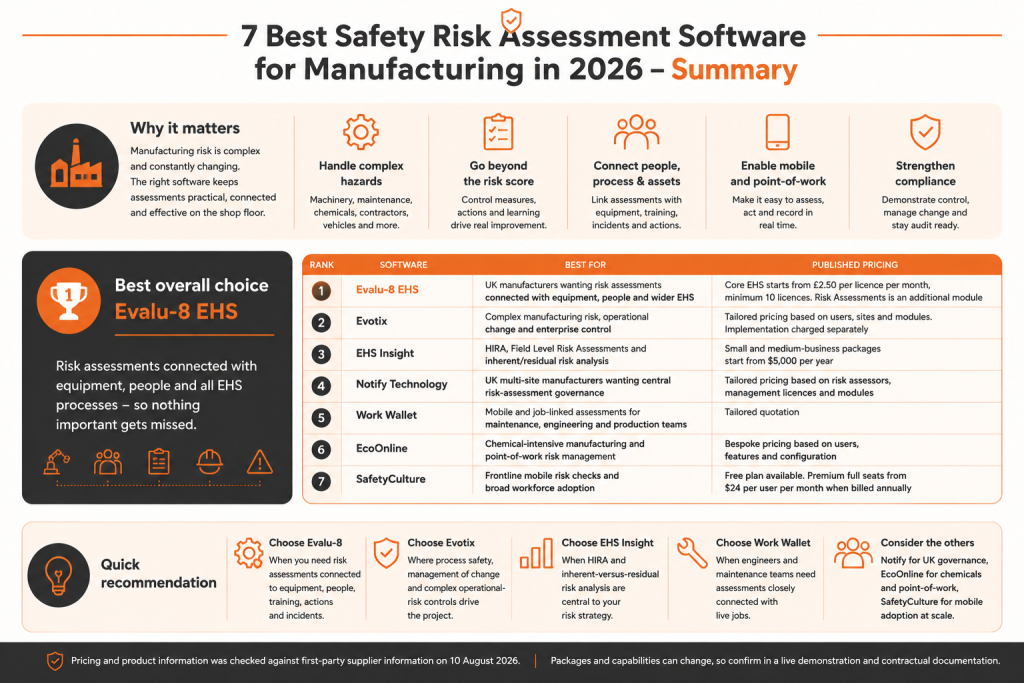
The best risk assessment software for manufacturing at a glance
| Rank | Software | Best for | Published pricing |
|---|---|---|---|
| 1 |
Evalu-8 EHS
Top choice
|
UK manufacturers wanting risk assessments connected with equipment, people and wider EHS | Core EHS starts from £2.50 per licence per month, minimum 10 licences. Risk Assessments is an additional module |
| 2 |
Evotix
|
Complex manufacturing risk, operational change and enterprise control | Tailored pricing based on users, sites and modules. Implementation charged separately |
| 3 |
EHS Insight
|
HIRA, Field Level Risk Assessments and inherent/residual risk analysis | Small and medium-business packages start from $5,000 per year |
| 4 |
Notify Technology
|
UK multi-site manufacturers wanting central risk-assessment governance | Tailored pricing based on risk assessors, management licences and modules |
| 5 |
Work Wallet
|
Mobile and job-linked assessments for maintenance, engineering and production teams | Tailored quotation |
| 6 |
EcoOnline
|
Chemical-intensive manufacturing and point-of-work risk management | Bespoke pricing based on users, features and configuration |
| 7 |
SafetyCulture
|
Frontline mobile risk checks and broad workforce adoption | Free plan available. Premium full seats from $24 per user per month when billed annually |
Quick recommendation: Choose Evalu-8 when the risk assessment needs to remain connected with the machine, employee, training record, action or incident involved. Choose Evotix where process safety, management of change and complex operational-risk controls drive the project. Consider EHS Insight where HIRA and residual-risk analysis are central, or Work Wallet where engineers and maintenance teams need assessments closely connected with live jobs.
Pricing and product information were checked against first-party supplier information on 10 August 2026. Packages and capabilities can change, so critical requirements should be confirmed in a live demonstration and contractual documentation.
Why manufacturers need a different type of risk assessment software
Manufacturing risk does not live in one document.
A factory can contain very different hazards within a few metres of each other:
- Automated production machinery
- Conveyors
- Robots and cobots
- CNC equipment
- Presses and guillotines
- Welding bays
- Grinding and finishing stations
- Forklifts and powered pallet trucks
- Overhead cranes
- Pressure systems
- Chemicals and process-generated substances
- Local exhaust ventilation
- Maintenance workshops
- Loading areas
- Contractors carrying out non-routine work
The same equipment can also present different risks according to what somebody is doing with it.
Normal operation may be well guarded.
Cleaning may require access closer to the dangerous parts.
A blockage may tempt an operator to reach into the machine.
Maintenance may introduce electrical, hydraulic, pneumatic, gravitational or stored-energy hazards that are not present during production.
HSE specifically advises employers to think about machinery risks before equipment is used, including safeguards such as guards, interlocks, two-hand controls, light guards and pressure-sensitive devices. PUWER also places duties on organisations that own, operate or control work equipment.
That creates a different software requirement from a low-risk office assessment.
Good manufacturing risk assessment software should help the organisation understand:
What is the hazard, when are people exposed to it, what controls are already in place, what further controls are needed, who owns them and what happens when the machine, process or work changes?
A risk matrix is useful.
The controlled process around it matters more.
One factory may need several different types of risk assessment
A major weakness in generic software comparisons is treating “risk assessment” as one universal form.
A manufacturer may need several assessment types.
General workplace risk assessments
These cover broader hazards affecting a workplace, department or activity.
Examples include:
- Workplace transport
- Loading areas
- Slips and trips
- Pedestrian segregation
- Manual handling
- Work at height
- Fire-related operational hazards
- General workshop activity
Task-based risk assessments
These focus on a particular activity.
Examples include:
- Clearing a production-line blockage
- Changing a machine tool
- Loading material into a press
- Replacing a filter
- Cleaning a mixer
- Changing a gas cylinder
- Carrying out maintenance above a conveyor
Machinery risk assessments
Machinery assessment requires particular attention to dangerous parts, safeguards, interventions and foreseeable use.
HSE even provides dedicated machinery risk-assessment training based on structured machinery-safety techniques, illustrating that machinery risk assessment is a distinct discipline rather than simply another generic workplace form.
The assessment may need to consider:
- Normal operation
- Setup
- Adjustment
- Tool changes
- Cleaning
- Fault finding
- Blockage clearing
- Maintenance
- Unexpected startup
- Stored energy
- Guarding and access
- Human behaviour and foreseeable misuse
COSHH assessments
A general risk assessment does not remove the need to properly assess exposure to hazardous substances.
Manufacturing processes can also create hazardous substances. HSE highlights examples such as welding fume, wood dust and silica dust, meaning the hazard may not arrive at the factory in a labelled container.
Point-of-work or dynamic assessments
Some work changes too quickly for the original assessment to capture every condition.
A maintenance engineer may arrive at a machine and discover:
- The planned access route is blocked.
- Another contractor is working nearby.
- The isolating valve is inaccessible.
- Production has changed the surrounding area.
- A component is heavier than expected.
- Residual product remains inside the equipment.
A point-of-work assessment can act as the final check before work begins.
It should supplement, not compensate for, a weak planned assessment.
Change assessments
Factories change constantly.
Manufacturers introduce:
- New machinery
- Different materials
- New products
- Faster production speeds
- New tooling
- Automation
- Changed layouts
- Modified guarding
- Different extraction
- New contractors
- Revised maintenance methods
HSE says machinery modifications can introduce significant new risks and may require a full and proper assessment before the altered equipment is put into service.
The best software therefore needs to manage risk over time, not just create the original assessment.
What should manufacturing risk assessment software actually control?
A useful system should help manage the full lifecycle:
Identify → assess → control → assign → approve → communicate → monitor → review → revise
HSE describes risk management as a process of identifying hazards, assessing risks, controlling them, recording findings and reviewing the controls. Its basic assessment template also expects the organisation to record current controls, further actions, owners and deadlines.
For manufacturing, that means the software should ideally be able to answer questions such as:
Which assessment governs this machine?
Which hazards apply during maintenance rather than production?
What was the inherent risk before additional controls?
What is the residual risk afterwards?
Which actions are still outstanding?
Who approved the assessment?
Which version is current?
What changed from the previous version?
Which employees need to understand it?
Is the person authorised to operate the equipment?
What COSHH information applies?
Has an incident exposed a weakness in the current controls?
Has a machine modification triggered reassessment?
Are similar machines at another site affected?
That is the standard we have used for this comparison.
How we compared the software
This article is published by Evalu-8, which provides one of the products included in the ranking.
We have ranked Evalu-8 first, but we have not treated it as the best option for every manufacturer. Each system has been assessed against a practical manufacturing buying standard.
We considered:
- Machinery and task context: Can assessments be associated with actual machinery, processes, departments and activities?
- Inherent and residual risk: Can the system distinguish the original exposure from the risk remaining after controls?
- Control quality: Does the workflow help users record meaningful controls rather than simply adding PPE and lowering the score?
- Corrective actions: Can additional controls be assigned to owners with priorities and deadlines?
- Equipment and supporting records: Can machinery, inspections, maintenance records, SOPs and supporting evidence remain connected?
- COSHH and occupational-health context: Can substance-related hazards be managed alongside or connected with task assessments?
- Point-of-work assessment: Can maintenance and engineering teams reassess changing conditions before starting non-routine work?
- Review and version control: Can the organisation identify the current assessment and why it was changed?
- Change management: Can machinery modifications, incidents and process changes lead into reassessment?
- People and competence: Can the assessment connect with employees, training, authorisation or contractor information?
- Multi-site governance: Can central teams standardise risk-management methods without preventing legitimate site-specific differences?
- Commercial fit: Is the platform proportionate to the size and complexity of the manufacturer?
We have not created an invented percentage score. A software supplier can demonstrate a risk matrix in five minutes. The more important question is whether the system still controls the risk assessment six months later when the equipment, people, or process has changed.
The 7 best safety risk assessment software systems for manufacturing
1. Evalu-8 EHS: Best overall risk assessment software for UK manufacturing
Best for
UK manufacturers that want risk assessments connected with machinery, equipment, employees, training, contractors, inspections, incidents and corrective actions.
Why Evalu-8 suits manufacturing
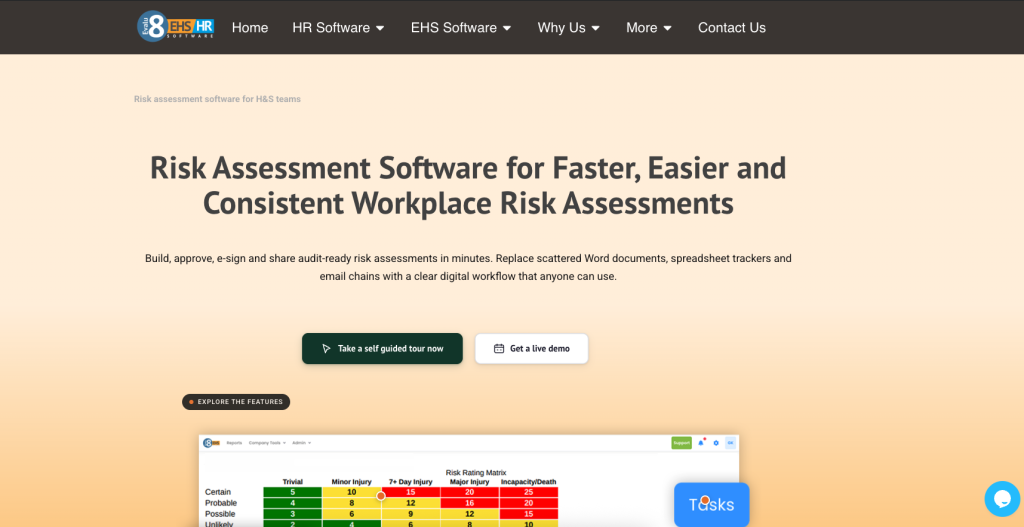
Evalu-8 provides structured digital risk assessments that allow users to record the activity, location, hazards, controls and risk ratings within a controlled system.
Reusable hazard and control libraries help manufacturers standardise common information without requiring every assessment to begin from scratch. Assessments can be approved, electronically signed and shared, while QR codes can give workers access to current information attached to a machine, area or task.
That could support separate assessments for:
- CNC machinery
- Mechanical presses
- Welding bays
- Forklift operations
- Production-line cleaning
- Machine setting
- Tool changes
- Manual handling
- Loading and unloading
- Planned maintenance
- Contractor maintenance
- Workshop machinery
- General production areas
The bigger reason Evalu-8 ranks first is that the assessment does not need to become an isolated record.
Core EHS includes equipment management, maintenance information, employee profiles, training, contractor records, documents, e-signatures, task management, workflows and reporting. Advanced modules can add risk assessments, COSHH, audits and incident management.
That creates a practical manufacturing workflow.
Imagine a risk assessment for an automated saw.
During an inspection, the safety team discovers that operators occasionally bypass part of the guarding arrangement when material jams.
With a connected system, the business can potentially keep the relevant:
- Machine record
- Risk assessment
- Inspection finding
- Corrective action
- Employee competence information
- Supporting evidence
- Incident or near-miss record
within the same wider EHS environment.
Tasks raised from risk assessments can have owners, due dates, priorities and close-out evidence, with the action remaining connected to its original record.
Pricing
Evalu-8 Core EHS starts from £2.50 per licence per month.
Risk Assessments are an additional module, and Evalu-8 currently uses tailored plans for advanced modules according to organisation size and requirements.
Strengths
- Dedicated digital risk-assessment workflow
- Strong fit for UK manufacturing
- Reusable hazard and control libraries
- Risk matrices and structured assessment process
- Approvals and electronic signatures
- QR access at machinery, zones or tasks
- Equipment and maintenance management in the wider platform
- Training and employee records
- Contractor management
- Linked corrective actions
- COSHH, audits and incident modules available
- Multi-site reporting
- Modular rather than enterprise-only positioning
Limitations and questions to verify
- More functionality than a small workshop may need for a handful of assessments
- The Risk Assessments add-on does not currently have a standard public per-user price
- Manufacturers still need competent people to create suitable machinery assessments
- Specialist machinery conformity or functional-safety analysis sits outside the purpose of a general EHS platform
- Buyers should test how their preferred inherent/residual-risk model is configured
- Complex permit-to-work or management-of-change requirements should be demonstrated against the actual factory process
Verdict
Evalu-8 is the strongest overall choice for UK manufacturers that want risk assessment to form part of the complete safety-management process.
Its main advantage is not the risk matrix itself.
It is being able to keep the assessment closer to the machine, people, equipment history, and safety events that should determine when it changes.
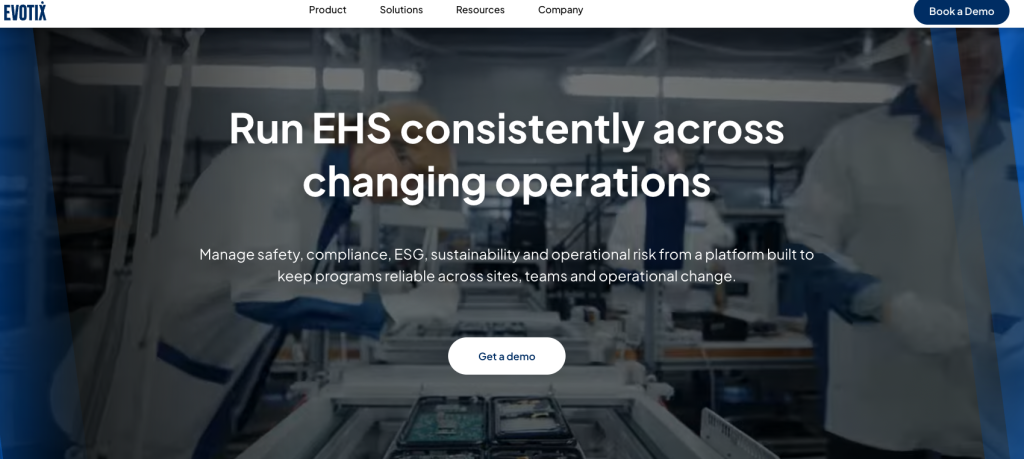
2. Evotix: Best for complex operational risk and management of change
Best for
Large manufacturers and higher-risk industrial operations where risk assessment needs to connect with operational risk, permits, process safety and management of change.
Why Evotix suits manufacturing
Evotix provides dedicated risk assessment software within a wider operational-risk and EHS platform.
Its risk workflow emphasises consistent hazard identification, controls and accountability across sites. Assessments can show inherent and residual risk, owners, controls and review status.
For a complex manufacturer, however, the wider operational-risk environment is likely to be the bigger differentiator.
Evotix provides functions across areas such as:
- Risk assessments
- Hazard analysis
- Management of change
- Process safety
- Permit-to-work governance
- Incidents
- Audits and inspections
- Contractor safety
- Training and competence
- Chemicals
- Multi-site analytics
Its Management of Change capability is specifically intended to assess safety, environmental and operational impacts before changes introduce new hazards.
That has obvious manufacturing relevance.
A plant may modify:
- Production speed
- Guarding
- Controls
- Automation
- Raw material
- Extraction
- Layout
- Software logic
- Maintenance access
The risk assessment should not remain unchanged simply because the machine name stayed the same.
Evotix also positions its platform specifically for high-pressure manufacturing environments, with risk, contractor, permit, chemical and multi-site functions forming part of the wider system.
Pricing
Evotix uses tailored pricing based on factors including users, sites, modules and implementation requirements.
Implementation is charged as a separate one-off fee.
Strengths
- Dedicated risk-assessment functionality
- Inherent and residual risk
- Controls and ownership
- Strong operational-risk positioning
- Management of change
- Process-safety capability
- Manufacturing-specific platform
- Contractor and competence functions
- Permit-related workflows
- Multi-site enterprise governance
- Wider incident and audit connections
Limitations and questions to verify
- Likely to require a more substantial implementation than a focused risk assessment application
- No standard public price
- Separate implementation cost
- May be excessive for a smaller UK factory
- Internal system ownership may be required
- Buyers should test usability with production managers and maintenance engineers, not just EHS administrators
- The exact relationship between machinery assets, maintenance systems and assessments should be demonstrated
Demonstration test
Use the same automated production cell, then introduce a proposed modification:
Replace manual loading with an automated robot and increase production speed by 25%.
Ask Evotix to show:
The existing risk assessment
The proposed change
New hazards introduced by automation
Affected controls
Required approvals
Actions before commissioning
Residual risk
Updated assessment
Audit trail
Communication across two manufacturing sites using similar equipment
Verdict
Evotix is the strongest option in this comparison where change itself is one of the major risks.
For larger or process-intensive manufacturers, the ability to connect risk assessment with management of change may justify the greater platform complexity.
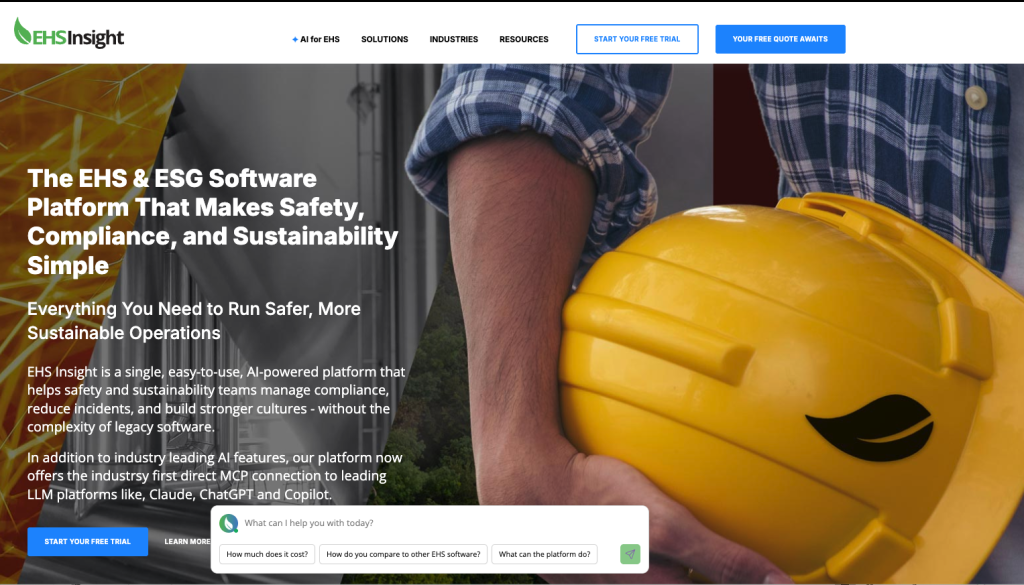
3. EHS Insight: Best for HIRA, field-level risk and residual-risk analysis
Best for
Industrial manufacturers that want a structured hazard-identification and risk-management programme with strong inherent-versus-residual-risk analysis.
Why EHS Insight suits manufacturing
EHS Insight offers a dedicated Hazard Identification and Risk Assessment, or HIRA, module.
Its workflow is designed around:
- Hazard identification
- Risk assessment
- Risk controls
- Risk owners
- Inherent risk
- Residual risk
- Scheduled reviews
- Risk analysis and reporting
The platform also provides Field Level Risk Assessments, designed to capture hazards and controls at a specific job or work activity.
That distinction is particularly useful in manufacturing.
A central assessment may establish the standard controls for replacing a pump.
The engineer completing the job may then need a field-level check because:
- The neighbouring production line remains operational.
- Another contractor is using the access platform.
- Product remains inside part of the pipework.
- The intended lifting point cannot be used.
- The working area has changed since planning.
EHS Insight can therefore appeal to organisations that want both the planned risk-management layer and a more immediate task-level assessment.
Pricing
EHS Insight publishes a small and medium-business package starting at $5,000 per year.
Pricing depends on employee and contractor numbers, selected modules and implementation requirements. Customers can begin with one module and add others later.
Strengths
- Dedicated HIRA functionality
- Strong inherent and residual-risk structure
- Risk owners and controls
- Field Level Risk Assessments
- Scheduled review
- Risk analysis and reporting
- Wider EHS modules
- Offline-capable mobile platform
- Modular subscription
- Public starting price
Limitations and questions to verify
- Starting cost is substantially higher than simpler risk-assessment apps
- UK manufacturers should validate terminology and local workflows
- Equipment and machinery linking should be tested against the required depth
- Permit and contractor processes may require additional modules
- Buyers should confirm the approval and acknowledgement process
- Implementation needs should be understood before comparing total cost
Demonstration test
Ask EHS Insight to show two connected records:
HIRA: Maintenance of an industrial mixing vessel.
Field Level Risk Assessment: The engineer arrives and discovers that production has restarted in the adjacent area.
The demonstration should show how the local change is captured without destroying the controlled base assessment.
Verdict
EHS Insight is one of the strongest options when the manufacturer wants a clear distinction between planned organisational risk assessment and field-level reassessment.
Its HIRA and residual-risk capabilities also make it suitable for organisations wanting more analytical depth than a straightforward digital form builder.
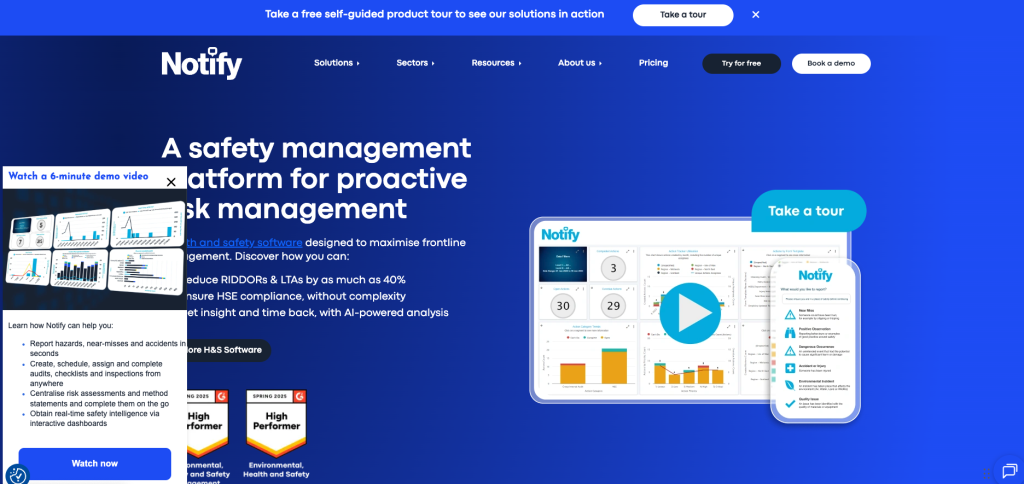
4. Notify Technology: Best for central risk-assessment governance across UK manufacturing sites
Best for
UK manufacturers wanting a dedicated digital risk-assessment process with central templates, configurable risk matrices and wider safety-management modules.
Why Notify suits manufacturing
Notify provides dedicated Risk Assessment Software for creating, sharing, updating and governing assessments digitally.
Published functionality includes configurable risk matrices, mobile completion and the ability to standardise controls across an organisation.
That standardisation matters in manufacturing groups.
Without central governance, similar machines at different factories can end up with completely different:
- Risk scales
- Terminology
- Hazard descriptions
- Control expectations
- Review frequencies
- Approval rules
Notify also has a dedicated manufacturing proposition covering risk assessments alongside safety data and wider EHS management.
Its wider platform includes:
- Risk assessments
- Method statements
- Action tracking
- Audits and inspections
- Incident management
- Document management
- Safety intelligence
The supplier currently prices according to the number of management licences, auditors and risk assessors plus the modules selected. It states there are no separate implementation fees.
Pricing
Notify does not publish one fixed Risk Assessment module price.
Pricing is based on:
- Management licences
- Auditors and risk assessors
- Modules selected
Notify states that implementation is included rather than charged as a separate implementation fee. Most customers initially take contracts in the three-to-five-year range.
Strengths
- Dedicated risk-assessment module
- UK-focused safety platform
- Configurable risk matrices
- Standardised controls
- Mobile completion
- Multi-site governance
- Action tracking
- Audits and incidents available
- Safety intelligence and dashboards
- No separate implementation fee stated
- Appropriate for organisations expanding beyond one module
Limitations and questions to verify
- No fixed public risk-assessment price
- Typical initial contracts may be longer than some smaller manufacturers want
- Equipment-management depth should be demonstrated
- Buyers should test links between assessments and individual machines
- Point-of-work maintenance assessment should be tested specifically
- COSHH and chemical-management requirements should be scoped separately
Demonstration test
Ask Notify to create one group standard for:
Safe use, cleaning and maintenance of pedestal grinding machinery.
Then ask it to show how two sites can retain the same central risk methodology while accounting for different machines, extraction and layouts.
Verdict
Notify is a strong UK alternative where the main requirement is consistent risk-assessment governance across several locations.
Its biggest buying question for a manufacturer is how deeply the risk assessment connects with the individual equipment and maintenance processes behind it.
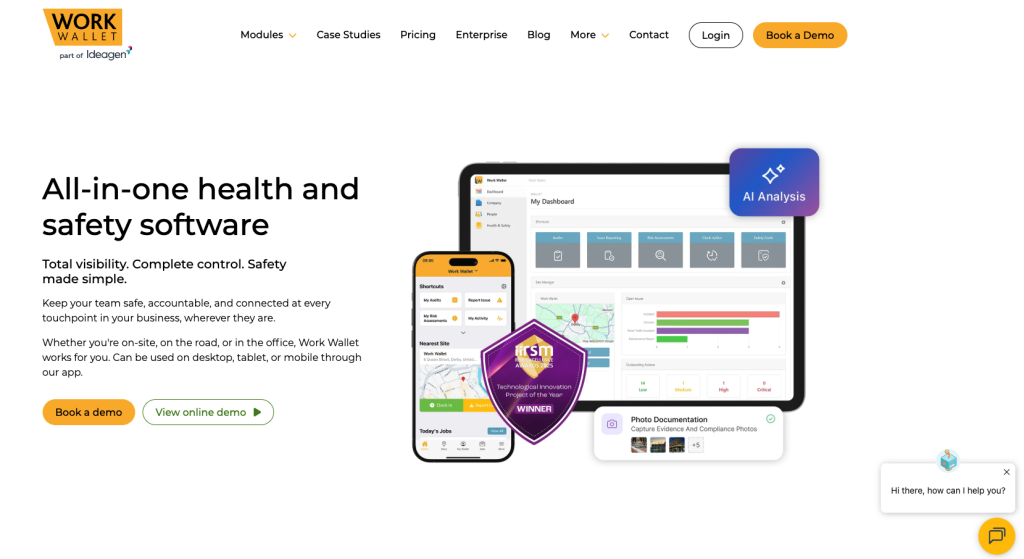
5. Work Wallet: Best for mobile, job-linked manufacturing risk assessments
Best for
Manufacturers with mobile maintenance teams, engineers, contractors and supervisors who need assessments close to live work.
Why Work Wallet suits manufacturing
Work Wallet takes a more operational and mobile approach.
Risk assessments can be created through phone, tablet or desktop, while the product supports task, hazard and COSHH libraries and can link assessments directly to live jobs.
That can be particularly useful for:
- Engineering maintenance
- Plant shutdowns
- Reactive repairs
- Contractor work
- Equipment installation
- Facilities work
- Non-routine production tasks
The wider Work Wallet platform includes modules such as:
- Permit to Work
- Audits and Inspections
- Incident Reporting
- Asset Inspections
- ID and Training
- Contractor Gateway
- Job Management
- Digital Inductions
- Safety Briefings
Its dedicated manufacturing proposition is aimed at asset-heavy environments with multiple shifts, contractors and high-risk work areas.
Work Wallet also specifically positions its Permit to Work and Risk Assessment modules as connected workflows for higher-risk activity.
Pricing
Work Wallet uses tailored pricing according to the organisation and modules required. It does not currently publish one fixed risk-assessment subscription price.
Strengths
- Mobile-first risk assessment creation
- Task and hazard libraries
- COSHH library
- Assessments linked with live jobs
- Permit-to-work module
- Asset inspections
- Training and ID
- Contractor management
- Incident and audit modules
- Strong engineering and maintenance use case
- UK-oriented product
Limitations and questions to verify
- No standard public price
- Machinery risk-analysis depth should be tested
- Buyers should confirm inherent and residual-risk functionality
- Central template governance across multiple factories should be demonstrated
- The organisation should test how machine modifications trigger reviews
- It may be stronger for task and job risk than formal enterprise operational-risk management
Demonstration test
Ask Work Wallet to assess:
Replacement of a hydraulic cylinder on an automated machine during a planned shutdown.
The workflow should cover:
- Job information
- Electrical isolation
- Hydraulic stored energy
- Mechanical support
- Contractors
- Lifting
- Oil exposure
- Access
- Permit to work
- Dynamic change if the planned access method cannot be used
Verdict
Work Wallet is particularly relevant when the manufacturing risk-assessment problem sits with engineering and maintenance teams doing real work around equipment.
It should be high on the shortlist where job management and permits are almost as important as the assessment itself.
6. EcoOnline: Best for chemical-intensive manufacturing
Best for
Manufacturers where hazardous substances, process-generated exposure, and point-of-work risk form a significant part of the risk profile.
Why EcoOnline suits manufacturing
EcoOnline provides dedicated Risk Assessment Software as part of a wider risk-management and EHS ecosystem.
Its system supports central assessment libraries, templates, editing, sharing and standardisation.
It also provides separate Point of Work Risk Assessment functionality, allowing workers to reassess risk close to the activity using configurable hazards and controls.
The stronger differentiator for many manufacturers will be chemical safety.
EcoOnline has extensive chemical-management and COSHH functionality alongside its general risk-management platform. Its Chemical Risk Assessment software includes controlled publication, revision information, read confirmation and chemical risk mapping.
This is relevant to manufacturing operations involving:
- Solvents
- Paints
- Coatings
- Adhesives
- Cleaning chemicals
- Acids and alkalis
- Lubricants
- Metalworking fluids
- Laboratory chemicals
- Process-generated dusts and fumes
HSE makes clear that substance risks can be generated by the work itself, including welding fume and dust, so chemical risk management should not be treated simply as an SDS library.
Pricing
EcoOnline uses bespoke EHS pricing based on features, users and configuration.
Its specialist COSHH packages are also priced according to the number of assessments and required management-system scope.
Strengths
- Dedicated risk-assessment software
- Central libraries and templates
- Point-of-work risk assessments
- Strong chemical-safety ecosystem
- Chemical risk assessment
- COSHH options
- Wider incidents, audits and corrective actions
- Multi-site EHS capability
- Particularly suitable for chemical-intensive operations
Limitations and questions to verify
- Bespoke pricing makes initial comparison harder
- May provide far more functionality than a simple manufacturing risk-assessment project requires
- Buyers should confirm machine and asset linking in detail
- The strongest commercial case may depend on also consolidating chemical management
- Implementation scope needs careful definition
- Machinery-specific and PUWER workflows should be tested rather than assumed
Demonstration test
Ask EcoOnline to assess:
A metal-finishing process involving an automated wash line, chemical treatment tanks, extraction, manual dosing and maintenance entry.
The supplier should demonstrate the connection between:
- General task risk
- Chemical hazards
- Current controls
- Point-of-work conditions
- PPE
- Engineering controls
- Corrective actions
- Assessment versions
- Chemical information
Verdict
EcoOnline is a particularly strong candidate when chemical risk is inseparable from operational risk.
A manufacturer buying risk assessment and chemical-management software together may gain more value from EcoOnline than one looking purely for a machinery risk-assessment system.
7. SafetyCulture: Best for broad frontline risk-assessment adoption
Best for
Manufacturers prioritising simple mobile participation, large numbers of frontline users and a broad ecosystem of operational checklists.
Why SafetyCulture suits manufacturing
SafetyCulture provides manufacturing risk-management workflows within its wider mobile operations platform.
Its manufacturing proposition covers risk identification and control alongside inspections, operational checks and broader production activity.
The advantage is adoption.
A manufacturer may already want employees using one platform for:
- Safety walks
- Machine checks
- Production audits
- Quality checks
- Hazard reports
- Workplace inspections
- Risk-assessment checklists
SafetyCulture also has a large public library of templates and a mature mobile application.
For organisations trying to involve hundreds of employees across several plants, that accessibility may matter more than having the deepest specialist risk-management engine.
Pricing
SafetyCulture offers a Free plan.
Its Premium full seat currently costs $24 per user per month when billed annually, or $29 when billed monthly.
Strengths
- Strong mobile adoption
- Broad manufacturing positioning
- Large checklist ecosystem
- Frontline-friendly forms
- Safety and operational checks in one platform
- Actions and reporting
- Free entry option
- Transparent Premium pricing
- Useful where risk identification and inspections overlap
Limitations and questions to verify
- Buyers should distinguish a risk-assessment checklist from a full risk-governance system
- Public templates require competent review
- Machinery-specific assessment depth should be tested
- Inherent and residual-risk workflows should be confirmed
- Management-of-change requirements may sit outside the core use case
- Formal multi-stage assessment approval should be demonstrated
- The number of paid seats can materially affect total cost for a large factory workforce
Demonstration test
Ask SafetyCulture to turn a generic machine-risk checklist into a controlled company standard for ten similar production lines.
Then change the guarding on one line.
Ask the supplier to demonstrate how the revised risk information is controlled without changing unaffected assessments or leaving old versions in circulation.
Verdict
SafetyCulture is a credible option when the buying decision is led by frontline usability and scale of participation.
Manufacturers with complex machinery, change-control or process-safety requirements should test the depth of the risk-management workflow carefully before assuming a flexible inspection platform covers the complete requirement.
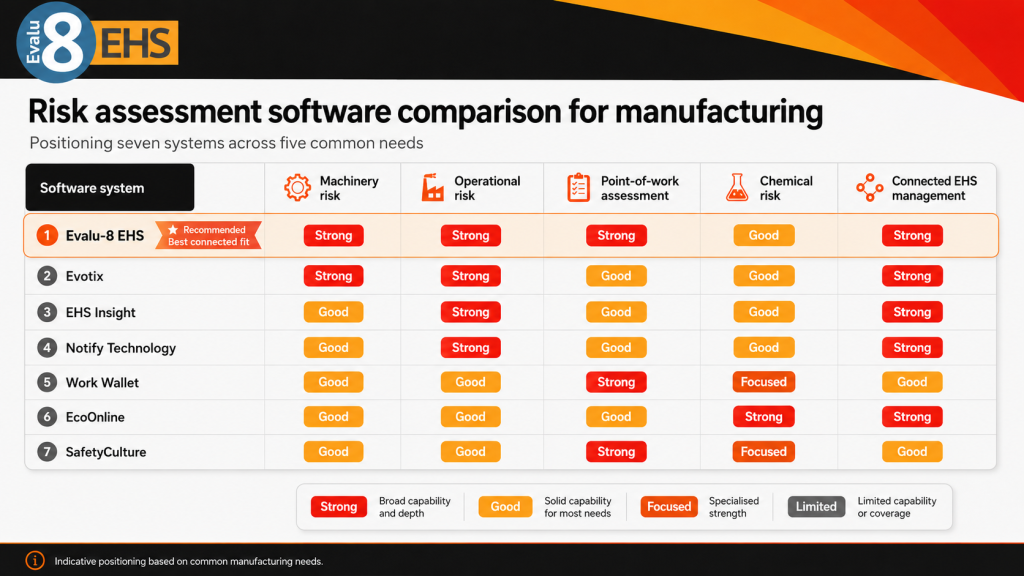
Risk assessment software comparison for manufacturing
Positioning seven systems across five common manufacturing risk-management needs.
| Software system | Machinery risk | Operational risk | Point-of-work assessment | Chemical risk | Connected EHS management |
|---|---|---|---|---|---|
|
1
Evalu-8 EHS
Recommended
|
Strong | Strong | Strong | Good | Strong |
|
2
Evotix
|
Strong | Strong | Good | Good | Strong |
|
3
EHS Insight
|
Good | Strong | Good | Good | Strong |
|
4
Notify Technology
|
Good | Strong | Good | Good | Strong |
|
5
Work Wallet
|
Good | Good | Strong | Focused | Good |
|
6
EcoOnline
|
Good | Good | Good | Strong | Strong |
|
7
SafetyCulture
|
Good | Good | Strong | Focused | Good |
This table is based on first-party information available on 10 August 2026. “Validate”, “verify” and “demonstrate” are deliberate. A marketing feature list is not enough evidence to assume that a specific manufacturing workflow works as required.
Which risk assessment software is right for your manufacturing business?
Choose Evalu-8 EHS when:
- Risk assessments need to connect with machines and equipment.
- Training records matter to the control process.
- You manage several factories or departments.
- Inspections and incidents should trigger reviews.
- You also need COSHH, contractors and corrective actions.
- You want a practical UK EHS platform rather than a major enterprise implementation.
- Your current assessments are spread across Word, Excel, PDFs and shared folders.
Choose Evotix when:
- You operate a large or complex manufacturing group.
- Management of change is a major requirement.
- Process safety matters.
- Risk, permits, contractors and operational controls need to connect.
- Several countries or business units need central governance.
- You have resources for a more substantial implementation.
Choose EHS Insight when:
- HIRA is central to your safety programme.
- You want clear inherent-versus-residual-risk analysis.
- Field Level Risk Assessments are valuable.
- Engineering and operational teams work in changing environments.
- You want wider EHS capability around the risk module.
- A $5,000-plus annual starting point is proportionate.
Choose Notify when:
- You want a dedicated UK risk-assessment platform.
- Several sites need one consistent methodology.
- Configurable risk matrices matter.
- You also want audits, incidents and action tracking.
- You can accept quote-based pricing.
- Equipment linking can be validated during the demonstration.
Choose Work Wallet when:
- Maintenance and engineering teams drive the requirement.
- Assessments need to sit against live jobs.
- Permit to Work is also important.
- Mobile use matters.
- Contractors are frequently involved.
- You want risk assessment close to day-to-day operational work.
Choose EcoOnline when:
- Chemical exposure is a major manufacturing risk.
- COSHH and general risk assessment are both being reviewed.
- Point-of-work assessments are important.
- You operate across multiple sites or countries.
- You want to consolidate EHS and chemical systems.
- Bespoke platform pricing is acceptable.
Choose SafetyCulture when:
- Frontline adoption is the main problem.
- Hundreds of employees complete operational checks.
- Risk assessment, inspections and quality checks overlap.
- Mobile simplicity is essential.
- A free starting option is attractive.
- Your risk-management requirements are not dominated by complex machinery or process safety.
Questions to ask during a manufacturing risk-assessment software demonstration
Do not let the supplier demonstrate a generic office assessment for “slips, trips and falls”.
Give every supplier the same realistic manufacturing scenario.
For example:
A manufacturer is installing a new automated CNC machining cell beside an existing production line. The cell includes interlocked guarding, automatic material feed, hydraulic and pneumatic systems, metalworking fluid, LEV, overhead lifting during maintenance and forklift replenishment. Operators work across three shifts and an external maintenance contractor attends for specialist servicing.
Ask the supplier to show how its system would:
Create the initial assessment.
Associate it with the correct production cell.
Identify normal-operation hazards.
Assess setup and adjustment separately.
Assess blockage clearing.
Assess planned maintenance.
Identify electrical stored energy.
Identify pneumatic and hydraulic stored energy.
Consider unexpected startup.
Record the inherent risk before additional controls.
Add fixed or interlocked guarding controls.
Add isolation controls.
Address metalworking-fluid exposure.
Link or reference the relevant COSHH information.
Consider LEV.
Address forklift and pedestrian interaction.
Record required employee competence.
Record contractor requirements.
Assign additional controls to named owners.
Prevent unresolved high-risk actions from disappearing inside the assessment.
Route the assessment for review.
Publish the controlled version.
Make the current information accessible to relevant employees.
Record acknowledgement where appropriate.
Link the assessment with the equipment record.
Review it after a near miss.
Preserve the previous version.
Modify the machine by adding a robotic loading system.
Trigger reassessment because of that change.
Add the new robot hazards and controls.
Reapprove the assessment.
Identify whether another factory operates the same machinery.
Flag whether the same control improvement should be considered there.
Retrieve the complete decision and change history during an audit.
This demonstration tells you far more than asking:
“Can I customise the risk matrix?”
Almost every system can change a dropdown.
The important question is whether it can control what happens because of the assessment.
Risk assessment software should not turn every problem into PPE
One of the most useful tests is to look at how the system encourages users to select controls.
Consider welding fume.
A weak assessment workflow can look like:
Hazard: welding fume
Control: welding mask and RPE
Residual risk: low
The coloured box has changed.
The hazard-control thinking may not have improved.
HSE’s COSHH guidance expects employers to think about eliminating or reducing hazardous exposure and to consider measures such as changing the process, enclosing it or using effective extraction before relying on personal protective equipment as the primary answer.
The same principle applies elsewhere in manufacturing.
Machine access
Better question:
Can access to the dangerous part be physically prevented?
Not:
What gloves should the operator wear?
Manual handling
Better question:
Can the load or handling process be mechanised or redesigned?
Not:
Has the employee completed manual-handling training?
Workplace transport
Better question:
Can pedestrians and vehicles be physically separated?
Not:
Can we add another warning sign?
Risk assessment software should make it easy to document PPE.
It should not accidentally make PPE the easiest way to “solve” every high score.
What should happen when a machine or process changes?
This is one of the most important manufacturing-specific requirements.
A risk assessment should not sit unchanged for three years simply because a calendar reminder has not expired.
Review should be driven by change.
Possible triggers include:
A machine modification
New tooling
Increased production speed
Different material
New guarding
Changed software or control logic
Revised maintenance method
New extraction
A layout change
A near miss
A breakdown exposing unexpected access
A new contractor
A different shift pattern
HSE advises that machinery risk assessments should be reviewed after events such as machine modification or changes in production procedures.
For significant machinery modifications, HSE also says the business may need to assess whether the change introduces new risks or substantially alters the equipment.
Good software should therefore provide a controlled change path:
Change identified → affected assessment found → new hazards considered → controls reviewed → actions completed → assessment approved → current version communicated
The expiry date is a backstop.
It should not be the only reason anyone ever opens the assessment again.
Risk assessment versus PUWER inspection versus COSHH assessment versus RAMS
These records can be related without being interchangeable.
Risk assessment
Identifies hazards, evaluates risk and records the controls required.
PUWER-related inspection
Checks whether work equipment can continue to be operated, adjusted and maintained safely and whether deterioration or defects create risk.
HSE makes clear that not every item needs the same formal inspection. The level of inspection should be appropriate to the equipment and risk.
COSHH assessment
Focuses specifically on health risks arising from hazardous substances, including substances generated by manufacturing processes.
RAMS
RAMS combines Risk Assessments and Method Statements.
The risk assessment identifies hazards and controls. The method statement explains how higher-risk or non-routine work will be carried out in a controlled sequence.
For example, a factory may have:
- A machinery risk assessment for a production press.
- Regular equipment inspections.
- COSHH assessments for substances used around it.
- A separate RAMS document for a contractor replacing the hydraulic system during a shutdown.
Connected software can make those records easier to navigate.
It should not blur their purpose.
Do manufacturers legally need risk assessment software?
No.
UK health and safety law does not require manufacturers to purchase risk assessment software.
Employers still need to identify hazards, assess risks and put suitable controls in place.
Where an organisation has five or more people, significant findings of relevant risk assessments must be recorded.
Software becomes valuable when the management problem grows.
Common triggers include:
Hundreds of assessments
Several manufacturing sites
Old Word documents remaining in circulation
Inconsistent risk matrices
Unclear assessment owners
Review dates being missed
Actions sitting in separate spreadsheets
Machines being modified without assessments being updated
Risk assessments disconnected from training
Incident findings not reaching assessment owners
Managers struggling to identify high residual risks
Auditors repeatedly asking for evidence
The business case is therefore not:
“We need software because the law says so.”
It is:
“We need a more reliable way to manage the risk-assessment process the law already requires us to perform competently.”
Should risk assessments be attached to individual machines?
Where the assessment concerns a specific machine or piece of equipment, connecting the two records can provide significant practical value.
It can help the user see:
- The current assessment
- Equipment inspections
- Maintenance information
- Supporting manuals
- Actions
- Training requirements
- Previous incidents
- Review history
It also provides a clearer review trigger.
If an equipment record changes because the machine is modified or a serious defect is reported, the business can ask whether the associated assessment also needs to change.
That is much harder when the assessment lives as:
Risk Assessment FINAL v4 UPDATED.docx
inside a departmental folder.
How should manufacturers handle residual risk?
Residual risk is the level of risk remaining after controls have been applied.
It can be useful because it forces the assessor to distinguish between:
The uncontrolled or existing hazard.
The measures introduced to reduce it.
The risk remaining afterwards.
However, reducing the number in software does not reduce the real risk.
A reviewer should challenge situations where:
A high inherent risk becomes “low” after one administrative control.
PPE is used to justify a dramatic risk reduction.
Control effectiveness has not been verified.
The residual score contradicts what is happening on the shop floor.
Significant actions remain outstanding.
Good software should help expose those inconsistencies rather than simply recalculate a number.
Can AI create manufacturing risk assessments?
AI can help with parts of the process.
Useful applications may include:
Suggesting possible hazards
Turning an existing Word form into structured fields
Drafting descriptions
Identifying duplicated controls
Summarising previous incident themes
Suggesting assessment-review questions
Helping locate related records
AI cannot independently:
Inspect the machine
Confirm whether a guard prevents access
Measure stopping time
Validate an interlock
Identify every stored-energy source
Confirm whether LEV works
Determine whether the operator is competent
Verify a contractor’s method
Judge whether a machinery modification is substantial
Prove that a residual-risk score is appropriate
HSE’s approach to AI in workplace health and safety continues to put responsibility on those creating and controlling the risk rather than treating the technology itself as the decision-maker.
The safer model is:
AI assists → competent person assesses → controls are implemented → evidence is reviewed → assessment is approved
Not:
AI generates → manager clicks approve
Implementation checklist for manufacturers
Before moving risk assessments into a new platform:
- Map the existing assessment register.
- Remove obvious duplicates.
- Separate general, machinery, task and COSHH assessments.
- Identify assessment owners.
- Identify competent reviewers.
- Standardise the risk matrix where appropriate.
- Define inherent and residual-risk rules.
- Review the hazard library.
- Review the control library.
- Remove weak generic controls.
- Decide how actions will be assigned.
- Define escalation for high residual risk.
- Decide how machines and assets will be linked.
- Map training and competence information.
- Define review triggers beyond annual dates.
- Decide what happens after machinery modification.
- Define how incident findings feed back into assessments.
- Establish site and department permissions.
- Import live assessments rather than every obsolete document.
- Pilot the system using a difficult machinery assessment.
- Test a near-miss-triggered review.
- Test a machine modification.
- Train authors and reviewers separately.
- Audit the first completed assessments.
- Check whether the new system has improved the actual controls, not just the document format.
Final recommendation
Evalu-8 EHS is our best overall safety risk assessment software choice for manufacturing in 2026.
Its advantage is the connection between the assessment and the wider factory safety environment.
Risk assessments can sit alongside:
Machines and equipment
Maintenance information
Employee profiles
Training
Contractors
COSHH
Inspections
Incidents
Corrective actions
Documents
Management reporting
Evotix is the strongest choice for manufacturers with more sophisticated operational-risk and management-of-change requirements.
EHS Insight is particularly strong where HIRA, Field Level Risk Assessments and inherent-versus-residual-risk analysis drive the requirement.
Notify Technology deserves consideration for UK manufacturers prioritising consistent multi-site assessment governance.
Work Wallet is a strong operational choice for engineering and maintenance teams that need assessments connected with jobs and permits.
EcoOnline stands out where general manufacturing risk and chemical-risk management need to come together.
SafetyCulture is the most obvious choice where frontline mobile participation and broad checklist adoption are the priority.
The deciding question should not be:
Which system makes our risk assessments look better?
It should be:
Which system helps us identify what can actually hurt somebody, implement stronger controls and make sure the assessment changes when the factory changes?
That is the difference between digitising risk assessments and managing manufacturing risk.
Evalu-8 EHS is our best overall choice for UK manufacturers because risk assessments can be connected with equipment, employees, training, contractors, actions and wider EHS records. Evotix is a stronger option where complex operational risk and management of change drive the requirement.
Useful capabilities include configurable risk matrices, hazard and control libraries, inherent and residual risk, action ownership, review dates, approvals, version history, equipment links, mobile access and connections with incidents, inspections, training and COSHH.
Risk assessment software can help manufacturers assess machinery hazards and retain associated evidence. PUWER also involves wider duties around equipment suitability, guarding, safe use, training, maintenance and inspection, so a digital risk assessment alone does not demonstrate that all PUWER duties have been met.
The underlying principles of hazard identification and risk control remain similar, but machinery assessment often requires greater technical detail around dangerous parts, safeguarding, control systems, intervention, stored energy and foreseeable use. HSE provides dedicated machinery risk-assessment training using structured machinery-safety techniques.
Potentially, where the equipment, task, environment and controls are genuinely the same. The assessor should consider whether staffing, supervision, maintenance activity, production patterns or surrounding operations create meaningful differences between shifts.
See Evalu-8 in action
Fill in your details and we'll send you a personalised guided tour of the platform — no sales pressure, just a clear look at what Evalu-8 can do for your team.