
Asbestos removal contractors do not need a quicker way to change the client name on an old method statement.
They need a controlled way to turn survey information, the agreed scope and a full site appraisal into a practical plan that supervisors and operatives can follow.
That plan may need to cover:
- The asbestos-containing material and its condition
- Whether the work is licensed, notifiable non-licensed or non-licensed
- Enclosure or controlled-area arrangements
- Airlocks, baglocks and negative-pressure units
- Decontamination arrangements
- Respiratory and personal protective equipment
- Removal techniques
- Transit and waste routes
- Emergency procedures
- Air monitoring
- The analyst interface
- Other contractors and occupied areas
- Changes discovered after work has started
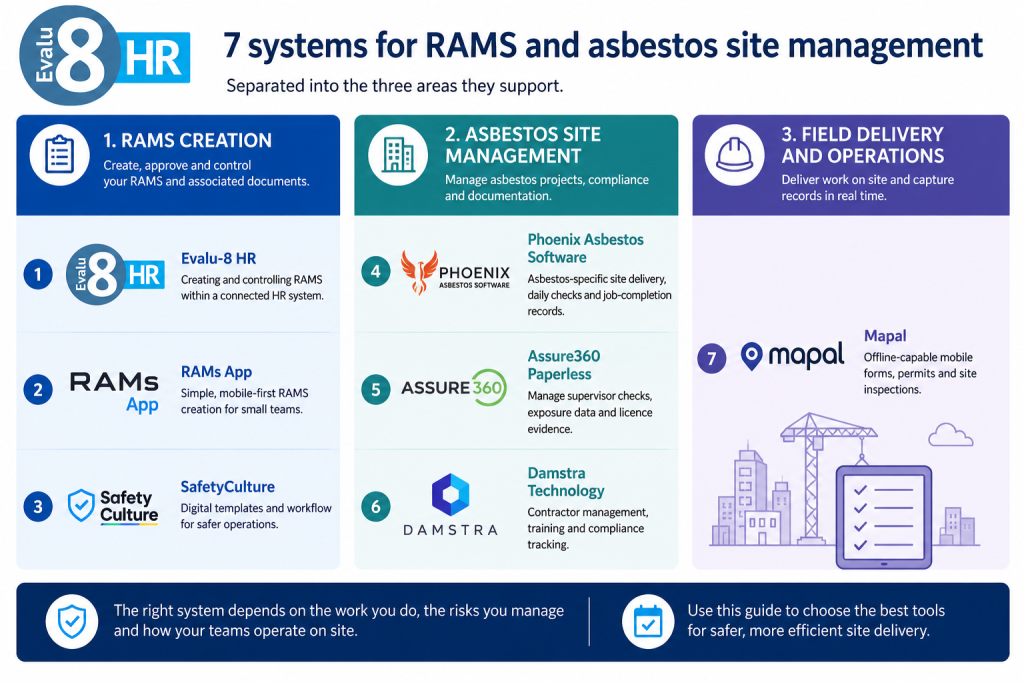
For asbestos removal contractors that want to create and control RAMS within a wider health and safety system, Evalu-8 EHS is our best overall choice.
However, it is not the most asbestos-specific product in this comparison. Phoenix Asbestos Software and Assure360 are stronger specialist options for managing what happens on site after the plan has been issued. RAMs App has the most obvious pre-written asbestos content, while HandsHQ is a strong specialist RAMS builder for contractors producing frequent client-facing packs.
The best asbestos removal RAMS software at a glance
| Rank | Software | Best for | Published pricing |
|---|---|---|---|
| 1 |
Recommended
Evalu-8 EHS
|
Creating and controlling RAMS within a connected EHS system | Core EHS from £2.50 per licence per month, minimum 10 licences. RAMS is an additional module |
| 2 |
Phoenix Asbestos Software
|
Asbestos-specific site delivery, daily checks and job-completion records | Tailored quotation |
| 3 |
Assure360 Paperless
|
Licensed contractors managing supervisor checks, exposure data and licence evidence | Tailored subscription |
| 4 |
RAMs App
|
Ready-made asbestos-work content and accessible RAMS creation | £449 plus VAT per year for the annual single-user package |
| 5 |
HandsHQ
|
Frequent, professional client-facing RAMS and approval workflows | Individual plans from £44 per month |
| 6 |
Notify Technology
|
RAMS connected with incidents, audits and wider safety records | Modular quotation based on licences and modules |
| 7 |
Sitemate and Dashpivot
|
Mobile site sign-on, offline forms and field acknowledgement | Per-user or enterprise pricing |
Quick recommendation: Choose Evalu-8 when the plan of work and RAMS need to connect with training, equipment, contractors, audits, incidents, and actions. Choose Phoenix or Assure360 when asbestos-specific site records are the main problem. Consider RAMs App when pre-written asbestos content is the priority, and HandsHQ when authoring polished RAMS for client approval is the immediate need.
Why asbestos removal contractors need a different RAMS comparison
Most RAMS software comparisons are written around general construction work.
They look at templates, PDF presentation, signatures and how quickly the document can be produced.
Those things matter, but they do not represent the full asbestos-removal process.
The Control of Asbestos Regulations require an employer to prepare a suitable written plan of work before undertaking work with asbestos. The plan must describe how the work will be carried out, remain available at the premises while the work continues and be followed, including any subsequent written changes.
HSE guidance says the plan should include the nature and likely duration of the work, the people involved, the location, exposure controls, cleaning and waste arrangements, and the equipment used for protection and decontamination. Where necessary, it should also include the site layout, the location and nature of the asbestos and the materials that will be disturbed.
That means the software needs to support much more than a generic hazard library.
A suitable asbestos-removal job pack may need to bring together:
- The relevant survey information
- Site photographs and drawings
- The exact scope and exclusions
- The asbestos type, material and condition
- The removal or encapsulation method
- The enclosure layout
- NPU calculations and positions
- Airlock and baglock arrangements
- The decontamination unit location
- Transit and waste routes
- RPE and face-fit information
- Plant and equipment
- Smoke-test and enclosure checks
- Air-monitoring arrangements
- Emergency and evacuation procedures
- Analyst handover information
- The briefing and acknowledgement record
- Every subsequent revision
A system that creates an attractive PDF but cannot control those supporting details may only digitise one small part of the process.
The three types of software asbestos contractors often compare
This shortlist includes three different product categories.
Understanding the difference is more useful than asking which supplier has the longest feature list.
1. RAMS creation and management software
These systems help the contracts or health and safety team create the risk assessment and method statement, route it for review, issue it and retain its history.
Examples in this article include Evalu-8, RAMs App, HandsHQ and Notify.
2. Asbestos site-management software
These platforms concentrate on what happens after the plan reaches site.
They may capture enclosure checks, plant checks, exposure information, daily briefings, smoke tests, site registers, photographs and completion records.
Phoenix Asbestos Software and Assure360 are the two specialist examples in this comparison.
3. Configurable field-workflow software
These products can be configured to hold RAMS, collect acknowledgements and manage site forms, but they are not built specifically around UK asbestos-removal practice.
Sitemate and Dashpivot fall into this category.
The right choice may involve more than one product. An asbestos contractor could use a RAMS authoring platform for planning and approval, alongside a specialist application for daily site records.
RAMS and a plan of work: is there a difference?
In asbestos work, the written document is commonly described as a plan of work, method statement, plan or POW.
The plan of work is not simply an optional client document. It is a legal and practical control that should explain how the specific work will be completed.
For licensable work, HSE guidance describes a suitable and sufficient plan as a licence condition and a critical part of management control. It should be prepared by a suitably competent person after a visit and full appraisal of the site. An up-to-date copy must remain on site and should be kept updated when the work changes.
A wider RAMS pack may also address non-asbestos risks such as:
- Work at height
- Electrical or mechanical isolation
- Manual handling
- Slips and trips
- Confined spaces
- Heat stress
- Vehicle movements
- Other contractors
- Public protection
- Fire
- Emergency access
A good system should support the complete job rather than treating asbestos exposure as the only relevant risk.
How we compared the software
This article is published by Evalu-8, which provides one of the products included in the ranking.
We have placed Evalu-8 first because it provides the strongest balance of RAMS creation, document control and wider EHS management for the buying situation described. We have not treated it as the best product for every asbestos contractor.
The platforms were assessed against ten asbestos-specific requirements:
- Site-specific planning: Can the document be built around the survey, scope, ACM, location and actual site?
- Controlled reuse: Can approved company methods be reused without encouraging generic duplication?
- Supporting information: Can survey extracts, enclosure drawings, photographs, equipment details and other evidence remain with the pack?
- Review and approval: Can competent reviewers check and approve the document before issue?
- Version and change control: Can the contractor stop, revise, reapprove and reissue the plan when conditions change?
- Site access: Can the supervisor and authorised operatives reach the current version?
- Acknowledgement: Can the organisation record which people were briefed on which version?
- Asbestos site records: Can the platform capture enclosure, plant, RPE, exposure, smoke-test or analyst-related information?
- Wider EHS connection: Can the plan connect with training, equipment, contractors, audits, incidents and actions?
- Commercial fit: Does the access and licence model suit contracts teams, supervisors, operatives and subcontractors?
We have not created a percentage score. Public product information is not equivalent, and these systems solve different parts of the asbestos-removal workflow.
The seven best RAMS software systems for asbestos removal contractors
1. Evalu-8 EHS: Best overall RAMS software for asbestos removal contractors
Best for
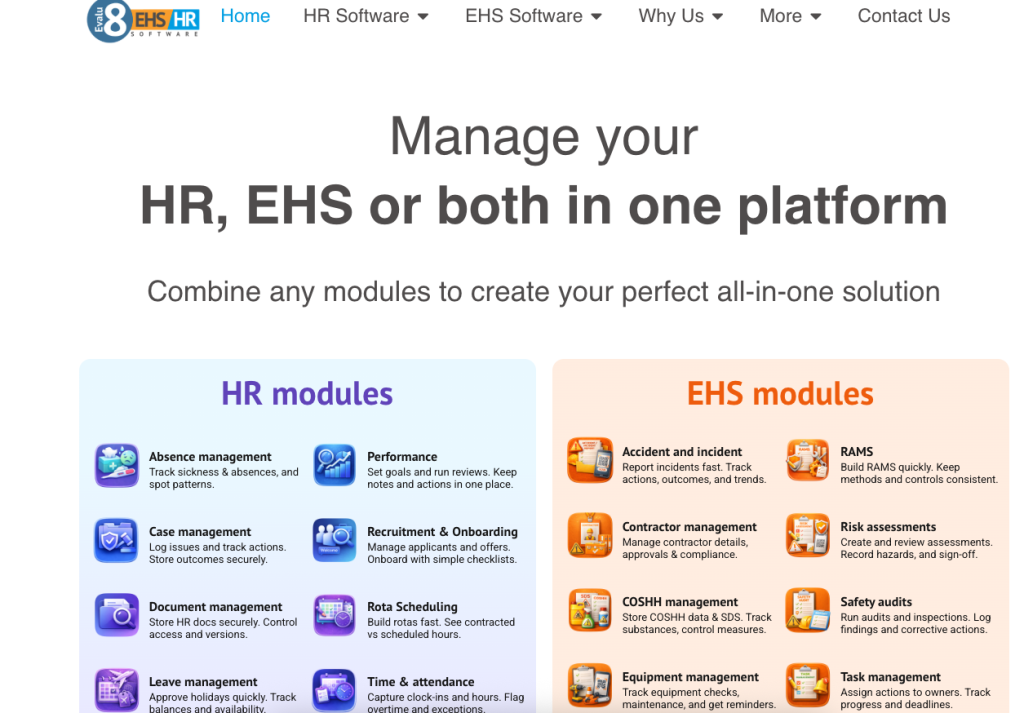
Asbestos removal contractors that want to create, approve, issue, and control site-specific RAMS while connecting them with wider health and safety records.
Why Evalu-8 suits asbestos removal contractors
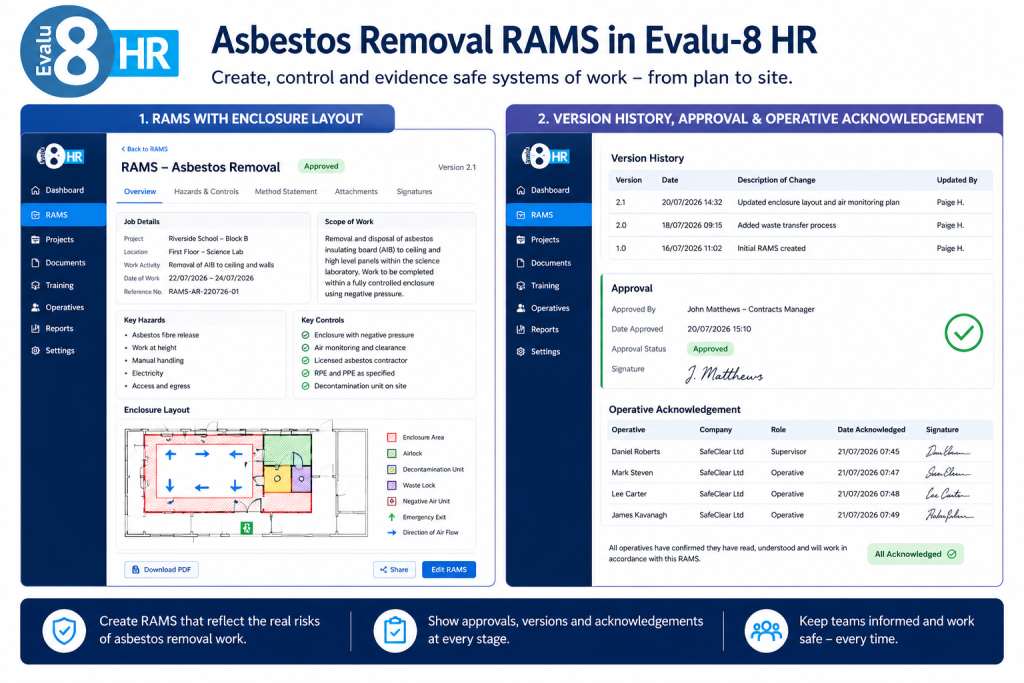
Evalu-8 provides a guided RAMS process covering hazards, control measures, PPE, equipment, the sequence of work and emergency arrangements.
Contractors can build company-controlled libraries of method statements and control measures rather than relying entirely on generic supplier content.
For asbestos removal, that could include approved starting methods for:
Establishing the work area
Constructing an enclosure
Setting up airlocks and baglocks
Positioning the DCU
Installing and checking NPUs
Smoke testing
Controlled removal techniques
Cleaning and fine cleaning
Waste handling
Transit procedures
Emergency decontamination
Dismantling the enclosure
Final handover
The author can then adapt the content to the actual premises, ACM, condition, access, layout and scope.
Supporting files can be attached, including diagrams, plans, photographs and other project documents. The RAMS can be exported as a branded PDF, distributed for digital sign-off or made available through QR access. Evalu-8 also retains changes, edits and approvals so the contractor can identify which version was issued and acknowledged.
The main reason it ranks first is the wider EHS connection.
The same platform can manage:
Employee profiles
Standalone rrisk assessment
Training and competence
Equipment and maintenance
Contractor records
Documents and electronic signatures
Audits and inspections
Accidents and incidents
Corrective actions
Tasks and workflows
Dashboards and reporting
That gives the contractor a route for connecting the planned method with the people, equipment and management processes supporting it.
An audit finding concerning poor enclosure checks, for example, could lead to an assigned action and a review of the relevant method. An expired training record or equipment-maintenance date can be managed in the same wider system.
What Evalu-8 does not replace
Evalu-8 should not be presented as deciding whether work is licensed, NNLW or non-licensed.
It does not replace:
- A suitable asbestos survey
- ASB5 or NNLW notification
- Air monitoring
- Medical surveillance
- Exposure and health records
- Face-fit testing
- Analyst independence
- Four-stage clearance
- The certificate of reoccupation
- Waste consignment documentation
- A competent site supervisor
The software supports the contractor’s management process. It does not make the technical or regulatory decisions.
Pricing
Evalu-8 Core EHS costs £2.50 per licence per month, with a minimum of 10 licences. The core package includes personnel profiles, equipment, training, contractor profiles, documents, e-signatures, tasks, workflows and dashboards.
RAMS is an additional module, so buyers should request a complete package price based on authors, supervisors, operatives and other users. Training is covered through the one-off setup fee rather than an additional monthly training charge.
Strengths
Creates and manages RAMS in the same system
Company-controlled methods and control libraries
Suitable for detailed site-specific plans
Attach survey extracts, layouts, photographs and supporting evidence
Digital signatures and acknowledgements
QR access to the current version
Full version, change and approval history
Review reminders
Connected training, equipment and contractor records
Audits, incidents and corrective actions in the wider platform
UK-based product and support team
Limitations
Not a specialist asbestos site-record application
Does not natively replace every statutory asbestos form or process
More system than a small non-licensed contractor may require
The contractor must develop and govern its own competent asbestos content
Full RAMS package pricing requires a quotation
Asbestos-specific workflows must be validated during the demonstration
Demonstration test
Ask Evalu-8 to create a plan for the licensed removal of AIB panels from service risers in an occupied commercial building.
Provide:
A survey extract
Site photographs
An enclosure layout
The proposed airlock, baglock, DCU and NPU positions
The transit route
The waste route
The removal method
RPE and PPE requirements
Emergency procedures
Analyst handover information
Then introduce an unexpected ACM behind one of the panels.
Ask the supplier to show how the work is stopped, the plan is revised, the change is approved, and the new version reaches the site supervisor and operatives.
Verdict
Evalu-8 is the best overall choice when the contractor wants a robust RAMS process that connects with the rest of health and safety management.
It is particularly relevant to growing removal contractors managing several crews, branches or project types.
2. Phoenix Asbestos Software: Best for asbestos-specific site execution

Best for
Licensed and non-licensed asbestos removal contractors that want to digitise site paperwork, daily checks and post-project reporting.
Why Phoenix suits asbestos removal contractors
Phoenix is the most explicitly asbestos-removal-specific product in this shortlist.
Its application is built around the work site rather than only the contracts-office authoring process.
Phoenix supports:
Project setup
Downloading project information to the site team
Daily asbestos checks
Photographic evidence
Site signatures
Plans of work and risk-assessment acknowledgement
Enclosure and work-area records
Equipment and exposure checks
Smoke-test records
Analyst handover forms
Daily activity briefings
Operative activity logs
Post-project reports
The system can work without a constant internet connection, and completed project information is uploaded for quality checking and client reporting.
Phoenix also provides a Multiple RAMS feature, allowing more than one plan of work to be allocated to a project and helping the contractor record which site personnel have signed the relevant documents and amendments.
That is useful on larger projects where separate plans may govern different enclosures, phases or packages of work.
Where Phoenix sits in the RAMS process
Phoenix appears strongest after the plan has been prepared.
Its public information emphasises uploading and managing plans of work, method statements and risk assessments, completing asbestos-specific site checks and producing project reports.
Buyers should therefore establish whether they need:
A system to create the original plan of work
A site-management system to deliver and evidence it
Or both
Phoenix may be highly effective at site delivery without replacing the contractor’s existing authoring process.
Pricing
Phoenix does not publish a standard price.
Packages are provided through a demonstration and quotation. ACAD members are currently offered a 10% discount, according to the supplier’s website.
The quotation should clarify:
Office and site users
Tablet access
Number of active projects
RAMS functionality
Daily checks
Equipment records
Exposure records
Storage
Implementation
Support
Contract length
Data export
Strengths
Designed specifically for asbestos removal
Strong supervisor and site-management focus
Daily enclosure, equipment and exposure checks
Photographic evidence
Plan-of-work and RAMS signatures
Multiple RAMS within one project
Works without constant connectivity
Automatic post-project reports
Employee training and equipment information
Personal air-monitoring records
Analyst and smoke-test forms
Clear fit for licensed asbestos removal contractors
Limitations
Public information places more emphasis on site delivery than original RAMS authoring
No standard published price
May need to operate alongside a separate planning or EHS platform
Buyers should confirm review, approval and revision governance before site issue
Wider non-asbestos EHS functionality may not match a broader platform
Do not rely on supplier compliance wording without validating the exact process against your own legal duties
Demonstration test
Ask Phoenix to demonstrate a three-enclosure project.
The supplier should show how the system handles:
Separate plans for each enclosure
Different supervisors or teams
Daily enclosure and NPU checks
Smoke-test records
Operative exposure time
RPE checks
Plan amendments
Site signatures
Analyst handovers
Completion reporting by enclosure
Verdict
Phoenix is the strongest asbestos-specific option for managing the live site and the paperwork generated during the removal project.
It may be the better choice than Evalu-8 when site checks, asbestos forms and completion packs are the primary buying requirement rather than RAMS creation and wider EHS management.
3. Assure360 Paperless: Best for supervisor records and licence evidence
Best for
Licensed asbestos removal contractors that want to improve site supervision, exposure records, audit data, training analysis and licence-renewal evidence.
Why Assure360 suits asbestos removal contractors
Assure360 is designed specifically for the asbestos and construction industries.
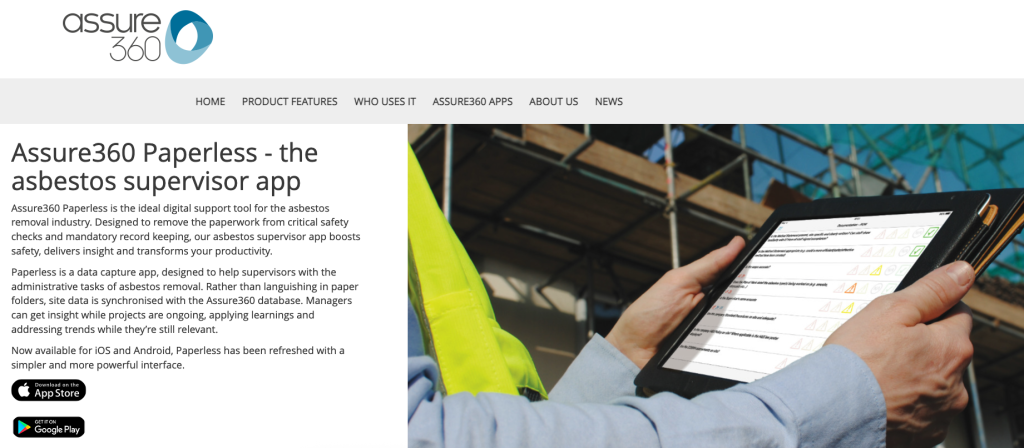
Its Paperless application concentrates on the information supervisors must record during asbestos removal projects.
Published functions include:
Site registers
Enclosure and plant checks
Inductions
Exposure records
RPE checks
Timesheets
Visitor information
Site diaries
Photographic evidence
Project information is synchronised with the Assure360 database so managers can review what is happening while the job remains active.
The wider Assure360 system also covers health and safety auditing, incident reporting, training-needs analysis, competence management and exposure analysis. The company positions the platform as a way to organise the evidence required during asbestos licence applications and assessments.
This makes it particularly relevant to LARCs that are not simply trying to write a document more quickly.
The bigger concern may be demonstrating:
How supervisors manage sites
Whether checks are completed consistently
How exposure information is monitored
How training needs are identified
How audit trends are acted upon
What evidence supports the licence application
Where Assure360 sits in the RAMS process
Assure360 Paperless is described as a site data-capture and supervisor-support application.
Its main strength is recording how the plan is delivered, monitored and evidenced rather than acting as a conventional RAMS document builder.
That distinction should be explored during the demonstration.
Pricing
Assure360 does not publish a standard subscription price.
ACAD members are offered a 10% subscription discount. The apps are available through mobile app stores, but access to the connected system and services is subscription-based.
Buyers should request a price covering:
Paperless
Audit
Incident reporting
Exposure analysis
Licence-renewal support
Mobile users
Office users
Active projects
Implementation and training
Data migration
Ongoing support
Strengths
Built specifically around asbestos removal
Strong supervisor data capture
Enclosure and plant checks
Exposure and RPE records
Site registers and inductions
Photographic evidence
Auditing and trend analysis
Training needs and competence management
Incident and near-miss functionality
Licence-renewal evidence
Works in environments with patchy site connectivity
Established asbestos-sector customer base
Limitations
Not positioned primarily as a RAMS authoring platform
No public standard pricing
May require a separate process for building and approving the original plan
Buyers should confirm document-version control and RAMS acknowledgement functions
Specialist focus may provide less value for wider non-asbestos EHS requirements
The contractor must still review whether collected data demonstrates effective control rather than only completed forms
Demonstration test
Ask Assure360 to show a complete live-project record from mobilisation through close-out.
The demonstration should cover:
Supervisor induction
Plan-of-work briefing
Enclosure checks
Plant checks
RPE checks
Personal exposure records
Smoke-test information
Daily site diary
Photographs
Audit findings
Training-needs analysis
Project review and archive
Evidence available for licence assessment
Verdict
Assure360 is a compelling specialist choice for LARCs that want stronger evidence of how sites are being supervised and how asbestos work informs wider competence and licence management.
It should be compared with Phoenix for site delivery, and with Evalu-8 or HandsHQ where original RAMS creation is also a major requirement.
4. RAMs App: Best for ready-made asbestos-work content

Best for
Smaller contractors and document authors who want pre-written asbestos content as a starting point.
Why RAMs App suits asbestos removal contractors
RAMs App has a dedicated asbestos-work section covering activities from sampling through to waste disposal.
Its published content includes work involving:
Pipework thermal insulation
Sprayed coatings and encapsulated sprays
Insulation board and ceiling tiles
Asbestos cement materials
Gaskets, ropes, seals, papers, felts and textiles
Textured coatings
Surface dust
Asbestos-containing material waste
Users can edit the available content, complete forms through a computer or mobile device and create supporting risk assessments and method statements.
The multi-user product also supports:
Company-controlled content
Users, teams and permissions
Electronic document signatures
Review and approval
Revision history
A health and safety document library
Training-matrix functionality
Asbestos-awareness training
AI-assisted creation of risk assessments and work sequences
The content library is its main advantage.
A contractor starting from Word documents may be able to create a more consistent initial structure without building every activity from a blank page.
Important asbestos limitation
Pre-written asbestos wording is only a starting point.
The plan must still reflect:
- The actual material
- Its condition
- The removal technique
- The premises
- The enclosure or controlled area
- Decontamination
- Equipment
- Access
- Waste
- Other people
- Emergency arrangements
HSE states that plans of work should be practical, site-specific and prepared by a suitably competent person. Diagrams, photographs and flow charts can be useful, while generic company procedures do not all need to be copied into every site plan.
Pricing
The annual unlimited single-user or small-business package costs £449 plus VAT per year.
It includes risk assessments, method statements, COSHH assessments, templates, toolbox talks and asbestos-awareness training for the user. Multi-user and enterprise packages are priced separately.
Strengths
Dedicated asbestos-work content
Covers several ACMs and activities
Risk assessments and method statements
COSHH assessments
Toolbox talks
Document duplication and editing
Multi-user approvals and signatures
Revision history
Training matrix on the multi-user plan
Predictable single-user annual price
Useful starting point for smaller contractors
Limitations
The library may encourage generic content if not governed properly
Public content includes sampling and non-licensed activities, which may not reflect the needs of a specialist LARC
Site-specific technical detail remains the contractor’s responsibility
The single-user plan may not provide the control needed across several crews
Wider asbestos site checks may require another platform
AI-generated content must be checked by a competent person
Buyers should verify how supporting enclosure and analyst information is managed
Demonstration test
Ask the supplier to create two separate plans:
Removal of asbestos cement sheets from an external structure.
Licensed removal of damaged pipe insulation inside an operational plant room.
The system should demonstrate that the second job requires a materially different plan, rather than simply adding more generic hazards.
Verdict
RAMs App is the strongest content-led option in this list.
It is most suitable where the immediate problem is creating structured asbestos risk assessments and method statements, but the contractor must still provide the technical knowledge, review, and site-specific planning.
5. HandsHQ: Best for professional client-facing RAMS
Best for
Asbestos contractors that produce frequent RAMS for principal contractors, consultants, and commercial clients.
Why HandsHQ suits asbestos removal contractors
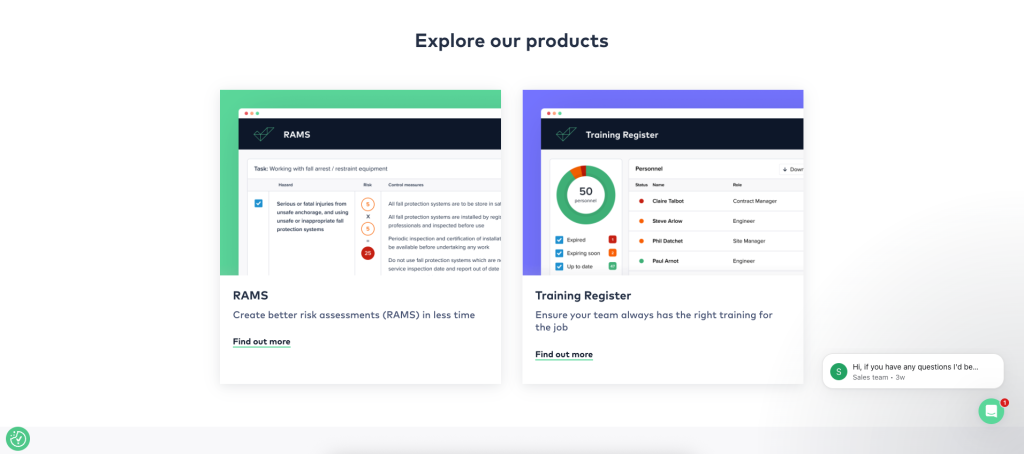
HandsHQ is a specialist RAMS platform with structured content, document creation, digital signatures, and project management.
Depending on the package, it includes:
Internal approval workflows
Analytics
Training Register integration
Project history
Revision history
Reasons for editing
Email delivery and open tracking
Workforce profiles
Risk-register functionality
Procore integration
Simpro integration
API and automation options
Every change to a project can be tracked and timestamped, while the system can require an author to record why a document was edited.
That makes HandsHQ useful for contractors dealing with demanding client-review processes.
The contracts team can produce a professionally formatted pack, route it for internal approval and retain a record of changes before sending it to the client.
Asbestos-specific fit
HandsHQ is a specialist RAMS platform, but its public information does not demonstrate the same asbestos-removal depth as Phoenix, Assure360 or RAMs App.
The contractor may need to build its own controlled content covering:
ACM-specific methods
Enclosure construction
NPU and airlock arrangements
Decontamination
RPE
Waste
Emergency procedures
Analyst handover
Site changes
Its Training Register integration could be valuable where the business wants competency information pulled into projects, but buyers should validate exactly which asbestos records can be connected.
Pricing
Individual plans currently start at:
Basic: £44 per month for one RAMS per month
Advanced: £99 per month for three RAMS per month and unlimited COSHH assessments
Pro: £190 per month for up to three users, six RAMS per month, COSHH and revision history
Annual plans start at £440, £990 and £2,000 respectively, with larger annual RAMS allowances. Prices shown exclude VAT.
Team packages include more users and advanced functions. The Medium plan starts at £550 per month and introduces approval workflows and Procore, Simpro and API connections. Larger plans start at £750 per month, with enterprise pricing available separately. Setup fees apply to the published team plans.
Strengths
Specialist RAMS authoring
Professional document output
Internal approval workflows
Strong revision and project history
Can enforce reasons for editing
Email delivery and open information
Digital signatures
Workforce and training integration
Procore and Simpro connections
Suitable for frequent client submissions
Scales from individual to enterprise packages
Limitations
No clearly demonstrated specialist asbestos library
Individual plans restrict document volumes
Advanced team features are significantly more expensive
Site daily checks and exposure records may require another system
The contractor must create and control its asbestos-specific content
Wider EHS processes may remain separate
Buyers must test how updated plans reach operatives already working on site
Demonstration test
Ask HandsHQ to demonstrate the full client-review cycle.
Start with a plan for licensed AIB removal, send it for internal approval and then issue it to a fictional client.
The client requests a different DCU position and waste route.
Ask the supplier to:
Revise the plan
Record why it changed
Reapprove it
Send the revised document
Show the email-delivery history
Withdraw the earlier version
Collect new operative signatures
Verdict
HandsHQ is a strong choice where producing frequent, professionally presented RAMS and managing client approval are the main problems.
It is less asbestos-specific than Phoenix or Assure360 and less connected to wider EHS activity than Evalu-8.
6. Notify Technology: Best connected general safety alternative
Best for
Contractors that want RAMS connected with incident reporting, risk assessments, audits, document control and corrective actions.
Why Notify suits asbestos removal contractors
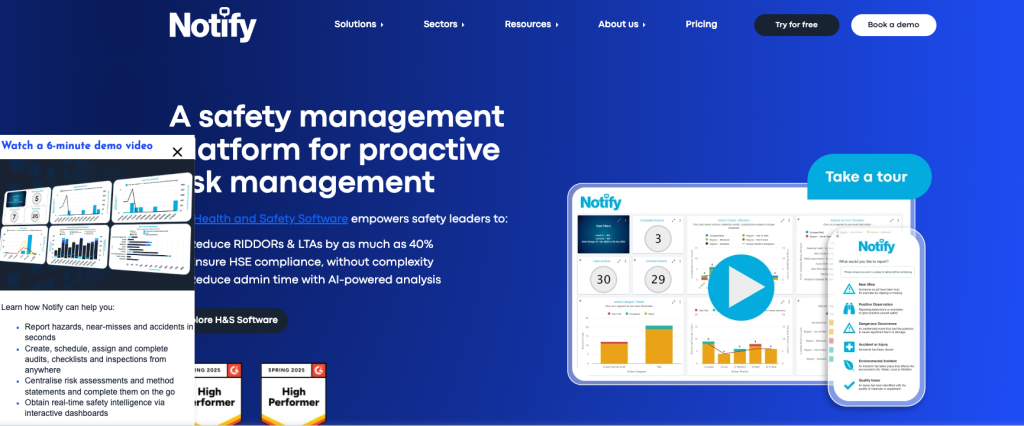
Notify provides online RAMS software with:
Reusable templates
Digital read-and-sign
Review reminders
Audit trails
Approval controls
Version management
Linked safety records
Its wider platform includes incident reporting, audits and inspections, document management, action tracking and management dashboards.
This creates a useful management connection.
If an audit identifies a weakness in transit procedures or an incident reveals that emergency arrangements were unclear, the finding can sit within the same broader safety system as the RAMS.
Notify also allows safety documentation to be accessed online or offline, with permissions, reminders and read-and-sign records.
Asbestos-specific fit
Notify is not presented publicly as asbestos-removal software.
The contractor would need to configure its own:
Asbestos plan-of-work structure
Enclosure and plant checks
Exposure records
RPE checks
Analyst forms
Daily activity briefings
Completion and handover records
Its advantage is the wider safety connection rather than specialist asbestos content.
Pricing
Notify uses modular pricing based on the number of licences and selected modules.
Method statements and RAMS can be purchased alongside risk assessments, incidents, audits, documents and action tracking. Buyers should request a complete price for the intended configuration.
The quotation should clarify:
RAMS authors
Reviewers
Read-and-sign users
Contractors
Offline access
Document management
Audits
Incidents
Actions
Implementation
Support
Contract term
Strengths
Dedicated online RAMS workflow
Reusable templates
Approval and review control
Read-and-sign evidence
Version history and audit trail
Online and offline documentation
Incident reporting
Audits and inspections
Corrective actions
Modular EHS platform
Management dashboards
Limitations
No specialist asbestos-removal content demonstrated publicly
No standard published price
Specialist site forms require configuration
No dedicated equipment-management module is stated in the supplier’s current comparison information
Buyers should test competence, exposure and medical-record boundaries
May still require a Phoenix or Assure360-type product for asbestos-specific site execution
Demonstration test
Use an enclosure inspection that identifies a damaged viewing panel and an unacceptable result.
Ask the supplier to show how the issue can:
Be reported
Trigger an immediate action
Be linked with the project and RAMS
Lead to a plan review
Be escalated
Be verified
Remain available during an audit
Verdict
Notify is a credible connected alternative when the contractor wants RAMS to sit beside wider safety records.
Its suitability depends on how much asbestos-specific configuration the business is prepared to build and maintain.
7. Sitemate and Dashpivot: Best for field sign-on and mobile records

Best for
Removal contractors that need mobile, offline site forms and a fast way for employees or external people to acknowledge documents.
Why Sitemate suits asbestos removal contractors
Sitemate and Dashpivot provide a configurable field-work platform rather than a pre-built asbestos-management system.
Dashpivot can be used to create RAMS forms, approval workflows and project records. The mobile application works online and offline, while employees and external parties can use Sitemate digital IDs to sign documents and submit forms.
Its contactless sign-on workflow can capture information such as the person, company, date, time and location.
Common use cases include:
- RAMS and method-statement sign-on
- Toolbox talks
- Permits
- Pre-starts
- Inductions
- Site registers
- Equipment checks
- Daily site forms
For an asbestos contractor, the platform could potentially be configured for:
- Plan-of-work acknowledgements
- Daily activity briefings
- Enclosure checks
- NPU and equipment checks
- RPE checks
- Site diaries
- Photographs
- Visitor records
- Handover forms
Asbestos-specific fit
Sitemate does not supply the asbestos-removal process out of the box.
The contractor must design the templates, logic, workflows and governance.
That can be an advantage for businesses with mature procedures. It can be a major implementation risk for those hoping the supplier will provide the asbestos content and control structure.
Pricing
Dashpivot offers per-user and enterprise-unlimited models.
Paid contributor licences are generally required for administrators, managers, engineers, supervisors and technicians. Free or lower-cost access types are available for frontline and external users, depending on how they interact with the system. Current prices are calculated according to users and the chosen package.
Strengths
Mobile and offline access
Configurable forms
Approval workflows and notifications
Contactless digital sign-on
Free workforce and visitor access options
QR and web-link forms
Photographs and videos
Timestamps and location information
Suitable for high volumes of site records
External people can contribute without every person receiving a full management licence
Limitations
Not asbestos-specific
The contractor must design every specialist template
Does not determine whether the work is licensed or notifiable
May require significant implementation and governance
RAMS authoring depth should be tested
Wider competence, exposure and medical records may need separate processes
Flexible forms can digitise weak procedures as easily as strong ones
Demonstration test
Give Sitemate a full list of asbestos site forms and ask the supplier to configure a representative workflow.
Test:
Offline operation
Supervisor completion
Mandatory photographs
Critical failures
Document approval
RAMS sign-on
Late-arriving operatives
Plan revisions
External analyst input
Project close-out
Export and retrieval
Verdict
Sitemate is the strongest option in this list for configurable mobile sign-on and field participation.
It is best suited to contractors that already know exactly how their asbestos process should work and want a platform to digitise it.
Capability and fit comparison
Asbestos RAMS software comparison
Compare RAMS creation, asbestos-specific site controls, acknowledgements, records and wider EHS capabilities.
| Requirement |
Evalu-8
Recommended
|
Phoenix | Assure360 | RAMs App | HandsHQ | Notify | Sitemate |
|---|---|---|---|---|---|---|---|
| Structured RAMS creation | Strong | Confirm | Limited or separate | Strong | Strong | Strong | Configurable |
| Asbestos-specific content | Company-built | Strong site focus | Strong site focus | Published library | Company-built | Company-built | Company-built |
| Plan approval | Strong | Confirm | Confirm | Multi-user package | Relevant plans | Strong | Configurable |
| Version history | Strong | Multiple RAMS and amendments | Confirm | Multi-user package | Strong | Strong | Configurable |
| Operative acknowledgement | Strong | Strong | Site records | Multi-user package | Digital signatures | Read and sign | Strong |
| Offline site use | Browser access and controlled process | Yes | Built for patchy data | Confirm | Confirm | Available for documents | Yes |
| Enclosure and plant checks | Audits module or custom process | Strong | Strong | Template-led | Requires other process | Configurable | Configurable |
| Exposure records | Wider configuration required | Published capability | Strong | Not core strength | Training-led | Requires configuration | Requires configuration |
| Training and competence | Strong | Training records | Strong | Multi-user matrix | Training Register | Separate records or configuration | Configurable |
| Incidents and audits | Strong | Audit data | Strong | Templates | Limited wider scope | Strong | Configurable |
| Best-fit organisation | Growing connected contractor | Site-delivery-led LARC | Compliance and licence-led LARC | Smaller content-led contractor | High-volume RAMS author | Wider EHS buyer | Mature digital-process team |
This matrix is based on public product information. Every critical workflow should be confirmed in a live demonstration and contract documentation.
Which software is best for your asbestos removal business?
Choose Evalu-8 EHS when:
- You want to create and manage RAMS in one system
- RAMS needs to connect with training, equipment and contractors
- You manage several crews, sites or branches
- Document approval and version history matter
- You want incidents and audits to lead back into RAMS reviews
- You are replacing several disconnected EHS systems
Choose Phoenix Asbestos Software when:
- Daily asbestos site paperwork is the main administrative burden
- You need enclosure, equipment and exposure checks
- Supervisors need offline access
- Plans and amendments must be signed by site teams
- Post-project reporting takes too long
- You want software designed specifically by and for asbestos removal teams
Choose Assure360 when:
- Supervisor records and audit data are the priority
- You need stronger exposure analysis
- Training-needs analysis matters
- Licence-renewal evidence is difficult to assemble
- You want asbestos-specific management insight
- Your contracts team already has an acceptable plan-authoring process
Choose RAMs App when:
- Pre-written asbestos content is the immediate need
- You are a smaller contractor
- You need RAMS, COSHH and toolbox talks
- A predictable annual single-user price is attractive
- Your approval process is relatively simple
- You understand that every template must be reviewed and adapted
Choose HandsHQ when:
- You send a large number of RAMS to clients
- Professional presentation matters
- Client comments create frequent revisions
- You want internal approval workflows
- Procore or Simpro integration is relevant
- You can justify the higher team-plan cost
Choose Notify when:
- Incidents, audits and actions need to connect with RAMS
- You want a modular UK safety system
- Read-and-sign records are important
- Specialist asbestos workflows can be configured internally
- You want a broader EHS platform
- You do not require Phoenix-level asbestos site forms out of the box
Choose Sitemate when:
- Frontline and external participation are the priority
- Mobile and offline forms are essential
- You have mature internal asbestos procedures
- You need contactless sign-on
- Many operatives need to interact without full licences
- You are willing to design and govern the workflows
Questions to ask during an asbestos RAMS software demonstration
Do not allow suppliers to demonstrate a generic office refurbishment or a prepared construction template.
Give every supplier the same asbestos-removal scenario.
For example:
Licensed removal of asbestos insulation board panels from three service risers in an occupied commercial building. The work requires separate enclosures, a remote DCU, controlled transit and waste routes, negative-pressure units, air monitoring, analyst handover and coordination with the client’s building-management team.
Ask the supplier to show how the system would:
Capture the exact survey information being relied upon.
Record the ACM, condition and locations.
Separate the work across three risers or enclosures.
Attach the site and enclosure layouts.
Record the airlock, baglock, NPU and DCU positions.
Explain the removal and cleaning sequence.
Record RPE, PPE and decontamination arrangements.
Include the transit and waste routes.
Identify equipment and plant.
Record emergency arrangements.
Route the plan through competent review and approval.
Show the current plan to the supervisor.
Brief operatives and record acknowledgement.
Capture daily enclosure, plant and RPE checks.
Record exposure and air-monitoring information.
Retain smoke-test and analyst handover evidence.
Stop work when previously unidentified material is found.
Revise the risk assessment and plan.
Withdraw the previous version.
Reapprove and rebrief the revised plan.
Show which operatives acknowledged each version.
Produce the final project pack.
Retrieve the evidence during a licence assessment or investigation.
A product that performs the first ten steps but cannot manage the change and evidence process is only solving part of the problem.
What should an asbestos plan of work include?
The exact content depends on the work, but HSE guidance identifies several essential areas.
A suitable plan should include:
- The nature and likely duration of the work
- The number of people involved
- The address and location
- Methods used to prevent or reduce exposure
- Cleaning arrangements
- Asbestos-waste handling and disposal
- Equipment used for protection
- PPE and RPE
- Decontamination arrangements
- Protection of other people
- Site layout where needed
- The location and nature of the asbestos
- Which ACMs will be disturbed
For licensable work, the plan should also provide a practical record of the scope, contract information, equipment, materials, controls, site-specific information, working method and management arrangements.
The final document should be useful to the people carrying out the work. Length alone does not make a plan suitable.
What happens when site conditions change?
This is one of the most important software tests.
If hidden, missed or incorrectly identified ACMs create an unacceptable risk during the work, HSE guidance says work affecting the asbestos should stop, other than action needed to put controls in place and prevent further spread.
Where significant contamination occurs, work should not restart until a new plan has been prepared or the existing plan has been amended.
The software should therefore support a controlled sequence:
Stop → make safe → assess → amend → review → approve → reissue → rebrief → restart
A simple ability to edit the original PDF is not enough.
The contractor should be able to demonstrate:
- What changed
- Who assessed the change
- Who approved it
- When it was issued
- Which earlier version was withdrawn
- Who received the new briefing
- When work restarted
Does licensed asbestos work need to be notified?
Licensable work normally needs to be notified to the appropriate enforcing authority using the ASB5 process at least 14 days before work starts.
HSE guidance states that a suitable and sufficient plan of work should have been prepared by the time of notification.
The RAMS platform should not claim to have completed the statutory notification unless it genuinely submits and records the required process.
During a demonstration, ask whether the system:
- Submits ASB5
- Stores a copy of the notification
- Links it with the plan
- Records changes affecting the notification
- Or simply allows the document to be uploaded
These are very different capabilities.
Does all asbestos removal require a licensed contractor?
No.
Each job must be assessed to determine whether it is:
- Licensable
- Notifiable non-licensed work
- Non-licensed work
Most higher-risk work with materials such as sprayed coatings, asbestos insulation, lagging and much work involving AIB requires a licensed contractor. Lower-risk work may be non-licensed or NNLW depending on the material, condition, task and likely exposure.
Software should not make that decision automatically.
It can record the competent decision and support the resulting workflow, but the employer remains responsible for classifying the work correctly.
Can asbestos contractors reuse a plan of work?
Approved methods and company procedures can be reused as starting content.
The final plan must still be suitable for the actual job.
HSE guidance recognises that generic company procedures do not all need to be repeated in the site-specific document. They can remain within controlled company procedures that are available for reference.
The plan itself should still explain the specific removal methods, controls and containment in a practical format for the people on site.
Reusable content may include:
- Standard enclosure-construction methods
- Airlock and baglock procedures
- DCU procedures
- RPE procedures
- Waste-handling methods
- Emergency decontamination
- Controlled removal techniques
- Cleaning procedures
- Equipment checks
The site-specific plan must then address:
- The actual material
- Location and condition
- Quantities and extent
- Building use
- Access
- Enclosure layout
- NPU requirements
- DCU position
- Transit route
- Waste route
- Other trades
- Occupants
- Emergency arrangements
- Analyst interface
Reuse should improve consistency. It should not prevent the author from thinking about the job.
Can operatives sign the plan electronically?
Electronic acknowledgement can provide useful evidence that a particular version was issued to a particular person.
However, a signature alone does not prove that the operative understood the plan or is competent to carry out the work.
HSE requires workers carrying out asbestos work to receive suitable information, instruction and training. Workers undertaking licensable work should have access to the job-specific risk assessment, plan of work, air-monitoring information and notification details.
A strong digital briefing process should therefore record:
- The document version
- The person
- Date and time
- The briefing leader
- Questions or concerns
- Any language or accessibility support
- Confirmation that changes were explained
- Rebriefing after a revision
Can AI write an asbestos removal plan of work?
AI may help structure a first draft or identify missing headings.
It cannot independently:
- Inspect the site
- Confirm the survey information
- Identify hidden ACMs
- Determine whether work is licensed
- Design the enclosure
- Calculate air management
- Select RPE
- Check face fit
- Approve the removal technique
- Confirm analyst arrangements
- Judge whether a changed condition is acceptable
A suitable plan should be prepared by a competent person after a visit and full appraisal of the site.
Any AI-generated wording must be treated as unverified draft content until it has been checked against the actual project.
Implementation checklist for an asbestos removal contractor
Before moving live, the contractor should:
- Decide whether the system will create the plan, manage the site or do both.
- Map the process from survey receipt through project archive.
- Identify every controlled template and form.
- Assign ownership for each content library.
- Define the competent review and approval route.
- Set permissions for contracts managers, supervisors and operatives.
- Decide how external analysts and clients will interact.
- Test offline access.
- Define the stop-and-change process.
- Agree how old versions are withdrawn.
- Import current training and equipment information where relevant.
- Test project close-out and archive retrieval.
- Train users using real asbestos-removal scenarios.
- Audit the first live projects.
- Review whether the software is improving control rather than only reducing paper.
Final recommendation
Evalu-8 EHS is our best overall RAMS software choice for asbestos removal contractors in 2026.
It provides the strongest balance of RAMS creation, approval, issue, sign-off, version history and wider EHS management.
Its value is greatest where the contractor wants RAMS to connect with:
Training and competence
Equipment
Contractors
Audits
Incidents
Corrective actions
Management reporting
Phoenix Asbestos Software is the strongest asbestos-specific site-execution option. It deserves serious consideration where daily checks, operative records and completion packs are the primary concern.
Assure360 is particularly relevant to licensed contractors focused on supervision, exposure analysis, competence and licence evidence.
RAMs App provides the clearest ready-made asbestos content, while HandsHQ is a strong specialist authoring platform for frequent client-facing RAMS.
Notify provides a credible connected EHS alternative, and Sitemate offers the most configurable field sign-on model for contractors with mature internal procedures.
The deciding question should not be:
Which software produces the asbestos RAMS fastest?
It should be:
Which system helps us turn the survey and site appraisal into a practical plan, put the correct version in front of the team and prove that changes were controlled throughout the work?
That is the difference between generating a document and managing asbestos removal properly.
Evalu-8 EHS is our best overall choice for contractors that want to create and control RAMS alongside training, equipment, audits and incidents. Phoenix and Assure360 are stronger specialist options for asbestos site records and project delivery.
The terms may be used together, but the asbestos plan of work has a specific legal and practical role. It must explain how the asbestos work will be carried out and should reflect the actual site, material, method and controls.
Yes. HSE guidance states that a written plan should be prepared before work involving asbestos begins, including licensable and properly controlled lower-risk work. The detail should be proportionate to the task.
No. Software can support document control, evidence and communication. Compliance still depends on competent assessment, correct work classification, suitable controls, training, supervision, monitoring and following the plan.
Some specialist systems may store or support notification information, but buyers must confirm whether the product genuinely submits ASB5 or simply holds an uploaded copy.
See Evalu-8 in action
Fill in your details and we'll send you a personalised guided tour of the platform — no sales pressure, just a clear look at what Evalu-8 can do for your team.