

Workplace inspections should help an organisation understand whether its safety arrangements are working in practice.
That sounds straightforward, but it is possible to complete inspections every week, produce neat records and still miss the conditions that are most likely to cause harm.
A generic checklist may be completed at a quiet time. A problem may be photographed without anyone being asked why it keeps happening. An action may be marked as complete because somebody sent an email, even though the underlying risk remains.
The inspection exists. The evidence looks organised. The workplace may not be any safer.
What are the most common workplace inspection mistakes?
The most common mistakes in workplace inspections include relying on generic checklists, inspecting only at convenient times, focusing on visible conditions, failing to speak to workers, writing vague findings, assigning actions without owners or deadlines, and closing issues without checking whether the improvement has worked.
A useful inspection must examine real work, test whether controls are effective and turn findings into verified improvements.
The Health and Safety Executive places monitoring and reporting within the “Check” stage of its Plan, Do, Check, Act approach. Employers also need arrangements for the planning, organisation, control, monitoring and review of preventive and protective measures.
Workplace inspections are one way to support that process. Their value, however, depends on how they are planned, completed and followed up.
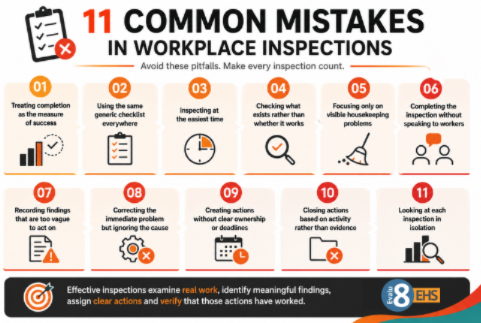
1. Treating completion as the measure of success
One of the easiest inspection measures to report is the completion rate.
If 98 per cent of scheduled inspections have been completed, the figure looks reassuring. It tells management that people are opening the forms and submitting them on time.
It does not show whether inspectors visited the right areas, observed the work, challenged weak controls or recorded useful findings.
This creates a familiar problem. Managers push teams to complete more inspections, but the additional activity produces very little new understanding. The organisation becomes better at proving that checks took place without becoming better at finding risk.
Completion remains useful, particularly when checks are being missed. It should sit alongside stronger measures such as:
- significant findings raised;
- repeat findings;
- overdue high-risk actions;
- time taken to contain serious hazards;
- actions rejected during verification;
- trends by site, department or activity; and
- controls that required changes to risk assessments or procedures.
The question should not simply be, “Was the inspection completed?”
It should be, “What did the inspection help us understand or improve?”
2. Using the same generic checklist everywhere
A standard checklist can bring useful consistency, particularly across multiple sites. The problem begins when standardisation is treated as a substitute for understanding the workplace.
A checklist developed for an office will not adequately inspect a loading yard. A warehouse checklist may not reflect the risks associated with engineering maintenance, contractor activity or hazardous substances.
Even sites completing similar work can have different layouts, equipment, traffic flows, working hours and local constraints.
HSE’s own workplace transport checklist states that it is intended as a guide and will not necessarily be comprehensive for every work situation. That is an important principle for any inspection checklist.
A stronger approach is to separate the inspection into two layers:
Core checks provide a shared organisational standard. These might cover emergency arrangements, housekeeping, access routes, action follow-up and basic control compliance.
Local checks reflect the actual activities, equipment, people and risks found at the site or department.
The checklist should support the inspector’s judgement. It should not limit what the inspector is allowed to notice.
3. Inspecting at the easiest time
Workplaces often look very different depending on when they are inspected.
An early-morning inspection may take place before deliveries arrive. A production area may be quiet during a planned shutdown. A warehouse may appear organised before the afternoon backlog develops. Contractor controls may look adequate when no contractors are present.
None of these inspections is necessarily wrong. They are simply incomplete if the same conditions are examined every time.
Inspection schedules should reflect when risk is most likely to be visible. That may mean including:
- shift changes;
- loading and unloading periods;
- maintenance activity;
- temporary work;
- cleaning;
- peak production;
- weekend or night work;
- periods involving agency workers; and
- unusual seasonal conditions.
Predictable inspections can also encourage local teams to prepare the area specifically for the visit. Occasional unannounced or differently timed inspections can give a more representative view, provided they are used constructively rather than as an attempt to catch people out.
4. Checking what exists rather than whether it works
A guard is fitted. A risk assessment has been signed. The pedestrian route is marked. The emergency exit is labelled.
Those observations confirm presence. They do not confirm effectiveness.
The machine guard may be routinely bypassed. The signed risk assessment may describe an old process. The pedestrian route may lead people through a vehicle turning area. The emergency exit may be blocked whenever deliveries exceed the available storage space.
An inspection should move beyond “Is it there?” and ask:
- Is it being used?
- Is it suitable for the work?
- Does it control the risk?
- Do people understand it?
- Is someone responsible for maintaining it?
- Is there evidence that it has been checked?
HSE guidance on risk controls says employers must review controls to make sure they are working and reconsider them when they may no longer be effective or when workplace changes introduce new risks.
This distinction matters because many recurring findings are not caused by a complete absence of controls. They happen because a control exists on paper but no longer fits the way the work is being done.
5. Focusing only on visible housekeeping problems
Poor housekeeping should not be dismissed. Obstructed walkways, trailing cables, spillages and badly stored materials can lead to serious harm.
They are also easy to see, photograph and record.
That can cause an inspection to become dominated by straightforward visual defects while more significant issues receive less attention.
The inspector notices the box in the walkway but does not examine why the designated storage area is too small. They record a damaged sign but do not observe how vehicles and pedestrians interact. They ask for an area to be tidied but do not examine production pressure, staffing, maintenance, fatigue or supervision.
A good inspection should consider both conditions and causes.
Visible problems often provide the starting point for a wider conversation:
- Why was the material placed there?
- How often does this happen?
- What was the person trying to achieve?
- Is the normal process practical during busy periods?
- Has the same problem been raised before?
- What prevents the control from being followed?
The immediate defect may need correcting straight away. The longer-term value comes from understanding why it appeared.
6. Completing the inspection without speaking to workers
An inspector can learn a great deal by observing the workplace. They will usually learn more by speaking to the people doing the work.
Workers know which controls are awkward, which shortcuts have become normal and which parts of the process change when demand increases. They can explain why an apparently simple rule is difficult to follow and where the written procedure no longer reflects reality.
Employers have duties to consult workers on health and safety. HSE describes consultation as a two-way process that allows employees to raise concerns and influence how risks are managed. HSE also advises consulting employees and safety representatives when carrying out risk assessments because the people doing the work understand practical risks, shortcuts and problems.
Useful inspection questions include:
- What makes this task difficult to complete safely?
- Does anything change during busy periods?
- Which part of the procedure is hardest to follow?
- What normally happens when equipment fails?
- Has this problem been reported before?
- What would make the control more practical?
The purpose is not to interrogate employees or test whether they can repeat a policy. It is to understand how work actually happens.
7. Recording findings that are too vague to act on
Findings such as “poor housekeeping”, “PPE issue” or “staff need retraining” provide very little useful information.
A manager receiving the inspection may not know where the problem was found, what was observed, who was exposed or how serious the issue was.
The finding should make sense to someone who was not present.
A useful inspection record should normally explain:
- the exact location;
- the activity taking place;
- the hazard or failed control;
- who could be affected;
- what was observed;
- any immediate action taken;
- supporting photographs or documents;
- the required improvement; and
- the risk or priority attached to it.
Compare these two findings:
Vague finding:
“Walkway blocked. Area needs tidying.”
Useful finding:
“The marked pedestrian route beside loading bay two was obstructed by three incoming pallets. Employees were stepping into the vehicle route to pass the obstruction. The pallets were moved immediately and the route reopened. The site should review whether the designated delivery holding area has sufficient capacity during peak periods.”
The second record supports investigation and action. The first encourages somebody to move the pallets and wait for the problem to return.
8. Correcting the immediate problem but ignoring the cause
Some findings require immediate intervention.
A blocked emergency exit should be cleared. Unsafe equipment may need to be isolated. A spill should be contained. People may need to be moved away from an uncontrolled risk.
That immediate response is essential, but it is not always the corrective action.
Consider a pedestrian route that is repeatedly obstructed by incoming stock. Moving the latest delivery restores the route. It does not explain why the obstruction keeps happening.
The underlying issue might involve:
- insufficient storage capacity;
- an unrealistic delivery schedule;
- unclear responsibility;
- poor supervision;
- changes in stock volume;
- a layout that no longer suits the operation; or
- a control that works during normal activity but fails during peak periods.
The immediate correction deals with the condition found during the inspection. Corrective action should reduce the likelihood of the condition returning.
Confusing the two is one of the main reasons organisations keep recording the same inspection findings.
9. Creating actions without clear ownership or deadlines
“Management to review.”
“Team to monitor.”
“Staff to be reminded.”
These actions may sound sensible, but they often lead nowhere because they do not establish clear accountability. Nobody knows exactly what must happen, who is expected to move the action forward or how completion will be judged.
Every meaningful inspection action should identify what needs to change, who owns the action, when it must be completed, the priority or risk level, what evidence is required and who will verify the result.
The wording should be specific enough for the owner to understand the expected outcome. For example, “staff to be reminded” is weaker than “the warehouse manager will brief all loading-bay employees on the revised storage arrangements by Friday and attach the briefing record to the action.”
HSE’s example risk assessment template records what further action is required, who will carry it out and when it needs to be completed. The same basic discipline should be applied to inspection actions.
The owner must also have sufficient authority, knowledge and access to the necessary resources. Assigning a facilities change to a supervisor who cannot approve expenditure may create an owner in the system without creating a realistic route to completion.
Where budget, specialist support or senior approval is required, those dependencies should be made clear from the start. Otherwise, the action may remain open while deadlines are repeatedly extended and responsibility becomes increasingly unclear.
10. Closing actions based on activity rather than evidence
An email has been sent. A briefing has been delivered. A new sign has been installed. The action is marked as complete.
The difficulty is that these activities do not prove the risk has been controlled.
Verification should examine the result.
Evidence might include:
- a photograph of the physical change;
- an updated risk assessment or procedure;
- completed training or briefing records;
- a maintenance certificate;
- observation of the revised process;
- worker feedback;
- a follow-up inspection; or
- data showing that the problem has not returned.
The person verifying the action should ask whether the improvement is present, being used and working under real conditions.
HSE’s inspection guidance for its own field staff includes discussing findings and follow-up action and encouraging representatives to ensure that issues are progressed through arrangements such as safety meetings.
An action should not be closed because somebody has done something. It should be closed when there is enough evidence to show that the required improvement has been made.
11. Looking at each inspection in isolation
A single inspection provides a snapshot. A collection of inspections can reveal a pattern.
Organisations lose valuable information when findings remain inside separate forms, spreadsheets or local folders.
A repeated housekeeping problem across several departments may point to storage or procurement issues. Similar equipment defects may indicate that the maintenance schedule needs review. A high number of overdue actions at one site may reflect management capacity rather than individual negligence.
Useful trend reviews might examine:
- repeat findings;
- Findings by hazard category;
- sites with high numbers of overdue actions;
- time taken to close serious findings;
- actions that fail verification;
- inspections completed without findings;
- common causes across departments; and
- Differences between inspectors.
An inspection programme should become more intelligent over time. Findings should influence future inspection questions, risk assessments, training, maintenance plans and management priorities.
Without that wider review, the organisation may deal with individual symptoms while missing the system that produces them.
The Evalu-8 Inspection Quality Test
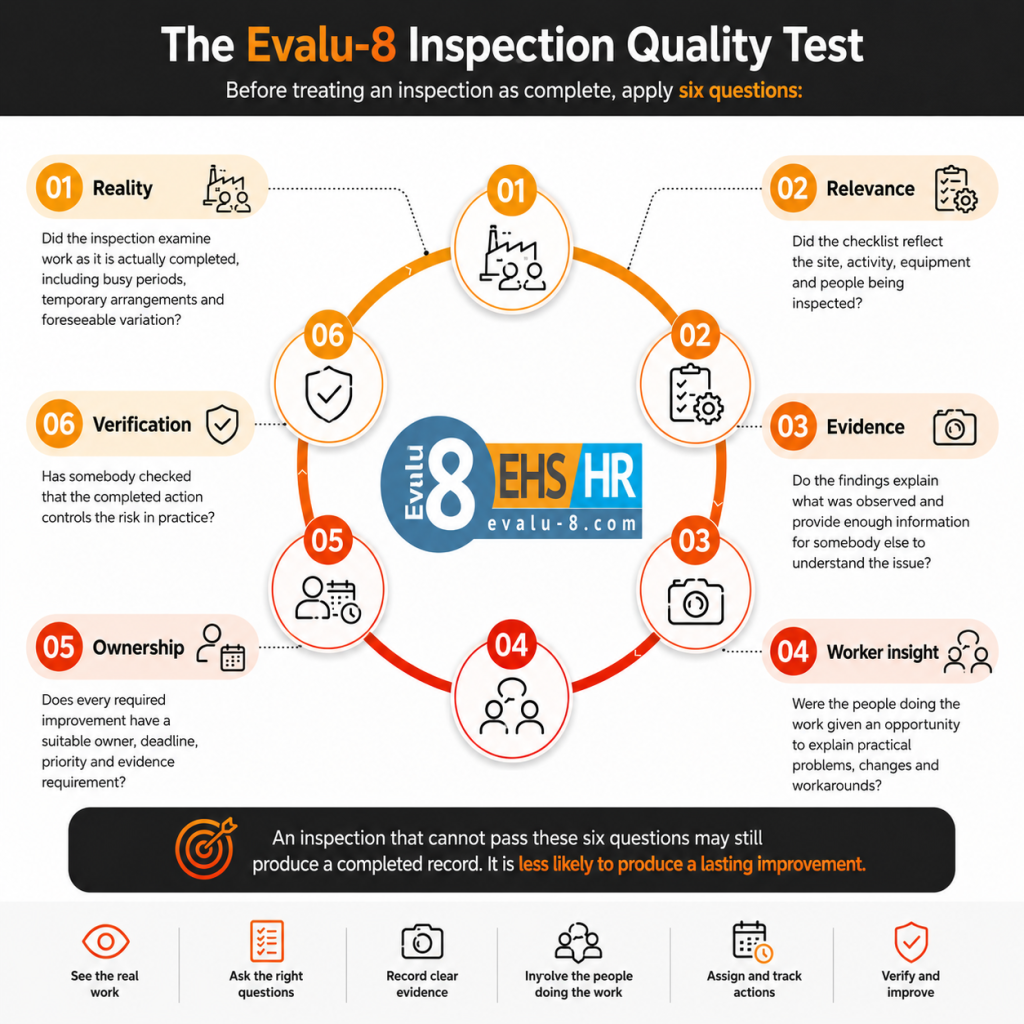
1. Reality
Did the inspection examine work as it is actually completed, including busy periods, temporary arrangements and foreseeable variation?
An inspection carried out only during quiet or controlled conditions may miss the pressures and workarounds that affect safety in normal operation. Inspectors should consider different shifts, peak activity, maintenance periods and other situations where the agreed controls may be harder to follow.
2. Relevance
Did the checklist reflect the site, activity, equipment and people being inspected?
Generic questions can create the appearance of consistency without examining the risks that matter in that particular workplace. The checklist should reflect the machinery, layout, processes, workforce and local conditions involved, while still supporting a common organisational standard.
3. Evidence
Do the findings explain what was observed and provide enough information for somebody else to understand the issue?
A useful finding should identify the location, task, expected standard, people exposed and potential consequence. Photographs, notes and supporting records should add context rather than replace a clear explanation of what failed and why it matters.
4. Worker insight
Were the people doing the work given an opportunity to explain practical problems, changes and workarounds?
Employees often understand when a problem occurs, why a procedure is difficult to follow, and whether the same issue affects other shifts or tasks. Their input can help distinguish between an isolated behaviour and a wider problem involving equipment, layout, resources or conflicting priorities.
5. Ownership
Does every required improvement have a suitable owner, deadline, priority and evidence requirement?
Actions should be assigned to someone with the authority and resources needed to complete them. The expected outcome, timescale and evidence of completion should be clear, with an escalation route where progress stalls or interim controls become unreliable.
6. Verification
Has somebody checked that the completed action controls the risk in practice?
An action should not be closed simply because work has been reported as complete. Verification may require a workplace observation, employee discussion, test result, photograph or follow-up inspection to confirm that the change is being used, remains effective and has not introduced another problem.
An inspection that cannot pass these six questions may still produce a completed record. It is less likely to produce a lasting improvement because the process has not established whether the inspection reflected reality, generated meaningful action or reduced the original risk.
How inspection software can help
Software cannot turn a weak inspection question into a strong one or replace competent judgement.
It can, however, make the surrounding process easier to control.
A connected inspection system can help organisations schedule checks by location, asset, frequency or risk, attach photographs to findings, assign actions to named owners, set deadlines, monitor overdue work and retain evidence of completion.
It can also make it easier to identify repeat findings and compare performance across sites instead of leaving each inspection inside a separate document.
Evalu-8 EHS supports scheduled audits and inspections, corrective-action tracking and central visibility of what is due, overdue or complete. Inspection findings can also be connected with areas such as risk assessments and incident reporting, helping organisations maintain a clearer trail from the original issue to the resulting improvement.
The aim is not simply to digitise the checklist. It is to create a process in which findings are visible, actions remain accountable and closure requires evidence.
Conclusion
The biggest workplace inspection mistakes are rarely dramatic.
They are the small weaknesses that gradually turn an inspection into an administrative routine: using the same questions everywhere, visiting at convenient times, recording vague findings, sending reminders instead of fixing causes and accepting completion without verification.
The solution is not necessarily more inspections.
It is to make each inspection more representative, more curious and more connected to action.
Inspect real work. Speak to the people doing it. Record enough detail to support a proper response. Give every improvement an owner and deadline. Then return to check that it worked.
The inspection is not complete when the form is submitted. It is complete when the organisation has understood the finding, made the improvement and verified the result.
A connected EHS system can help keep that entire process visible, from the initial inspection and supporting evidence through to corrective action, verification and wider trend review.
Frequently asked questions
The purpose of a workplace inspection is to identify hazards, examine whether safety controls are being used and determine whether the organisation’s arrangements are working in practice. Findings should lead to appropriate correction, investigation and verified improvement.
There is no single inspection frequency suitable for every workplace. The schedule should reflect the level of risk, the type of work, how quickly conditions change, previous findings, equipment requirements and any applicable legal or industry-specific duties.
Higher-risk or rapidly changing activities may require more frequent checks than stable, low-risk areas.
Inspections should be completed by people with sufficient knowledge of the work, hazards and required controls. Involving managers, supervisors, employees and safety representatives can provide a more balanced view.
The person completing the inspection must also be able to recognise when specialist advice is needed.
A mixture can be useful. Planned inspections allow relevant people to participate and provide information. Occasional unannounced or differently timed inspections can help the organisation see normal working conditions.
Unannounced inspections should be used to improve understanding, not to create a blame-led attempt to catch employees out.
The checklist should reflect the workplace and its actual risks. It may cover access routes, equipment, hazardous substances, emergency arrangements, work practices, PPE, housekeeping, contractors, previous actions and local hazards.
It should also allow inspectors to record issues that were not included in the original questions.