

When a workplace inspection identifies a failed check, the organisation should first control any immediate risk, record the finding clearly and decide how urgently it needs to be addressed.
It should then investigate why the expected standard was not met, assign corrective actions to named owners and verify that the resulting changes have reduced the original risk.
The inspection should not be considered closed simply because the checklist has been submitted or somebody has marked the action as complete.
A failed result is useful only when it leads to a safer and more reliable way of working.
What does a failed workplace inspection mean?
A failed workplace inspection means that something being examined did not meet the required legal, organisational or operational standard.
This could involve:
- a physical hazard, such as damaged guarding;
- a control that is missing or no longer effective;
- work being completed differently from the agreed method;
- an expired inspection or maintenance record;
- employees being unable to explain an important procedure;
- an action from an earlier inspection remaining unresolved; or
- evidence that a documented arrangement is not being followed.
The word “failed” can sometimes be misleading. An inspection may receive an overall failing score because several lower-level questions were answered negatively. Alternatively, it may achieve a high percentage while still containing one critical failure that requires work to stop.
That is why the response should be based on the nature of the finding and the risk it creates, not the overall percentage alone.
A missing signature and a missing machine guard should not be managed in the same way simply because both produced a failed checklist answer.
Why the response matters more than the score
Inspections form part of the organisation’s active monitoring arrangements. They help establish whether agreed controls are present, understood and working before an accident or other adverse event exposes the weakness.
HSE’s Plan, Do, Check, Act approach describes monitoring and reporting as vital parts of health and safety management. It also recommends periodic audits of management structures and risk controls, together with prompt reporting of major failures and the effects of organisational changes.
The Management of Health and Safety at Work Regulations 1999 require employers to make suitable and sufficient assessments of risk. HSE guidance explains that controls should be reviewed where they may no longer be effective, following workplace changes, or where workers, accidents or near misses reveal a problem.
A failed inspection can provide exactly that kind of warning.
The important question is not whether the inspection form was completed. It is whether the organisation responded appropriately to what the inspection revealed.
What should happen immediately after an inspection failure?
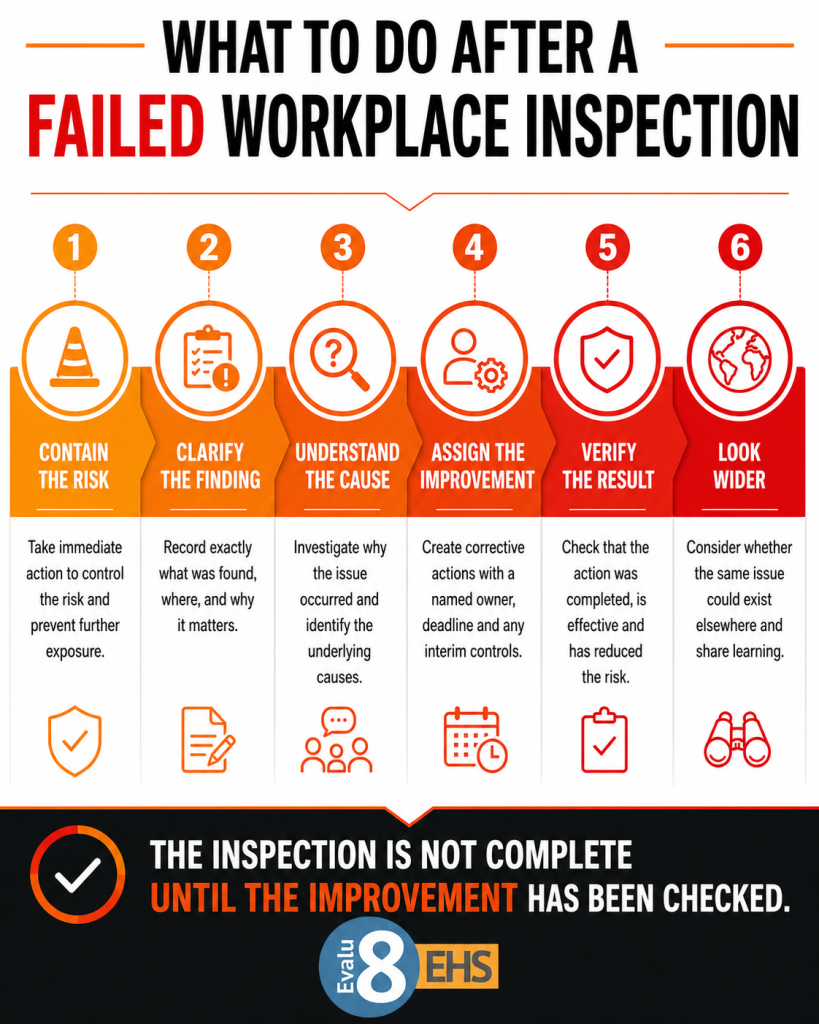
The first response should reflect the potential for harm.
Some findings can remain open while a planned improvement is arranged. Others require immediate intervention before the activity can safely continue.
Make the situation safe
Where the finding creates an immediate or serious risk, the organisation should prevent further exposure.
That may involve:
- stopping the task;
- isolating equipment;
- closing an area;
- restricting access;
- removing a defective item from use;
- installing a temporary barrier;
- providing additional supervision; or
- introducing another suitable interim control.
The decision should not be delayed while the full report is prepared.
Immediate action deals with the current exposure. It does not necessarily address why the control failed, so a longer-term corrective action may still be required.
For example, removing a damaged ladder from use makes the immediate situation safe. The organisation may still need to examine why the damage was not reported, whether pre-use checks are effective, and whether similar equipment should be inspected.
Tell the people who could be affected
Employees, contractors and managers need to know when an inspection finding changes how work should be completed. Corrective action is unlikely to succeed when the change exists only in an inspection report, action tracker or manager’s inbox.
Communication should explain what was found, the risk it created, what has changed and what people are now expected to do. Where temporary controls have been introduced, workers should also understand how long they will remain in place, who is responsible for reviewing them and what to do if the controls cannot be followed.
The method should reflect the significance of the finding. A minor administrative update may only require a revised document or team message. A change affecting machinery, vehicle movements, emergency arrangements or another critical control may require a formal briefing, updated signage, revised instructions and confirmation that people understand the new requirements.
Consider everyone who could be exposed, including agency workers, contractors, visiting drivers, maintenance teams and employees working different shifts. Shift handovers and contractor arrangements are common points at which important information can be lost.
Communication should also be recorded where appropriate. A signed briefing record alone does not prove understanding, so managers may need to ask questions, observe the work or check during a later inspection that the change has been applied correctly.
Communication should explain:
- what was found;
- what activity or area is affected;
- what temporary controls apply;
- what people should do differently;
- who to contact with concerns; and
- when further information will be provided.
A notice on an action tracker is not enough when people remain exposed to the issue during normal work.
Preserve useful evidence
The organisation should retain enough evidence to understand what the inspector saw before the situation was changed.
This may include photographs, notes, measurements, equipment details, statements and copies of the documents being used at the time.
Evidence should not delay immediate risk control. Its purpose is to support a clear investigation, not to leave an unsafe situation untouched.
Evalu-8’s Six-Step Failed Inspection Response
A failed inspection should trigger a connected improvement process, not simply produce another entry on an action list.
A useful response should create a clear line from the original finding, through investigation and corrective action, to evidence that the risk has genuinely been reduced. Evalu-8’s Six-Step Failed Inspection Response provides a practical structure for doing that.
1. Contain the risk
Control the immediate exposure and decide whether the activity, equipment or area can continue to be used safely.
This may require stopping work, isolating equipment, restricting access or introducing temporary controls while a permanent solution is developed. Any interim arrangement should be clearly documented, communicated to the people affected and reviewed regularly. Temporary controls should not quietly become the accepted way of working simply because the full solution is difficult, disruptive or expensive.
2. Clarify the finding
Record exactly what failed, where it was found, what standard was expected and why the issue matters.
The finding should be specific enough for someone who was not present during the inspection to understand the problem. Photographs, equipment references, location details and observations from workers can all help provide useful context and prevent the issue from being misunderstood later.
3. Understand the cause
Establish why the required standard was not met, rather than stopping at the most visible symptom.
The cause may involve equipment condition, unclear procedures, inadequate supervision, poor layout, missing resources, production pressure, weak communication or gaps in training. Looking at technical, organisational and human factors helps avoid weak actions that correct the immediate problem but allow it to return under the same conditions.
4. Assign the improvement
Create specific corrective actions with named owners, risk-based deadlines and any necessary interim controls.
The action should explain what needs to change and what successful completion will look like. Ownership should sit with someone who has the authority, resources and competence to deliver the improvement. Higher-risk findings may also need shorter deadlines, escalation arrangements and more frequent progress checks.
5. Verify the result
Return to the workplace and confirm that the action was completed, is being used and has reduced the original risk.
Closing an action from a photograph, invoice or written update alone may not be enough. Verification should check whether the change works in practice, whether employees understand it and whether the original unsafe condition or behaviour is likely to reappear. Where appropriate, this may involve observation, testing, worker feedback or a follow-up inspection.
6. Look wider
Consider whether the same problem could exist in other equipment, teams, shifts, departments or sites.
A failed inspection may reveal a wider weakness rather than an isolated issue. Similar assets may have the same defect, other teams may be following the same unsafe method, or the same gap may appear across several locations. Looking wider allows the organisation to share learning and address the underlying system before another inspection finds the same problem elsewhere.
These six steps prevent the inspection from becoming a standalone record that is disconnected from the work needed to resolve its findings. They help turn a failed check into a controlled, accountable and verifiable improvement process.
Record a finding that somebody can act upon
A vague finding almost always leads to a vague corrective action. Statements such as “housekeeping poor”, “procedure not followed” or “staff need retraining” may indicate that something is wrong, but they do not give the person responsible enough information to investigate the issue properly, decide what needs to change or demonstrate that the problem has been resolved.
A useful finding should set out the expected standard and explain how the conditions observed differed from it. It should identify the specific location, equipment, task or process involved, together with the people who could be affected and the potential consequences if the issue remains unresolved. The record should also refer to the evidence supporting the finding, such as photographs, observations, documents, employee accounts or inspection results, and note any immediate action taken to control the risk.
The finding should contain enough context for someone who was not present during the inspection to understand what happened and why it matters. This means describing the actual unsafe condition or failure rather than applying a broad label to it. A guarding issue, for example, could refer to a missing guard, a damaged interlock, unsuitable access or a guard being deliberately bypassed. Each of those circumstances would require a different investigation and potentially a different corrective action.
For example:
Packaging waste was stored across the marked pedestrian route beside loading bay three. Employees were observed stepping into the vehicle lane to pass the obstruction, creating a risk of contact with reversing vehicles. The waste was removed and the route reopened during the inspection.
This finding identifies where the issue occurred, what was observed, who was exposed and the possible consequence. It also records the immediate correction without suggesting that moving the waste has resolved the underlying cause.
Clear findings make later verification much easier. The reviewer knows which route, activity and risk the corrective action must address and can return to the same area to check whether the improvement has worked. Without that level of detail, actions may be closed on the basis of a general assurance even though the original condition, or the reason it developed, has not been properly addressed.
Investigate why the inspection failed
Not every finding requires a formal investigation. The depth should be proportionate to the seriousness, complexity and recurrence of the problem.
However, the organisation should avoid selecting an action before it understands why the standard was not met.
Look beyond the person nearest to the problem
“Employee failed to follow the procedure” may describe the final behaviour, but it rarely explains the entire failure.
The investigation should consider whether:
- the procedure was realistic;
- the employee understood it;
- appropriate equipment was available;
- supervision was sufficient;
- workloads or deadlines encouraged shortcuts;
- managers had previously accepted the practice;
- the workplace layout supported the required method;
- maintenance had been completed;
- previous reports had been acted upon; or
- responsibilities were unclear.
HSE’s guidance on human factors advises that investigations should consider why human failures occurred and identify underlying causes to reduce the risk of similar events.
Automatically assigning retraining after every failed inspection can leave the real cause untouched.
Speak to people who understand the work
The employees completing the activity can often explain when the problem occurs, whether it affects every shift and what makes the required method difficult to follow in practice. They may also know which workarounds have developed, whether the issue has been raised before and which proposed solutions would actually work in the real operating environment.
The language used during these conversations matters. Questions should be open, neutral and focused on understanding the work rather than proving that somebody made a mistake. Instead of asking, “Why did you ignore the procedure?”, ask, “Can you talk me through how this task is normally completed?” or “What makes the documented method difficult to follow during a busy shift?” This gives people space to explain the pressures, equipment limitations, layout problems or conflicting instructions that may be influencing the way the work is done.
Useful questions include:
- “When does this problem usually occur?”
- “Is the task completed differently on other shifts?”
- “What gets in the way of following the agreed process?”
- “What do people normally do when that happens?”
- “Has this been raised before, and what happened?”
- “What would make the safer method easier to follow?”
- “Would the proposed action work during the busiest part of the shift?”
Avoid language that assumes the answer, places blame or makes employees defensive. Phrases such as “carelessness”, “common sense”, “operator error” or “failure to comply” may close down the conversation before the underlying conditions have been understood. Where a serious breach has occurred, accountability may still need to be addressed, but it should not replace a proper examination of the system in which the behaviour took place.
The purpose is to understand how the task, equipment, environment and management arrangements combined to create the failure. A good conversation should leave the investigator with a clearer picture of how the work is actually completed, not simply how the procedure says it should be completed.
Check whether it has happened before
A failed inspection finding should not be reviewed in isolation. Previous inspections, incident and near-miss reports, maintenance records, employee concerns and outstanding actions may reveal that the same weakness has already appeared elsewhere or has been allowed to return after an earlier intervention.
The review should look beyond identical wording. The same underlying problem may have been recorded previously under a different heading, by another inspector or at another location. For example, repeated references to blocked walkways, temporary storage, poor housekeeping and restricted access could all point to a wider shortage of suitable storage space rather than several unrelated failures.
A repeat finding may indicate that an earlier action addressed only the visible symptom, was closed without checking whether it worked or was not sustained once attention moved elsewhere. It may also reveal unclear ownership, repeatedly extended deadlines or a problem that affects more equipment, teams, shifts or sites than was first understood.
Repeated low-level findings can therefore be more revealing than one isolated failure. Individually, each issue may appear minor. Together, they may show a pattern of weak supervision, ineffective controls, insufficient resources or an action-management process that records completion without delivering lasting improvement.
How Evalu-8 EHS supports the historical review
Evalu-8 EHS helps organisations bring previous inspections, findings, corrective actions, supporting evidence and verification records into one connected system. Instead of searching through separate spreadsheets, emails, paper reports and shared folders, managers can review the history of an issue and see what was found, when it occurred, who owned the response and how the action was eventually closed.
This makes it easier to compare inspections over time, identify recurring findings and distinguish between a genuinely new problem and one that has returned. Teams can also review overdue actions, deadline changes, attached photographs or documents and whether evidence of effectiveness was recorded before closure.
For organisations operating across several locations, the wider view is particularly useful. A finding recorded at one site may appear isolated until similar issues are identified across other departments or facilities. Bringing that information together helps managers recognise patterns earlier, challenge actions that have not produced lasting change and decide where a broader operational or leadership response is required.
Decide what needs to change
The selected action should address the cause identified during the review.
There may be more than one action.
For example, a failed inspection of a pedestrian route could require:
- immediate removal of an obstruction;
- an alternative storage area;
- changes to the warehouse layout;
- clearer floor markings;
- revised housekeeping checks;
- contractor communication; and
- monitoring during peak activity.
Simply adding “keep route clear” to a briefing may not address the lack of storage that caused the obstruction.
Apply the hierarchy of control
Where possible, the response should eliminate the hazard or reduce reliance on people remembering to act correctly every time.
Stronger actions might involve:
- removing the hazard;
- substituting equipment or materials;
- redesigning the workplace;
- installing an engineering control;
- separating people from the risk; or
- changing the process.
Instructions, training and personal protective equipment may still be necessary, but they should not automatically become the preferred response because they are quick to record.
Distinguish between correction and corrective action
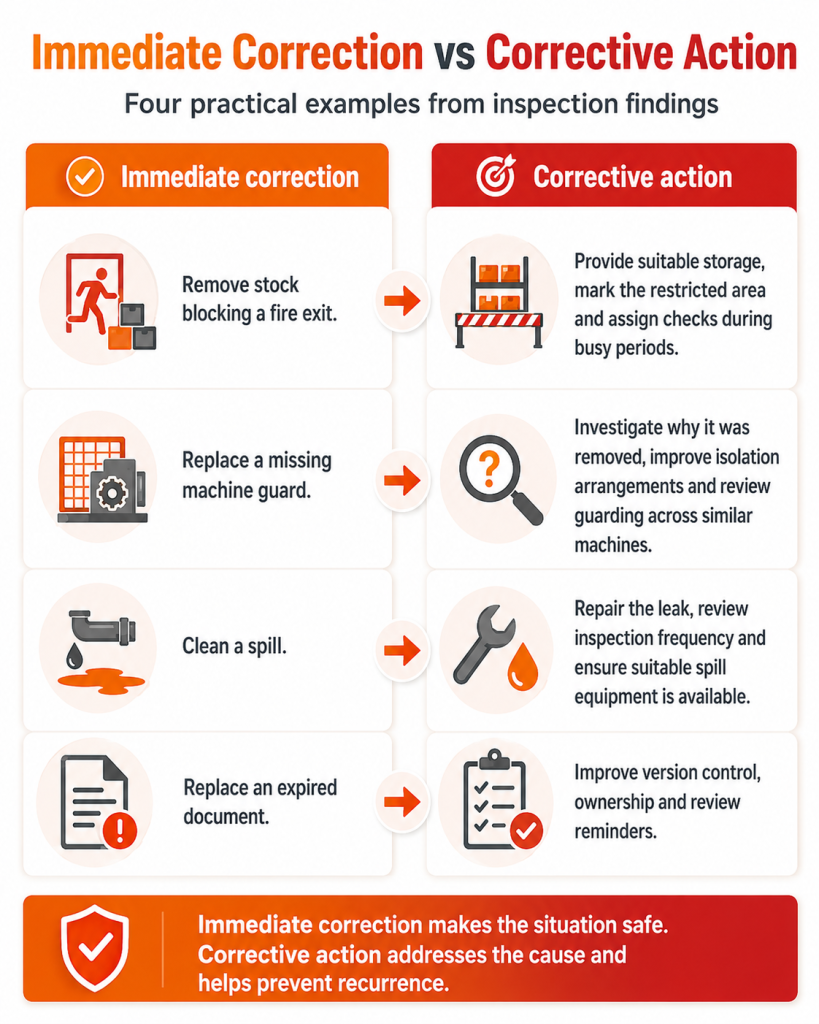
A correction deals with the immediate problem.
A corrective action addresses why it happened and reduces the likelihood of recurrence.
Assign clear ownership and deadlines
Every action should have a named owner or clearly defined responsible role.
Descriptions such as “management”, “maintenance” or “site team” make it difficult to establish who is expected to move the action forward.
The owner should have:
- enough authority to make the required change;
- access to the necessary budget or support;
- sufficient knowledge of the issue;
- a clear understanding of the expected result; and
- a realistic deadline.
HSE’s risk-management guidance recommends recording what further action is needed, who will carry it out and when it is required.
Set deadlines according to risk
Giving every action 30 days may appear consistent, but it does not reflect the seriousness or complexity of the finding.
A risk-based deadline should consider:
- the potential consequence;
- the number of people exposed;
- how frequently exposure occurs;
- the strength of interim controls;
- whether specialist work or purchasing is needed; and
- the possibility that conditions will deteriorate.
Where a permanent improvement will take time, the record should show what protects people in the meantime.
Define escalation before the deadline is missed
The organisation should decide in advance what happens when an action is not progressing as expected. This includes situations where the owner does not accept responsibility, progress stalls, funding is unavailable, the deadline becomes unrealistic, interim controls fail or the level of risk increases.
The escalation route should identify who must be informed, who can approve additional resources and when senior management involvement is required. Higher-risk actions may need more frequent review and faster escalation.
Repeatedly changing the due date does not resolve the underlying problem. It can conceal delay, weaken accountability and allow the original risk to remain uncontrolled for longer than intended.
Review connected documents and controls
A failed inspection may indicate that other parts of the health and safety management system are no longer working as intended. In some cases, the issue is not limited to the specific finding itself, but points to a wider need to review the documents, controls and arrangements that support the work. That could mean revisiting risk assessments, method statements, safe systems of work, maintenance schedules, inspection frequencies, training or induction materials, contractor arrangements, emergency procedures, equipment registers or management reporting.
HSE guidance is clear that controls should be reviewed when they may no longer be effective, when the workplace or activity changes, or when workers, accidents or near misses highlight a problem. A failed inspection should therefore not always be treated as an isolated checklist issue. It may instead provide evidence that the underlying risk assessment, control measure or management arrangement is no longer reliable and needs to be reconsidered.
That review should go beyond paperwork alone. Updating a document may be part of the response, but it should not be treated as the finished outcome where the real need is physical improvement, clearer communication, stronger supervision or a change to the way the work is actually carried out.
Verify the corrective action
A corrective action should not be closed simply because its owner states that it has been completed. Verification is the stage that confirms whether the agreed work was actually carried out, whether the supporting evidence is genuine and relevant, whether the control is now present and whether employees understand and are using the change in practice. It should also test whether the original risk has genuinely been reduced, whether the same problem has reappeared and whether the change has introduced any new hazards of its own.
The method of verification should reflect the nature and significance of the finding. Useful evidence may include follow-up workplace observations, photographs, maintenance or test results, employee interviews, updated documents, training records, exposure measurements, repeat inspection results or a review of performance over a suitable period. A photograph, for example, may show that a barrier has been installed, but it may not show whether that barrier remains in place during the busiest part of the shift or whether workers are bypassing it in practice.
For that reason, higher-risk actions will usually need more robust verification than minor administrative corrections. The aim is not simply to collect evidence that something changed. It is to establish that the change is relevant, sustained and effective in reducing the original risk.
Should the inspection simply be repeated?
A repeat inspection can be helpful, but it should not be treated as a substitute for corrective action. Repeating the same checklist immediately after an area has been tidied or a visible defect has been removed may produce a better score, but it does not necessarily show that the underlying issue has been addressed. A workplace may look compliant for the moment while the original cause remains untouched.
A follow-up inspection is usually most useful after the agreed actions have been completed, employees have had time to apply the revised arrangements and the control can be observed under realistic working conditions. In many cases, enough time also needs to pass for the organisation to judge whether the improvement has been sustained rather than briefly restored for the purpose of inspection.
Some corrective actions can be verified straight away, particularly where a simple physical defect has been fixed. Others need to be assessed over several shifts, during busy production periods or when non-routine work is taking place. The aim is not to obtain a better score on paper. It is to determine whether the workplace is now safer in practice.
Look beyond the site where the failure was found
A failed inspection at one location may reveal a weakness that exists elsewhere in the organisation. It is important to ask whether the same equipment is used at other sites, whether other teams follow the same procedure, whether the control was designed centrally and whether the same supplier or contractor may be involved in other areas. Organisations should also consider whether similar findings may already have been recorded under different descriptions, or whether another site appears compliant simply because it has not been inspected recently.
This wider review matters because some failures are not local at all. A guarding defect caused by an equipment-design issue may require checks across similar machines, not just the one originally identified. In the same way, an out-of-date contractor process may indicate that the arrangement needs to be reviewed across the whole organisation rather than only at the site where it first came to light.
This is particularly important in organisations with multiple sites, shared templates, standardised processes and centralised management arrangements. In those environments, one failed inspection can provide early evidence of a broader weakness, and treating it as an isolated local issue may allow the same risk to remain hidden elsewhere.
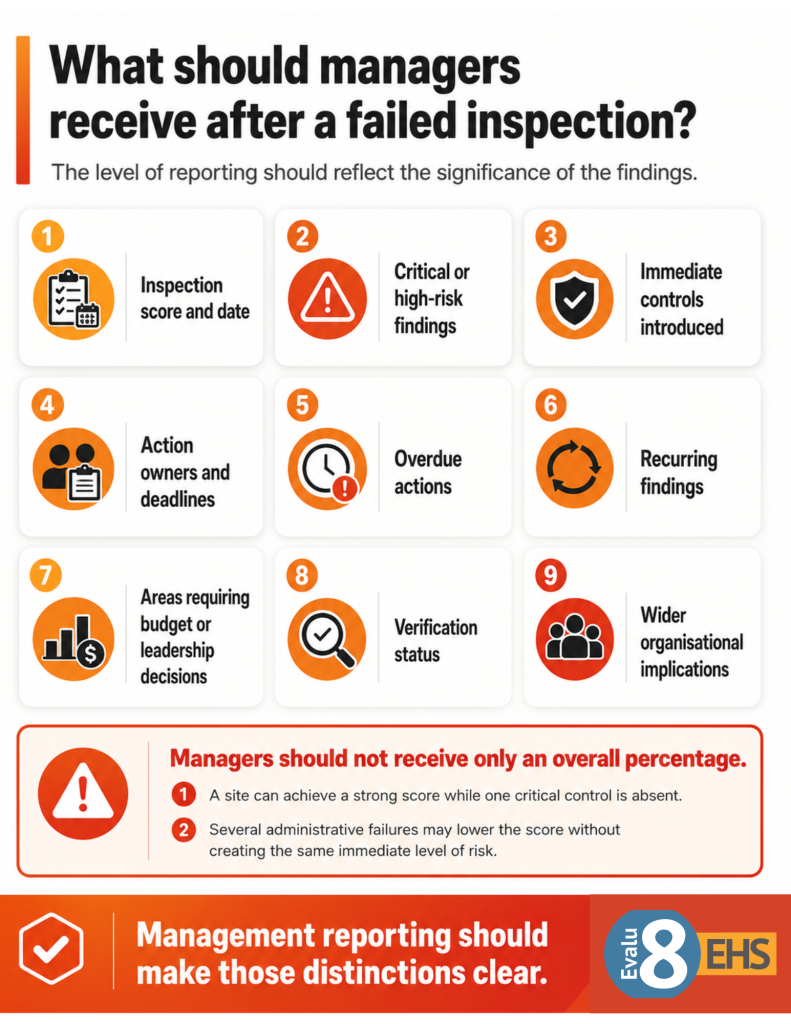
What should managers receive after a failed inspection?
The level of reporting should reflect the significance of the findings.
A useful management summary may show:
- the inspection score and date;
- critical or high-risk findings;
- immediate controls introduced;
- action owners and deadlines;
- overdue actions;
- recurring findings;
- areas requiring budget or leadership decisions;
- the verification status; and
- any wider organisational implications.
Managers should not receive only an overall percentage.
A site can achieve a strong score while one critical control is absent. Conversely, several administrative failures may lower the score without creating the same immediate level of risk.
Management reporting should make those distinctions clear.
Common mistakes after a failed workplace inspection
Treating the inspection as complete when the form is submitted
Submitting the checklist only records what was found at that point in time. It does not remove the hazard or confirm that the required improvement has been made.
A complete inspection process should include clear action ownership, suitable deadlines, escalation where progress stalls, evidence of completion and verification that the original risk has been reduced.
Fixing only what the photograph shows
The condition shown in a photograph may be only the visible symptom of a wider problem.
Removing an obstruction, repairing damage or cleaning an area may be necessary immediately, but the organisation should still ask why the issue occurred and whether the same cause could create similar problems elsewhere.
Automatically choosing retraining
Retraining may be appropriate where knowledge, understanding or competence is genuinely part of the problem. However, it should not become the default response to every failed inspection.
Training alone will not correct unsuitable equipment, poor workplace design, unrealistic workloads, conflicting priorities, unclear procedures or weak supervision. The action should address the real cause of the failure.
Giving every finding the same priority
Not every inspection finding presents the same level of risk.
The potential severity of harm, likelihood of exposure and effectiveness of existing controls should determine how quickly the issue is addressed, who becomes involved and how strongly completion is verified.
Closing actions using an email
An email stating that work has been completed provides limited assurance, especially where the original finding involved a significant risk.
Suitable close-out evidence may include photographs, updated documents, test results, maintenance records, worker feedback or a follow-up inspection confirming that the control is present, being used and working as intended.
Allowing temporary controls to become permanent
Barriers, additional supervision, restricted access and temporary procedures can provide useful short-term protection while a permanent solution is developed.
However, temporary controls should have an owner, a review date, and a clear exit plan. Without regular review, they can gradually become accepted as normal even when they are less reliable than the intended permanent control.
Hiding repeated failures inside separate trackers
The same underlying issue may appear across inspections, audits, incident reports, maintenance records and employee concerns.
When these records sit in separate systems, the organisation may treat each case as an isolated event and miss an important pattern. Bringing the information together helps identify recurring failures, weak controls and areas requiring wider intervention.
Focusing on the score rather than the risk
A higher inspection score does not automatically mean that workplace conditions have improved.
Scores can be useful for identifying trends, but they should be considered alongside the seriousness of findings, repeat failures, overdue actions and evidence that corrective measures have genuinely reduced risk.
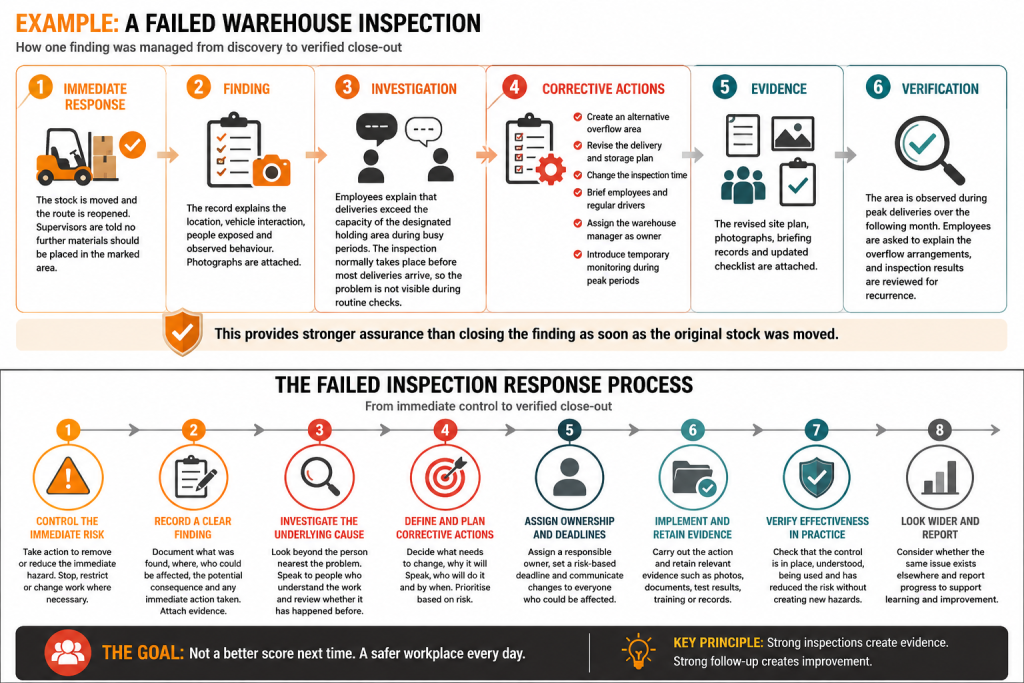
During a weekly warehouse inspection, the inspector finds that a marked pedestrian route beside the loading area is repeatedly obstructed by incoming stock. Employees are having to step around the materials and, in some cases, move closer to the vehicle route to pass through the area.
Immediate response
The stock is moved immediately and the pedestrian route is reopened. Supervisors are instructed to prevent further materials from being placed in the marked area while the wider problem is reviewed.
This removes the immediate obstruction, but it does not explain why stock continues to be stored there or prevent the issue from returning during the next busy delivery period.
Finding
The inspection record identifies the exact location, the interaction between pedestrians and vehicles, the people who may be exposed and the behaviour observed during the inspection. Photographs are attached to show the obstruction and its proximity to the loading route.
The finding also records the immediate action taken, while making clear that the underlying cause still needs to be addressed.
Investigation
Employees explain that incoming deliveries regularly exceed the capacity of the designated holding area during busy periods. When that space becomes full, stock is temporarily placed in the nearest available area, which includes the marked pedestrian route.
The review also finds that weekly inspections normally take place early in the day, before most deliveries arrive. As a result, the route often appears clear during the inspection even though the obstruction develops later.
This shows that the problem is not simply poor housekeeping. It is linked to limited storage capacity, delivery planning and the timing of inspections.
Corrective actions
The organisation creates a suitable overflow storage area and revises the delivery and storage plan so that incoming stock has a defined location during peak periods.
The inspection schedule is changed so that the loading area is also checked during busy delivery times. Employees, supervisors and regular drivers are briefed on the revised arrangements, and the warehouse manager is assigned responsibility for implementing and maintaining the changes.
Temporary monitoring is introduced during peak periods until the organisation is satisfied that the new arrangements are working consistently.
Evidence
The revised site plan, photographs of the new overflow area, briefing records and updated inspection checklist are attached to the action record.
This evidence demonstrates what has changed and provides a clear reference for the person responsible for verifying the action.
Verification
The loading area is observed during peak delivery periods over the following month. Employees are asked to explain where overflow stock should be placed, and supervisors check that pedestrian and vehicle routes remain clear during normal operations.
Subsequent inspection results are reviewed to confirm that the obstruction has not returned and that the revised storage arrangement remains practical during busy periods.
This provides stronger assurance than closing the finding as soon as the original stock was moved. It confirms that the underlying cause has been addressed and that the improvement works under the conditions in which the failure originally occurred.
When does inspection follow-up become difficult to manage?
A spreadsheet or paper action log may be sufficient when an organisation carries out only a small number of inspections at one site and has relatively few action owners.
The process becomes harder to control as the number of inspections, locations and responsible people increases. Findings may be recorded in separate documents, photographs may remain on phones or in email chains, and action owners may not have a clear view of what they are responsible for completing.
Deadlines may require manual chasing, while managers struggle to distinguish between actions that are open, overdue, reportedly completed or independently verified. Repeat findings can also be difficult to identify where different sites use separate trackers, inconsistent wording or different scoring methods.
Management reporting becomes increasingly time-consuming when information has to be collected and rebuilt manually before every review meeting.
The problem is not normally the organisation’s ability to create another checklist. The real difficulty is maintaining a reliable connection between what was inspected, what failed, what immediate action was taken, who owns the improvement, what evidence has been provided and whether the final result has been verified in practice.
When those elements are stored separately, the inspection can become disconnected from the work required to resolve its findings. This makes it easier for actions to be delayed, duplicated or closed without clear evidence that the original risk has genuinely been reduced.
How can inspection software support the response?
Audit and inspection software can connect the failed check directly to the resulting action.
Evalu-8 EHS allows teams to complete inspections on site, capture photographs and notes, and use follow-up questions when checks fail. Findings can be turned into corrective actions with owners, deadlines and completion evidence, while managers can see what is open, overdue and completed across sites.
This can help organisations avoid separate inspection forms, action spreadsheets, photographs and email chains.
The platform can also support:
- scheduled and recurring inspections;
- consistent scoring;
- mobile and offline completion;
- evidence capture;
- reminders;
- central reporting; and
- a retained history from the finding through to close-out.
Software cannot decide whether a control is appropriate or whether the investigation has gone far enough. Those decisions still require competent judgement and an understanding of the work.
Its value is in making responsibility, progress and evidence more visible, particularly where several sites or departments are involved.
A failed inspection should create a controlled improvement
A failed workplace inspection should not be treated as an administrative inconvenience or an attempt to obtain a better score next time.
It is an opportunity to find a weakness before it contributes to harm.
A strong response should be able to answer:
- Was the immediate risk controlled?
- Was the finding recorded clearly?
- Was the reason for the failure understood?
- Was a suitable improvement assigned?
- Was ownership and urgency clear?
- Was completion supported by evidence?
- Was the result checked in practice?
- Was the potential for the same failure elsewhere considered?
Where those questions cannot be answered, the organisation may have completed the inspection without completing the work that made the inspection worthwhile.
For organisations managing inspections across several teams or locations, bringing schedules, findings, corrective actions and evidence into one connected EHS system can make it easier to see what failed, what remains unresolved and whether improvements have genuinely been verified.
Frequently asked questions
The first priority is to control the immediate risk. This may involve stopping an activity, isolating equipment, restricting access or introducing temporary controls. The organisation should also decide whether work can continue safely and clearly communicate any restrictions to the people affected.
A useful finding should explain what failed, where it was found, what standard was expected and why the issue matters. It may also include photographs, equipment or asset references, location details, worker observations and any immediate controls introduced.tur.
A correction deals with the immediate problem, such as replacing a damaged guard or clearing an obstructed escape route. Corrective action addresses why the problem occurred and reduces the likelihood of it happening again. Both may be necessary before the issue can be properly closed.
The investigation should look beyond the most visible symptom. Relevant factors may include equipment condition, procedures, supervision, training, workload, workplace layout, communication, available resources and production pressures. The depth of the investigation should reflect the seriousness and recurrence of the risk.
Each action should have a named owner with the authority, competence and resources needed to complete it. Assigning an action to a department or general team can make accountability unclear. The owner should also understand the required outcome, deadline and any escalation arrangements.