Choosing HR software is a big decision. Most of the time, the focus is on the features.
- Can it manage holidays?
- Can it track absence?
- Can it store employee documents?
- Can it support recruitment, onboarding, training, cases, and reporting?
Those are all important questions. But there is another part of the buying process that is just as important, even if it is not always the first thing people focus on.
The contract.
It might not be the most exciting part of choosing HR software, but it can make a big difference to how confident you feel in your decision.
A contract should not feel confusing, hidden away, or difficult to understand. It should clearly explain what you are agreeing to, how long you are agreeing to it for, and what happens when the agreement comes to an end.
Longer agreements are not automatically a bad thing either. For some organisations, they can offer more stability, clearer budgeting, and confidence over the term. The important thing is that the contract works for your organisation and that you understand the options available.
Throughout this guide, we will walk through the main human resources software contract points to check before making a decision. We will also share how we approach contracts at Evalu-8 HR, alongside some of the feedback we hear from customers when they are reviewing different HR software options.
The aim is not to make contracts feel more complicated. It is to make them easier to understand, so you can choose a provider with more clarity and confidence.
HR software contract red flags to watch for
Choosing HR software should not come with hidden surprises. Before you sign, take a closer look at the small details that could cause problems later.
| Contract area | Red flag | Better sign |
|---|---|---|
| Contract length |
Red flag The contract term is unclear, buried in the agreement, or only explained after you ask. |
Better sign The contract length, start date, and end date are clearly explained before you sign. |
| End of contract |
Red flag It is not clear what happens when the contract ends, or whether you need to take action. |
Better sign The provider explains your options before the contract ends, including renewal, changes, or cancellation. |
| Auto-renewal |
Red flag The agreement renews automatically without a clear reminder or a simple opt-out process. |
Better sign Auto-renewal terms are clearly stated, or the provider contacts you before the end of your contract. |
| Notice period |
Red flag The notice period is long, easy to miss, or hidden within the contract terms. |
Better sign The notice period is easy to find and clearly explained before you commit. |
| Support included |
Red flag Support is vague, limited, or charged separately without being made clear upfront. |
Better sign The provider explains what support is included, how to access it, and what response times to expect. |
| Scalability |
Red flag It is unclear whether you can add users, modules, departments, or extra functionality later. |
Better sign The system can grow with your organisation, with clear options to add users or modules when needed. |
| Written details |
Red flag Important points are discussed verbally but not confirmed in writing. |
Better sign Key details such as pricing, support, renewal terms, notice periods, and modules are documented clearly. |
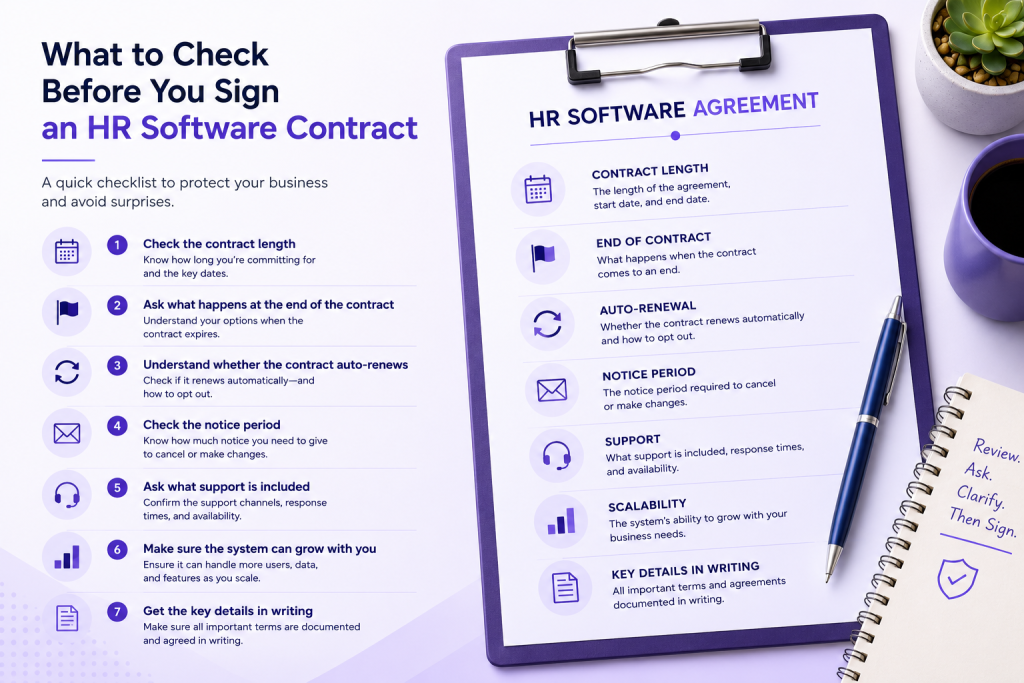
What to check before signing an HR software contract
Quick checklist
Before you sign, check:
- Contract length
- What happens when the contract ends
- Whether it auto-renews
- Notice period
- What support is included
- Whether the system can grow with you
- Whether the key details are confirmed in writing
- What happens to your data if you leave
- Whether pricing can change during the term
- Whether onboarding and training are included
1. Check the contract length
The first thing to understand is how long the agreement lasts.
Some HR software providers offer 12-month contracts, while others offer multi-year agreements.
At Evalu-8 HR, customers can choose a contract length from 12 months to five years, depending on what works best for their organisation. The contract length is completely led by the customer, giving them the flexibility to choose an option that suits their plans and budget.
Their package price is also locked in for the full duration of the chosen contract, so whether they choose 12 months or five years, they know what they are paying for the full term.
There is no single “right” contract length. It should be up to your company to decide which contract length suits you.
A shorter contract may suit a business that wants more flexibility. A longer contract may suit a business that wants stability, predictable costs, and time to properly embed the system across the organisation.
The important thing is that you know what you are choosing.
Before signing, ask:
- How long is the contract?
- Are different contract lengths available?
- Is the contract length chosen by us or set by the provider?
- Does a longer contract affect pricing?
- Can we review the contract before making a final decision?
A longer agreement can be a good thing when it is chosen clearly and works for the customer.
It becomes a problem when the buyer does not fully understand what they are agreeing to.
2. Ask what happens at the end of the contract
This is one of the most useful questions you can ask.
- What happens when the contract reaches its end date?
- Does it end naturally?
- Does it roll into a new agreement?
- Does it automatically renew?
- Will someone contact you before the end date?
- Do you need to give notice by a certain point?
These are not awkward questions. They are sensible ones.
HR software often becomes a central part of how a business manages its people, so it is worth knowing how the agreement works from the start.
3. Understand whether the contract auto-renews
Some software contracts automatically renew unless the customer gives notice before a certain date.
That does not always mean the contract is bad. Auto-renewal can be used in lots of software agreements. But it should be clear.
If a provider uses auto-renewal, you should understand:
- When the renewal happens
- How long it renews for
- How much notice you need to give
- Whether you will receive a reminder
- Who needs to give notice
- How notice needs to be submitted
- Whether pricing changes at renewal
The key thing is avoiding surprises.
Nobody wants to reach the end of a contract, assume they have time to review their options, and then realise they have already entered another agreement.
This is why it is worth asking the question directly before signing.
What a good end-of-contract process should look like
A good end-of-contract process should feel clear, simple, and fair.
You should know when your contract is ending, what your options are, and who to speak to if you want to make changes. Ideally, your provider should give you enough notice to review the system properly, discuss whether it still fits your needs, and decide what you want to do next.
At Evalu-8 HR, contracts do not auto-renew.
When a contract is coming to an end, a member of our friendly customer service team will reach out before the end date to discuss your next steps. This gives you time to review your current package, ask questions, and decide whether you would like to renew, upgrade, make changes, or bring the contract to an end.
The aim is to make the process clear and stress-free, with no unexpected renewals or last-minute surprises.
4. Check the notice period
Notice periods can be easy to overlook.
For example, a contract may end in December, but require notice several months before that. So the real decision date is not the contract end date. It is the notice deadline.
Before signing, make sure you know:
- How much notice is required
- When the notice deadline is
- Whether notice must be given in writing
- Who in your business is responsible for managing the date
A simple internal calendar reminder can help avoid issues later.
It is also worth asking what happens if you choose not to continue at the end of the agreement. Does the contract simply end? Does it roll on? Is there a renewal conversation?
With Evalu-8 HR, there are no auto-renewals, so customers are not caught out by missed renewal windows. Instead, the contract endpoint creates a clear opportunity to review what is working, what the business needs next, and whether the current agreement still fits.
If a customer decides not to continue, we would advise making us aware and giving yourself at least three months before the contract end date, simply to give your team enough time to review, download, and manage your data properly before the contract ends ensuring the process is as smooth as possible.
5. Ask what support is included
The contract should not only explain how long you are signing for. It should also make clear what support you receive.
That might include:
- Onboarding
- Training
- Customer support
- Help with setup
- Ongoing account management
- Access to help guides or resources
- Support with adding more users or modules
This matters because the best HR software relationships are not just about the system itself.
They are about the support around it. The contract should not only explain how long you are signing for. It should also make clear what support you receive. If your team needs help, you want to know what is included and what might cost extra.
This is especially important with HR software, because the system often touches several parts of the business. HR teams, managers, employees, and leadership may all use the platform in different ways.
A good provider should help you understand not only what the software does, but how your organisation can get the most from it over time.
With Evalu-8 HR, support is included for the duration of the contract, with no extra charge for help from the support team beyond the initial set-up fee.
Customers can get support through the ticketing system or arranged training sessions, giving teams a clear route to ask questions, get guidance, and make better use of the system over time.
The aim is to give every customer a supported experience from the start, not just during implementation, so they feel confident using Evalu-8 HR as their organisation grows and their HR processes develop.
What customers say about Evalu-8 HR support
6. Make sure the system can grow with you
Your business may look different in one, three, or five years.
You may have more employees, need more modules, your internal processes may change, you may need better reporting, or want to bring more HR tasks into one place.
So it is worth asking how flexible the software is during the contract.
- Can you add users?
- Can you add modules?
- Can the system support different teams, sites, or departments?
- Can it grow with your organisation?
This is especially important if you are choosing a longer contract.
A longer contract can work well when the software has enough flexibility to support your future needs, not just your current ones.
It can also help with price certainty. If you know the system is the right fit, locking in a longer agreement can make budgeting easier and give the business more stability.
At Evalu-8 HR, customers can choose contract lengths from 1 to 5 years. The price is also locked in for the duration of the chosen contract, whether that is 1 year or 5 years. That means customers know what they are paying for the full term and can choose the agreement length that makes the most sense for their organisation.
7. Get the key details in writing
Before signing, it is worth asking the provider to clearly confirm:
- Contract length
- Start date
- End date
- Whether the contract auto-renews
- Notice period
- Renewal process
- Support included
- Onboarding included
- Any additional costs
- Flexibility to add users or modules
- What happens at the end of the agreement
This does not need to be complicated. It is simply about having clarity.
A good provider should be happy to explain how everything works.
How Evalu-8 HR handles contracts
At Evalu-8 HR, we believe HR software contracts should be clear from the start.
That means customers can choose the contract length that works best for their organisation.
Evalu-8 HR offers contract lengths from 1 to 5 years, and the choice sits with the customer.
Some organisations prefer a shorter agreement because they want flexibility.
Others prefer a longer agreement because they want stability, price certainty, and a clearer long-term plan. Both are valid.
The important thing is that the customer understands the options and chooses what works for them.
We also do not auto-renew contracts.
When a contract is coming to an end, there should be a clear conversation about what happens next, rather than customers being automatically moved into another agreement without properly reviewing it.
For us, that is simply a better way to build long-term customer relationships.
HR software should make things easier, not create uncertainty around contract dates, renewal terms, or cancellation windows.
Final thoughts
HR software contracts do not need to be complicated. But they do need to be clear.
Before choosing a provider, take the time to ask how the contract works, how long it lasts, and what happens at the end.
A longer contract can be a good option when it is chosen properly. A shorter contract can be a good option when flexibility matters more.
The main thing is that the choice should be clear, understood, and right for your organisation.
If you are reviewing HR software, do not just compare features. Check the contract too.
It might be one of the most useful conversations you have before signing.
HR software contract FAQs
Before signing an HR software contract, check the contract length, renewal terms, notice period, support included, pricing, data access, and whether the system can grow with your organisation. It is also worth making sure all key details are confirmed in writing before you commit.
Not always. A longer HR software contract can give your organisation more price certainty and stability, especially if you are confident the system is the right fit. The important thing is that you understand the term, know what is included, and feel comfortable with the commitment before signing.
Auto-renewal is not always a problem, but it should be made very clear. You should know whether the contract renews automatically, when the renewal happens, how much notice you need to give, and whether the provider will remind you before the renewal date.
A notice period is the amount of time you need to give the provider if you do not want to continue with the contract. For example, some providers may require notice several months before the contract end date. This is why it is important to check the notice period before signing.
You should ask whether customer support, onboarding, training, setup help, system guidance, and ongoing account support are included in the contract. It is also useful to understand how support is provided, such as by ticket, phone, email, training sessions, or a dedicated contact.
No. Evalu-8 HR contracts do not auto-renew. When a contract is coming to an end, the customer service team contacts customers before the end date to discuss their options and give them time to review what they want to do next.
Yes. Evalu-8 HR customers can add or remove employees to suit their organisation, and additional modules can be added if and when they are needed. This helps the system grow with the business rather than locking customers into a setup that may not suit them later.
Before signing an HR software contract, ask how you can access, export, download, or manage your data if the agreement comes to an end. This matters because HR software can hold employee records, documents, absence history, training information, case notes, and other important business data.
At Evalu-8 HR, we do not own your HR data. If a customer decides not to continue, we recommend letting us know at least three months before the contract end date. This gives your team enough time to review, download, and manage the data you need before access ends and the data is deleted in line with the contract and relevant data retention processes.